
e-Literate

Present is Prologue

Category: Ed Tech

The “Ed Tech” category includes posts about educational technology products themselves, including LMSs and other learning platforms, adaptive learning and other digital curricular materials products, learning analytics, and educational apps of all types. It also includes technical aspects of ed tech products, especially interoperability.

  • Evolve Conference on Friday: Engaging students in the online conversation

    On Friday, January 17th, I’ll be in LA to help moderate the Evolve Conference put on by the 20 Million Minds Foundation. Despite all the talk about the role of online education in higher ed, most conferences and events – GSV Education Innovation Summit, EDUCAUSE, WCET, Sloan Consortium, and others  – include institutional leaders and staff, faculty, technologists, investors, and consultants but not students. Last year’s Re:Boot conference did include a student panel, but we need more focus on the student perspective. I don’t fault  these conferences, as it is very hard to get student input outside of a survey, but it is still a missing piece to the puzzle – arguably the biggest piece.

    This student focus gets to the core purpose of the Evolve Conference:

    Major stakeholders have weighed in on the role of online and educational technologies–we have heard from faculty, unions, system leaders, policy makers, and leading ed-tech innovators. However, the ever-critical student perspective has largely been absent.

    Building on the success of the 20MM “Re:Boot California Higher Education” symposium of January 2013, “EVOLVE California Higher Education” is the second installment of the collaborative discussion series that will shift the focus to ensure that the student voice is given prominent placement in the state and national conversations surrounding online learning and technology. Student presenters will be joined by a myriad of post secondary leaders and technology innovators.

    I’ll co-moderate the panels with Isa Adney, a recent (read that as ‘much younger than Phil’) community college graduate who went on to get her bachelor’s and master’s degrees. She has written a book on the community college experience and is now a speaker and advocate for students. I look forward to working with Isa at the conference.
    (more…)

  • New IPEDS Data: State by state online ed comparison / public institutions

    It’s Tuesday, so it must be time for my daily post on the new IPEDS data including online education. There are so many ways to slice this data that just was not possible before, and with a little spreadsheet engineering, I’m finding it easy to come up with new views. Today let’s look at the adoption of online education per state for public institutions (both 4-year and 2-year schools). Note that this data does not include private non-profit or for-profit institutions as I wanted to focus on official state involvement in online ed.

    IPEDS tracks information now about students taking exclusively distance education courses, students taking some but not all distance education courses, and students not taking any distance education courses. Please note the following:

    • I am using the terminology “online courses” rather than “distance education”. For the most part these terms are interchangeable, but they are not equivalent as “distance education” can include courses delivered by a medium other than the Internet (e.g. correspondence course). Part of the reason I stick with “online course” is that there is a growing use case where students local to a campus choose to take a course online, which is not really at a distance.
    • I have combined the fields for students taking “exclusive online courses” and “some but not all online courses” to derive the “at least one online course”, as this roughly equals the data reported by the Sloan survey / Babson Survey Research Group survey.

    (more…)

  • New IPEDS Data: Profile of online education in US / Fall 2012

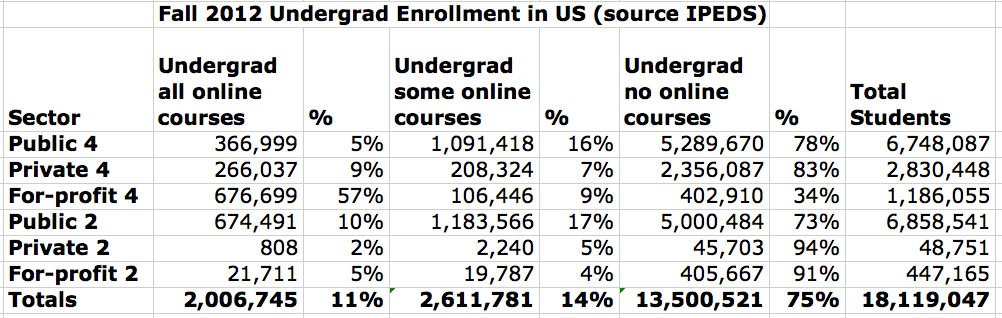
    Last week I mentioned how the National Center for Educational Statistics (NCES) and its Integrated Postsecondary Education Data System (IPEDS) are now providing preliminary data for the Fall 2012 term that for the first time includes online education. Let’s look at a profile of online education in the US for degree-granting colleges and university, broken out by sector and undergrad / grad  degrees.

    IPEDS tracks information now about students taking exclusively distance education courses, students taking some but not all distance education courses, and students not taking any distance education courses. Please note the following:

    • I am using the terminology “online courses” rather than “distance education”. For the most part these terms are interchangeable, but they are not equivalent as “distance education” can include courses delivered by a medium other than the Internet (e.g. correspondence course). Part of the reason I stick with “online course” is that there is a growing use case where students local to a campus choose to take a course online, which is not really at a distance.

    Here is the new IPEDS data for undergraduate and graduate students and courses:

    Undergrad by sector

    (more…)

  • Opportunities and Predictions, 2014 A.D.

    I make fun of predictions all the time (see, for example, Education Analysts Have Predicted 7 of the last 0 Mobile Revolutions). But heck, why not jump in?

    Here’s how I see the world. Mostly, being in a field doesn’t give you predictive powers — it just makes you aware of where the real opportunities are.

    But opportunities, even great ones, aren’t always seized upon. There’s good opportunities that people will take. There’s good opportunities people will ignore. And then there are the dead-ends everyone else is in love with. Here’s my take on what will have more prominence in a year’s time, more or less in those categories. (more…)

  • Boundless Is Totally #Winning

    I was contacted by Boundless CEO Ariel Diaz regarding a concern he had with my blog post about the lawsuit outcome. This was not entirely surprising, and I was curious to see which aspects of the post concerned him. Was it my characterization of Boundless as not a content company? Was it my speculation that Boundless was really designed to ride on Chegg’s coattails with the VC community? No, none of those. It was my claim that Boundless lost the legal fight.

    You may wonder, “How can a company that was required to pay $600,000 to the plaintiffs, destroy three of the products it had created, and accept a permanent injunction on how it does business going forward, have actually won?” I wondered that too.

    (more…)

  • Instructure releases their third public security audit

    In the fall of 2011 I made the following argument:

    We need more transparency in the LMS market, and clients should have access to objective measurements of the security of a solution.  To paraphrase Michael Feldstein’s suggestions from a 2009 post:

    • There is no guarantee that any LMS is more secure just because they say they are more secure
    • Customers should ask for, and LMS vendors should supply, detailed information on how the vendor or open source community has handled security issues in practice
    • LMS providers should make public a summary of vulnerabilities, including resolution time

    I would add to this call for transparency that LMS vendors and open source communities should share information from their third-party security audits and tests.  All of the vendors that I talked to have some form of third-party penetration testing and security audits; however, how does this help the customer unless this information is transparent and available?  Of course this transparency should not include details that would advertise vulnerabilities to hackers, but there should be some manner to be open and transparent on what the audits are saying. [new emphasis added]

    Inspired by fall events and this call for transparency, Instructure (maker of the Canvas LMS) decided to hold an public security audit using a white hat testing company, where A) the results of the testing would be shared publicly, and B) I would act as an independent observer to document the process. The results of this testing are described in two posts at e-Literate and by a post at Instructure.

    Instructure has kept up the practice and just released their third public security audit.

    (more…)

  • Lessons from the Boundless Copyright Infringement Suit

    On December 17th, the Boundless OER-based textbook startup issued a press release describing the settlement they had reached with Pearson, Cengage, and Macmillan in the lawsuit those three companies had filed against the company. (Full disclosure: Pearson has been a client of MindWires Consulting.) Actually, a lot of the press release wasn’t really about the lawsuit, and the description of the settlement consisted of the following:

    Today, we’re excited to announce that we’ve settled the lawsuit. In agreeing to a confidential settlement agreement, along with a public judgment and injunction entered by the Court, the parties have resolved the dispute. The resolution allows the parties to move forward and focus on their mutually shared goal of helping students learn. Boundless now has a clear path for building and marketing its OER-driven textbook alternatives without treading upon the Plaintiffs’ rights, and it is confident that it is in compliance and will not have further legal issues with the Plaintiff publishers. In turn, Plaintiffs have reinforced the strong protection they have in and to their copyrighted works and the related goodwill that they and their authors have established, and look forward to Boundless operating its business within the agreed upon framework.

    This seemed like a strangely muted ending to a strange story. It’s hard to tell from the press release what actually happened. But having read the consent decree and injunction, I have come to two conclusions. First, Boundless lost. Second, the suit and its outcome tell us very little about the future of OER but rather more about business strategy for ed tech startups.

    (more…)