
Last week I mentioned how the National Center for Educational Statistics (NCES) and its Integrated Postsecondary Education Data System (IPEDS) are now providing preliminary data for the Fall 2012 term that for the first time includes online education. Let’s look at a profile of online education in the US for degree-granting colleges and university, broken out by sector and undergrad / grad degrees.
IPEDS tracks information now about students taking exclusively distance education courses, students taking some but not all distance education courses, and students not taking any distance education courses. Please note the following:
- I am using the terminology “online courses” rather than “distance education”. For the most part these terms are interchangeable, but they are not equivalent as “distance education” can include courses delivered by a medium other than the Internet (e.g. correspondence course). Part of the reason I stick with “online course” is that there is a growing use case where students local to a campus choose to take a course online, which is not really at a distance.
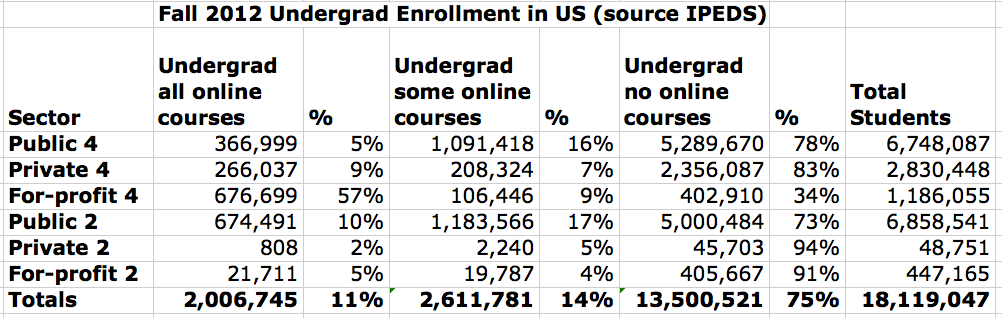
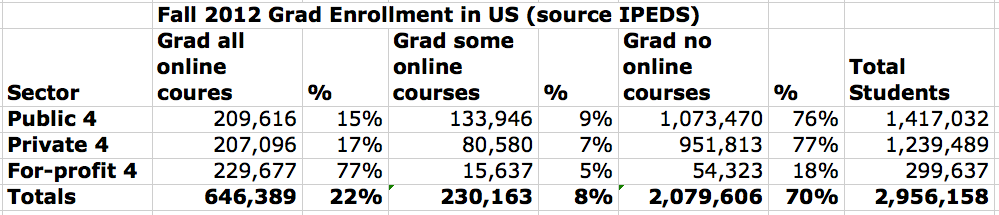
Here is the new IPEDS data for undergraduate and graduate students and courses:
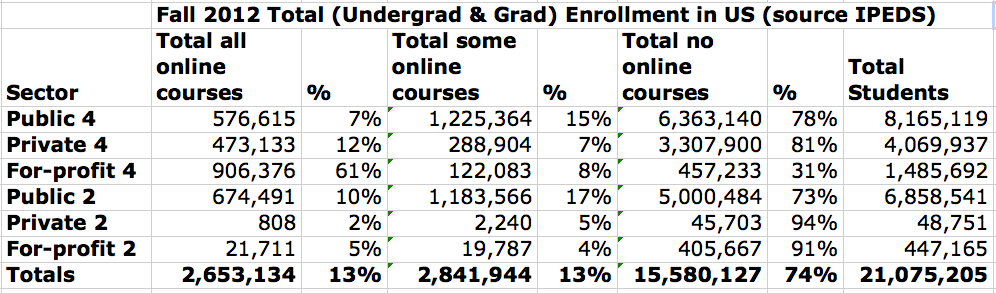
Now let’s combine the data, undergraduate and graduate students and courses:
Previously, the best data available on total student counts came from the Babson Survey Research Group with their annual survey (prior to 2012 called the Sloan survey). This is the survey tracking the total number of students taking at least one course online. When I talked to the researchers earlier this year, they mentioned that they hoped the new IPEDS data would ‘put them out of business’. I hope this comment was half in jest, as their survey measures much more information than just total student counts and they have very useful longitudinal data. I have asked BSRG for an updated statement on their plans but have not been able to get a response yet.
Some additional notes on the data:
- According to the IPEDS data, 5.5 million (26%) degree-seeking students in the US took at least one online course in Fall 2012, which is significantly less than that reported by Babson (6.7 million / 32% for Fall 2011 data). Keep in mind the different methodologies involved – IPEDS collects data reported directly from colleges and universities, while Babson is based on a representative survey; IPEDS measures “distance education”, while Babson measures “online courses”. I would look forward to this year’s Babson survey to explain the differences, but for now, I’ll just note the difference.
- For-profit schools (66% undergrad and 82% of grad students taking at least one online course) and public 2-year colleges (27% students taking at least one online course) have the highest usage of online courses, followed by public 4-year institutions (22% undergrad and 24% of grad students taking at least one online course.
- Graduate students have a higher rate of taking online courses (22% exclusively online and 30% taking at least one online course) than do undergraduates (11% exclusively online and 25% taking at least one online course); however, there is a higher percentage of undergrads taking some, but not all, of their courses online (14%) than of grad students (8%). In other words, grad programs appear to be fully face-to-face or fully online whereas undergrad programs have a higher mix-and-match percentage.
- Overall, there were slightly more students taking some, but not all, of their courses online than students taking exclusively online courses. This group of students who are augmenting their face-to-face programs with online courses, gets far less coverage and analysis than the fully online students. I suspect that this number will grow over time.
Comments
5 responses to “New IPEDS Data: Profile of online education in US / Fall 2012”
[…] another post I showed the number and percentage of students taking online courses by sector – public, […]
[…] written several posts recently looking at the new IPEDS data on distance education (for the most part equivalent to […]
[…] online courses offered by others for free, only having to pay the school for assessment. Using Phil Hill’s analysis of the recently released IPEDS data, even if those 2 million public sector students who took some online courses in 2012 were allowed […]
[…] Hill of the e-Literate blog previously posted his insights on sector-specific data, with details on graduate and undergraduate differences. He also did a great job of explaining the methodology used to combine data fields from the IPEDS […]
[…] and 0.1% of their students take any courses online, according to 2012 IPEDS data. Compare this to approximately 26% of students taking any online courses across all US […]