e-Literate

Present is Prologue

Category: Ed Tech

The “Ed Tech” category includes posts about educational technology products themselves, including LMSs and other learning platforms, adaptive learning and other digital curricular materials products, learning analytics, and educational apps of all types. It also includes technical aspects of ed tech products, especially interoperability.

  • SJSU and Udacity End Game: 3 courses to be offered for-credit on Canvas LMS

    After a great deal of publicity from their spring and summer pilots, San Jose State University has just announced that they will offer three of the courses again in Spring 2014 – but with a twist. On the surface, the announcement sounds like a continuation of the pilot.

    This spring, San Jose State will offer three online courses that were developed with Udacity to SJSU and California State University students.

    San Jose State students are registering now for Elementary Statistics, Introduction to Programming and General Psychology. In addition, the programming and statistics courses will be open to all CSU students through the CSU’s CourseMatch program.

    But after digging deeper, it really appears that this is an effort to separate without admitting failure or making either side look bad. There are some significant changes here:

    • Udacity is no longer being paid for the courses;
    • All the course content is free and open to SJSU and CSU faculty;
    • The for-credit course content will be on Udacity platform but faculty interactions and assessments will be run on SJSU’s official LMS (Canvas); and
    • SJSU will provide the teaching assistants.

    (more…)

  • What Faculty Should Know About Adaptive Learning

    I was honored to be asked by the American Federation of Teachers to write an article on what their membership should know about adaptive learning technologies. That piece is running in this month’s issue of AFT On Campus. I am reprinting it here with their permission.

    The phrase “adaptive learning” is an umbrella term that applies to an incredibly broad range of technologies and techniques with very different educational applications. The common thread is that they all involve software that observes some aspect of student performance and adjusts what it presents to each student based on those observations. In other words, all adaptive software tries to mimic some aspect of what a good teacher does, given that every student has individual needs. (more…)

  • Massive, Open, and Course Design

    Martin Weller has a great blog post up about course design responses to MOOC completion rates. He starts by arguing that, while completion rates are not everything in MOOCs, they are not nothing either. A lot depends on whether you think completion is an important metric to meet the course goals because, for example, the course is designed to help remedial students pass into a non-remedial track, or whether having students explore the content in a non-comprehensive way accomplishes your course goal. (Martin brings up an analogy by Stephen Downes that nobody complains about the low newspaper completion rates, which I have never heard before and which I love.)

    This is good stuff, but it starts us down the path toward a more radical re-examination of how we think about course design. Because while Martin is focusing primarily on course goals and how those should determine metrics, he’s beginning to raise the question of how individual learner goals should influence course design. And once you start asking that question, it changes everything.

    (more…)

  • Layoffs at Desire2Learn: Significant or not?

    In a little-reported event the week of Thanksgiving, Desire2Learn let go 28 employees. The only public report I’m aware of comes from The Record out of Desire2Learn’s hometown of Kitchener, Ontario in Canada.

    E-learning company Desire2Learn has cut about 25 workers from its product development department.

    Virginia Jamieson, spokesperson for the Kitchener-based company, said nine per cent of the 280-member product development section was let go. That represents about three per cent of the firm’s total workforce. [snip]

    Since it was founded in 1999, the company has grown to more than 900 [sic] employees in several countries.

    “So it is a small percentage of that, but it happens to be people in Kitchener, which is where our initial growth was, so it may seem bigger than it really is,” Jamieson said.

    While this move might be harsh for those employees affected, it does not sound too significant. But is there more to the story?

    According to Sources

    Michael and I have talked to 10 off-the-record sources and reviewed Twitter, LinkedIn and Glassdoor as we looked into this issue, and the consistent story we heard was that the layoffs may be much more significant, both in number and motivation. After research, we now believe: (more…)

  • MOOC history as presented at AACN13 conference

    With all of the great discussions spawned by the “greatest MOOC conference in the history of MOOCs” (MRI13), it seems a good time to share a segment of a keynote presentation I gave last year on MOOC history. This presentation was at the American Association of the Colleges of Nursing (AACN) conference in April 2013. For context, I had just shared how online education was no longer an issue kept in the corner, away from mainstream higher ed, but was now affecting the traditional campus discussions.

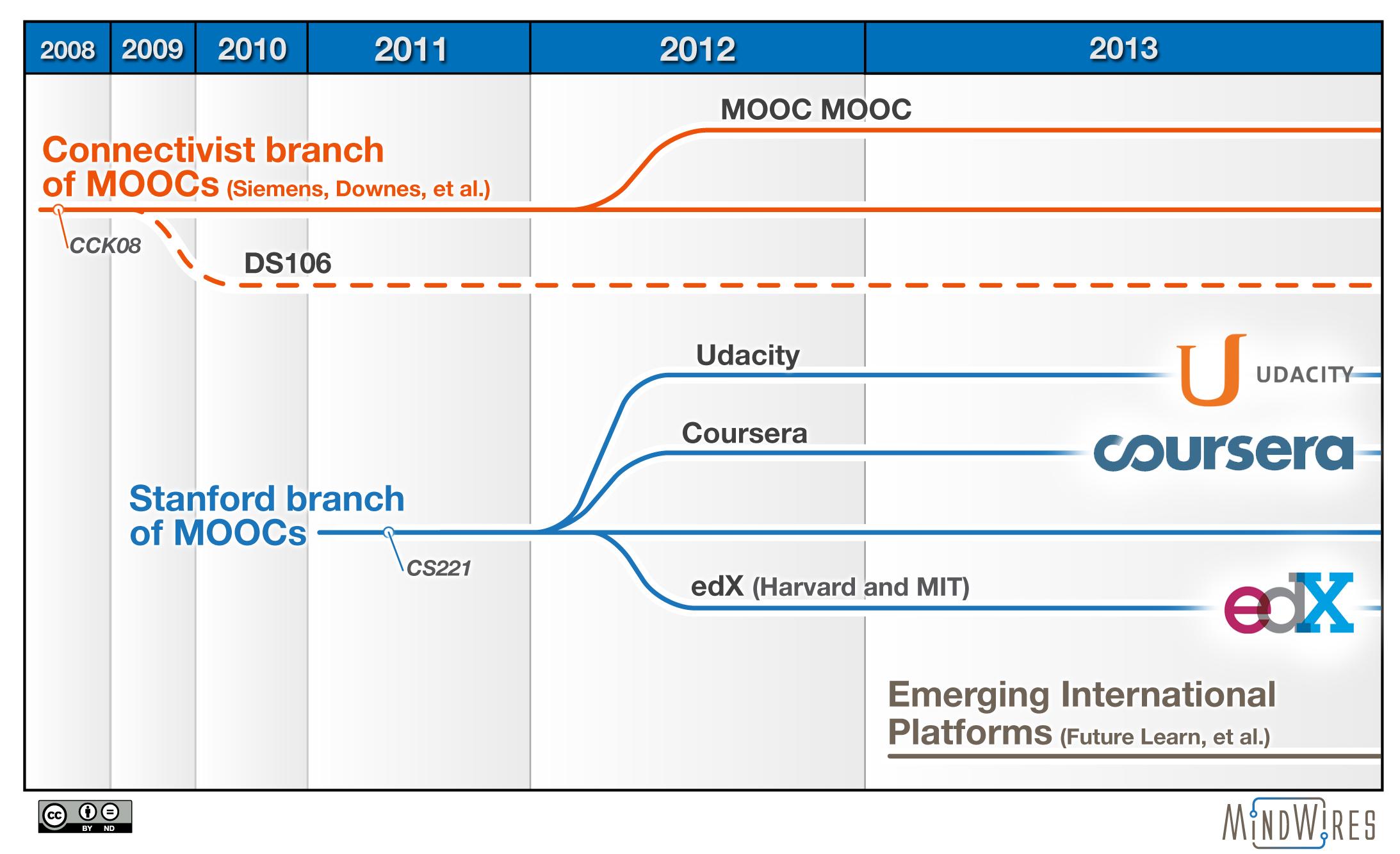
    There is a relevant graphic that was shown during this segment of the talk, showing the MOOC timeline (updated version shown below).

    MOOCpreHistory20131202

  • Changing the Narrative

    As Phil mentioned, he and I were both lucky to attend the MOOC Research Initiative conference, which was a real tour de force. Jim Groom observed that even the famously curmudgeonly Stephen Downes appeared to be enjoying himself, and I would make a similar observation about the famously curmudgeonly Jonathan Rees. If both of those guys can be simultaneously (relatively) pleased at a MOOC conference, then something is going either spectacularly right or horribly wrong. I believe it was the former in this case.

    We are at one of those rare moments when there’s enough confusion that real conversation happens and possibilities open up. The sense I got is that everybody is really grappling with the questions of where we can take the concept of a “MOOC” and what MOOCishness might be good for. That is fun and hope-inducing. Phil and I spent a lot of the time interviewing folks for a future e-Literate TV series (coming to a computing device near you in March or April of 2014), so we were lucky to hear a lot of perspectives. There is some very good exploration happening now. George Siemens and his fellow conference organizers (as well as the Bill and Melinda Gates Foundation, which sponsored the event and the research) did a real service by bringing people together to talk about these issues at this pregnant moment.

    One thing happened toward the end of the conference that has me puzzled, though. Jim mentioned it in his blog post:

    At the same time[,] Bon Stewart’s admonitions for some kind of organized response to start filling the temporary void of direction with alternative narrative still rings in my ears—and it is very much the lesson I took away from Audrey Watters keynote at OpenEd.

    There was a lot of conversation, really throughout the conference but coming to a head at the end, that the term of MOOC is somehow damaged goods and that…something…should be done about it. Usually the word “narrative” was brought up. But this talk of “alternative narratives” or, as Bonnie put it, “changing the narrative”, confuses me. As far as I’m concerned, the connectivist/open ed crowd has been spectacularly, stunningly successful at “changing the narrative,” and I’m not at all clear what it would look like to somehow do it differently. I don’t understand what they mean here. Unfortunately I had to rush out the door to try to catch a plane shortly after the panel discussion and didn’t have an opportunity to follow up with some of the attendees. So I’m going to try to express my confusion in this blog post and hope that somebody can help me figure out what I’m missing.

    Warning: This post is long and lit crit wonkish.

    (more…)

  • About those U Penn MOOC results reported at MRI13

    Michael and I have been at the MOOC Research Initiative conference in Arlington, TX (#mri13) for the past three days. Actually, thanks to the ice storm it turns out MRI is the Hotel California of conferences.

    13th_Floor_-_Hotel_California

    credit: Bailey Carter assignment for Laura Gibbs’ class

    While I’m waiting to find out which fine Texas hotel dinner I might enjoy tonight, I thought it would be worthwhile to share more information from the University of Pennsylvania research that seems to be the focus of media reports on the conference (see Chronicle, Inside Higher Ed, and eCampusNews, for example). Penn has tracked approximately one million students through their 17 first-generation MOOCs on Coursera, which provided the foundation for this research.

    Per IHE:

    “Emerging data … show that massive open online courses (MOOCs) have relatively few active users, that user ‘engagement’ falls off dramatically especially after the first 1-2 weeks of a course, and that few users persist to the course end,” a summary of the study reads.

    For anyone who has paid even the slightest bit of attention to the MOOC space over the past year, those conclusions hardly qualify as revelations. Yet some presenters said they felt the first day of the conference served as an opportunity to confirm some of those commonly held beliefs about MOOCs.

    While it is accurate that these basic observations have been made in the past, there was some additional information from U Penn worth considering. The following slide images are courtesy of Laura Perna, a member of the research team.

    (more…)