
e-Literate

Present is Prologue

Category: Ed Tech

The “Ed Tech” category includes posts about educational technology products themselves, including LMSs and other learning platforms, adaptive learning and other digital curricular materials products, learning analytics, and educational apps of all types. It also includes technical aspects of ed tech products, especially interoperability.

  • Notes from Paul LeBlanc keynote address at WCET13

    Two weeks ago I attended the WCET Conference in Denver. While much smaller than EDUCAUSE and some others, I find these conferences to be great learning experiences, especially as WCET supports open dialogue between academic leaders (provosts, deans, etc), academic IT and edtech support, and industry leaders. The combination of mindsets – especially the combination of academic and technology – leads to very strategic discussions.

    This year the keynote was presented by Dr. Paul LeBlanc, the president of Southern New Hampshire University, which has made quite a name for itself with the College for America (CfA) program. College for America is probably the second best-known example of competency-based education (CBE) after Western Governors University (WGU), and in fact the CfA program was the first to gain Department of Education approval using the “direct assessment” rule that completely avoids seat time. See my previous post for a primer on CBE.

    While you can see the entire keynote here (using the mediasite player), I wanted to highlight four key points that help illuminate the reality of competency-based education today. As CBE becomes more hotly debated, it is useful to have real examples to evaluate. I have very roughly paraphrased and taken notes on what I heard in the keynote on these points, not as a defense or endorsement of CfA, but as a real-world early example of CBE.

    1) Competency-based education is typically targeted at working adults (14:11 – 20:40)
    (more…)

  • Announcing the Apereo Foundation Advisory Council

    Long-time readers know that I have had a close affiliation with the Sakai Foundation at teams and served on the Board of Directors relatively recently. This year, Sakai merged with the Jasig Foundation to form the Apereo Foundation. The purpose of the new organization is to become a sort of Apache Foundation of higher education in the sense that it is an umbrella community where members of different open source projects can share best practices and find fellow travelers for higher ed-relevant open source software projects. In this merger, the whole is greater than the sum of its parts. For example, last week the foundation just announced that the board of the Opencast project, which supports the Matterhorn lecture capture and video management project, voted to effectively merge with the Apereo Foundation. (The decision is subject to discussion and feedback by the Opencast community.) On the one hand, Opencast probably wouldn’t have joined the Sakai Foundation because they want to interoperate with all LMSs and wouldn’t want to be perceived as favoring one over another. On the other hand, had they joined Jasig prior to the merger, they would not have had access to the rich community of education-focused technologists that Sakai has to offer. (Jasig has historically focused mostly on tech-oriented solutions like portals and identity management solutions). The fact that the Opencast community is interested in joining Apereo is a strong indicator that the new foundation is achieving its goal of establishing an ecumenical brand.

    And in that context, I am pleased to tell you that I will be involved with the foundation in a more ecumenical role. Specifically, I will be facilitating an advisory council.

    (more…)

  • Competency-Based Education: An (Updated) Primer for Today’s Online Market

    There has been a significant amount of progress and interest in competency-based education, as Wisconsin has launched its Flexible Option program, federal legislators are pushing the concept, ‘patient zero’ has graduated from College for America, and resistance is emerging to the concept. I thought it might be useful to update and re-share the primer that was originally posted in August, 2012.

    I’m not an expert in the academic theory and background of outcomes and competencies, so in this post I’ll summarize the key points from various articles as they relate to the current market for online programs. Links are included for those wanting to read in more depth.

    What is Competency-Based Education?

    SPT Malan wrote in a article from 2000 about the generally-accepted origins:

    Competency-based education was introduced in America towards the end of the 1960s in reaction to concerns that students are not taught the skills they require in life after school.

    Competency-based education (CBE) is based on the broader concept of Outcomes-based education (OBE), one that is familiar to many postsecondary institutions and one that forms the basis of many current instructional design methods. OBE works backwards within a course, starting with the desired outcomes (often defined through a learning objectives taxonomy) and relevant assessments, and then moving to the learning experiences that should lead students to the outcomes. Typically there is a desire to include flexible pathways for the student to achieve the outcomes.

    OBE can be implemented in various modalities, including face-to-face, online and hybrid models.

    Competency-based education (CBE) is a narrower concept, a subset or instance of OBE, where the outcomes are more closely tied to job skills or employment needs, and the methods are typically self-paced. Again based on the Malan article, the six critical components of CBE are as follows: (more…)

  • Purdue University Has an Ethics Problem

    It’s fair to say that Purdue University has sparked several important conversations in ed tech through their work on Course Signals. First, they pretty much put the retention early warning system as a product category on the map, conducting ground-breaking research and building a system that several major ed tech players have either licensed or imitated. More recently, they have sparked a conversation about the state of ed tech research and peer review as their more recent research has been called into question. I highly recommend reading the comment threads on these two posts to get a sense of that conversation.

    Now I think Purdue may spark a third conversation—this time around the ethics of institutional learning analytics research and commercialization. Because there is no question in my mind that they have a serious ethical problem on their hands.

    (more…)

  • The quiet revolution in college pricing effects

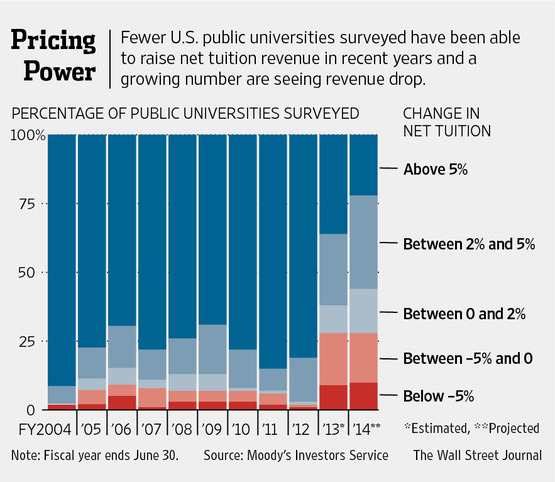
    Douglas Belkin wrote an article yesterday in the  Wall Street Journal based on a study from Moody’s Investors Service. The lede of the article is that “nearly half of the nation’s colleges and universities are no longer generating enough tuition revenue to keep pace with inflation”, which comes from Moody’s interest in institutional financial stability, but I think there are other lessons available. While the revolution in college pricing effects is quiet, it is profound.

    Tuition revenue

    It is worth noting that the big changes are based on FY2013 and 2014, which includes survey-based estimates and projections rather than hard data. The article is behind a paywall, but here are some relevant excerpts (read the whole article if you can).

    (more…)

  • Patent Troll Sues Blackboard for Patent Infringement

    A company called Sampo IP, which is a wholly owned subsidiary of patent troll Marathon Patent Group, is suing Blackboard for patent infringement. The patents in question appear to be incredibly broad and have also been asserted against Salesforce as well as high-profile customers of collaboration companies Jive, Hyperoffice, and Rally, including Dell, Starbucks, Hewlett-Packard, Aetna, and about 15 others. I have not read the patents carefully, but they seem to be related to applying push notifications to allow one person in a group to send notifications or requests to other people in the group.

    Really.

    For those of you tempted to Schadenfreude because of sins of Blackboard’s past, that would be a mistake. Patent trolls like Marathon can come after any company and their customers. In this case, the Marathon patents appear to be broad enough to be important for countless educational applications and could be applied against a range of vendors and schools alike. At the moment, there are no reports of suits against education customers, and there are practical reasons why the patent trolls would be somewhat unlikely to file suit against such customers in the future. But there is no legal barrier. We should all be rooting for Blackboard and the other defendants in this case.

    Patents are a serious and ongoing threat to education. I had hoped during the Blackboard v. D2L fight that there would have been enough concern and awareness within the community to take some broader action, but that never happened. Unfortunately, there are very few tools to employ against patent trolls but what steps can be taken to minimize edupatent suits in general should be taken. Vendors in the space, who own substantial IP, should be encouraged by their customers to form a protective patent pool, for example. Patent pools are of little value against trolls, but at least it would reduce the likelihood of lawsuits by practicing companies. And since big technology players like Google, IBM, Microsoft, and Oracle do substantial business in this space, perhaps they could be persuaded to contribute broader patents and create a substantial umbrella of protection. It is even possible the patent pool might yield prior art that could be effective in invalidating patents held by trolls. The sector could also unite to give companies like Marathon a PR black eye whenever they come after educational software. There are steps that could be taken, but educational leadership needs to step up to make it happen.

    You can find and read the legal complaint here.


  • Comments from a Researcher on the Course Signals Kerfluffle

    Doug Clow of the Open University has published a thoughtful and detailed blog post in response to the Course Signals effectiveness controversy. He covers far too much ground for me to attempt to summarize here, but I think there are some common themes emerging from the commentary so far:

    • The concerns over the one study have not changed the fact that Course Signals and the researchers who have been studying it are generally held in high regard. They have some very strong intra-course results which have not been challenged by current re-analysis. Even on the research that is now being challenged, they made a good faith effort to follow best research practices and are exemplars in some respects. On a personal note, I know Kim Arnold (although I did not realize she was an author on the particular study in question until Doug mentioned it in his post) and, like Doug, I think very highly of her and have learned a lot from her about learning analytics over the years.
    • That said, both the researchers and, especially, Purdue as an institution have an obligation to respond as promptly as is feasible to the challenge, in part because Purdue has chosen to license the technology in question and stands to make money based on these research claims (regardless of whether the researchers’ work was independent of the business deal). To be clear, nobody is accusing anyone of deliberately cooking the books. The point is simply that Purdue has an added ethical obligation as a consequence of the business deal.
    • The larger problem is not so much with the Purdue work itself as it is with the fact that both pre- and post-publication peer review failed. This can happen, even in papers that get a lot more eyeballs than this one did; Mike Caulfield has aptly pointed to the widely influential Reinhart and Rogoff economics paper on the effects of debt on national economies which has been belatedly proven to be in error as an apt analogy. Nevertheless, any such failure should trigger some introspection within a field regarding whether we should be doing more to cultivate robust community-based exploration of these studies, of which peer review is a part.

    I highly recommend reading Doug’s post in full.