e-Literate

Present is Prologue

Category: Ed Tech

The “Ed Tech” category includes posts about educational technology products themselves, including LMSs and other learning platforms, adaptive learning and other digital curricular materials products, learning analytics, and educational apps of all types. It also includes technical aspects of ed tech products, especially interoperability.

  • You know what would help MOOC articles? Getting the facts and goals right before analyzing

    Keith Devlin has an article at Huffington Post today titled “MOOC Mania Meets the Sober Reality of Education”. The premise is that the halting of the San Jose State University (SJSU) / Udacity pilot project and of SB 520 show that naive assumptions on the power of MOOCs to disrupt higher education are insufficient in reality – education is too complex. While the overall article has some good points, the very foundation of the article is flawed.

    I have written about both issues – SJSU program and SB 520 – and agree that there were flaws in both. Michael and I co-wrote a position paper for 20 Million Minds Foundation making recommendations to change and improve California legislation, and we have been critical of overly-simplistic views of higher education disruption. But authors should at least characterize the goals of each program accurately before drawing conclusions. The HuffingtonPost article has three glaring problems that undercut its entire message.

    Problem 1: Getting the explicit goals wrong

    Devlin begins:

    Politicians who saw MOOCs as a means to cut the cost of higher education are having to think again after two high-profile initiatives in California recently came to a crashing halt.

    Did politicians see “MOOCs as a means to cut the cost of higher education” in both of these programs? Let’s look at the stated goals for the SJSU program:

    This marks the first time that a broad and diverse range of students, not just matriculated students, will have access to online college classes for credit from an accredited university at a very affordable price of $150 per course, about the same as a course at the California Community Colleges.

    The pilot’s target population includes underserved groups such as high school students who will earn college credit, waitlisted students at California Community Colleges who would otherwise face out-of-state or private options, and members of the armed forces and veterans. [emphasis original]

    (more…)

  • Moodle has quietly become the dominant LMS for online service providers

    One subject that we have not covered much at e-Literate lately is the market position of Moodle. Given the significant LMS market changes over the past two years, it might be worth considering how institutions are adopting and using Moodle. In the US at least, there has been a significant change – whereas in previous years Moodle growth came primarily from institutions moving away from Blackboard, today much of the growth appears to have shifted to online service providers.

    Traditional US Market

    From 2006 – 2011 Moodle grew quickly in the US, both in terms of the number of users (students, faculty) and in terms of the number of schools adopting Moodle. This growth appears to have slowed considerably since 2011, although the data can be difficult to interpret since the system is open source – anyone can download for free and run Moodle, without even notifying Moodle headquarters or often the institution.

    While the data is inconclusive, my assumption is that traditional Moodle growth – institutions adopting the LMS as the campus standard, typically moving away from Blackboard or WebCT – has significantly slowed from its peak growth in 2009 – 2011. I’ll write a separate post on this subject in the future.

    New Growth Model

    While the traditional growth may have slowed, there is a market segment in the US where Moodle is quietly dominating – as the preferred learning platform (or LMS) for online service providers.

    (more…)

  • Major Twist in CCSF Accreditation Crisis: DOE Threatens Accrediting Agency

    I have recently described the seven-year accrediting crisis that City College of San Francisco (CCSF) faces as well as a summary of the dissenting voices.

    Now it’s time to be petty.
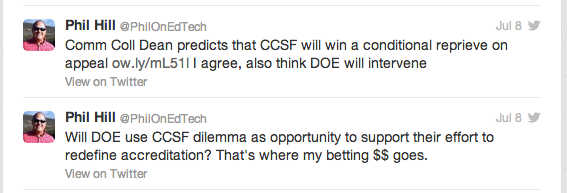
    Your_Twitter_archive


    We are now seeing just the intervention that I  predicted one month ago. Per Inside Higher Ed today:

    City College of San Francisco’s regional accreditor is now in the same existential bind as the college, having been told by its overseer to fix several problems, pronto, or risk being stripped of power.

    The U.S. Department of Education on Wednesday notified the Accrediting Commission for Community and Junior Colleges that it is out of compliance in several areas related to its sanctioning of City College. The commission must take “immediate steps” to avert the suspension or termination of its federal recognition as an accrediting body, according to a letter from the department.

    What this development, which stunned many in California, means for the fate of City College is less clear. Most involved parties said they were still absorbing the letter and its ramifications.

    The DOE directly responded to the California Federation of Teachers (CFT) complaints about the process itself – not the actual findings and whether CCSF was in compliance. As can be read in the letter, the DOE listed 4 issues that ACCJC must address.

    1. The agency does not have a policy for the on-site evaluation teams. The issue is that the teams were administrator heavy.
    2. The agency does not have a policy on conflict-of-interest. The issue is that the spouse of the ACCJC president was on the evaluation team, and this could bias the commission to favor the team’s findings over other voices.
    3. The agency letters (see post on history of warnings) did not clearly differentiate issues that indicated the college was out of compliance from issues which were mere recommendations.
    4. The agency’s use of the word “recommendation” was not clear. One one hand, ACCJC gave strong language for correction, but they did not start the two-year clock on resolution until the agency formally sanctioned the school. The policy is not clear on when the time period starts.

    Note that the DOE did not address the CCSF findings, but rather they accepted the CFT complaints about technicalities in the accrediting review process.

    Rather than give ACCJC the normal 12 months to fix their internal policies, the DOE “determined that in order to avoid initiation of an action to limit, suspend or terminate ACCJC’s recognition [authorizing it as accrediting agency], ACCJC must take immediate steps to correct the areas of non-compliance identified in this letter”.

    Given my accurate prediction one month ago, I’ll make two more predictions:

    • This is a complete victory for the CFT, and the DOE has taken sides in this dispute. I predict ACCJC will be forced to reverse the CCSF accrediting decision as “a conditional reprieve on appeal” as noted by Community College Dean. At the very least, CCSF will get another two years to comply.
    • This action will enable the federal government, through DOE regulations, to dramatically step up its involvement in accrediting policy. I predict new DOE-driven demands on revisions to accrediting policies for all seven regional agencies within the next 12 months.

    Update 8/21: CCSF formally asked the commission to reverse its decision, according to a story at the San Francisco Chronicle.

    City College of San Francisco asked a commission on Tuesday to reverse its devastating decision to revoke the school’s accreditation next year – but has been told not to share any details of its request with the public.

    And, unwilling to upset those who hold its fate in their hands, the college made its request without citing mistakes the commission made when it evaluated the college that were recently identified by the U.S. Department of Education.

    The news disappointed faculty, who had hoped the Accrediting Commission for Community and Junior Colleges would be forced to withdraw its decision to revoke City College’s ability to operate after the Department of Education upheld complaints by the faculty union last week. The Department found the commission had violated four regulations in its scrutiny of the large college – including giving the appearance of a conflict of interest when it let the husband of commission President Barbara Beno help evaluate the college.

    The Department of Education said its findings could be used as part of the college’s appeal of the accrediting decision.

    Unlike a court of law, however, accrediting appeals are made to the same commission that issued the original verdict. So the college considered a complaint about the commission too risky.

  • CCSF Accreditation Crisis: The Dissenting Voices

    I recently wrote about City College of San Francisco (CCSF) and its impending loss of accreditation, which would essentially shut down the largest community college in California (85k students).

    Last week the Accrediting Commission for Community and Junior Colleges (ACCJC), which operates under the corporate entity the Western Association of Schools and Colleges (WASC), voted to end accreditation for the City College of San Francisco (CCSF) as of June 2014. Unless reversed, the loss of accreditation would like force the 85,000 student college to shut down. CCSF would be the largest college to date to lose accreditation, and it is also the largest community college in California.

    The rest of the post walked through the seven years of history that led to the current crisis. In essence, CCSF was notified originally in 2006 by ACCJC that they were potentially out of compliance on three issues.

    Based on this evaluation, the ACCJC “took action to reaffirm accreditation, with a requirement that the college complete a Progress Report and a Focused Midterm Report”. In the letter, two areas were highlighted for further review.

    • The Commission asked that the Progress Report be submitted in 2007 to specifically cover resolution of Recommendation #4 (Financial Planning and Stability).
    • The Commission required a Focused Midterm Report in 2009 “which must give evidence of progress” on specific recommendations #2 (Planning and Assessment and #3 (Student Learning Outcomes).

    But this is all one side of the story – the view according to the accrediting agency. What are the dissenting views?

    Emerging Consensus from Institution and Political Leaders

    There have been many complaints about the ACCJC process and decision, and the vast majority that disagree with the decision have originated from faculty and faculty unions. Despite their concerns over the potential closing of such a large college, most non-faculty groups have essentially supported the process.

  • MOOCs: A Disruptive Innovation or Not?

    Nearly five years ago on October 27, 2008 Clayton Christensen and Michael Horn briefed participants at an American Enterprise Institute [AEI] meeting on “Disruptive Innovation in Education and Health Care.” Christensen and his work were well known by this Washington DC group. AEI described the meeting:

    The ability of technology to “disrupt” long-established business practices–dramatically changing the landscape of industries by increasing access, cutting costs, and revolutionizing delivery–has been a subject discussed for decades and is the topic of Harvard Business School professor Clayton M. Christensen’s iconic volumes, The Innovator’s Dilemma and The Innovator’s Solution. Yet, as Christensen has observed, these radical, innovation-driven transformations have been largely absent in the education and health industries–perhaps the two most important arenas of everyday life.

    At that time of the AEI briefing, Christensen and Horn’s book Disrupting Class had just been published. Subsequently, their work has been interpreted by some in the press as resolving the problems of students’ access to (in both a physical and economic sense), and success in, higher education. Christensen and Horn’s presentations and the discussion focused on “online learning”. It should be noted that data from MOOCs [Massive Open Online Courses] would not be available for three more years. Both presentations were far more nuanced than reported.

    The press, governments, public and some college leaders assume their model describes what can be achieved by higher education in a few years.

    (more…)

  • Yup, Something (Good) Is Up at Blackboard

    When a company the size of Blackboard makes substantial organizational changes, it can be difficult to assess what is really going on. In the beginning, the stories tend to look similar. The old CEO…decides he wants to “spend more time with his family.” ((Or “hikes the Appalachian trail.” Pick your favorite euphemism.)) Well-known long-time employees leave the company en masse, some of their own volition and others not. It’s a common enough story trope, but it comes with two distinctly different endings. In one version, the company accelerates its downward spiral until it crashes spectacularly. In the other version, everybody is amazed at the company’s revitalization and they live happily ever after. It is nearly impossible to tell from the beginning of the story how it will end. All of the people leaving the company are, of course, unhappy and are likely to have negative opinions of what’s going on. And often they have valid criticisms, even in the stories that later come to happy endings. When an executive is trying to turn around a billion-dollar company quickly, a scalpel won’t do it. Some meat cleaver work is necessary. Collateral damage is inevitable even in the best of cases. So reports from former employees are interesting but don’t tell the whole story. Customers won’t see the results of the changes for a while, so there will be few clues there. In fact, they may see things get worse before they get better due to the chaos of the reorganization. And even the employees who are on the inside often don’t know what to think in the early stages.

    And so it has been with Blackboard. Up until recently, it has been very hard to tell which way the story will go. But I agree with Phil that we’re beginning to see early signs that we may get the happy ending here. I had an opportunity to visit Blackboard this week, and what I heard is very consistent with Phil’s recent experiences with them.

    (more…)

  • This is not your father’s Blackboard

    Thanks for inviting me to this conference in Las Vegas, but I couldn’t help notice there is no After Party. Could you point me to the BbWorld conference instead? . . . What’s that? . . . Really?? Because I just came out of a product roadmap presentation where people were clapping, and not just for improved customer service but actual product usability and features that people want. . . . OK, OK, maybe you’re right . . . But the ex-WebCT folks were actually clapping the loudest. . . . WTH?

    Blackboard’s user conference this year was unlike any previous BbWorld I’ve attended. After the WebCT acquisition in 2006, the user conferences tended to be love-hate events (love the show and good times, hate the acquisition of competitors and tin ear). After the 2009 acquisition of ANGEL and subsequent changes in the management team, the user conferences moderated to ambivalence. Many of the product announcements were exciting in the abstract, but it was not clear that product roadmaps and new features were directly addressing client concerns.

    BbWorld 2013 was the first time that I’ve seen customers have such a positive response to Blackboard presentations. At least from a short-term roadmap perspective, the product changes presented this year seemed to hit the sweet spot of what current customers have been requesting. There was a sense of appreciation and relief from customers that Blackboard was listening and reacting to them. And that is no small feat.

    (more…)