
e-Literate

Present is Prologue

Category: Ed Tech

The “Ed Tech” category includes posts about educational technology products themselves, including LMSs and other learning platforms, adaptive learning and other digital curricular materials products, learning analytics, and educational apps of all types. It also includes technical aspects of ed tech products, especially interoperability.

  • SJSU Plus / Udacity Update: Different student populations

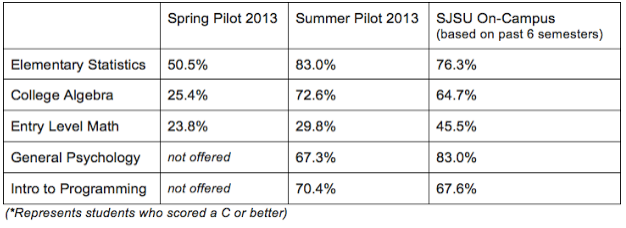
    San Jose State University (SJSU) and Udacity have announced the results of their summer pilot, and the headlines cover the big improvements (text from IHE article, table from Udacity blog).

    Thrun recently hinted that the summer pilot’s results would be more positive, and that Udacity was getting close to finding the “magic formula” to deliver high-quality, low-cost education.

    The lone holdout among the SJSU Plus courses is entry-level math, which saw the smallest increase in students who received a passing grade, from 23.8 to 29.8 percent. That places the pass rate almost 40 percentage points below the closest SJSU Plus course, and about 15 percentage points below the pass rate of the on-campus course.
    Thrun Blog

    I am not trying to throw cold water here, but it is very important to look at the student populations. To his credit, Sebastian Thrun describes the big differences in his blog post.

    This summer, we ran the second instance of our pilot. While in the Spring, we actively sought out underserved high schools from low-income areas in California, this time we simply opened up enrollment to anyone. As predicted, with 2,091 students who enrolled, we mainly reached students who would not ordinarily attend college. Only 11% of the summer students who took the for-credit courses from SJSU were matriculated students in one of the California State Universities. 71% of our students came from out of state or foreign countries. And while the total number of high school students went up, their proportion in the total student body went down. [snip]

    One key difference between Spring and Summer was that we opened our Summer session to everyone. This led to a substantial difference in student body. Among the student body, 53% reported that they already hold a post-secondary degree (5% Associate, 28% Bachelor’s, 16% Master’s, and 4% Doctorate). Only 12% of the students had a high school graduate diploma or equivalent, and 15% were active high school students. This is very different from the Spring Pilot, in which approximately 50% of the student body were active high school students, and the other 50% were matriculated SJSU students. [emphasis added]

    One of the key success factors of online education is to target student populations who can succeed in this environment. If you target groups (remedial students, underserved students, high school students), then there must be tremendous student support.

    Pay attention to the student populations – this might be the real story. If you ignore the difference in student populations, you might draw the wrong conclusions.
  • Cal State’s New Online Concurrent Enrollment Program: A Student’s View

    Michael and I have written about California’s efforts to leverage online education to address the challenge of students having access to needed courses, but it would help to hear what students have to say. Towards that end, I am sharing a student newspaper article about Cal State’s new online concurrent enrollment program. The student is my daughter, Hillary Hill, who is in her third year at Sonoma State University. You can find the original article here.

    As a student attending a school that is part of the California State University system, specifically Sonoma State University, I know the dread and frustration associated with registering for classes.

    In some ways, it seems like we are being set up to fail; we have a 16 unit cap, registration times get mixed up, and it seems like every class you need is full after five minutes.

    (more…)

  • Ray Henderson Update

    As e-Literate readers know, Ray Henderson is no longer President of Learning Platforms and is now serving on the company’s Board of Directors instead. This sort of thing naturally sets of all sorts of concerns and speculation. I had the good fortune to be able to speak with Ray today and have some details straight from the horse’s mouth.

    First, he made it clear that this change was initiated by him rather than the company, and it was for reasons unrelated to Blackboard politics or direction. A lot of people don’t know that Ray’s family still lives in Indianapolis; both his kids and his parents are half a country away when  he is at Blackboard headquarters in Washington D.C. Euphemisms aside, when he told me that he needed to spend more time with his family, I believed him. I also believed him when he told me that both Blackboard CEO Jay Bhatt and company owners Providence Equity Partners have been working hard to find alternative arrangements that would keep him involved with Blackboard in a meaningful way. Ray made it clear that he will continue to be a very active participant in Blackboard product planning, albeit now in a non-operational role. Boards on Private Equity-owned companies are different from those in publicly traded ones in that way; it is not abnormal for a member of the Board of a PE-owned company to be actively involved in decision-making on a focused and part-time basis.

    Ray used a lot of the first person plural pronoun—we—when talking about Blackboard’s work going forward. I didn’t get any less of a sense of enthusiasm for what the company is doing than I did when I spoke with him a few weeks ago. I believe he will continue to have meaningful involvement with the company. Whether the new executives being brought in will perform well remains to be seen, but if they have the benefit of Ray’s perspective and experience in the strange market that is higher education, then parts of his job that he will no longer be doing are easier for a seasoned technology executive from another industry to take on and do well. (In fact, in some cases those parts may be better managed by more of an operational specialist.) There’s no question that Ray’s reduced involvement is a loss for Blackboard, but it’s being mitigated and, most importantly, it’s not an indicator that executive management failed to recognize the substantial improvements in the company that have taken place on his watch.

    Beyond that, we can make some reasonable guesses about what Ray’s future might look like. In addition to a continuing part-time commitment to Blackboard, I wouldn’t be surprised to see him involved in due diligence evaluations for Providence when they consider acquiring ed tech companies. Nor would I be surprised to see him involved with other ed tech companies. He mentioned, for example, that he is on the Board of In The Telling. Ray is still a fairly young guy and seems as fired up as ever about education and entrepreneurialism. I doubt that he is going to fade away any time soon.

  • Postscript on accreditation transparency: Basic financials of two accrediting commissions

    Last week I wrote a post on two significant accrediting actions related to City College of San Francisco and Tiffin University.

    If there really is a shift in the DOE’s views on accreditation or in the accrediting commissions’ interpretation of standards, then that could have fairly profound cascade effects on competency-based learning programs, private online colleges, MOOCs, and online service providers.

    That is also why the lack of transparency from the accrediting commissions is so troubling. They are making decisions that have profound effects on many institutions, not just the specific schools under review.

    Mathieu Plourde asked a good question in the comments.

    Do you know how these accrediting bodies get their funding? If it’s at least in part from government funding or through membership fees from public institutions, I’d say it’s time to make them open up their data.

    While I have not figured out if there is a method to force the accrediting commissions to “open up their data”, I would like to answer the first part of Mathieu’s question on funding.

    Accrediting commissions are designated non-profit organizations, typically designated as 501 (c) (3) by the IRS. This means they have to file annual returns (form 990) to maintain their tax-exempt status. One sight that has this information is the Foundation Center. I’ve pulled up the most recent forms for the  Accrediting Commission for Community and Junior Colleges (ACCJC), responsible for CCSF’s accreditation, and the Higher Learning Commission (HLC), responsible for Tiffin University’s accreditation. Some notes before getting to the data:

    • There are six regional accrediting agencies in the US covering postsecondary education. Each agency has one or two commissions as members that are responsible for the actual accreditation reviews, for a total of eight regional accrediting commissions (New England and Western agencies have two commissions each).
    • ACCJC is part of the Western Association of Schools and Colleges (WASC). Since there are two commissions in WASC, WASC files the form 990 instead of ACCJC. Their most recent form available is for the tax year ending June 30, 2011 (I do not know why the 2012 data is missing).
    • HLC is a member of the North Central Association of Colleges and Schools (NCACS). Since there is only one commission in NCACS, HLC files its own form 990. Their most recent form available is for the tax year ending August 31, 2012.
    • “Membership Dues” covers the fees paid by accredited institutions.
    • “Program Services” combines paid workshops, consulting and annual conference revenues – typically from the member institutions.
    • “Evaluation Visits” are primarily travel and direct expenses for peer review teams visiting institutions during review.

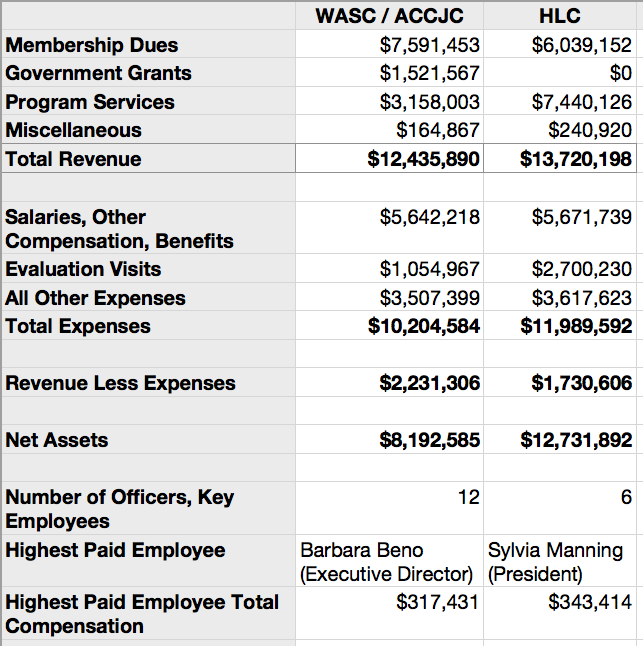
    The actual forms can be found here for WASC / ACCJC and here for HLC . I have combined the most relevant data into one table.

    Form 990


    I went back and forth on whether to highlight the ‘highest paid employee’ data. In the end I chose to include this in the table as it seems relevant in terms of the organization’s motivations for self-preservation. In the case of ACCJC, there have been many charges of conflict-of-interest for the commission members, and the Department of Education has even found that the commission does not have adequate conflict-of-interest policies. The people running accrediting commissions are few in number but make a decent living. There is more information available in the form 990s.

    So, for my long-winded answer to Mathieu: Accrediting commissions get their revenue primarily from membership dues and additional program services from member institutions, many of which are themselves public entities; they also make some revenue directly from government or foundation (e.g. Lumina Foundation, Gates Foundation) grants but not every year.

  • Some big personnel changes in LMS market

    In just the past week we have had three fairly significant people depart higher ed LMS companies. This really is turning out to be a bumpy ride as the market changes.

    • Ray Henderson announced last night that he is leaving his operational role at Blackboard (President, Academic Platforms and CTO) and is moving into a role with the Board of Directors. More info from Jay Bhatt’s post here and Ray Henderson’s post here. Michael is working on an e-Literate post with more information soon. Bill Flook covered in an article here.
    • Devlin Daley, one of the two founders of Instructure, the company behind the Canvas LMS, is leaving the company as of today. I talked to Instructure rep today who indicated that Devlin is looking to get back in to startup ed tech mode, whereas Instructure is becoming a larger company. I’ll write more of an analysis on this move soon. For now I’ll just say that it is extremely rare for a tech founder to leave a company that might go public within a year or two.
    • Al Essa, the Director of Analytics Research and Strategy for Desire2Learn, has left the company to join McGraw-Hill based on his LinkedIn profile. This is curious timing, given Desire2Learn’s major focus on analytics and the Student Success System this year.

    More to come.

  • Higher Ed Accrediting Commissions: Transparency for thee, not for me

    Why do I keep covering accreditation issues on e-Literate, a blog nominally about online learning and educational technology? The reason is that accrediting commissions have enormous influence on higher education institutions, particularly as the industry wrestles with questions of which changes are necessary, which changes are worth trying but might not work, and which changes should be avoided. If there really is a shift in the DOE’s views on accreditation or in the accrediting commissions’ interpretation of standards, then that could have fairly profound cascade effects on competency-based learning programs, private online colleges, MOOCs, and online service providers.

    That is also why the lack of transparency from the accrediting commissions is so troubling. They are making decisions that have profound effects on many institutions, not just the specific schools under review.

    Case 1: Tiffin University and HLC

    Tiffin University was forced to drop its partnership with Ivy Bridge College – an private college owned by Altius Education – earlier this month. From the press release:

    (more…)

  • Blackboard Analytics Update

    In my last post, I promised that I would give an update specifically on the state of Blackboard’s learning analytics. Well, here you go. This is a summary of what I learned about their product from a chat with Mark Max, Blackboard’s VP of Learning Analytics and, to a lesser degree, with VP of User Experience Stephanie Weeks. I wrote about Blackboard’s Retention Center product some time ago. That product (or feature set, since it is free in Blackboard) directly competes with Desire2Learn’s Student Success System. This post is more broadly about their Analytics product suite, which is most directly analogous with Desire2Learn’s Insights product, although it is actually much, much broader in scope.

    The short version is this: Blackboard has very solid and reliable technology base from which they are building their learning analytics. It is easily the most mature platform among the LMS providers from that perspective. What they are a little short on is vision. In other words, they are pretty much the mirror image of Desire2Learn.

    (more…)