e-Literate

Present is Prologue

Tag: adaptive learning

  • OSU Panel Discussion: Faculty experience with adaptive learning for Intro to Psychology course

    In Spring 2016, faculty, support staff and administrators at Oregon State University met to candidly share their experiences with adaptive learning technology. ((Disclosure: Our e-Literate TV series of video case studies and explainer videos is funded by a grant from the Bill & Melinda Gates Foundation.)) I shared two different videos from the event at EdSurge in this article and highlighted comments on vendors over-promising here at e-Literate. This time I’d like to highlight part of a panel discussion where a faculty member relates her experiences – what worked and what didn’t work – when using adaptive learning tools.

    Kathryn Becker-Blease has taught Intro to Psychology, a large lower-division lecture course, using both traditional quizzing and with adaptive quizzing with the help of Macmillan’s LearningCurve. In this part of the panel discussion Susana Rivera-Mills, Vice Provost and Dean of Undergraduate Studies, asks Becker-Blease about her experiences based on research and teaching.

    (more…)

  • Marketing Claims From Adaptive Learning Vendors As Barrier To Adoption

    In Spring 2016, faculty, support staff and administrators at Oregon State University met to candidly share their experiences with adaptive learning technology. ((Disclosure: Our e-Literate TV series of video case studies and explainer videos is funded by a grant from the Bill & Melinda Gates Foundation.))  I shared two different videos from the event at EdSurge in this article.

    At one point I asked what people saw as risks or barriers to further adoption of adaptive learning courseware, and two people had very similar responses. In a nutshell, the over-active marketing claims from many vendors could be the biggest barrier. This is somewhat counter-intuitive as over-active marketing is commonly seen as the cause of technology being adopted even when it should not be. Listen to their responses (< 30 seconds).

    (more…)

  • No Filters: My ASU/GSV Conference Panel on Personalized Learning

    ASU’s Lou Pugliese was kind enough to invite me to participate on a panel discussion on “Next-Generation Digital Platforms,” which was really about a soup of adaptive learning, CBE, and other stuff that the industry likes to lump under the heading “personalized learning” these days. One of the reasons the panel was interesting was that we had some smart people on the stage who were often talking past each other a little bit because the industry wants to talk about the things that it can do something about—features and algorithms and product design—rather than the really hard and important parts that it has little influence over—teaching practices and culture and other messy human stuff. I did see a number of signs at the conference (and on the panel) that ed tech businesses and investors are slowly getting smarter about understanding their respective roles and opportunities. But this particular topic threw the panel right into the briar patch. It’s hard to understand a problem space when you’re focusing on the wrong problems. I mean no disrespect to the panelists or to Lou; this is just a tough nut to crack.

    I admit, I have few filters under the best of circumstances and none left at all by the second afternoon of an ASU/GSV conference. I was probably a little disruptive, but I prefer to think of it as disruptive innovation.

    Here’s the video of the panel:

  • Personalized Learning vs. Adaptive Learning

    In our recent EDUCAUSE Review article, Phil and I defined personalized learning as a set of technology-supported practices that help undepersonalize teaching. The three general practices that we identified are as follows:

    1. Moving content broadcast out of the classroom: Even in relatively small classes, a lot of class time can be taken up with content broadcast such as lectures and announcements. Personalized learning strategies often try to move as much broadcast out of class time as possible in order to make room for more conversation. This strategy is sometimes called “flipping” because it is commonly accomplished by having the teacher record the lectures they would normally give in class and assign the lecture videos as homework, but it can be accomplished in other ways as well, for example with reading-based or problem-based course designs.
    2. Turning homework time into contact time: In a traditional class, much of the work that the students do is invisible to the teacher. For some aspects, such as homework problems, teachers can observe the results but are often severely limited by time constraints. In other cases, such as comprehension of assigned readings, the students’ work is invisible to the teacher and can be observed only indirectly and with significant effort. Personalized learning approaches often allow the teacher to observe the students’ work in digital products, so that there is more opportunity to coach students. Further, personalized learning often identifies meaningful trends in a student’s work and calls the attention of both teacher and student to those trends through analytics.
    3. Providing tutoring: Sometimes students get stuck in problem areas that don’t require help from a skilled human instructor. Although software isn’t good at teaching everything, it can be good at teaching some things. Personalized learning approaches can offload the tutoring for those topics to adaptive learning software that gives students interactive feedback while also turning the students’ work into contact time by making it observable to the teacher at a glance through analytics.
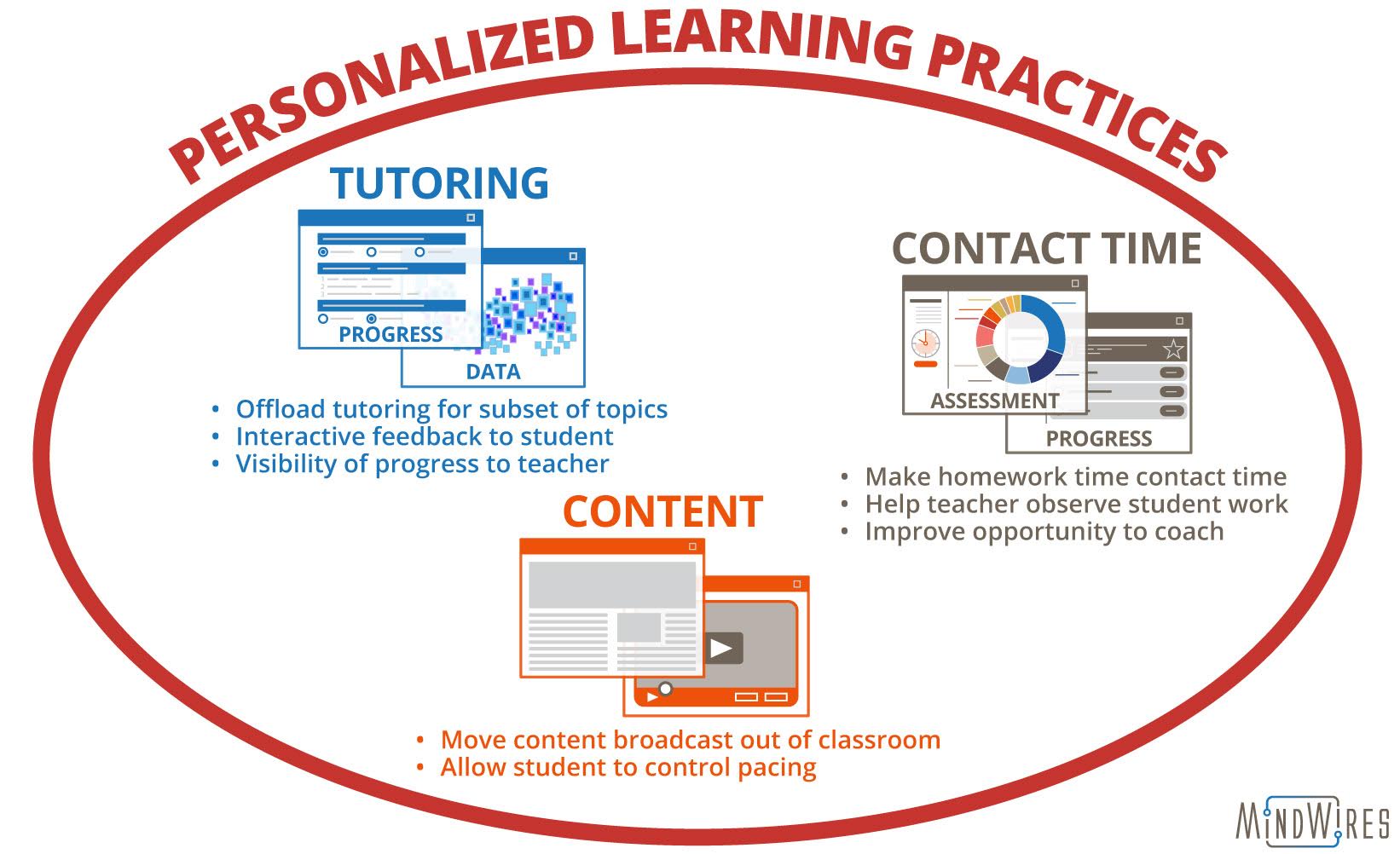
    ERO Graphic 1

    Personalized learning is a set of things that you do, not a set of things that you buy. Products can support or enable personalized learning practices, but they are not “personalized learning products.” And in fact, once you have products that support personalized learning practices, that’s actually when the hard work begins. OK, so you moved content broadcast out of the classroom. Now what are you going to do with class time? Students get some benefit from having course content that they can review multiple times at home, but most of the big gains typically come from the teacher reclaiming class time for more high-value direct and interactive work with the students.

    On the other hand, adaptive learning is a label that applies to products. Further, adaptive learning products can support all of the practice areas of personalized learning. They enable teachers to move content broadcast outside of class time, they make homework time into contact time through analytics, and they provide some tutoring function. “Adaptive” tends to provoke a lot of discussion around the latter of the three practice areas. See the piece I wrote for the American Federation of Teachers if you want a primer on the strengths and limitations of adaptive learning products as tutors. But as often as not the first two capabilities, neither of which is dependent on adaptive algorithms, are the ones that enable the biggest gains in personalized learning teaching practices. “Courseware” is a set of products that, when designed well and used properly, can enable faculty to move content broadcast out of the classroom and make homework time content time. Adaptive courseware adds the tutoring element while also, if done well, increasing the value of that homework contact time by providing better feedback through more targeted analytics.

  • Making Lab Sections Interactive: More evidence on potential of course redesign

    Two weeks ago Michael and I posted an third article on EdSurge that described an encouraging course redesign for STEM gateway courses.

    In our e-Literate TV series on personalized learning, we heard several first-hand stories about the power of simple and timely feedback. As described in the New York Times, administrators at the University of California, Davis, became interested in redesigning introductory biology and chemistry courses, because most of the 45 percent of students who dropped out of STEM programs did so by the middle of their second year. These students are the ones who typically take large lecture courses.

    The team involved in the course-redesign projects wanted students to both receive more individual attention and to take more responsibility for their learning. To accomplish these goals, the team employed personalized learning practices as a way of making room for more active learning in the classroom. Students used software-based homework to experience much of the content that had previously been delivered in lectures. Faculty redesigned their lecture periods to become interactive discussions.

    (more…)

  • Exclusive: University of Phoenix moving from homegrown platform to Blackboard Learn Ultra

    The University of Phoenix has a history of using its scale to develop and rely on homegrown platforms, including the  adaptive learning platform branded as “Classroom”. I wrote about this investment in 2013.

    The full significance of the University of Phoenix bet on adaptive learning platforms goes beyond pure dollars and became clear when the school announced the closure of 115 of its 240 locations. The stated usage of the savings from campus closures is primarily to further invest in the platform as described by the Phoenix Business Journal.

    In early 2015 the University of Phoenix experienced “significant disruption with respect to our new online classroom platform”. By summer, the university’s parent company The Apollo Group announced to investors that it planned “to move away from certain proprietary and legacy IT systems”. CEO Greg Cappelli further described these changes in broad terms in the most recent earnings call. (more…)

  • Personalized Learning is Hard

    Paul Fain has written a really good, nuanced article at IHE covering the update that Essex County College gave of their developmental math adaptive learning pilot at a recent conference in Washington, DC. We did a two–part case study on ECC in our e-Literate TV series). The headline results are as follows:

    • In the first year, the pass rate was worse than  in the traditional classes. (The first semester was “disastrous.”)
    • This year—the second year—the pass rate is coming closer to the traditional class but is still underperforming.
    • The article seems to imply that students who earn a C in the personalized learning class do better than students who earn a C in the traditional class, but the article is not explicit about that.

    There is no magic pill. As Phil and I have been saying all along—most recently in my last post, which mentioned ECC’s use of adaptive learning—the software is, at best, an enabler. It’s the work that the students and teachers do around the software that makes the difference. Or not. In ECC’s case, they are trying to implement a pretty radical change in pedagogy with an at-risk population. It’s worth digging into the details.

    (more…)