I had a conversation with a friend last night about the counter-intuitive challenges of working with AI/ML and the implications for using them in EdTech. I decided it might be useful to share my thinking more broadly in a blog post.
Essentially, I see three stages in working with artificial intelligence and machine learning (AI/ML). I call them the miracle, the grind, and the wall. These stages can have implications for both how we can get seduced by these technologies and how we can get bitten by them. The ethical implications are important.
The Miracle
One challenge with AI/ML is how deceptively easy it is to produce mind-blowing demos with these tools. For example, I spent some time playing with GPT-3 as a learning exercise. GPT-3 is one of several gigantic AI models that can do some pretty miraculous things with natural language. (Google has the other prominent gigantic model.) One reason I started with GPT-3 is that it can be programmed using natural language. For example, you can tell it, “You are a helpful chatbot that teaches first-year college students about philosophy” and voila! You have a helpful philosophy-teaching chatbot.
It’s not quite that simple. For example, I found that GPT-3’s idea of what a first-year college student understands about philosophy differed from mine. I got better results when I asked it to target 11th grade. I couldn’t have known that in advance. GPT-3 is a neural network of 175 billion parameters. It has indexed large swathes of the internet and many books. But it doesn’t store all that information, exactly. It distills it in very complex ways. In fact, GPT-3 and similar models are so complex that even the programmers who made them can’t explain why they produce specific responses to instructions or questions. So I had to figure out how to “program” my chatbot through a bit of trial and error.
Not all AI/ML algorithms are this complex. Some of them are much easier to understand. It’s a spectrum, and GPT-3 is on the far end of that spectrum.
Anyway, after a few days of intermittent tinkering, I was able to produce a chatbot that could carry out a sustained and informative conversation about David Hume’s theory of epistemology, to the point where it gave me new insights into the subject. I accomplished this by tinkering over a few days, as a layperson, using plain English.
I had reached the miracle stage of AI/ML.
But there were problems. First of all, the chatbot would end the conversation just when it got really interesting. It suddenly would insist on saying goodbye and could not be persuaded to continue talking. It turns out that this kind of AI model has a strict memory limitation. When you hit it, the chatbot suddenly forgets your entire conversation. My new philosophy tutor friend also sometimes gave weird answers. I knew when to ignore them but they would have confused some students.
GPT-3 has a community of developers who are incredibly helpful, particularly when the topic is something idealistic like education. I was able to find a very knowledgeable programmer who was generous with his time and helped me understand what I would need to do in order to take my tutor to the next level.
The grind
The first thing I’d need to do is learn to program in Python since I had reached the limits of programming in plain English. And for the 9,781st time, I was momentarily tempted to learn a little programming. But then he explained what I’d need to do.
For the memory problem, I’d need to chain portions of the conversation together. But since GPT-3 doesn’t actually remember large chunks of information so much as it distills them, the chatbot wouldn’t literally be able to recall our entire conversation. You can quickly see where this could become problematic. If the student says something like, “When you said earlier that…”, it’s hard to predict how the chatbot would respond.
And so we enter the grind phase. It could also be called the whack-a-mole phase, since you’re finding a problem, writing a solution, and then looking for unintended consequences elsewhere. Also, since the model isn’t knowably deterministic and the questions students will ask also aren’t knowably deterministic, it’s probably impossible to test all the possible scenarios.
Which is why you don’t see chatbots that are this open-ended and ambitious. Translating that initial miracle into a reliable response is a daunting if not impossible task. Today’s chatbot designers use UX and context tricks to make the inputs from the students more predictable and they also use less complex algorithms with outputs that they can predict and debug more easily. They tend to reserve the usage of models like GPT-3 for limited and specific applications. And even when they’re careful, producing a chatbot that is rock-solid reliable takes a lot of hard work, including difficult debugging that’s often quite different from debugging traditional software.
This brings us to the final phase: The wall.
The wall
Sooner or later you reach the limit of what your tech can do for you. Predicting that limit in advance takes tremendous skill, often requiring extensive domain knowledge of both the tech itself and the problem it’s being applied to, whether that’s detecting manufacturing defects, discovering new drugs, or tutoring students. There are always nooks and crannies of knowledge and skill that are a poor match for the technology’s capabilities or the data it can access.
Think about spelling and grammar checkers. They’ve been around since 1961, believe it or not. Even as recently as five or six years ago, Microsoft Word’s spell checker was so bad that I always turned it off. Today, I use Grammarly Pro, which checks spelling, and grammar, and now even makes suggestions on effective sentence structures. I love it. It makes me a better writer.
But it still makes mistakes in spelling. It makes more mistakes in grammar. And it’s writing style suggestions, while pretty good, make the sentence worse or even change it’s meaning fairly often. The reasons for these limitations are often not obvious to the layperson. For example, Wikipedia notes this eye-opening fact about spell checkers:
It might seem logical that where spell-checking dictionaries are concerned, “the bigger, the better,” so that correct words are not marked as incorrect. In practice, however, an optimal size for English appears to be around 90,000 entries. If there are more than this, incorrectly spelled words may be skipped because they are mistaken for others. For example, a linguist might determine on the basis of corpus linguistics that the word baht is more frequently a misspelling of bath or bat than a reference to the Thai currency. Hence, it would typically be more useful if a few people who write about Thai currency were slightly inconvenienced than if the spelling errors of the many more people who discuss baths were overlooked.
The tech has a non-obvious fundamental limitation. And in this case, not only is more data not better; more data is worse. So the idea that all AI/ML problems can be fixed with big data is flat-out false. Sometimes better data is better.
Grammar is significantly more complex than spelling and writing for clarity is significantly more complex than grammar. Each of these functions will likely hit a wall. It might not be a permanent wall, since technology improves over time. But it might be, since sometimes the limitation isn’t the tech but the nature of the problem or the data available in a form that is accessible to the tech.
Ethical implications
The rush I felt when I learned something about philosophy from the chatbot I wrote myself is indescribable. I was a philosophy major with a particular interest in anything related to the mind or knowledge. While I don’t have an advanced degree, I certainly knew something about David Hume’s epistemology when I started the dialogue. I was certain I was seeing the future.
And maybe I was. But it isn’t the near future. When I think about the much more mature technology of the grammar checker, I wouldn’t trust it with weak writers, and certainly not with ESL students. The checker would be more prone to make mistakes and the students would be less likely, on average, to have the confidence and knowledge necessary to know when to ignore the machine. In order for me to change my mind, I’d want to see some quality IRB-approved, peer-reviewed studies showing that grammar checkers help these students rather than harm them.
We’re in a heady moment with AI/ML. I see a lot of projects rushing headlong into heavy use of the tech, often putting it into production with students without the kind of careful oversight necessary to fulfill the EdTech Hippocratic oath: First, do no harm.
Artificial intelligence will soon be able to research and write essays as well as humans can. So will genuine education be swept away by a tidal wave of cheating – or is AI just another technical aid that teaching and assessment will evolve to take account of? John Ross reports[.]
Does AI Spell the End of Education?
This is an excellent article. I don’t mean that it is insightful or well-written. While it has its moments, overall, it’s an unenlightening mess wrapped in clickbait packaging. It is not good writing or good journalism.
But it is a near-perfect illustration of how the popular representations of both artificial intelligence (AI) and cheating can be harmful. ((The THE article also completely elides the difference between artificial intelligence (AI) and its cousin machine learning (ML). This is forgivable because the reader doesn’t need to understand the difference for the purpose of the piece. I’m not going to delve into the distinction in this blog post for the same reason. But I’m aware there is one. When I refer to AI, please read that as shorthand for the larger family of AI and ML techniques.))
It also shows a way for educators to understand AI better because AI and cheating sometimes work in similar ways. I will explain the parallel in this blog post. In the process, I will also argue that framing cheating in the context of “academic integrity” is harmful. And I will argue that all of these misunderstandings are counterproductive to preparing students for the future of work.
People who cheat are not “cheaters”
As you’ve probably figured out by now, I’m going to treat the THE article harshly. I’ll try my best to avoid the oh-so-tempting cheap shots. (The original working title for my post was “Does AI Spell the End of Education Journalism?”) The deeper problem at the heart of this article deserves serious treatment. I’m going to argue that “Does AI Spell the End of Education” is an example of journalistic “cheating.” In the process, I’m going to take a somewhat unconventional position on what it means to “cheat.” That position is relevant not only to how AI is used in the classroom but also to how we should think about AI and knowledge work and to how we should think about so-called “academic integrity.”
As part of that reframing, I want to be very careful to separate judgments about the writing from ones about the article’s writer, John Ross. I don’t know the man. I also don’t know the assignment he was given that led to him producing this article. I have no opinion of him as a writer or a human being. I only have opinions about the quality of this piece and the writing process that led to it.
I define “cheating” as “engaging in behaviors that are intended to facilitate passing without learning.” This definition avoids passing a blanket judgment on the person engaging in the behavior. It doesn’t accuse them of lacking “academic integrity.” It simply identifies behaviors that facilitate students getting good grades—which in the workplace we might call “scoring well on key performance indicators (KPIs)—without actually doing the hard thought work necessary to complete the assignment as intended. Any scoring system can be gamed. People game scoring systems for all kinds of reasons. One might be pressure. Perhaps a student wants to learn but needs to pass. Or a journalist wants to write an insightful piece but needs to complete a hugely ambitious assignment with an unrealistic deadline or word count limit. Sometimes we engage in sloppy or lazy shortcuts not because we are sloppy or lazy people but because we feel forced to do so by the circumstances. Whether in the classroom or the workplace, our primary focus should be on reducing the incentives to game the scoring system rather than on punishing “cheaters” for their lack of “integrity.”
From here forward, I will distinguish between John Ross, the human author of “Does AI Spell the End of Education?”, and the mental algorithm he employed to write this piece, which I will call Journobot 2000. These two are not the same. John Ross may very well be a smart guy. Journobot 2000 is a set of mental shortcuts that John Ross employed to avoid the hard work of thinking and learning when writing parts of his article. It does not understand AI, cheating, or the teaching of writing. It is capable of assembling passages about such topics in ways that sound coherent. It can even fool some intelligent readers into thinking that its output reflects some understanding of these topics. But Journobot 2000 does not understand anything. It is simply a sophisticated pattern-matching algorithm that can copy/paste in interesting ways and employs a souped-up thesaurus to rephrase sentences.
Journobot 2000 is a cheating strategy. It enables a writer under pressure to produce an article that sounds coherent without forcing that writer to invest the time necessary to understand the subject. When students employ Journobot 2000—which many do—they do not learn. When knowledge workers do the same, they do not perform useful knowledge work.
Knowledge work and learning are the same. Knowledge workers solve novel problems. How do they do that? By learning. Learning, in turn, requires thinking. Shortcuts that reduce drudge work are fine, but ones that reduce thought work are dangerous if your work requires you to think and learn.
Writing as collage
Journobot 2000 has assembled a series of quotes and facts related to the topics of AI, writing, and/or cheating in some combination. Before we analyze how it does this, let’s look at a few of the individual quotes from interviewees that appear in the article. I’ve arranged these out of order from their placement in the article for a specific reason. Think about each of these passages on its own and consider which issue or issues each speaker is concerned about.
I’ll provide fairly extensive quotes from every person to provide the flavor of their concerns. The first passage quotes Lucinda McKnight, a senior lecturer in pedagogy and curriculum at Deakin University:
“How do we prepare teachers to teach the writers of the future when we’ve got this enormous fourth industrial revolution happening out there that schools – and even, to some extent, universities – seem quite insulated from?” McKnight asks. “I was just astonished that there was such an enormous gap between [universities’] concept of digital writing in education and what’s actually happening out there in industry, in journalism, business reports, blog posts – all kinds of web content. AI is taking over in those areas.”
McKnight says AI has “tremendous capacity to augment human capabilities – writing in multiple languages; writing search engine-optimised text really fast; doing all sorts of things that humans would take much longer to do and could not do as thoroughly. It’s a whole new frontier of things to discover.”
Moreover, that future is already arriving. “There are really exciting things that people are already doing with AI in creative fields, in literature, in art,” she says. “Human beings [are] so curious: we will exploit these things and explore them for their potential. The question for us as educators is how we are going to support students to use AI in strategic and effective ways, to be better writers.”
And while the plagiarism detection companies are looking for more sophisticated ways to “catch” erring students, she believes that they are also interested in supporting a culture of academic integrity. “That’s what we’re all interested in,” she says. “Just like calculators, just like spell check, just like grammar check, this [technology] will become naturalised in the practice of writing…We need to think more strategically about the future of writing as working collaboratively with AI – not a sort of witch-hunt, punishing people for using it.”
Does AI Spell the End of Education?
That’s interesting. I agree with some of McKnight’s comments and have questions about others. For example, there’s an enormous difference between writing search-engine-optimized (SEO) text really fast and writing informative and well-written SEO text really fast. What is the relationship between the tool and the knowledge worker here? I have an SEO tool in my blog. It hates my writing. The feeling is mutual. If I followed its recommendations slavishly, I would have many more people coming to my site and many fewer reading it.
For now, the takeaway is that McKnight is interested in teaching students about how they might use AI text generation tools in the workplace. Let’s save further exploration of this line of thinking for later in this piece.
The next person in the article whose concerns I’d like to explore is Dr. Jesse Stommel, Digital Learning Fellow and Senior Lecturer of Communication and Digital Studies at the University of Mary Washington. Stommel is concerned about anti-plagiarism software. Here is how he is quoted:
“They have data about student writing,” he says. “They have data about how student writing changes over time because they have multiple submissions over the course of a career from an individual student. They have data where they can compare students against one another and compare students at different institutions.”
The next step, Stommel argues, is the development of an algorithm that can capture “who my students are, how they grow, if they’re likely to cheat. It’s like some dystopic future that is scarily plausible, where instead of catching cheaters, you are suddenly trying to catch the idea of cheating. What if we just created an algorithm that can predict when and how and where students might plagiarise, and we intercede before they do it? If you’ve seen Minority Report or read Nineteen Eighty-Four or watched Metropolis, you can see the dystopic place that this will ultimately go.”
Does AI Spell the End of Education?
Stommel is focused here on student data privacy, which can be a critical issue of certain applications of both AI and non-AI EdTech. While I don’t agree with his assessment regarding the plausibility of his nightmare scenario, I completely agree with the concern he is highlighting and would like to see it unpacked and explored. I could easily write an entire long post explaining which fears are realistic and why or why not. Notice, though, the concern Stommel expresses here isn’t about text generation tools or even AI specifically.
The third quote from the article that I’d like to highlight is from Andrew Grauer, CEO of Course Hero. He said,
“I’ve got a blinking cursor on my word processor. What a stressful, inefficient state to be in!” he says. Instead, he could use an AI bot to “come up with some kind of thesis statement; generate some target topic sentences; [weigh up] evidence for a pro and counter-argument. Eventually, I’m getting down to grammar checking. I could start to facilitate my argumentative paper.”
Does AI Spell the End of Education?
This, too, is interesting and worth exploring. When is this sort of support scaffolding that helps students learn, and when is it a crutch that helps them avoid learning? I did write about this topic as part of a larger post on scaling the digital seminar and could easily write more about it.
Grauer’s quote does seem related to McKnight’s. They’re both interested in how AI can scaffold writing. When John Ross interviewed people for the article that would eventually be named “Does AI Spell the End of Education?”, he did seem to probe his interviewees to foster a genuine dialog on this aspect of the article. He even introduces a quote from Turnitin’s Chief Product Officer Valerie Scheiner that acts as connective tissue between the two others. Here’s her relevant passage:
Turnitin is now using AI to give students direct feedback through a tool called “Draft Coach”, which helps them avoid unintentional plagiarism. “‘You have an uncited section of your paper. You need to fix it up before you turn it in as a final submission. You have too much similarity [with a] piece on Wikipedia.’ That type of similarity detection and citation assistance leverages AI directly on behalf of the student,” [Scheiner] says.
But the drawing of lines is only going to get more difficult, she adds: “It will always be wrong to pay someone to write your essay. But [with] AI-written materials, I think there’s a little more greyness. At what point or at what levels of education does using AI tools to help with your writing become more analogous to the use of a calculator? We don’t allow grade-three students to use a calculator on their math exam, because it would mean they don’t know how to do those fundamental calculations that we think are important. But we let calculus students use a calculator because they’re presumed to know how to do those basic math things.”
Schreiner says it is up to the academic community, rather than tech firms, to determine when students’ use of AI tools is appropriate. Such use may be permissible if the rules explicitly allow for it, or if students acknowledge it.
Does AI Spell the End of Education?
This seems to be a direct response to McKnight’s quote while nodding at some of the ethical issues raised elsewhere the piece. The most interesting part of “Does AI Spell the End of Education?” is the tension—and arms race—between text generation tools and plagiarism detection tools.
But the piece never quite manages to fully focus on this dilemma. It’s weirdly fragmented. There’s a one-sentence reference to “word spinners,” which are text paraphrasers that can be used to disguise plagiarism. But Ross never follows up on this angle, despite the fact that it fits perfectly with the dialog on text generation he’s assembled with the quotes from McKnight, Grauer, and Scheiner. Instead, he just supplements that one-sentence mention with a link to an article about word spinners on Turnitin’s web site. And then there’s Stommel’s quote, which is stuck in the middle of the piece and doesn’t seem directly related to the rest of the narrative. Student data privacy is not raised either before or after. The quote is just…there.
Why?
The answer is that John Ross, the human writer, cheated. This article seems like the result of a reporter who has interviewed a range of experts on the topic of AI in education as part of an effort to understand and report on the issues.
But it isn’t.
Several interviewees told me that they were interviewed months ago on topics other than AI and the teaching of writing. One of them, Jesse Stommel, went on record for me on this topic. He told me that he was originally interviewed about Turnitin’s acquisition of one of its competitors. While he does not object to authors using his quotes in other articles, he said, “[M]y quotes were not direct reflections on AI.” In fact, AI did not even come up in his interview.
When read with this in mind, the article makes much more sense. The most coherent parts of the writing were on threads that would have fit in the context of an article on Turnitin and anti-plagiarism software. The parts that get messy are precisely those where John Ross’s original research on a Turnitin story did not line up well with the purported topic of the article. For example, Stommel’s quote would have fit more naturally in the anti-plagiarism software piece because he was voicing concern about how anti-plagiarism software uses student data.
When John Ross decided to use some of the material from his original, never-published piece on Turnitin, he could have gone back to Stommel and asked him for questions that would have been directly relevant to the AI article. But he didn’t. Why not? I don’t know. Maybe he was lazy. Maybe he was under time pressure. Maybe his editors wanted something particular from him. I’m not going to judge the human being based on one article.
But I am going to judge his work on the article itself. For whatever reason, Ross fired up Journobot 2000. Rather than conducting further research, he took what he had already from a piece on another topic. He rearranged the pieces to look like they had always been intended to be parts of an article on AI. Journobot did so by following a simple pattern that I’ll analyze in the next section.
This is remarkably like the strategy students take of plagiarizing an essay on a similar topic to the one they’ve been assigned and then rearranging it to try and make it fit. The only difference is that he was plagiarizing himself. The problem here isn’t taking somebody else’s thoughts and claiming them as your own. It’s claiming to have thought about and analyzed a topic when you haven’t.
When students do this sort of thing, we call it “cheating.” It results in them failing to think and learn. When journalists do it, we call it “lazy journalism.” It results in messy articles that fail to enlighten the reader. More generally, when knowledge workers do it…well, we don’t have a specific name for it, but it results in low-quality work.
In data science, we call it “artificial intelligence.”
What cheating looks like
Journobot 2000 does not understand the relationship between Jesse Stommel’s data privacy concern and AI. It’s matching two kinds of patterns. First, since this is an article on a controversial topic, it represents controversy by alternating between quotes with positive sentiment scores and ones with negative sentiment scores. It’s simulating point/counterpoint. John Ross, the human journalist, could have chosen to leave out the hyperbolic end of Stommel’s quote and focused instead on the underlying concern. Journobot 2000 likely found that quote to fit its pattern-matching algorithm precisely because of the ending, which expresses a strong negative sentiment about something related to the topics at hand. It also knows how to write transitional phrases so that one passage appears related to the next.
Speaking of which, Journobot 2000 knows that anti-plagiarism software, AI, cheating, and writing are related topics. It organizes the quotes in ways that show relatedness among the topics. Because it doesn’t really understand the topics the same way humans do, a careful reader can see the seams where the piece doesn’t really hold together. But a casual reader might not notice that Stommel’s quotes have been spackled into places where they only loosely fit with the analysis that comes before or after. He’s not really part of the dialog in the same way that some of the others were.
Likewise, there’s that largely unutilized reference to word spinners. In an article about Turnitin, the topic might have only made sense to mention as one of many aspects concerning the company and its acquisition of a competitor. But in an article about AI potentially ending education, word spinners should have received significant attention. John Ross might have seen that and researched accordingly. Journobot 2000 did not make the connection.
Let’s pick up on a couple of the threads missed by Journobot 2000 to get a sense of the article that could have been if John Ross had applied the same level of attention that the archeological evidence in his published piece suggests he put into the original, unpublished version.
Articles written by actual machines
Let’s start with the wonders of machines writing articles. You have almost certainly read articles written by a machine. For example, if you follow stocks, you may have already learned to recognize the articles written by bots. Imagine a massive drop in the stock price of a biotech stock because they had bad clinical trial results. You might read a perfectly well-written financial news story in your inbox, telling you all about the technical indicators on the stock price, complete with a headline suggesting the article will provide insight as to whether to buy or sell…but no mention whatsoever of the news that drove the price move. The technical analysis is data-driven and seems perfectly cogent. The writing has just a dash of colorful language, suggesting the barest hint of a simulated authorial voice. If you didn’t know about the news, it would seem normal. But it’s not really a financial analysis news piece. It’s a data analytics report written in narrative form with a formulaic headline tacked on the top. The machine doesn’t really understand the topic it’s writing about.
In this example, there may be little to no actual artificial intelligence involved in the writing. A human might have written a template covering the topic of a certain type of stock movement. The software fills in the data. It has been provided with a handful of colorful phrases to substitute for different common phrases. “The stock took a nosedive.” “The stock tanked.” “The stock plummeted.” These can be interchanged randomly to create the appearance of an author behind the piece.
Genuine AI can generate original writing using a family of techniques called Natural Language Processing (NLP). A particular product called GPT-3 produced by a company called OpenAI is getting most of the buzz right now, but there are others. It can produce uncanny writing. By which I mean writing that falls in the uncanny valley. It’s writing that seems sort of human but not quite. The result is weird and sometimes creepy. (To get a delightful sense of just how weird and creepy, read Janelle Shane’s blog AI Weirdness. And then read her book, You Look Like a Thing and I Love You: How Artificial Intelligence Works and How It’s Making the World a Weirder Place.)
A recent article on NextWeb, “Don’t mistake OpenAI Codex for a programmer,” is illustrative. It’s all about how the Microsoft-owned Github software repository platform took a highly customized version of GPT-3 and trained it to write computer code. The idea is that if GPT-3 can learn English, then it should be able to learn Javascript. Programming languages are languages, after all.
A good part of the article is devoted to the No Free Lunch Problem, “which means that generalization comes at the cost of performance. In other words, machine learning models are more accurate when they are designed to solve one specific problem. On the other hand, when their problem domain is broadened, their performance decreases.” Even an enormous, computationally expensive, state-of-the-art AI program like GPT-3 is mediocre at performing a wide range of tasks. Developers invest enormous time and energy tuning it to do one thing really well. And even then, “really well” isn’t always…um…all that well. Here’s the money quote from the piece:
In their paper, the OpenAI scientists acknowledge that Codex “does not sample efficient to train” and that “even seasoned developers do not encounter anywhere near this amount of code over their careers.”
They further add that “a strong student who completes an introductory computer science course is expected to be able to solve a larger fraction of problems than Codex-12B.”
Don’t mistake OpenAI Codex for a programmer
While I don’t know how much money Microsoft spent on developing Codex, I’m confident it cost at least several orders of magnitude than the typical EdTech AI. And yet, it can’t match a first-year computer science undergraduate.
Why not? The piece goes into some technical detail, but it boils down to the fact that today’s AI still has some sharp limitations relative to humans when it comes to problem-solving. It can’t hold as many relevant facts in its “head” as we can. It doesn’t match patterns in the same way. It’s not as good at catching nuances of meaning in language and relationships among ideas. While the progress being made in AI today is miraculous, it’s not biblically so. It’s not magic. If one of the most expensive and technologically advanced algorithms in human history can’t match a first-year college student, then we should probably let go of the breathless hyperbole about AI “ending education” for a while.
Rather than employing Journobot 2000, John Ross could have engaged his full human faculties as a learner, thinker, and knowledge worker to engage with the purported topic of his article. He has many of the raw ingredients for something genuinely interesting. But he didn’t take the time to follow the threads.
Word spinners are another example.
Spinning words
John Ross’s article mentions “word spinners”—tools that rewrite sentences using AI—as cheating tools to get around plagiarism detectors. But it doesn’t name any or explore the topic in detail. The most he does is link to an article about word spinners on Turnitin’s website (which is probably another artifact of the original article).
In the absence of John Ross’s due diligence, I conducted a little of my own by employing an advanced AI research tool called Google. It turns out not all word spinners are the same. For example, Rewriter Tools Article Spinner all but explicitly advertises itself as a tool that is designed for cheating:
Today, almost everything is done online – including work assignments, student essays, and anything else you can think of. As a result, a large amount of written work also has to be done online.
The problem is that so much has already been written about pretty much everything, that creating completely new and unique content is quite difficult. Not to forget, also time-consuming and rather tiring, too. As a result, many people get confused and frustrated while trying to create unique content.
Do you want to create original, fresh content but are pressed for time? Rewriting a document to make it unique is not always an easy task. This is why we present you with Article Spinner – the perfect to help you create fresh content in very little time.
Probably some bot
Ladies and gentlemen, welcome to the future of knowledge work! Papers that are badly rewritten by a tool created by a bad writer because thinking is too hard and who has original ideas anymore anyway?
The future of work?
On the bright side, their search engine optimization algorithm must be good because this text put them near the top of my search results page.
Quillbot, on the other hand, positions itself as a tool that helps writers tune their language to their audience:
Your words matter, and our paraphrasing tool is designed to ensure you use the right ones. With 3 free modes and 4 premium modes to choose from, QuillBot’s paraphraser can rephrase any text in a variety of different ways, guaranteeing you find the perfect language, tone, and style for any occasion. Just enter your text into the input box, and our AI will work with you to build the best paraphrase from the original piece of writing.
A slightly more sophisticated bot
Is that better than Article Spinner? I think it may be worse. First, it appears to be more sophisticated at rephrasing other people’s work. When McKnight talks about the Fourth Industrial Revolution and AI helping humans do their jobs better, I don’t think she means AI helping college students take pieces written by somebody else and paraphrasing them in varied ways to pass a plagiarism detector.
Siri, make this plagiarized essay sound more friendly.
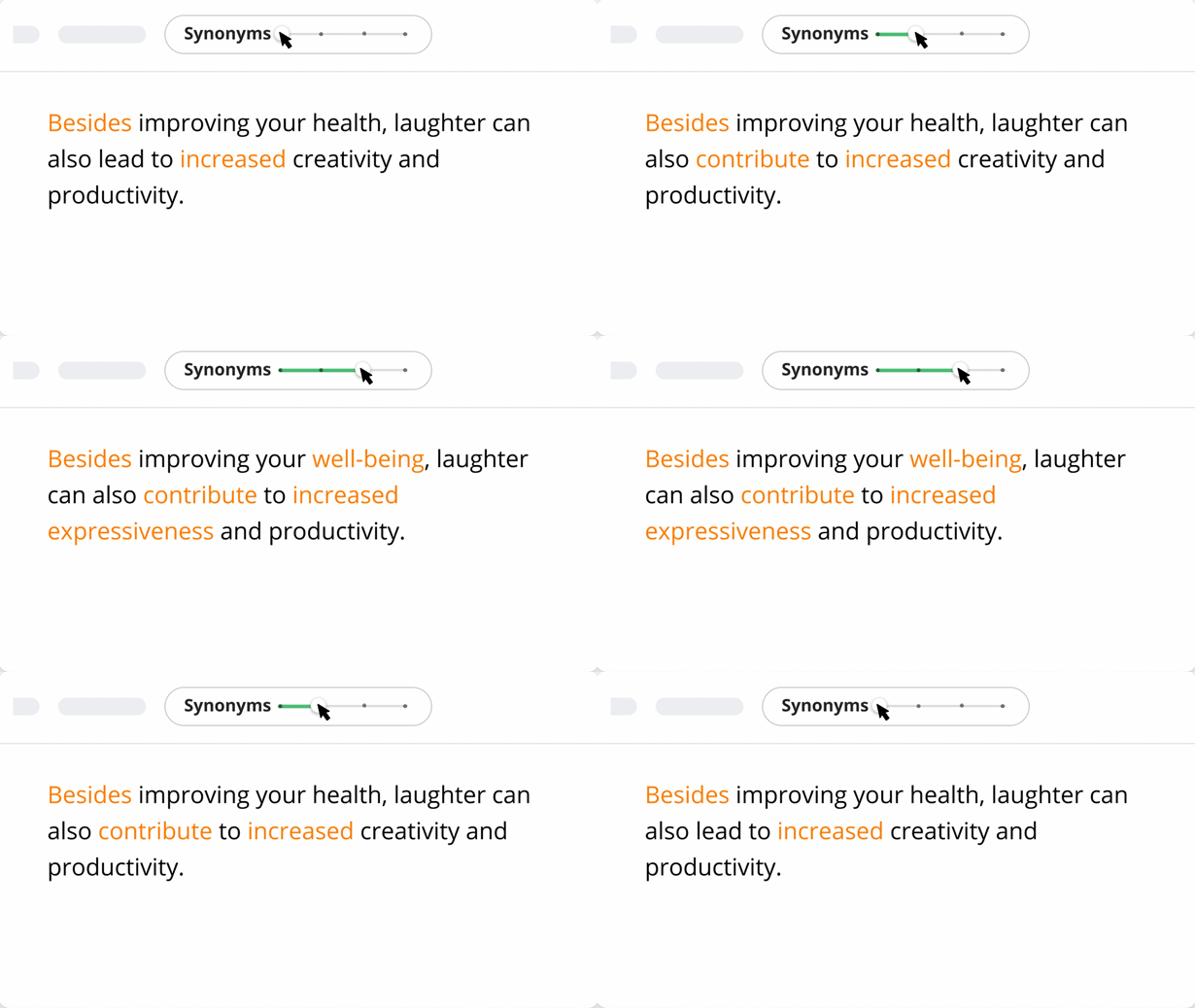
Second, again, I’m having a hard time coming up with legitimate use cases that aren’t just shortcuts to avoid thinking. I use a grammar checker that makes style suggestions—more on that momentarily—but it doesn’t wholesale rewrite for me. Instead, it highlights choices that I can make as a knowledge worker. Quillbot calls itself a “paraphraser.” (Side note: Judging from the text on both sites, I’m guessing that “paraphrase” may be a good SEO term for both products.) Maybe there are some legitimate uses for a tool that can quickly paraphrase a longer document. If I write a follow-up post to this one, I may try using it on a previous post to see if anything useful comes out.
Then there are grammar checkers, which are mentioned but—again—never explored in “Does AI Spell the End of Education?” I use Grammarly Premium regularly. In fact, I am using it right now. It helps me catch mistakes and write clearer, punchier prose. Even though I am a pretty good writer, Grammarly improves almost everything I write (when I use it). But it is only useful to me because I know when—and why—I should ignore or overrule its suggestions. If I were to ask students in a writing class to use it, I would have to teach them to do the same. The problem is that I don’t know how Grammarly works. I can’t teach students how to anticipate all the mistakes it might make.
This is particularly true with students who have language patterns that Grammarly might not anticipate. For example, second-language learners whose native language is Chinese or Russian may write English sentences that drop certain types of words (like articles or pronouns), mix up verb tenses, mess up idiomatic expressions, and change the word order. And even fluent second-language learners may make mistakes that the grammar checker won’t diagnose correctly when the writers are stressed, such as when they are trying to express difficult ideas while writing under time pressure. In combination, these problems could confuse a grammar checker and cause it to make a bad suggestion.
As a result, I would have to think hard about whether, when, and how to use Grammarly as a teaching tool, even if I believed it would help most students improve their writing the majority of the time. As a writing teacher, my job isn’t to get students to produce better writing. It’s to teach them how to be better writers. As a writer, while I use Grammarly to help me edit my text more quickly and effectively, I also use it to help me make mindful decisions about when to break the rules. Good writers balance clarity against expressiveness all the time. Sometimes I override Grammarly not because its suggestion is wrong but because I have chosen to write a more challenging sentence to read to communicate a challenging idea more effectively.
I would have liked to read a researched article on this topic. I suspect John Ross could have written it. Journobot 2000 cannot.
The bottom line
The future of work is knowledge work. Knowledge work and learning are the same. Therefore, if we want to prepare students for the future of work, we need to teach them how to think and learn. Cheating is behavior intended to achieve a passing grade without learning. Cheating is bad because it leaves students ill-prepared for the future of work (not to mention for life). Tools or strategies that help knowledge workers (including students) avoid mindless work are probably good more often than not. Tools or strategies that help knowledge workers avoid thought work are probably bad. More often than not.
“Does AI Spell the End of Education?” raised (but did not explore) authentic assessment as one way out of the cheating problem. While I’m a fan of authentic assessment, the article itself is proof that it is not a panacea. Because it is, in fact, an authentic assessment of John Ross’s writing. As a writing portfolio artifact, the piece shows that the author could pass, i.e., get his article published, without learning anything new about the promise and perils of AI in education.
Many decent educators have faced the challenge of trying to break students out of algorithmic behaviors that have enabled them to pass without learning, whether the behavior is writing a robotic five-paragraph essay or memorizing physics equations without understanding them. If cheating is the set of behaviors designed to succeed without learning, then these behaviors, which have been taught to students as perfectly appropriate, are cheating just as much as copying somebody else’s answer is. It matters in the classroom, it matters in the workplace, it matters in the home, and it matters in the ballot booth. I hope the next article I read about AI and cheating will be about applying AI to solve that problem.
There has been a lot of interest in Tuesday’s guest post by Steve Lattanzio from MetaMetrics on an alternate approach to college rankings that relies on algorithmic analysis of thousands of variables from the College Scorecard instead of typical cherry-picking of variables and subjective analysis. There have been some good questions posted on social media and blog comments asking for more information on the algorithms or assumptions behind the algorithms.
While we linked to a corresponding article with more results and more detail on the methodology, we should have made that link more obvious. That article gives a much deeper description of the assumptions and methods used, including references to assumptions behind the theory and underpinnings of the approach. We have updated the Tuesday post with a direct link and include links in this postscript.
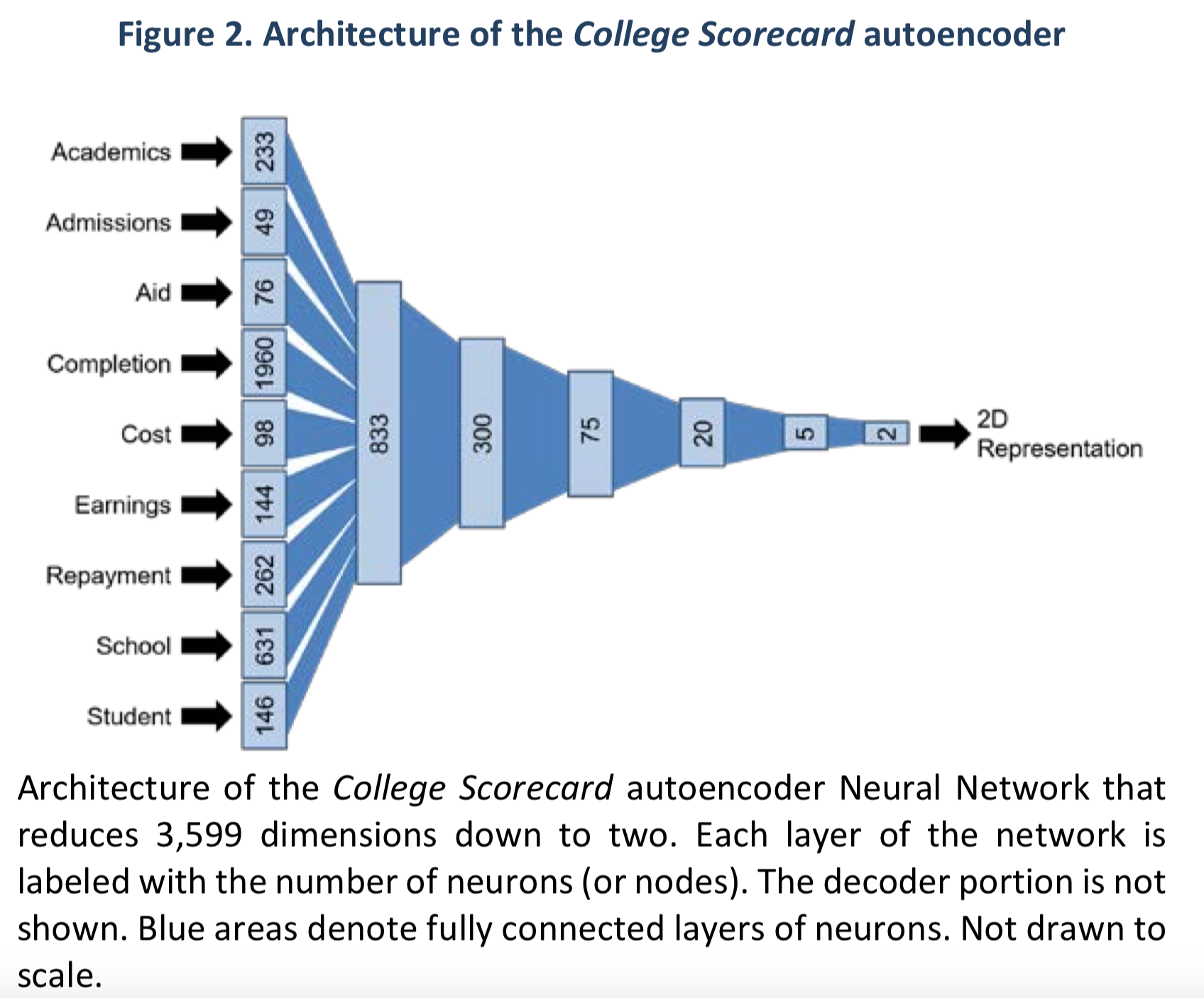
The solution that we propose is to use neural networks to perform representational learning on the data. In other words, instead of manually going through the dataset and engineering a handful of features, we propose to use neural networks to automatically encode (autoencode) the information, including information about where data are missing, in a smaller dimensional space. Similar to principal components analysis (PCA), auto-encoding via neural networks is a dimension-reducing technique, but is more apt at handling variables that are nonlinearly related. In fact, it could be thought of as a more generalized version of PCA. Of course, such compression is lossy, but much of the information lost will be uninteresting noise and redundancies.
The approach breaks up the 3,599 variables into a discrete number of categories, which then goes through successive layers of the neural network to generate a 2D representation.
I won’t pretend to answer all questions by this summary, but instead I want to point out the source for describing this additional detail.
Through all of this discussion, I want to remind readers that Steve in the original post was quite deliberate about what is not being claimed by this research.
Out of an abundance of concern that the results of this experiment would be misrepresented, we’ll immediately point out that we make no claim that the rankings in this piece are the proper method for ranking these institutions, and we caution anyone from thinking of them as such.
The real goal is further described in the New School article’s concluding paragraph:
The methodology described in this paper and the pedagogical use-cases provide a rich framework for advanced analytics of post-secondary education—something that the consequence of the industry and the unwieldiness of the data demands. It is our hope that a future proliferation of similar work will promote further transparency in the post-secondary school market, more holistic approaches to data use, and ultimately more complete, fairer, and objective metrics that empower students to make the best decisions.
This post is from guest contributor Steve Lattanzio from MetaMetrics. While we do not tend to cover college rankings at e-Literate, we do care about transparency in usage of data as well as understanding opportunities where technology and data might inform students, faculty, administrators and the general educational community. The following post is an interesting exploration in the usage of the full set of College Scorecard data in a way that is understandable and usable. For people wanting a deeper description of the algorithms and assumptions, please see this corresponding article. For access to an interactive table to explore results, see this post.- ed
Emphasis on might.
Ranking colleges has become a bit of a national pastime. There are many organizations that publish “overall” rankings for our institutions of higher education (such as Forbes, Niche, Times Higher Education, and US News & World Report), each with their own methodologies.
We don’t typically get the complete and precise picture of how these rankings are constructed. The common assertion by critics is that these methodologies, which are definitely subjective, are also quite arbitrary. They may seem complex, often relying on many different variables, but at the end of the day experts and other higher education authorities are making a set of choices about what data should be used and how to weigh those variables. What if those experts were just tweaking what variables to include and how to weigh them until they got results that “feel right” or meet some other criteria they had in mind? Some methodologies go a bit further and outright include human judgments, sounding the fudge-factor alarm. Furthermore, there is reason to be concerned about the fact that none of these rankings exist in a vacuum—it’s very possible that they are, to some extent, reflections of each other (see “herding” in the polling industry). At the same time and counter to herding, there’s a desire to provide a unique twist to rankings which leads to a lack of consensus about what the underlying construct should be behind overall college rankings.
Against this backdrop, we now have access to ever-increasing amounts of data about our colleges. Newly released datasets like the College Scorecard present a vast trove of data to the public, enabling all sorts of new analytics. But while this provides an apparently more objective foundation for analysis, leveraging all of the data can be challenging.
This led MetaMetrics to consider whether we could apply some more current machine learning methods to overcome these issues, the type of methods that we employ everyday in our K-12 research. Was it possible to have a computer algorithm take in a bunch of raw data and, through a sufficiently black-box approach, remove decision points that allow ratings to become subjective? Forgive me the gratuitous use of such a buzzword, but could an artificial intelligence discover a latent dimension hidden behind all the noise that was driving data points such as SAT scores, admission rates, earnings, loan repayment rates, and a thousand other things, instead of combining just a few of them in a subjective fashion?
Out of an abundance of concern that the results of this experiment would be misrepresented, we’ll immediately point out that we make no claim that the rankings in this piece are the proper method for ranking these institutions, and we caution anyone from thinking of them as such. It is merely an alternative that we present that might be similar enough to other rankings to validate them, or different enough to invalidate them or this ranking. It is also possible that ranking colleges is an exercise in futility.
The data
Choosing a college is likely to be one of the most consequential decisions, financially and otherwise, of a postsecondary education consumer’s life. In an attempt to bring transparency to higher education and empower young Americans to make a more informed choice, the Obama administration created the College Scorecard in 2015.
The College Scorecard contains thousands of variables for thousands of schools going back almost two decades. It’s a great initiative that allows someone to look at all of the usual suspects, such as average SAT scores, along with very specific things, such as the “percent of not-first-generation students who transferred to a 4-year institution and were still enrolled within 2 years.” The catch, however, is that there is a lot of missing data and only a minority of the possible data elements actually exist. It’s fairly straightforward to search, filter, or sort by specific fields of information for specific schools, but it’s not really clear how you could utilize all of the data. Consequently, most analytic efforts with the College Scorecard are likely to gravitate towards the archetypal and complete variables you would find in a much less ambitious dataset anyway. Our goal is to take advantage of all of the data available in the College Scorecard.
The algorithm
Traditional statistical analyses work best with clean and complete data that have nice linear relationships. These analyses are also going to have trouble handling too many variables at once. But cleaning and curating specific variables in the dataset present more opportunities for humans to unduly (wittingly or not) impact the final results.
We also find ourselves lacking an independent variable to model. That is, we aren’t trying to predict one piece of data from a bunch of other data. We built an algorithm to find something not directly observable in the data that’s a driving force behind a lot of the directly observable things in the data. In machine learning, such a task is considered to be “unsupervised learning.”
To tackle this problem, we use neural networks1 to perform “representational learning” through the use of what is called a stacked autoencoder. I’ll skip over the technical details, but the concept behind representational learning is to take a bunch of information that is represented in a lot of variables, or dimensions, and represent as much of the original information as possible with a lot fewer dimensions. In a stacked neural network autoencoder, data entering into the network is squashed down into fewer and fewer dimensions on one side and squeezed through a bottleneck. On the other side of the network, that squashed information is unpacked in an attempt to reconstruct the original data. Naturally, information is lost during this process, but it’s lost in a deliberate fashion as the AI learns how it can combine the raw variables into new, more efficient, variables that it can push through a bottleneck consisting of fewer channels and still reconstruct as much of the original data as possible. To be clear, the AI isn’t figuring out which subset of variables it wants to keep and which it wants to discard; it is figuring out how to express as much of the original data as possible in brand new meta-variables that it is concocting by combining the original data in creative ways. As noise and redundancies are squeezed out over the many layers of the deep neural network, the hope is that a set of underlying dimensions – ones that represent the most important, overarching features of the data – emerge from the chaos, with one being a candidate for overall college quality.
The results
The nature and context of the representational learning problem dictates how far you can reasonably compress a dataset. In this case, it’s reasonable to compress to as few dimensions as possible where the meanings of the dimensions are still interpretable and we retain some amount of broad ability to reconstruct the original data.
It turns out that we were able to compress all of the information down to just two dimensions, and the significance of those two dimensions was immediately clear.
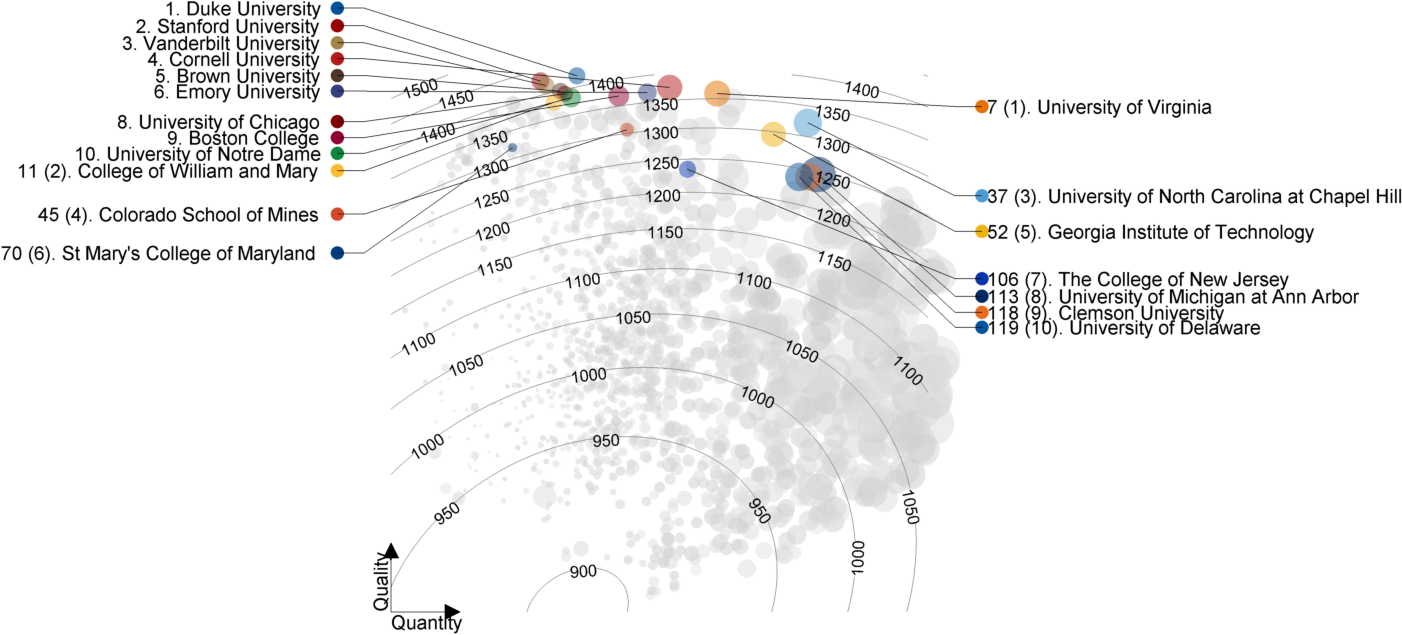
One dimension has encoded a latent dimension that is related to things such as the size of the school and whether it is public or private (in fact, the algorithm decided there should be a rift mostly separating larger public institutions from smaller schools). The other dimension is a strong candidate for overall quality of a school and is correlated with all of the standard indicators of quality. It seems as if the algorithm learned that for higher education, if you must break it down into two things, is best broken down into two dimensions that can loosely be described as quantity and quality.
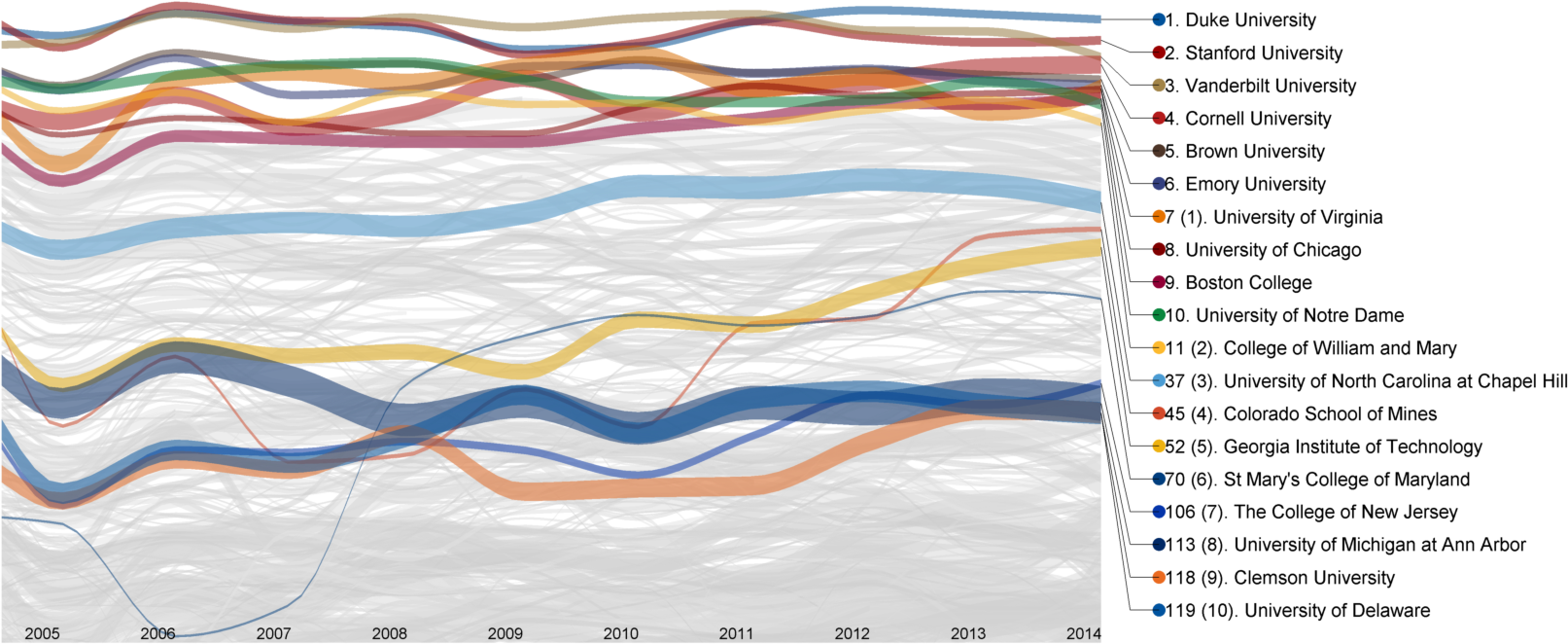
Below are the top 20 colleges according to the AI and the resultant two dimensions.
1.
Duke University
11.
College of William and Mary
2.
Stanford University
12.
University of Southern California
3.
Vanderbilt University
13.
Wesleyan University
4.
Cornell University
14.
Yale University
5.
Brown University
15.
Massachusetts Institute of Technology
6.
Emory University
16.
Northwestern University
7.
University of Virginia
17.
Bucknell University
8.
University of Chicago
18.
University of Pennsylvania
9.
Boston College
19.
Santa Clara University
10.
University of Notre Dame
20.
Carnegie Mellon University
Top 20 Colleges in the United States, according to our AI.2,3
College quality between 2005-2014 for the top 10 private and top 10 public schools as of 2014. The line thickness is proportional to the size of the student population.
College quality versus quantity for the top 10 private and top 10 public schools in 2014. Circle area is proportional to the size of the student population. Approximate SAT score contour lines are superimposed.
Most of the schools in the top 20 are present in the top 20 in at least one of the published rankings listed earlier. Seven schools—University of Virginia (7), Boston College (9), William and Mary (11), Wesleyan (13), Bucknell University (17), and Santa Clara University (19)—are the newcomers. Of those, the first four schools are reasonably close to being ranked in the top 20 in at least one other ranking, while the latter two are more surprising.
The most conspicuous name is 19th ranked Santa Clara University, a private school of about 5,000 undergraduate students located in Silicon Valley. It is typically ranked in the low 100s (the consensus still places it in the top 10% of all schools) with its best ranking of 64 by Forbes. However, it is impressing the AI and likely disproportionately benefits from a more holistic use of the data instead of using only the typical metrics used to differentiate top schools.
The most conspicuously missing names are the Ivy League schools Harvard (ranked 31st by the AI), Princeton (51), Dartmouth (23) and Columbia (26) along with Caltech (74) and Rice (25). It seems like blasphemy to rank Harvard and Princeton, arguably the most prestigious colleges in the United States, so far down. Caltech at 74 is probably the most jarring of all. However, we take this opportunity to remind you that the AI is not developing a metric strictly of prestige, reputation, the academic caliber of students, or earnings potential of its graduates, but something else that is different, but related.
Duke, Stanford, and Vanderbilt are at the top of the rankings and in any given year any one of them can take the top spot according to the AI. All three schools are often, if not always, ranked in the top 20 in other published rankings. Duke sometimes makes the top five while Stanford does so more often.
Although it goes against our human instincts, not too much weight should be given to the exact ranking of the top schools—relative to the variation in the rest of the field, the differences in quality are small and it’s very tight at the top.
The caveats and more
Throwing things through a black box is often a double-edged sword. You can avoid certain errors and biases that occur in human thinking, but algorithms often come with their own—or at least what we would consider—errors and biases. To an algorithm, data is data, and it’s all fair-game to use to meet some end. What if the neural network believes higher tuition rates, because they are associated with other favorable school characteristics, places a school higher on the dimension that encodes those things? A human would know that higher costs, without commensurate changes in other metrics, should count against a school. Sure, if corresponding quality was not reflected in other metrics, it’s likely the algorithm would mostly ignore the tuition data, but it might not actually lower the resulting quality output. That’s something humans bring to the table with their broad and vast real-world knowledge.
Even more concerning, what if it uses racial demographics to do the same? Unsurprisingly, an algorithm that’s agnostic to what data it is fed has the potential to be politically and socially insensitive. One may think the solution is to just curate what goes into the black box, but there are often proxies for the same information that the algorithm can exploit. This is a commonly cited, controversial hazard of black box machine learning algorithms that should always be kept in mind.
Additionally, these results are based on data aggregated across entire schools. Each student applying to or attending a school has a unique situation. There is much variation in a student population and the programs offered within a school. A single measure or ranking applied to a whole school does not tell you everything you need to know to make the best college decision, but it can provide some valuable context and some level of accountability for the schools themselves.
Of course, there is the axiom that an analysis can only be as good as the data, and while the AI should be relatively robust to sporadic random data errors, systematic errors are another story.
There are many more nuanced and technical caveats for this type of analysis. It is not perfect and the rankings should not be viewed as infallible. But when viewed among other college rankings, its validity is undeniable. It’s not merely a measure of prestige, and it addresses most of the concerns of critics of college rankings, while undoubtedly raising some new ones. However, the results somewhat “feel right.” The renowned “sabermetrician” Bill James was credited with saying, “If you have a metric that never matches up with the eye test, it’s probably wrong. And if it never surprises you, it’s probably useless. But if four out of five times it tells you what you know, and one of out five it surprises you, you might have something.’’ I think we might have something.
Whether you are researching schools to apply to, are curious about your own alma mater, or generally curious, full results can be found in an interactive table, along with other (possibly more useful and less controversial) results that are generated from this type of methodology (such as discovering “hidden” Ivy League schools, value-add metrics, and relatedness of schools).
Footnotes
We actually train an ensemble of neural networks and average for more reliable results.
These rankings are as of 2014, the last year of the College Scorecard that has sufficient data.
Wake Forest University is in the top 20 between the years 2004-2009, but has insufficient data afterwards.
Steve Lattanzio is a Research Engineer at MetaMetrics Inc., working in AI, machine learning, natural language processing, and data science. MetaMetrics is an education research company and are the developers of The Lexile® Framework for Reading and The Quantile® Framework for Mathematics.
Update 1/17: Fixed mistake on ranking of Dartmouth, Columbia, and Cal Tech in text description.
Update 1/19: Added direct link in introduction to article with more details.
It was two years ago, give or take a week, that the MOOC mania started. Think about the effects on higher education of this seminal event and how short a time it has been. In the past two years online education and ed tech have moved into the front pages, being discussed in the front pages of leading newspapers, popular media magazines, and in president’s cabinets and board meetings for most institutions. Previously, online education was discussed in small circles and specific contexts, but not as a dominant theme whenever higher education was the topic.
Below is a brief (and incomplete) timeline of the national media articles as MOOC mania started in August 2011. I have not included ed tech blogs in this list, but it is worth noting that George Siemens wrote about the new MOOC on August 4 – exactly two years ago.
July 17: Online Introduction to Artificial Intelligence – Stanford professor Sebastian Thrun uploads a video on Youtube announcing the Intro to Artificial Intelligence course he is teaching with Peter Norvig as open and online; 0 students enrolled.
August 2: Stanford U. Offers Free Online Course in Artificial Intelligence – Jie Jenny Zou writes an article in the Chronicle about the AI course, which is the first time I can find with the MOOC label applied to the course; 8,000 students asking for information, but official signup not yet started.
Last week, edX made a splashy spectacle of an announcement about automated essay grading, leaving educators fuming. Let’s rethink their claims.
“Give Professors a break,” the New York Times suggested in this joint press release from edX, Harvard, and MIT. The breathless story weaves a tale of robo-professors taking over the grading process, leaving professors free to kick back their feet and take a nap, and subsequently inviting universities, ever-focused on the bottom-line, to fire all the professors. If I had set out to write an article intentionally provoking fear, uncertainty, and doubt in the minds of teachers and writers, I don’t think I could have done any better than this piece.
Anyone who’s seen their claims published in science journalism knows that the popular claims bear only the foggiest resemblance to academic results. It’s unclear to me whether the misunderstanding is due to edX intentionally overselling their product for publicity, or if something got lost in translation while writing the story. Whatever the cause, the story was cocksure and forceful about auto-scoring’s role in shaping the future of education.
I was a participant in last year’s ASAP competition, which served as a benchmark for the industry; the primary result of this, aside from convincing me to found LightSIDE Labs, is that I get email; a lot of email. I’ve been told that automated essay grading is both the salvation of education and the downfall of modern society. Naturally, I have strong opinions about that, based both on my experience with developing the technology and participating in the contest, as well as in the conversations I’ve had since then.
Before we resign ourselves to burning the AI researchers at the stake, let’s step back for a minute and think about what the technology actually does. Below, I’ve tried to correct the most common fallacies I’ve seen coming both from articles like the edX piece, as well as the incendiary commentary that it provokes. (more…)