
e-Literate

Present is Prologue

Tag: Bridge

  • Instructure: Plans to expand beyond Canvas LMS into machine learning and AI

    Instructure: Plans to expand beyond Canvas LMS into machine learning and AI

    It’s common knowledge that Instructure has shifted its focus to place more emphasis on its growth in corporate learning markets than in the educational markets that have fueled the company growth to date. We covered the initial news about their introduction of the corporate learning LMS, Bridge, four years ago.

    While Instructure has excelled on maintaining product focus and simplicity of user experience, this move outside of education raises the question about whether they can maintain company focus. The corporate market is very different than the education market – different product needs, fragmented vendor market, different buying patterns. Many companies have tried to cross over between education and corporate learning, but most have failed. Blackboard, D2L and Moodle have made a footprint in the corporate space using one product for both markets. Instructure’s approach is different.

    As noted, the other Big Four LMS vendors are also targeting corporate learning (or professional ed, or workplace, pick your name). D2L and Blackboard are using the same platforms in both markets (Brightspace for D2L, Learn and Open LMS for Blackboard), while Moodle released Workplace, a set of plugins on top of core Moodle. Instructure, however, has different products for educational and corporate markets.

    That is old news. What is more interesting is to understand Instructure’s emerging strategy given the new executive team. Thanks to the nature of Instructure being a publicly-traded company, we are getting more insight that should set expectations for educational customers. As CEO Dan Goldsmith said during an investor conference a week ago:

    We really changed the company, as I came in nine months ago and then took over as CEO January 1st of this year. We’re initiating the second chapter in the journey of Instructure.

    I should first note that the audience for these calls is the investment community, so naturally Instructure executives focused more on financial performance and projections that they would in academic meetings. But there is a lot to learn here.

    In some ways, the changes to operations of Instructure are welcome and are already helping them manage corporate finances. In other ways, however, that second chapter reads a lot like Blackboard. Moving beyond the LMS, willing to bet on corporate acquisition, expecting big focus on data and analytics, and continuing challenges in completing products.

    Operational Improvements

    One of the ongoing criticisms of Instructure, particularly by their competitors, is that they continue to lose money and are buying growth. While these observations are accurate, as long as Instructure keeps growing, they have never been at risk of running out of money or having their losses significantly impact their operations. Under the new leadership, Instructure has been much more aggressive in managing expenses, with a big milestone described on the conference call by CFO Steve Kaminsky [emphasis added].

    Turning to the expense side. With our focus on operational excellence during the second half of 2018, we’ve changed the mindset of our leadership team and the entire organization about how we approach the business and fund investment. We focused on disciplined investments for balancing profitable growth has been put in place and is reflected in the outlook we provided today. On the cash side, we have a strong cash position to support our important strategic objectives for both Canvas and Bridge. And looking forward to 2019, we anticipate being approximately free cash flow neutral for the full year.

    Beyond simple finances, we have seen some operational changes for international operations as well. The global regions (EMEA, Latin America, APAC) all have more autonomy now, including control over country-specific marketing and product management. The non-US operations have moved beyond being regional sales and support offices into more aggressive engines of growth. In Europe and other regions, the management team has more autonomy is deciding which countries are worth investment for expanding markets, and when. From the Feb 25th investor presentation:
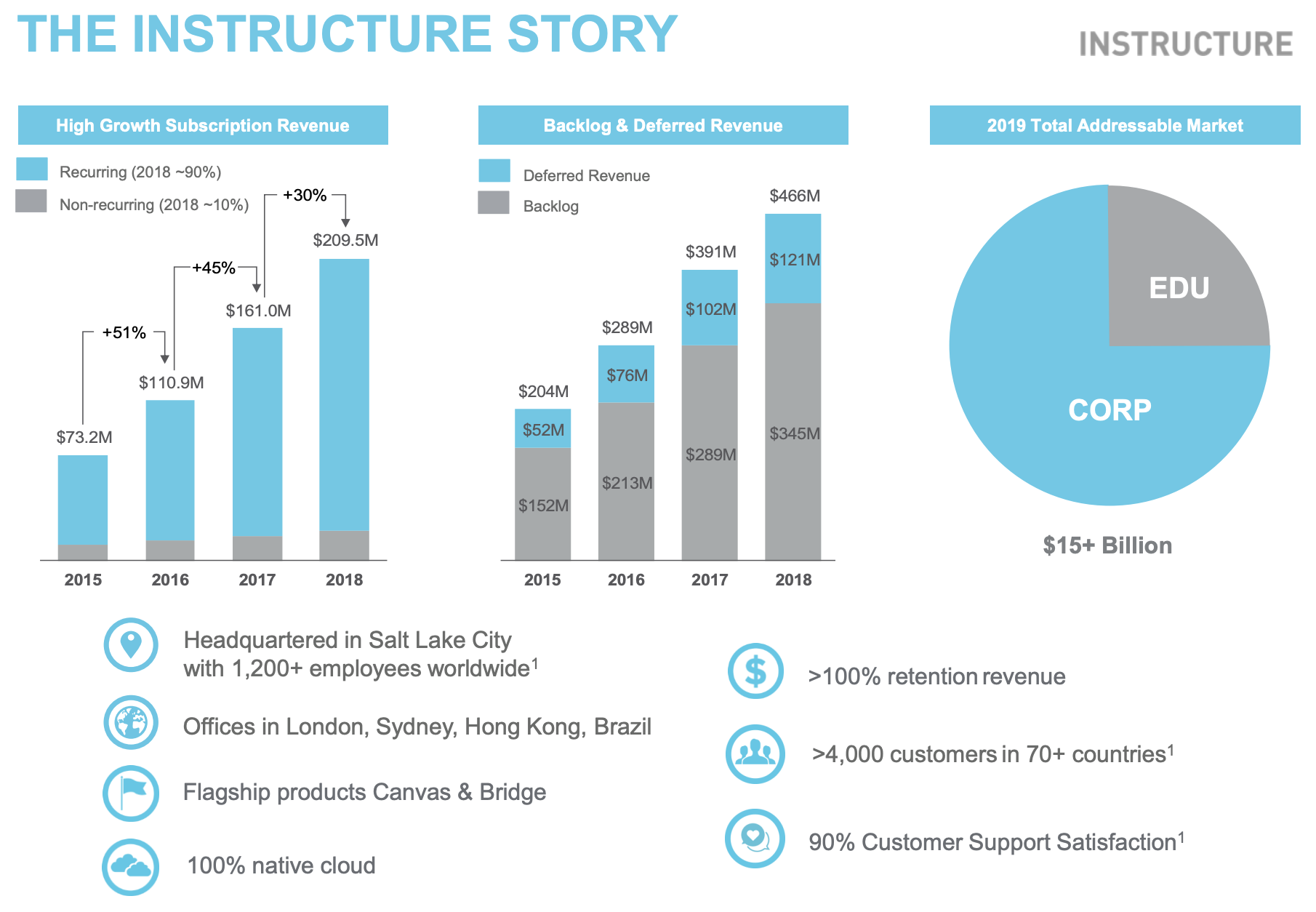
    The Instructure Story

    With the improving operations, Instructure has reduced their operating losses from 57% of revenue to 10% of revenue in the past three years.
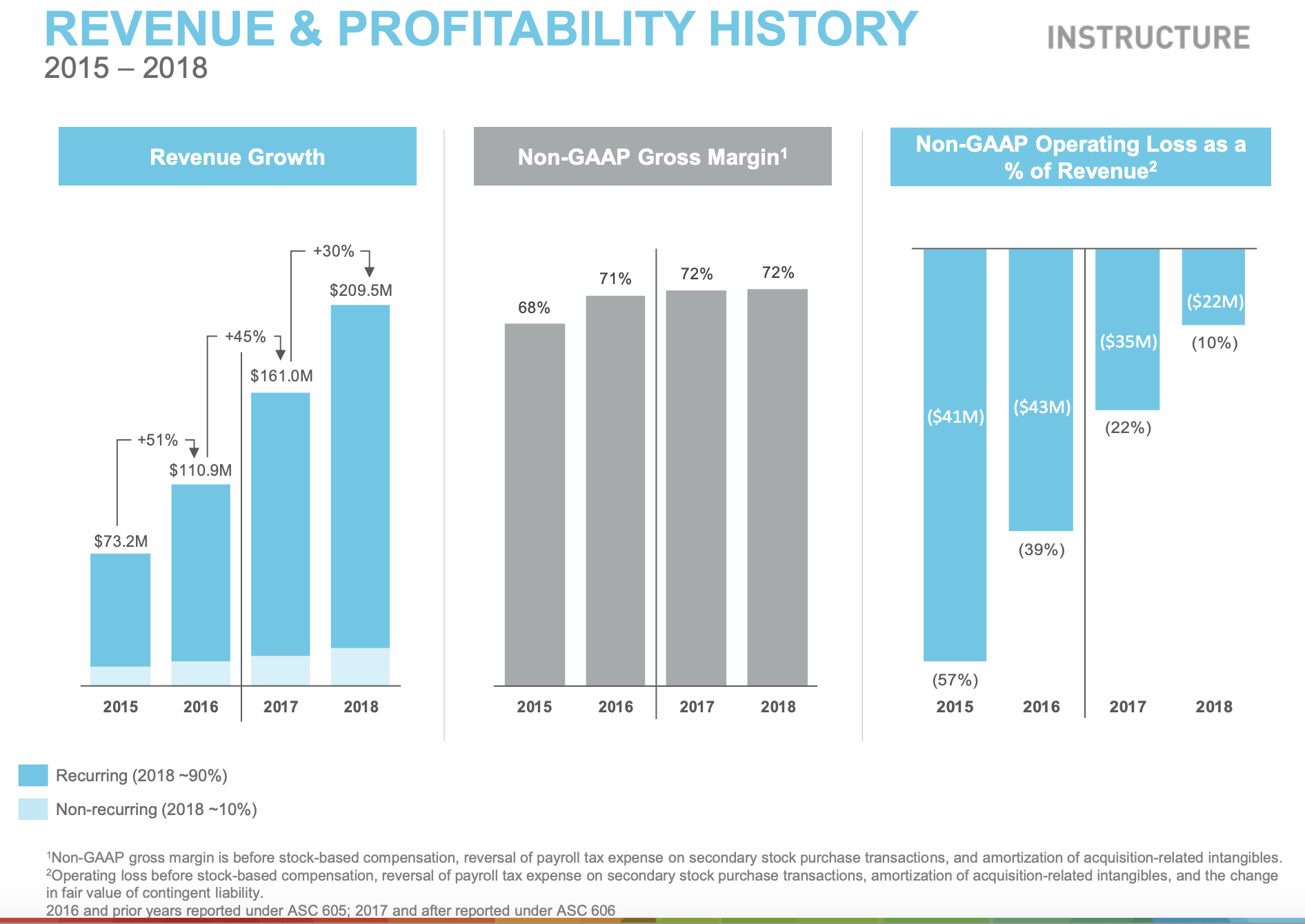
    Investor conference slide

    Moving Beyond the LMS

    On the same day as Instructure’s earnings call and release of FY2018 financial results, the company announced the acquisition of Portfolium for $43 million, a small startup focusing on “ePortfolio network, student-centered assessment, job matching capabilities, and academic and co-curricular pathways”. We interviewed Instructure staff the same day as the earnings call and noted a different message. In our initial call, the Portfolium acquisition was positioned primarily as a way to improve how Instructure can handle structured assessments in the education market – think CBE, mastery learning, with ePortfolios not as the goal but as the necessary infrastructure. During the earnings call, however, the positioning was more about bridging educational and corporate markets and expanding total addressable market (TAM).

    Today, we’ve taken a great stride towards enabling that transition with our expected acquisition of Portfolium, a successful long time Canvas partner. Portfolium vision is to help each person realize their full potential by connecting learning with opportunity, through e-portfolios, program and course level assessments, career pathways and by matching students to job opportunities. Portfolium will join Instructure with a wealth of shared customers, such as Virginia Tech, Santa Clara University and Swinburne University in Australia. This acquisition is a great match in vision and culture and represents our first major step into the Student Success market. And while Portfolium’s current offerings provide an excellent solution, more importantly, they establish the first Bridge between academia and the corporate world that aligns precisely with Instructure’s vision.

    Instructure now views itself as a company with a suite of products, and they are much more open to using corporate M&A to build this portfolio.

    Emphasis on Data & Analytics

    The second initiative announced on the earnings call was DIG, a strategic move with data and analytics.

    I am also pleased to share with you an early insight into our second growth initiative focused on analytics, data science and artificial intelligence. The code name for this initiative is DIG. And this technology platform combined with the most comprehensive SaaS database on the educational experience uniquely positions us to deliver meaningful value to our customers. And from a growth perspective, DIG has the potential to double our TAM in education.

    Instructure started ramping up their data and analytics efforts (again) about a year ago, although the focus was described at the time as being about internal analytics – that is, making Canvas a better and more valuable LMS product. From what I have heard the product validation for DIG are consistent with this message – dashboards, surfacing useful data within a workflow, etc. But that was not how DIG is being sold during the conference call [emphasis added].

    We’ve been working on the scaffolding for [DIG] for well over a year now. I mentioned in our remarks that we already have product validation towards out there in the market. We have instructors and students consuming output from some of the initial experiments with DIG. And we anticipate later this year obviously to make more announcements around specific products and offerings and how we bring them into the market. DIG ultimately is a platform first and foremost based upon machine learning and artificial intelligence. I believe that any multi tenant SaaS company born in the cloud has the opportunity once they hit a certain market share. And in fact, it may even be incumbent upon those organizations to partner with the industry and evolve that industry with new insights and predictive modeling using AI and ML. That’s what DIG is at its heart.

    This is brand new behavior for Instructure as a company. Previously the company was reticent to talk much about non-released products, but now they are talking not just about a new initiative, they are touting buzzwordy machine learning and artificial intelligence and predictive modeling well before any of those capabilities exist or are in customer hands. Goldsmith further clarified the DIG plans during the investor conference discussion [starting at 9:00, emphasis added].

    We already have analytical capabilities in our Canvas platform. I want to be really clear and delineate the difference between an analytics and reporting capability, and a machine learning and AI platform. [snip]

    We have the most comprehensive database on the educational experience in the globe. So given that information that we have, no one else has those data assets at their fingertips to be able to develop those algorithms and predictive models.

    Goldsmith then described an example of predicting a student’s expected performance in a class and how that prediction reliability goes up over time. Then we get the vision.

    What’s even more interesting and compelling is that we can take that information, correlate it across all sorts of universities, curricula, etc, and we can start making recommendations and suggestions to the student or instructor in how they can be more successful. Watch this video, read this passage, do problems 17-34 in this textbook, spend an extra two hours on this or that. When we drive student success, we impact things like retention, we impact the productivity of the teachers, and it’s a huge opportunity. That’s just one small example.

    Our DIG initiative, it is first and foremost a platform for ML and AI, and we will deliver and monetize it by offering different functional domains of predictive algorithms and insights. Maybe things like student success, retention, coaching and advising, career pathing, as well as a number of the other metrics that will help improve the value of an institution or connectivity across institutions. [snip]

    We’ve gone through enough cycles thus far to have demonstrable results around improving outcomes with students and improving student success. [snip] I hope to have something at least in beta by the end of this year.

    Wow. Robot tutor in the sky – meet the new kid on the block.

    The most generous interpretation I have is that they are being sloppy in their terminology and casually throwing out machine learning and AI to eager investors, while the reality could be more mundane but useful sharing of useful data to help instructors or administrators.

    If I had to guess, however, I would suggest that Instructure has its sights set on additional corporate acquisitions over the next year or two to try and back up these expectations. I hope they realize they are not the first company to believe that AI on top of their best-in-world data will deliver success for all.

    The message is also clear that Portfolium and DIG are intended to increase TAM. This means separate product categories with separate pricing in addition to Canvas. Either that or offering Canvas at different pricing levels to include add-on product bundles.

    Challenges in Completing Products

    We noted the modernization efforts behind Quizzes.Next, the next generation quizzing and test engine for Canvas, as well as the big schedule miss. In short, Quizzes.Next was announced at InstructureCon 2016 as being available within a few months. 12 months later at InstructureCon 2017 it entered limited beta, and at InstructureCon 2018 it entered general availability. But the story is not over. Quizzes.Next is still not at feature parity with the original quiz engine, as noted by Indiana University.

    Instructure has released a new quizzing tool for Canvas called Quizzes.Next. Quizzes.Next offers several new features and question types, but is missing many features from the current Quizzes tool on which many instructors depend. Both tools will continue to be available until Quizzes.Next has achieved feature parity with Canvas Quizzes. The original Canvas Quizzes tool will eventually be retired, but Instructure has not yet announced the timeline.

    If you read the Canvas Community page comparing features, it is clear that feature parity is not imminent. The transparency is impressive, however, and from what we are hearing customers are still giving Instructure some leeway because of trust. But Quizzes.Next and its delivery is a continuing problem, not least of which is the reduction in R&D spending growth for Canvas, described by CFO Steve Kaminsky on the call.

    Regarding the R&D investment, we don’t really break that out. But what we can tell you qualitatively is while we are doing some incremental investments on the Canvas side and DIG is a good example of that, the lion share of the growth in R&D is going into Bridge.

    What to Expect

    Instructure is at a crossroads. While they continue to grow, especially in education markets, and while they report improving financial performance, Instructure is entering uncharted territory (for them) in this second chapter. It is remarkable that they have not lost a major educational LMS customer in the 8+ years since Canvas was first selected by the Utah Education Network, but there are some warning signs that should not be ignored and some risky expectations being set.

  • Interview with CEO of Instructure on changes to executive team

    Interview with CEO of Instructure on changes to executive team

    Instructure is now a decade old as a company and faces a crucial test this year with recent changes to their executive management team and the need to scale both Canvas (academic LMS) and Bridge (corporate learning LMS). The long-time head of sales, Marc Maloy, and head of marketing, Misty Frost, left Instructure in the fall. The company eventually hired a new head of marketing, Bjorn Eriksson from the world of corporate HR, in January. After a months-long search, Instructure did not directly replace Marc with a new head of sales, but instead they hired a new president, Dan Goldsmith, who also has sales leaders reporting directly to him. With this move, Mitch Macfarlane, the long-time chief operating officer and former head of client services, will be leaving the company this summer. ((Disclosure: Instructure and D2L are subscribers to our LMS market analysis service and were sponsors at our recent Empirical Educator Project summit.))

    We’ve written about previous executive changes for Instructure – when their two founders left the company and when their CTO departed after just one year – but in each case the company managed the transitions and came out stronger in the end. As we have shared in our LMS Market Analysis service and on e-Literate, the Canvas track record is remarkable in terms of not losing customers and gaining new customers from most other LMS providers.

    But the executive changes over the past year come at a time when Instructure faces new challenges in product development and implementation support. At InstructureCon 2016, the company announced their next-generation quizzing platform, Quizzes.Next, stating that it would be “made available to you over the course of the next several months”. Last summer at InstructureCon 2017, Quizzes.Next entered a limited beta program, but the new set of tools is still not fully in production. To our knowledge, this might be the biggest product schedule miss in the company’s history, and it will be quite interesting to see what happens with this summer’s InstructureCon.

    In addition, we have had several people contact us privately, even before the most recent management change, telling us about a new level of frustration in implementation projects and product upgrades. None of the tales were extreme, but they were unusual for Canvas clients and in general spoke to distractions from staff and lack of clear answers and updates.

    The press release announcing the hiring of Dan Goldsmith included this description:

    With more than 20 years of experience in software and services, Goldsmith’s career is marked by directing high-performing global teams and achieving outstanding penetration and growth in challenging markets. Goldsmith spent the last eight years as a senior executive at Veeva Systems, a cloud-based software company, where he started and ran Veeva’s international business, led the company’s strategy in new markets and products, and most recently was responsible for Veeva’s global engagement and growth in strategic accounts.

    “It is an exciting time for Instructure. We are well positioned for success as we focus on the continued growth of Canvas, expansion of Bridge, and international execution,” said Josh Coates, CEO of Instructure. “Dan’s energy, creativity and proven track record in driving go-to-market strategies and rapidly scaling businesses make him a tremendous addition to Instructure at the perfect time to lead us through our next phase of growth.”

    Goldsmith was one of the first 50 employees at Veeva. He helped lead the company through a successful IPO and a growth path to a $10 billion market cap. Prior to Veeva, he worked in various executive positions at top companies, including Accenture, PwC and IBM. During his years in management consulting, Goldsmith led initiatives in global markets and developed new offerings. Goldsmith will have an immediate impact on Instructure’s strategy. His initial focus will be on market growth, with the sales leaders reporting directly to him.

    This was the setup for an interview that we had with Josh Coates, the CEO of Instructure, last week. Given our focus at e-Literate on education markets, we in particular wanted to ask about how the company is balancing the needs of Canvas and Bridge.

    Coates came prepared for the interview, and up front he made the point that the “vast majority of company resources” are allocated to the academic markets and that this is their foundational business. After we pointed out that the majority of discussions on quarterly earnings calls focus on Bridge, Coates noted that Wall Street is overly focused on corporate learning markets and unfortunately takes Canvas’ academic market performance for granted. He does not do so, but some of the investor community seems to.

    The primary selling points bringing Goldsmith to Instructure are that he helped Veeva grow into a $10 billion company, having joined as one of first ~40 employees, and that he specifically helped them grow international markets. According to Coates, Goldsmith spent his first three years opening up the Europe, Middle East, and Africa (EMEA) markets, and that yes, his international experience is a big reason for Instructure recruiting him.

    We have noted at e-Literate that Canvas really began international expansion just 3-4 years ago. According to our current data, Canvas leads in higher ed adoptions in Europe and Australia / New Zealand, but interestingly, D2L is beating Canvas in Latin America higher ed adoptions despite Instructure having a bigger investment in its regional office in São Paulo. At some point Canvas’ market share growth rate in North America will have to flatten out and international markets will naturally increase in importance for company finances. While market wins in Europe and Australia / New Zealand are impressive, Instructure will need more aggressive growth in other markets, and clearly Goldsmith is being tapped as a catalyst to increase sales overseas.

    We pointed out that Goldsmith had no education background and appears to be more closely aligned to corporate learning markets than higher ed or K-12 markets. Coates responded that Goldsmith has done quite well for himself at Veeva but is also passionate about education, as evidenced by his experience as the chair of the Montgomery School board of trustees. Coates acknowledged that this is not deep academic sector experience and that the company will need to give Goldsmith a big education on higher ed and K-12 markets. If we had a dollar for every time we heard of a rich dude who is passionate about education, well, we’d be rich dudes who are passionate about education. It is good to hear, however, the acknowledgement that the new executive brings rich software company scaling and international market growth experience but not domain knowledge of the academic markets for Canvas.

    We asked for an update on Quizzes.Next – when it will be generally available (GA) and whether the schedule challenges are related to the executive changes. Josh Coates assured me that no executives are working on the code, but Jared Stein, VP of higher ed product strategy, answered more directly.

    Quizzes.Next’s GA release is scheduled for Summer 2018. This is later than planned because we underestimated the complexity of building assessments entirely as a micro-service at the level of quality we set for ourselves and our users.

    The executive management team over the years has played a big role in establishing the company culture that is a large part of Instructure’s success. Now that the three M’s (Marc, Misty and Mitch) are out, the question is not whether the culture will change, but how. Coates’ acknowledges this reality and trusts that Instructure’s internal rudder is strong enough to keep the company on course.

    There are two company risks that stand out in trying to balance Canvas and Bridge. First is that complacency sets in not just with some in the investment community but with Instructure itself, and they begin to take their strong position in the academic market for granted. Second, and related, is that resources and talent end up flowing disproportionately to the corporate learning market given its increasing importance. These are risks to watch and not observations of actions, however, and Coates was emphatic that the academic market will always be the foundation of Instructure’s business. The corporate learning market is significantly larger than the academic market, however, and Coates estimated that in ten years or so, corporate will likely drive a larger portion of Instructure’s revenue.

    It should be noted that growth in corporate does not have to come at the expense of the academic market. It actually has the potential to strengthen product offerings in higher ed and K-12 as Instructure gains deeper insights into teaching and learning more broadly. There is also the potential for convergence, or at least cross-pollination, in these markets as the profile and needs of learners evolve.

    We’ll keep a close eye on academic LMS market trends in the coming months for signs of new developments. For the near term, at least, Instructure’s success is predicated on the continued success of Canvas in higher education and K-12 despite the quarterly investor calls skewing toward the corporate learning markets and new management hires with experience outside of the education sector.

  • Interview with Josh Coates, CEO of Instructure, on today’s IPO

    Instructure, maker of the Canvas (higher ed and K-12 markets) LMS and Bridge (corporate learning market) LMS, held their Initial Public Offering today. Prior to the IPO, Wall Street analysts focused on the company’s growth, its large losses, and the challenges of the education market. The company was priced on the lower end of its range ($16.00), and closed up 12.5% at $18.00.

    This IPO and its lead up have been highly watched, particularly given the rapid growth in ed tech investments and questions on whether there are real businesses to emerge based on the investments. I had the opportunity to interview CEO Josh Coates today. What follows is an edited version of the interview, focusing mostly on how Instructure’s IPO will impact education markets and existing customers. I tried to capture as much of the Q&A verbatim as was feasible, but treat the answers below as a paraphrase.

    Q. What are your impressions on how the IPO has gone so far?

    A. The market in general has been a blood bath [ed. Dow down 585, or 3.3%, for the week], but we’re doing well so far. Given market conditions right now, we’re pleased as punch. We priced in range [ed. $16 – $18], and the market responding well. We’re really focused as a company 6-12 months down the road, but it is nice to get this IPO feedback. (more…)

  • Instructure: Accelerating growth in 3 parallel markets

    I’m not sure which is more surprising – Instructure’s continued growth with no major hiccups or their competitors’ inability after a half-decade to understand and accept what is at its core a very simple strategy. Despite Canvas LMS winning far more new higher ed and K-12 customers than any other vendor, I still hear competitors claim that schools select Canvas due to rigged RFPs or being the shiny new tool despite having no depth or substance. When listening to the market, however, (institutions – including faculty, students, IT staff, academic technology staff, and admin), I hear the opposite. Canvas is winning LMS selections despite, not because of, RFP processes, and there are material and substantive reasons for this success.

    The only competitor I see that seems to understand the depth of the challenge they face is Blackboard. Other LMS solutions are adding “cloud” options or making incremental improvements to usability, but only Blackboard is going for wholesale changes to both its User Experience (UX) and cloud hosting architecture. Unfortunately, I question whether Blackboard will be able to execute this strategy, but that is a story for another post.

    Like last year’s post about InstructureCon, I believe that the company growth chart ((The chart shows the number of clients, which is essentially the number of contracts signed with institutions, school districts, or statewide systems adopting either Canvas or Bridge LMS products.)) gives a lot more information than just “gosh, we’re doing well”. (more…)

  • First View of Bridge: The new corporate LMS from Instructure

    Last week I covered the announcement from Instructure that they had raised another $40 million in venture funding and were expanding into the corporate learning market. Today I was able to see a demo of their new corporate LMS, Bridge. While Instructure has very deliberately designed a separate product from Canvas, their education-focused LMS, you can see the same philosophy of market strategy and product design embedded in the new system. In a nutshell, Bridge is designed to a simple, intuitive platform that moves control of the learning design away from central HR or IT control and closer to the end user.

    While our primary focus at e-Literate is on higher ed and even some K-12 learning, the development of professional development and corporate training markets are becoming more important even in the higher ed context. At the least, this is important for those who are tracking Instructure and how their company plans might affect the future of education platforms.

    The core message of Instructure regarding Bridge – just as with Canvas – is that it is focused on ease-of-use whereas the entrenched competition has fallen prey to feature bloat based on the edge cases. Despite this claim and despite Instructure’s track record with Canvas, what does this mean? I’m pretty sure every vendor out there claims ease-of-use whether or not there are elegant or terrible designs ((Although I would love to see the honest ad: “With a horrible, bloated user interface based on your 300-item RFP checklist!”)).

    Based on the demo, Bridge appears to define ease-of-use in three distinct areas – streamlined, clutter-free interface for learners, simple tools for content creation by business units, and simple tools for managing learners and content. (more…)

  • What TechCrunch Got Wrong (and Right) About Instructure Entering Corporate Learning Market

    After yesterday’s “sources say” report from TechCrunch about Instructure – maker of the Canvas LMS – raising a new round of financing and entering the corporate LMS space, Instructure changed plans and made their official announcement to today. The funding is to both expand the Canvas team and to establish the new corporate LMS team. I’m not a fan of media attempts to get a scoop based purely on rumors, and in this case TechCrunch got a few items wrong that are worth correcting.

    • Instructure raised $40 million in new financing (series E), not “between $50 to $70 million”. TechCrunch did hedge their bets with “low end of the range at over $40 million”.
    • The primary competition in the corporate LMS space is Saba, SumTotal, Skillsoft, Cornerstone – and not Blackboard.
    • The Canvas LMS was launched in 2010, not 2011. (OK, I’ll give them this one, as even Instructure seems to use the 2011 date).

    TechCrunch did get the overall story of fund-raising and new corporate product right, but these details matter.

    Instructure’s new product for the corporate learning market is called Bridge, with its web site here. This is an entirely new product, although it does share a similar product architecture as Canvas, the LMS designed for the education market (including being based on Ruby on Rails). Unlike Canvas, Bridge was designed mobile-first, with all mobile capabilities embedded in the product and not as separate applications. In an interview with Josh Coates, CEO of Instructure, he described their motivation for this new product.

    We like the idea of building software that helps people get smarter. Post education there is a void, with bad corporate software.

    (more…)