e-Literate

Present is Prologue

Tag: changing enrollment

  • The Catalysts for Competency-Based Learning and Prior Learning Assessments Have Arrived

    The Catalysts for Competency-Based Learning and Prior Learning Assessments Have Arrived

    As I outlined recently in my “e-Literate’s Changing Themes for Changing Times” post, I am shifting my coverage somewhat. I’ll be developing and calling out tags I use for these themes so that you can go to an archive page on each one. This one will be listed under the “changing enrollment” tag.

    Just before Christmas, The New York Times published an ostensibly feel-good story about a Syrian refugee who built a massively successful chocolate business in Canada. But the story buries the lede. The company’s CEO could have—and should have—been a doctor. He couldn’t get credit for his prior education in Syria. Canada is facing an acute healthcare crisis because of a shortage of skilled workers. Canada has figured out half the problem with the labor shortages that plague many industries there and here. They are welcoming immigrants willing to work hard and do the jobs. But they are missing the other half, enabling those immigrants, many of whom arrive with skills, to employ those skills where they are needed. This denial of economic opportunity causes a well-intentioned policy to fail to live up to its economic and humanitarian aspirations.

    Canada’s labor shortages are hardly unique, as anyone who has been paying attention to the US economy knows. We are suffering real economic pain from our inability to attract, train, and retain skilled workers in various industries. Worse, in this new era of economic, geopolitical, rapid technological advancement (e.g., ChatGPT) and climate volatility, we can expect the shifts in job markets to accelerate as supply chains get rewired, industries get disrupted, and reconfigured,

    Until recently, I have been a skeptic regarding Competency-Based Education (CBE) and Prior Learning Assessment (PLA) because I did not believe the economic drivers were present to force the massive reconfiguration of the higher education system. But situations change. Long-term economic forces will increasingly drive demand for more rapid reskilling than our current system can support. Meanwhile, a significant and growing percentage of U.S. colleges and universities face enrollment crises. While this problem is often framed by academia as a decrease in the supply of students—the so-called “enrollment cliff,” the hot job market, and so on—I think it is better understood as a failure to respond to changing demand and new opportunities. EdTech and venture investors have been arguing this for decades. I continue to believe that they were wrong. But, like I said, situations change.

    In this post, I will argue that now is the time for CBE and PLA at scale, using the Canadian healthcare labor market as the primary example. I will also make the case by focusing on skills mainly as an additive to the degree—the degree-plus-“skills” formula promoted by Coursera, boot camps and the like—institutions are missing opportunities. We will see that well-defined paths for pre-degree career credentials exist in critical industries. By neglecting these paths and leaving them to others, traditional higher education leaves itself vulnerable while failing to serve its mission to students and the public good.

    Willy Wonka could have invented the everlasting artificial heart

    Let’s return to our story about the Syrian refugee and his Canadian chocolate empire:

    Back in Syria, [Refugee Tareq] Hadhad’s father, Isam, had founded a confectioners in Damascus that eventually employed hundreds of people and shipped its chocolates throughout the Middle East. Bombing during the civil war leveled it.

    The Hadhads became privately sponsored refugees in Antigonish, Nova Scotia. While the town is the home of St. Francis Xavier University, it is generally known for having an aging population rather than being economically vibrant.

    Mr. Hadhad was midway through medical school when he fled Syria. But once in Canada, and with considerable help from the people of Antigonish, he vowed to re-establish his father’s business under the name Peace by Chocolate….

    This month, Mr. Hadhad opened a new, bigger shop and expanded the factory that produces the company’s chocolate. In all, Mr. Hadhad told me, Peace by Chocolate now employs about 75 people and could hire 30 to 40 more workers — if they were available in Antigonish. About 1,000 stores across Canada now sell its chocolates, thanks in part to a deal with the Empire Company, the Nova Scotia-based grocer that owns the Sobeys and Canada Safeway supermarket chains.

    The Syrian Family That Rebuilt a Chocolate Empire in Nova Scotia

    What an incredible story. Tucked in it is a comment about labor shortages, but given the aging population of Antigonish, that makes sense. Mr. Hadhad is doing precisely what the government of Canada and the people of Antigonish hoped he would do when they invited him and his family; create jobs that would attract more young workers. “Building a business in Canada, he said, is much easier in than in Syria,” he said.

    But.

    he was also keen to discuss what’s become something of a personal mission for him: eliminating barriers for newcomers and showing Canadians the economic value of immigrants.

    A former medical student, Mr. Hadhad is disturbed that many immigrants are unable to use their skills immediately when they come to Canada; instead, they often must undergo additional schooling, and face slow and costly certification processes.

    Mr. Hadhad was told that if he wanted to pursue his medical studies, he would have to return to high school, obtain a Canadian undergraduate degree and then take medical school admission exams.

    The Syrian Family That Rebuilt a Chocolate Empire in Nova Scotia

    Here’s a guy who was halfway through medical school when he arrived. He was told he would have to repeat all his education starting from high school to finish his degree and become a practicing physician.

    Let’s set aside the humanitarian aspect of this. Forget that most immigrants don’t arrive with the second set of skills Mr. Haddad had—running a chocolate business—or the confidence and support to reinvent themselves. Instead, let’s look at this purely from a policy perspective. Was Mr. Haddad’s career change a net gain or a net loss for Canada?

    About a month before The New York Times ran the chocolateer story, it ran another one with the headline, “Alleviating Canada’s Acute Shortage of Family Doctors“. According to that article, “Nova Scotia’s latest monthly tally, released in mid-October, showed that 110,640 people, or 11 percent of the population, were on the wait list for a family doctor.”

    Nova Scotia [is] not alone. The recently re-elected Coalition Avenir Québec government dropped its promise to ensure that everyone has a family doctor. More than 800,000 Quebecers are without one. In Ontario, the provincial advocacy group for family physicians estimates that 1.8 million residents do not have a family doctor and another 1.7 million people are under the care of physicians older than 65 who are nearing retirement.

    The desperation to secure a physician pushed Janet Mort in British Columbia to drastic measures. She took out an ad in a local newspaper in search of a physician to fill her 82-year-old husband’s prescriptions after his physician retired, as reported by Global News. Her strategy was successful.

    For others, the process to find a family doctor has meant working the phones to call individual clinics or to join growing provincial wait lists. Those who turn to the services of walk-in family doctors find longer wait room times and no continuity of care. And some people add to the congestion in overburdened hospital emergency departments.

    Alleviating Canada’s Acute Shortage of Family Doctors

    This is a many-faceted problem but one of the causes is that physicians are not trained in how to run a private practice as a business:

    [Katherine Stringer, the head of the Department of Family Medicine at Dalhousie University in Halifax,] acknowledged that while family doctors are in effect small business owners, the training they receive on how to run their business while in medical school is “very rudimentary.”

    As a result, Dr. Stringer said, for many new doctors “it’s a very stressful first year.” Emulating a strategy used for new technology companies, the medical school has brought in mentors to help new doctors find their way. Dalhousie is also working with the province on establishing teams to set up all of the patient record compiling needed for a new practice.

    Alleviating Canada’s Acute Shortage of Family Doctors

    Guess which could-have-been-a-doctor has proven he has prodigious business-building skills? While I believe in the healing power of chocolate, I suspect that the 110,640 people waiting to get a primary care physician would have preferred another option.
    Nor is primary care the only area where Nova Scotia’s health system suffers from a labor crisis. A quick search on the topic yields disturbing results. A Nova Scotia woman died on New Year’s eve while waiting for care in an emergency room. The same article notes that emergency room deaths are rising in the province while 43,000 people left Nova Scotia emergency rooms without being seen by a doctor last year.

    It gets worse. One hospital closed its emergency room for a month and is not sure if it will be able to run a full emergency room in the future.

    There are, of course, many reasons for Canada’s healthcare crisis. Cost-cutting measures and (often related) rise in time-consuming paperwork are significant drivers. But telling eager, trained physicians that they will have to repeat their education, starting in high school, does not help.

    Responding more nimbly to labor market changes

    The obvious solution, of course, is to test the immigrant healthcare workers on what they know and train them to fill the gaps. Canada is aware of this possibility. For example, The Globe and Mail reports Ontario is implementing a “Practice-Ready Assessment” program that “could add hundreds of foreign-trained doctors to the overstretched health care system within months.” The same article states, “Some estimates put the number of foreign-trained physicians living in Ontario but not working in their field as high as 13,000. They are blocked by licensing hurdles and other barriers because their medical training was done elsewhere.”

    Thirteen-thousand foreign-trained physicians are theoretically available to an overstretched system but have been blocked from practicing because they have not been given a chance to prove what they know. Ontario is one of just three Canadian provinces that are taking this approach so far. And they haven’t implemented it yet. A quick internet search will show similar mismatches with skilled nurses. Like a story in The New York Times from a few months ago entitled “‘Disaster Mode’: Emergency Rooms Across Canada Close Amid Crisis.” From the article: “Increasingly, I think many of us realize we are not going to, in the short term, train our way out of this…. We can’t produce nurses quickly, with the exception, possibly, of some foreign graduates.”

    Meanwhile, here in the United States, we find another labor mismatch crisis hidden in a feel-good story. New York City is addressing equity and climate change goals by training low-income workers to service modern electrical systems like heat pumps and electric vehicle charging stations. Here’s the story of one apprentice, Robert Clark:

    Before joining, he struggled to find work, in part because of a felony conviction for burglary. “It’s a no-brainer,” he said of joining the Civilian Climate Corps, which pays him $20 per hour to learn skills and receive the certifications that he needs to get work. He hopes to go back to school to become an engineer.

    Green energy has a problem: There aren’t enough electricians. Here’s one solution.

    Did you catch that last sentence? Mr. Clark wants to go back to school to become an engineer.

    There’s only one problem. New York City’s Civilian Climate Corps is a collaboration between the municipal government and employers. No colleges or universities are mentioned in the article or on the organization’s website. When Mr. Clark is ready to go back to college and become an engineer, will he get credit for the knowledge and skills he has learned through the program? As of today, I see no evidence of any pathway to do so. New York City has a robust collection of community colleges within the CUNY system. Why are they not involved? If Mr. Clark had completed his apprenticeship in a CUNY-affiliated program and received CUNY credit, it would be natural for him to return to CUNY someday to get his engineering degree. As it stands today, CUNY means nothing to him, and his knowledge means nothing to CUNY.

    We need to be able to meet students where they are and get them where they need to go. “Meeting students where they are” is often a euphemism for talking about skill deficits. There is so much more than deficits to “where students are,” including pre-existing skills. Today, we are seeing alternative skills networks being built around the edges of academia, particularly in credentialed trades like electricians and allied healthcare. Becoming certified in medical billing in the United States does not require a degree and can lead to earning a decent living. It’s an example of a relatively quick path to financial sustainability. I’m unsure whether similar pathways exist in Canada, where the medical paperwork processing explosion seems to be a newer phenomenon. Economies and job markets change.

    Meanwhile, people continue to aspire. Mr. Clark wants to go “back to school” to become an engineer. Nobody has told him that, as far as the system is concerned, he never went to school. Until academia better integrates itself into this network of ever-shifting needs and skill gaps, it will continue to face shrinking enrollments and dwindling relevance.

    To truly meet students where they are and get them to where they want to go, we need to assess what they already know on a granular level, give them credit for it, and help them fill in any gaps on an equally granular level. The knowledge Mr. Roberts gains working on heat pumps and electric car chargers will likely not line up neatly with traditional college course curricula. Mr. Hadhad may also have skill gaps that do not line up neatly with the courses he would have needed to take to become a Canadian physician. (For example, he would have no reason to know basic details about how the Canadian healthcare system works.) Both came from backgrounds where becoming an income earner quickly was a high priority. Both have highly valued skills that the workforce needs.

    Perhaps one day, Mr. Roberts could someday create a breakthrough in heat pump efficiency or electric car charging speeds. If so, I imagine two likely paths for him to learn the skills he will need to make that contribution to society. Either he will go to college, or he will learn what he needs on the job.

    In general, employers do not make good educators. If employer training becomes the dominant path, it will be a narrow and inefficient one. Some institution is needed to fill the educational role. Colleges and universities could provide this role while weaving career paths through the traditional liberal arts education that has served humanity so well for so long. But only if they build the pathways to accommodate these continuous and granular needs. If they don’t, then somebody else will.

    While we’re not going to be taking a deep dive into these issues, the webinar I’ll be facilitating this week will provide some basic groundwork for understanding CBE.

    It’s next Wednesday, January 18th, at 1 PM EST.
    Register here.

  • Coursera is Evolving into a Third-Wave EdTech Company

    Coursera is Evolving into a Third-Wave EdTech Company

    As I outlined recently in my “e-Literate’s Changing Themes for Changing Times” post, I am shifting my coverage somewhat. I’ll be developing and calling out tags I use for these themes so that you can go to an archive page on each one. This one will be listed under the “changing enrollment” and “third-wave EdTech” tags.

    Phil Hill recently tweeted out two slides from Coursera’s quarterly conference call. They made me sit up straight. Then they made me read the transcript from the call.

    I haven’t been paying enough attention. Having watched the rise of the MOOCs closely and having watched 2U/EdX chase EdX’s inspiration and rival, I assumed I understood Coursera as well.

    I was wrong. Coursera is evolving into a different and much more interesting company that is well-positioned to take advantage of the tectonic shifts I’m tracking.

    Coursera as a marketplace

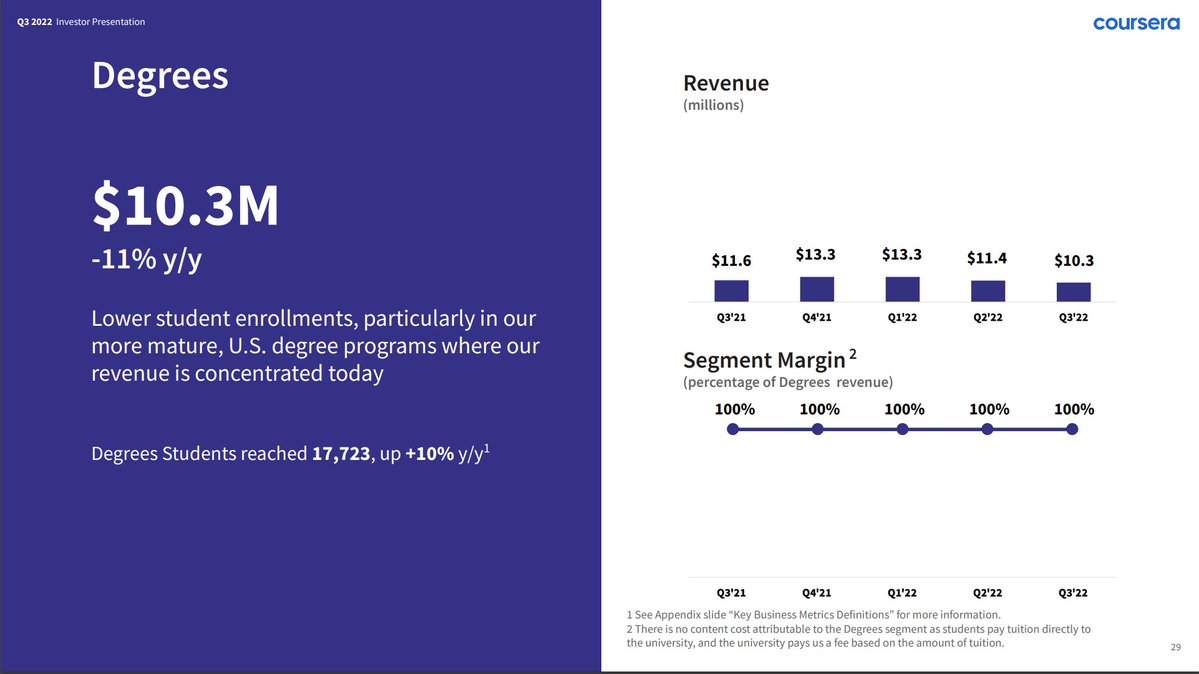
    One of the two slides Phil shared out was further confirmation of a trend that everyone in higher education has already been struggling with:

    Coursera, like US higher education institutions, has seen a decline in degree program enrollments. This seems like a significant drop relative to the drop across degree programs as a whole, particularly against primarily degree-granting institutions, which have fared better than their on-campus counterparts. So it’s curious.

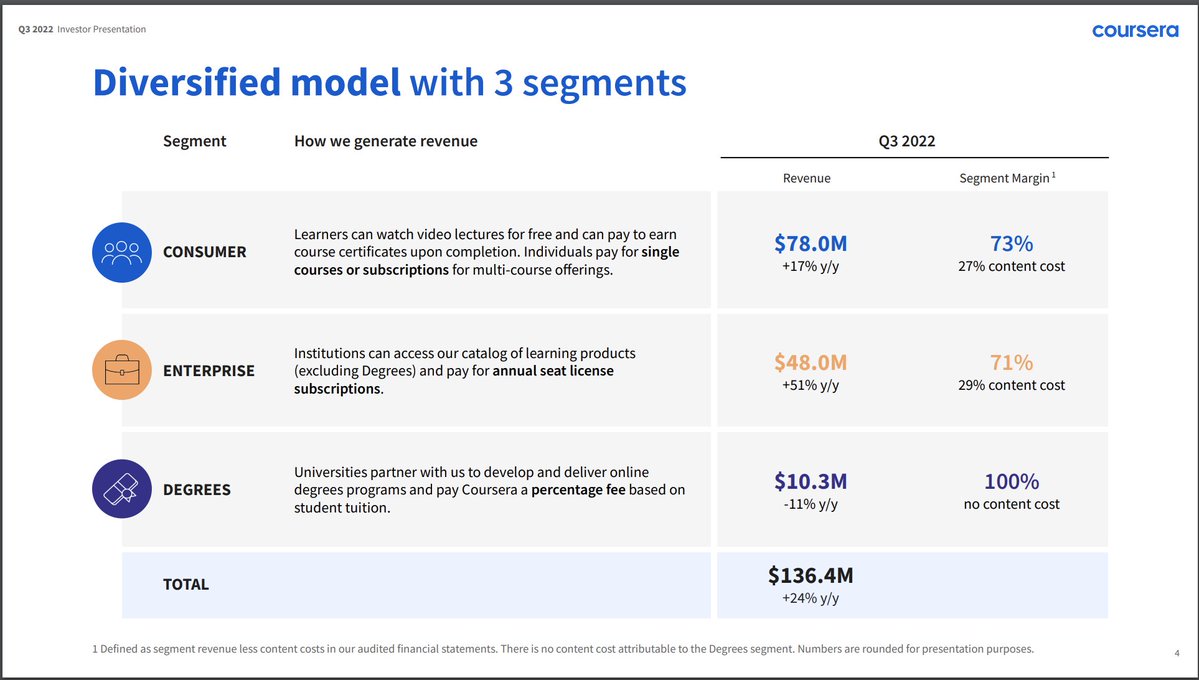
    But this is the slide that attracted my full attention:

    The point of this slide is to show the diversification of Coursera’s business. Degree programs may be down, but enterprise licenses and direct-to-consumer certificates are up. But it also indicates Coursera’s ability to diversify revenue streams for its university content providers. The enterprise business provides a distribution channel between universities and employers. From what I can tell, it’s a Guild competitor, even though the two companies look very different on the surface. The consumer segment started as the MOOC business and has expanded into the “tweener” space between courses and degrees: certificates, microdegrees, whatever.

    On the surface, it may appear that Coursera and 2U/EdX are evolving toward each other, with Coursera having grown out its degree programs and 2U acquiring EdX to get into Coursera’s MOOC space. In reality, 2U/EdX is moving much more toward Coursera than the converse. And it’s easy to see why if we look at the economics of their original models.

    2U historically made its money by helping premium-brand universities bring expensive graduate degree programs online. And they famously succeeded in attracting multiple premium university brands to offer the same degree through them by showing that, historically speaking, geographic brand reach is smaller than you might think. Students in the Northeast United States have been much more likely to apply for degrees from Harvard, Yale, or Princeton than from Stanford or even Duke, even if the degree programs are all online. The same is even more true, a notch or two down the reputation scale, where institutions may have strong regional brands but are not even broadly recognized nationally.

    Roughly about the same time that it became apparent that the growth of expensive online graduate degree programs would inevitably slow—there’s only so much demand in the world for $40,000 MSW degrees—2U got into the short course business. And then the BootCamp business. And then they bought EdX. But, as I have written about in the past, 2U has tended to publicly imply that its “free to degree” product range is a sales funnel. Of course they’re interested in diversifying their revenue. But outwardly, at least, the mindset has appeared to be that of a diversifying OPM.

    In contrast, Coursera has always thought of itself as a two-sided market. For those unfamiliar with the term, a two-sided market is one where the company’s primary business is to connect buyers with sellers. Amazon, Etsy, Airbnb, and Uber are all examples of this sort of business. Yes, they were attached in the early days to selling a particular form of MOOC as an individual product, much as Amazon only sold books in the early days. Much of the attention during the early years of MOOCs was on the pedagogical model of the MOOC itself, which is not very effective, and on the MOOC course delivery platforms, which directly translated lecture-model courses into an infinite lecture hall, with some relatively modest technological improvements. The innovation that got the least attention at the time was Coursera’s nature as a two-sided market. I remember talking to Daphne Koller about this circa 2014 (in front of one of those ridiculous fountains in the Swan and Dolphin Hotel at a Sloan-C conference).

    I’m not sure that EdX ever fully grasped the implications of the two-sided market model. 2U might; it’s hard to tell right now. The company’s in-process rebranding is confusing and their clearest marketing point so far has been that MOOCs lower the advertising costs for degree programs. Coursera, on the other hand, understood the business model implications early on, one of which is that two-sided markets tend to produce one big winner in any given space. Who is the second-largest competitor to Amazon? Walmart? Wayfair? The distributed network of stores that Shopify powers? I don’t know. The answer isn’t obvious. It’s not like Coke and Pepsi.

    Multi-sided platforms have unusual characteristics.

    A market is a platform

    We often use the term “platform” in tech conversations to narrowly mean the features and architecture of a kind of software. A platform is distinguished from an application in the sense that a platform encourages people to build other things on top of it. Mapping software that can only provide directions is an application. If the same software can be integrated into search and discovery applications like Yelp is a platform. In hardware, a flip phone is a device. An iPhone is a platform.

    But platforms can enable building more than just software extensions. When Phil Hill and I worked together at MindWires, the company was heavily involved with helping the 114-campus California Community College System onto one common LMS instance. ((Phil and some MindWires teammates did the lion’s share of the work, although I got to write a white paper for the state legislature, which was fun.)) The point wasn’t just to get everybody using the same LMS but rather to use that common base to build up a course exchange that would enable campuses to help each other with over- and under-subscribed courses as while enabling students to take courses that they need to graduate but that are oversubscribed on their own campuses:

    (Shameless plug: The webinar I’ll be facilitating about university/workplace partnerships for OpenLMS on Thursday, November 2nd at 1 PM ET will include a similar story about how a common LMS adoption facilitated teacher support and recertification amidst a state-wide teacher shortage.)

    With these examples in mind, I found the following anecdote from Coursera CEO Jeff Maggioncalda to be very interesting:

    In July, I highlighted the recent partnership with Louisiana Tech University and the University of Louisiana Systems. Our initial partnership with Louisiana Tech started as a social impact initiative with the office of student financial assistance via the Louisiana Board of Regions. [sic]

    It was designed to provide low-income high school students and graduates access to Coursera’s entry-level Professional Certificates from Google in order to prepare them for college or to begin a digital career. This was followed by Louisiana Tech summer programming series open to faculty and staff that is banded to include professional development opportunities for employees across all campuses within the University of Louisiana Systems.

    Now the Louisiana Workforce Commission, a state agency responsible for enhancing workforce growth and well-paying jobs for Louisiana residents, is partnered with Coursera to launch Tech Ready Louisiana, a statewide workforce development initiative providing training to thousands of Louisiana.

    The centerpiece of the program is Career Academy, as our entry-level professional professor certificates were specifically designed to prepare workers without a college degree or prior work experience. Using Career Academy, Louisianians can explore careers develop key skills and competencies, build a portfolio of hands-on projects using actual workplace tools and earn industry-recognized credentials.

    And many of these credentials have ACE Credit Recommendations, which make it easier for learners to earn credit towards a local or online degree program when they’re ready to continue their education.

    Finally, in recognition of the connectivity challenges that present a real barrier today, the Workforce Commission is making reliable Internet access at nearly 60 sites across the state for learners to complete their Coursera courses.

    Traditional university degree programs and workforce development initiatives often lack a solid connection to today’s in-demand jobs and are often not equipped to adapt to the fast-changing skilled landscape and evolving employer expectations.

    By leveraging Coursera, an entire system of higher education in coordination with government institutions can foster stronger collaboration with industry by unlocking new development opportunities for students, faculty and staff by diversifying and expanding talent pipelines for employers and by building a more competitive workforce.

    This is the vision of Coursera’s three-sided platform at scale, connecting learners, educators and institutions in a global learning ecosystem designed to keep pace with our rapidly changing world.

    Coursera Q3 2022 Earnings Call

    Notice he calls it a three-sided platform, although I count more than three sides here. The Coursera platform, writ large, connects universities, learners, government agencies, megacorporations, and local employers. It helps open up new opportunities for universities to reach students without falling afoul of the “dialing for dollars” problem that plagued for-profit universities and create ethical and legal complexities for OPMs.

    A multi-sided market also offers some benefits to the educational mission relative to other models. If, for example, you’re an OPM that has heavily subsidized the creation of a degree program in exchange for a share of the revenues for ten years, then you need to make sure your up-front investment pays off. This is true of any business that invests up-front in building products, including textbook publishers. In a multi-sided market, depending on how the compensation is set up, the marketplace owner shouldn’t care much about whether the company sells 100,000 units of one product or 1,000 units each of 100 products. For education, some programs are essential for students, local economies, and important business niches, even if they don’t require a lot of trained individuals. So a well-functioning multi-sided market should, all else being equal, offer more educational opportunities within a scalable model.

    (Side note: Somebody other than me should write an analysis the strategies and pricing for 2U/EdX, Coursera, Guild, and other evolving university sales channels.)

    Coursera sees evolution ahead

    Maggioncalda also had an interesting question on the inevitable future-of-the-college-degree question:

    I’m in Bangalore right now and I spent the last 10 days here in India. There is a demand — the government is trying to shoot gross enrollment ratio up to 50% by 2035.

    They need 3.3 million more professors to serve 35 million more students. And so a lot of the demographics that folks are seeing in the U.S. is not consistent with what some of the demographic trends are in other parts of the world. And we are seeing college degrees globally be as revered as they have been historically.

    So when we look at this on a global basis, I think a lot of it is going to be driven by demographic trends. I think that especially when you have rising middle classes, with a real premium on education, you’re going to see — we’re going to see a lot of demand for this. So we’re very bullish on the future value of a college degree.

    Another thing is colleges are not sitting still. I don’t know, there might have been five or six examples in the scripts about universities putting Career Academy literally into their curriculum, so that when someone graduates, they don’t just have a degree, they’ve got a degree and an industry certificate.

    I think a lot of people think of college degrees as this static thing that’s not going to change. But really, the competition among job seekers is going to be those who have maybe micro credentials and those who have college degree and micro credentials. So I think it’s going to almost always be worth it.

    And on the affordability side, we see affordability really being driven by technology and, frankly, competition. So I think degrees are going to come down in price. They’re going to be a lot more job relevant, they’ll be much more broadly available and especially because they’re online, open up to the working adult population, which is a much, much bigger market than just young people who are between the ages of 18 and 24.

    So we’re still very bullish on the long-term opportunity for degrees.

    Coursera Q3 2022 Earnings Call

    This answer hits many of the themes in e-Literate’s Changing Themes for Changing Times: rising economic value of the post-traditional student, merging of traditional and post-traditional student preferences, lifelong education, and regional maturation of education markets around the globe. (The company’s international story is interesting enough that it merits its own post.)

    Coursera is moving in the direction of becoming a uniquely horizontal EdTech company, not because of its MOOC pedagogical model but because of how it has leveraged the reach of the initial MOOC growth to become a successful multi-sided market. They haven’t completed this transition yet. But if they pull it off, they could become the first hyper-scaled EdTech company on the planet.

    But what about…you know…learning?

    I’ve come to realize that I don’t have a clear sense of how much the Coursera pedagogical platform has evolved in the way I do with EdX. Nor have I seen much in the way of efficacy research coming out of the company (or out of its university partners but publicized by the company). I’m skeptical about the platform. Once you’ve baked a particular set of assumptions into your platform design (e.g., video lectures plus assessments as a primary learning mode), it’s hard to change those later. But since I haven’t meaningfully explored that platform in years—I don’t count a couple of random, poorly designed MOOCs that I never completed over the years—I am making a conscious decision to set aside previous assumptions and acknowledge that I don’t know much about its current state. The same can be said for its underlying data architecture, suitability for research, and actual efficacy research being conducted. I haven’t personally seen evidence of significant progress on any of these fronts. But as the saying goes, absence of evidence is not evidence of absence.

    One of the tricky aspects about evaluating Coursera is that it isn’t just a multi-sided market (like Teachers Pay Teachers) or just a learning platform (like an enterprise-licensed LMS). It’s a fusion of both. It’s a compound, complex platform. Its marketplace can reach and connect many different stakeholders. Buyers, sellers, and enablers. Is their content production, delivery, and analytics platform equally able to serve these disparate learning needs and contexts? That’s a vastly more complicated feat to pull off than it sounds.

    From an economic perspective, Coursera is clearly evolving from a second-wave to a third-wave EdTech company. They’ve gone beyond direct-to-consumer and are demonstrating what it looks like to design a company for an environment of increasingly global, lifelong, and universal education. I have less clarity about whether their core teaching and learning capabilities are up to the task. But despite the hit their stock has taken in the current market, they may be the best-positioned player to crack that code.

  • If You Were Designing Cal State Today: A Proposal Out of MIT

    If You Were Designing Cal State Today: A Proposal Out of MIT

    As I outlined recently in my “e-Literate’s Changing Themes for Changing Times” post, I am shifting my coverage somewhat. I’ll be developing and calling out tags I use for these themes so that you can go to an archive page on each one. This one will be listed under the “changing enrollment”, “future of academic work” and “third-wave EdTech” tags.

    I recently ran across a white paper called Ideas for an Affordable New Educational Institution out of MIT’s J-WEL center. While the paper contains no groundbreaking new ideas, the gestalt of it is interesting and timely. My first thought after reading it was, “If I were designing the Cal State system in 2022, starting with a blank sheet of paper, this paper would be one decent blueprint to start from.” That kind of practical synthesis is valuable and, sadly, under-rewarded.

    And as it turns out, I know and respect one of the authors. My call with him confirmed my sense that this paper is worth writing about.

    The context of the paper

    It’s often hard to know where these sorts of papers are coming from—and what they might lead to—without additional context. J-WEL is one of many funded centers at MIT. To what extent is the university’s leadership aware of the paper? What are the odds that MIT might act on the recommendations? What are the motivations of the authors? What do they think or hope to accomplish?

    Through a quirk of fate, I am fortunate to know one of the five professors from different disciplines who are listed as the paper’s authors. S. P. Kothari was a Professor of Accounting at the University of Rochester during my brief stint as an English graduate student there. I helped him with a couple of writing projects as a way to earn a little extra cash. He was unfailingly kind and always expressed gratitude that seemed out of proportion with the modest help I offered. Beyond that, two things stuck with me about S. P. First, he was interested in designing software to teach students accounting. This was back in the 1990s, so it was early for a professor outside of an education or computer science department to be thinking about such things. Second, while I knew nothing about his field, the clarity of thought in his academic writing and the celebrated status of some of his co-authors suggested to me that he was an up-and-comer.

    I was certainly right about his career prospects. He went on to chair MIT Sloan School’s Department of Economics, Finance and Accounting; then became Deputy Dean of the school; and eventually serve for three years as the Chief Economist for the Security and Exchange Commission of the United States before returning to MIT. Despite being at the top of his field,

    S. P. clearly never lost his passion as an educator. I gather the same is true for his co-authors. The group started its work with some funding from J-WEL and continued on a volunteer basis afterward because they all cared about the project. I did not get the impression from S. P. that MIT will be picking up this work. But the authors are still trying to bring attention to their proposal in the hopes that somebody will take it forward.

    That, then, provides the lens through which the paper should be examined. It is a passion project by highly accomplished scholars in diverse disciplines, none of which is education, and supported by some limited funding. Accordingly, I read it with the same spirit of generosity in which it has been offered. At the same time, it’s worth acknowledging that the document contains some tensions and elisions that are typical of such endeavors. The authors make clear that this paper isn’t a fully formed, shovel-ready proposal. Rather, it is a thought piece and discussion starter.

    The context of the need

    The authors state their rationale and goals up front:

    The conventional model of higher education is facing growing skepticism. With rising tuition costs, ballooning debt, and concerns about preparedness for the work force, many are doubting the value of higher education. Alternative credentials and online offerings are gaining currency.

    Viable solutions to these challenges will require abandoning some of our long-held assumptions about how institutions of higher education should operate. But our core educational values—that each learner deserves individual attention and encouragement, and that education should nourish the entire person and not simply provide short-term skills—must be preserved. So we reject solutions that involve replacing teachers by robots, taking all lessons online, or demoting the humanities.

    We describe an alternate model for baccalaureate education that offers key levers for addressing these challenges. We list the features of this hypothetical “New Educational Institution,” or NEI, below. NEI is intended to be a new class of institution that is different from traditional R1 or R2 research universities. The focus of NEI will be on majors such as computer science and business, and eventually, broader areas of engineering and design.

    Ideas for an Affordable New Educational Institution

    This proposal might be called radically conservative in the sense that it is intended to conserve the best parts of an American-style liberal arts education by re-imagining it but not rejecting it. It will take on the challenges of cost and career value without rejecting the value of liberal arts of human teachers.

    The authors confine the scope of their NEI to “eventually, broader areas of engineering and design.” In this respect, I think they may be too modest in their ambition. To understand the potential role this model could play, we need to review a little history.

    The 1960 California Master Plan—the template from which the modern US higher education system has been built—had a variety of limitations and trade-offs, but one of the most glaring from the very beginning was the lack of identity for the middle tier. California created three systems for higher education. On the bottom was the California Community College System. Any student anywhere in the state would be within easy commute of a college that could offer a two-year degree, an on-ramp to skilled work, and the ability to transfer credit to four-year institutions. Community colleges accept the top 100% of students who apply.

    The top tier, the University of California System, would comprise universities that offered advanced degrees and conduct significant research. These institutions would be selective and model themselves after prestigious private universities in their range of activities and emphasis on scholarship.

    In the middle was the California State University System. More selective than the community colleges but less selective than the UC universities, these were intended to be four-year universities for students who would benefit from a liberal arts education and perform skilled work but did not need the benefits of studying with top scholars in the field. To prevent Cal State from competing with UC, the former universities were not to offer graduate degrees (although that prohibition didn’t last long).

    The problem with this approach is that the United States lacked (and still lacks) a distinctive identity for a Cal State-style institution. Other countries have various interpretations of a vocational university with distinctive goals and personalities for students with certain types of life and career goals. In contrast, the Cal State system and the middle-tier colleges and universities in other states generally lack a distinctive purpose that drives a different approach. This lack of differentiation from their research-oriented cousines creates a few problems. First, the tiers became castes. State colleges and universities that lack the R1 or R2 Carnegie designation are not generally perceived as places students go to pursue different goals but rather as “lesser” versions of research universities. Colleges want to become universities and universities want to become research centers. Why? Because that’s where the money and prestige are. Everything from college rankings to funding flow from the implications of this classed system.

    It gets worse. Graduate students are encouraged to aspire to research while being taught nothing about teaching. And why not? Faculty generally advance in their careers based on their research, not their teaching. Meanwhile, because the middle-tier institutions are modeled after their R1 cousins, they make the same research demands on faculty and incur expenses for building out facilities that are not focused on creating well-educated citizens, successful professionals, and thoughtful human beings. Money that could be used to build better connections to employers, add more advisors, or cut tuition is instead spent on the same trappings as research universities.

    I’m not claiming that all mid-tier institutions are this way or that Cal State universities are this way. Rather, I’m suggesting that the design of the system, and particularly the lack of a distinctive and valued purpose and identity for mid-tier institutions, creates enormous pressure on these colleges and universities to engage in behaviors that tend to raise tuition while lowering teaching quality.

    Higher learning for the rest of us

    What if universities were places where you go to learn? What I mean is, what if there were universities that exist to be places where you go to learn stuff that you need or want to learn? What if that was their main purpose? Not to generate research. Not to be the place that coming-of-age movies are made about (although personal growth counts as “stuff you need to learn” and would not be ignored).

    Education would be cheaper. The report’s authors point out that “the actual cost of instruction amounts to less than a third of total expenditures for four-year colleges today.” Exactly how the money flows is…complicated. The authors use the example of regulatory costs for a research university with a hospital to illustrate expenses. Now, given that S. P. is a celebrated financial expert and I am not, I want to be careful with this next bit. The authors imply that this extra cost is cross-subsidized in tuition. I strongly suspect this is true in many cases. The literature I’ve found on the topic over the years is murky. And this itself is a problem.

    Clark Kerr, the architect of the aforementioned California Master Plan, also described the modern research university as “a multiversity” where comparison of costs across internal interest groups is discouraged. Kerr’s problem in 1960 wasn’t economic. The California State Legislature was in the mood to write big checks for education. His problem was political. He had to hold his coalition together. Infighting would not help. Which means that comparing how much money goes to one group over another was discouraged. That which doesn’t get measured doesn’t get managed. It’s likely that teaching in general and large lecture courses in particular cross-subsidize functions that don’t directly benefit undergraduates in many institutions. For some students, one could make an argument that being educated by leading researchers provides them with direct benefits. But others probably get little from it.

    And the truth is that many academics get little from it as well. If you’re not a star researcher, life as a young academic can be brutal. And if you care about your teaching more than your research, your career prospects will suffer.

    A good portion of the paper argues that all parties would be better off if professors were trained, supported, and rewarded for effective teaching of relevant (though not narrowly vocational) skills and tuition money were invested high-quality, well-trained, well-supported educators. It’s not a novel idea. Again, the value of this paper is not in its original approaches but rather in its synthesis of various well-established ideas into a coherent idea of college. The online, CBE-oriented mega-universities are one realization of this new balance. This paper offers a second, complementary vision. One that holds onto more of the residential liberal arts college tradition.

    What a Neo-Cal State would be like

    Regular e-Literate readers will be well familiar with most or all of the recommendations in the report:

    • Research requirements for professors should be de-emphasized and should focus on either applied research or research in the scholarship of teaching.
    • Multidisciplinary courses showcasing the practical value and contribution of the humanities would be the new core curriculum.
    • Deconstruction of degrees into stackable micro-credentials would enable students to get credit for progress and to move in and out of the workplace as needed.
      • An added benefit of stackable credentials is that each micro-credential could have more design coherence and value than a collection of individually chosen courses.
    • Active learning, with strong training and support for the faculty, should be the rule rather the exception.
    • All faculty would have status that is often referred to as “professor of practice,” meaning they have full employment status, promotion largely based on their teaching, and elimination of tenure/non-tenure distinctions (which is usually implemented as long-term contracts and participation in shared governance but no tenure).
    • Students would be encouraged to participate in co-ops, where full-time, paid jobs count toward their academic degree (and students may simultaneously take online courses).
    • The university shifts to a trimester schedule to more easily accommodate long internships.
    • Visiting faculty fellows augment the regular faculty to bring more research, innovation, and real-world experience into students’ academic work.
    • An active but balanced extra-curricular schedule is encouraged and supported.
    • Facilities are designed for use. The section on this topic doesn’t provide a lot of detail, but the reference to libraries, which have evolved from warehouses of paper books to collaboration spaces, is a give-away. S. P. mentioned to me verbally that more online education (presumably along with off-campus coops) will reduce the amount of physical plant investment the university will need to make. Taken together, we can imagine a campus that is the academic analogue of a WeWork facility.

    (I’ll address the use of EdTech separately in the next section.)

    Can you close your eyes and envision such an institution as a coherent and attractive mid-tier institution where you would be comfortable sending your own kid? I can. Many details are still missing, of course, which I’ll touch on in the last section of the post. But strikes me as coherent.

    Further, while the NEI envisioned by the paper out of MIT is most easily applied to engineering, design, and business, I’m not sure why it would need to be so narrow. The biggest challenge I can see is that they call for co-ops, which are hard to implement broadly. But if we add in multi-term project-based learning as an acceptable substitute, I think it could work broadly.

    Would it be a good education? The best longitudinal study of educational outcomes that I know of is the 2014 Gallup Purdue Index Report. It correlates aspects of students’ college experiences with the vast collection of employee research the company has conducted over many decades, looking at various dimensions of long-term well-being such as wealth, physical health, mental health, and social connections. Gallup collectively calls these measures “wellbeing.” The Gallup Purdue research correlated survey answers about various aspects of college life to various measures of success later in life. According to the study, students’ of thriving in all five areas of Gallup’s wellbeing index were

    • 1.7 times higher if “I had a mentor who encouraged me to pursue my goals and dreams”
    • 1.5 times higher if “I had at least one professor at [college] who made me excited about learning”
    • 1.7 times higher if “My professors at [college] cared about me as a person”
    • 1.5 times higher if “I had an internship or job that allowed me to apply what I was learning in the classroom”
    • 1.4 times higher if “I was extremely active in extracurricular activities and organizations while attending [college]”
    • 1.1 times higher if “I worked on a project that took a semester or more to complete”

    Tellingly, the researchers found no correlation between the type of university respondents attended and their likelihood to answer positively to the questions above. Selective institutions were no better (or worse) than non-selective ones. Large universities were no better (or worse) than small ones.

    The design of the NEI as described in the paper would optimize for every single one of these student experiences.

    EdTech

    Unsurprisingly, the part of the report which generated the most cognitive dissonance for me is the one I know the most about: EdTech. Overall, the paper is commendably broad in its survey of various strands of educational reform, given that it was written by a group of non-specialists mostly in their spare time. Which makes the technology section stand apart. It’s so very…MIT. Some years ago, the folks inside EdX began talking about “SPOCs”—small, private online classes. They invented a name for these classes, explicitly positioning them in relation to MOOCs and implicitly positioning them as if they were MIT investions. In fact, tradtional-sized online courses have been widespread for almost 30 years. Much of the innovation in the field has been at access-oriented colleges. As far as I have seen, MIT’s approach to this educational form hasn’t been particularly innovative—in fact, it has been retrograde in some ways—and its framing has been ahistorical.

    Whoever was briefing the paper’s authors on EdTech apparently never got outside that frame, because the EdTech section largely centered on converting MOOCs to SPOCs to digital textbooks for use in flipped classrooms. This blind spot had the side effect of also blotting out the history of digital curricular products that are actually designed for use in a classroom which, when designed for classroom use often look quite different than MOOCs and can be used in more rich and interesting ways. And finally, the often video lecture-intensive nature of many MOOC designs tends to undercut the overall tendency of the NEI’s design to break out of the “second-class citizen” status that today’s mid-tier universities suffer under. Having students watch regular video lectures from a “real” professor would tend to undercut the authority of the instructor in the room.

    That aside, the authors make a few astute observations about the promise and perils of the MIT-centric frame they work within. First, they note that disintermediating the textbook publishers—my phrase, not theirs—with university-created content can subsidize the continued investment by the universities creating the content. While the MOOC is not the right format for this model, a two-sided curricular materials market in which universities are both sides of the market absolutely is moving in the right direction.

    Second, they note that “a social contract [for the use of digital curricular materials] needs to be established at the beginning of the class. And during the course, the coaching and in-person elements must reinforce the back-and-forth between the online content and its absorption and application.” The broken social contract is a core problem with analog curricular materials as well. Students are asked to purchase an expensive 400-page book of which they will be asked to read perhaps 15%. But the professor assumes that the students didn’t read and therefore lectures on the topic of the reading. The students feel like they’ve wasted their time so they stop reading, leaving the professor with the (correct) sense that students don’t do their homework. “Social contract” is exactly the right term. The paper’s authors then point out that educators need to be trained in how to integrate these materials into the give-and-take with their students, which is true. But at its heart, the issue can be drawn from those top three effect sizes in the Gallup Purdue research: Students want to know their professors care about what they do, what they learn, and how (and who) they are.

    Finally, the authors talk about co-creation of curricular materials with the “SPOC” provider. They list a few benefits of the approach, but two I didn’t see are (1) infusing the teaching expertise of the NEI professors of practice into the curricular materials design, and (2) bringing both diversity and localization to the students’ curricular experiences. e-Literate followers will recognize both this co-creation function, the renewal of the social contract around homework, and the two-sided market as hallmarks of my recently deceased start-up, Argos Education.

    The paper leaves a lot more to be explored in the potential for technology to support what I’ll call “medium-residency” universities. While the envisioned NEIs aren’t quite low-residency programs like Goddard College (or no-residency online programs), the sense of campus community and the nature of student touchpoints changes in an environment where students are routinely off-site for long-duration co-ops and are routinely engaged in hybrid or online learning. This has far-reaching implications for how students are supported, how work is organized, and how technology enables these changes. But that’s another topic for another time.

    Who will do this?

    The authors of the papers were very clear that they had not created a business plan and are aware of numerous practical implications that were beyond the scope of this work. That’s fair. I’ll raise one practical concern at this stage.

    A major disadvantage of this approach relative to scaled online universities is the up-front cost. Regardless of any benefits in ongoing operating costs, the upfront costs of either building or radically rebuilding a physical campus are considerable. Further, if this is intended to be a model rather than a one-off demonstration, then somebody would need to take it on at scale.

    The obvious candidate is an existing state university system. That would require a legislature with foresight, unity, and budget, not to mention a faculty union ready to embrace the idea. It’s a big lift.

    In normal times, I would write this off as a good but impractical idea. These are not normal times. We are approaching a tipping point of punctuated equilibrium in higher education. It’s hard to know what will come next, except that it will be necessarily different from what’s come before. So now is the time to put all good ideas on the table. However improbably they may seem from the perspective of the world as we lived it yesterday.

  • Post-Traditional Students are the New Premium Students

    Post-Traditional Students are the New Premium Students

    As I outlined recently in my “e-Literate’s Changing Themes for Changing Times” post, I am shifting my coverage somewhat. I’ll be developing and calling out tags I use for these themes so that you can go to an archive page on each one. This one will be listed under the “changing-enrollment” and “future-of-academic-work” tags.

    Several articles caught my eye this week. Connecting the dots, I’m seeing two patterns emerging. First, post-traditional students being recruited aggressively by a surprisingly broad swath of colleges and universities. One could argue this trend started with the MOOCs and with OPMs like 2U moving upmarket, if you consider employed white-collar college graduates as post-traditional. This target group is now expanding to students who either didn’t complete their degrees or didn’t go to college at all. Meanwhile, early signs suggest that “traditional” college students are looking more like post-traditional students in that more of them are not willing or able to give up their work and home lives to spend four years immersed in a residential college experience.

    If these trends hold, then the universities that have been hailed for pioneering student success initiatives under the banner of equitable education will become models for a large portion of the market that hasn’t been as driven by equity but now needs to reach an keep students who maintain lives outside of college because they need those enrollments to survive.

    Enrollment shifts

    We’re still in the early days of “post-pandemic” higher education. ((I put “post-pandemic in scare quotes because, even though we’re pretending the pandemic is over, we don’t really know what will happen next with it.)) Enrollments have been down. Early reports suggest they are still dropping but at a slower rate. How much of that is due to the pandemic and financial hardships it caused? How much of it is because of the red hot economy? Or a combination of those two? For students who skipped college, how many of them will come back? To what degree is the demographic cliff starting to bite? How will a possible recession and escalating international tensions impact international student inflows? The combination of these questions guarantees that we will not get a simple or uniform answer as to what will happen next. Add in the fact that some of these factors are changing faster than the data are coming in, and we have a confusing picture.

    So I’ll start my analysis with “As the Pandemic Wanes, All Eyes Are on Enrollment” by Liam Knox and Sara Weissman at Inside Higher Ed. As expected, the data are confusing and preliminary, while the analysis necessarily includes a significant amount of guesswork. Institutions are announcing enrollment upswings before official numbers are out. Enrollments of black, first-generation, and low-income students are down overall, according to author Nathan Grawe . On the other hand, institutions that are primarily black- and Hispanic-serving saw a 9% increase in FAFSA applications. Terry Hartle, senior vice president of government relations and public affairs at the American Council on Education tells us that selective schools have done well, as have schools in states with growing populations.

    Pennsylvania State System of Higher Education Dan Greenstein is quoted as saying,

    There’s no way to fill that gap on the back of what I’m going to call traditional students, high school age[.]… And there’s no way to fill that gap on the back of students who can afford the relatively high price of higher education. You’ve got to figure out a way to open the aperture.

    Dan Greenstein, “As the Pandemic Wanes, All Eyes Are on Enrollment“

    Right. This is where we are headed. For a variety of short- and long-term reasons, recruitment of traditional students is no longer a complete path to financial stability. The quote above is from the chancellor of a state system that has been in academic crisis since before the pandemic. But very few institutions feel safe right now.

    Here’s another revealing quote:

    At William Paterson University in New Jersey, matriculation rates fell by over 10 percent this fall; meanwhile, enrollment in its online programs, collectively known as WP Online, grew by 57 percent.

    “Our online growth is good news and a testament to the quality and appeal of our offerings,” the university’s president, Richard Helldobler, wrote in a letter to faculty. “However, the full-time, main campus population is the biggest source of revenue, so reversing these declines is imperative.”

    “As the Pandemic Wanes, All Eyes Are on Enrollment“

    This university president is giving us a view into how leadership is thinking in some institutions. Online enrollment has grown by 57 percent for his university but the full-time, main campus population is the biggest source of revenue. Maybe this is a recruitment problem in the short term. But do we know if that shift to online is temporary? Maybe the real long-term solution is to switch up the revenue mix by leaning into the growth in online.

    Meanwhile, in a section titled “Private Colleges Branch Out to Stand Out,” the article tells us “A Pew Research Center analysis released this month noted that Hispanic enrollment more than doubled in the last two decades, growing from 1.5 million in 2000 to 3.8 million in 2019.” Many of them, interestingly, are going to public four-year institutions. But we also get this anecdote:

    Chris Domes, president of Neumann University, a small private Catholic institution in Pennsylvania, also believes his university was spared the declines faced by some other small private institutions thanks to its focus on underrepresented students.

    Enrollment at Neumann fell from 2,506 students to 2,212 last year, but it held steady this fall, and first-year enrollment rose 9.5 percent compared to last year. The majority of the freshman class, 63 percent, are first-generation college students. About 40 percent of the student body are students of color, and more than 40 percent are eligible for the Pell Grant.

    “We serve a big percentage of underserved populations,” Domes said. “The demographic shifts are primarily in white and wealthier communities … We feel the community we’re serving is another piece of headwind against the demographic shift, because those are not where the drops are.”

    “As the Pandemic Wanes, All Eyes Are on Enrollment“

    Here’s another university president telling us about his sustainability strategy. He is describing underserved populations not as an equity mission but as a sustainability opportunity. This doesn’t mean that the university only sees underserved students as revenue sources. Rather, it suggests that equity and sustainability goals are increasingly aligning for a broader range of institutions.

    Anyway, while the Inside Higher Ed article authors do a good job of trying to present chaos in an orderly, sense-making way, chaos is chaos. We don’t know where enrollments are actually headed. We know a little more about how the universities are reacting to the change. For the short-term, many of them are trying to improve their recruitment of whoever they traditionally have been able to recruit. But some are beginning to recognize that the pool they have been fishing in is too small and getting smaller. To thrive in the future, they will need to reach and serve different students.

    Online explodes

    Meanwhile, Campus Technology‘s Rhea Kelly reports that “Student preference for Online Learning [is] Up 220% Since Pre-Pandemic“. The headline comes from a 2022 EDUCAUSE servey. It’s a staggering number.

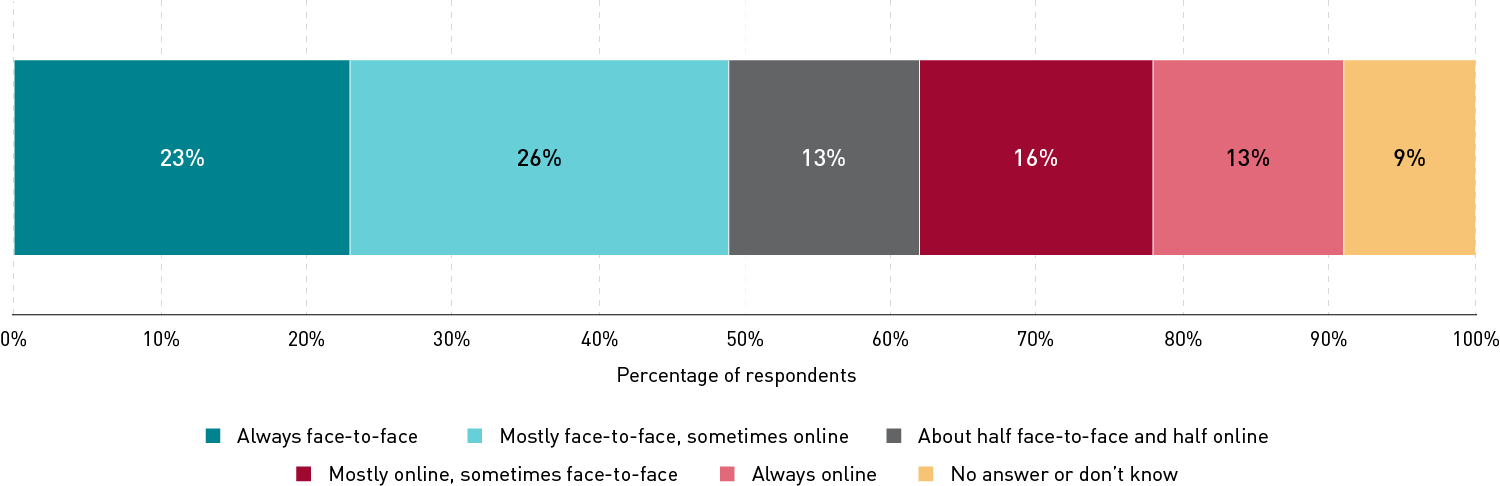
    Here’s how the preferences break out in 2022:

    “2022 Students and Technology Report: Rebalancing the Student Experience,” EDUCAUSE

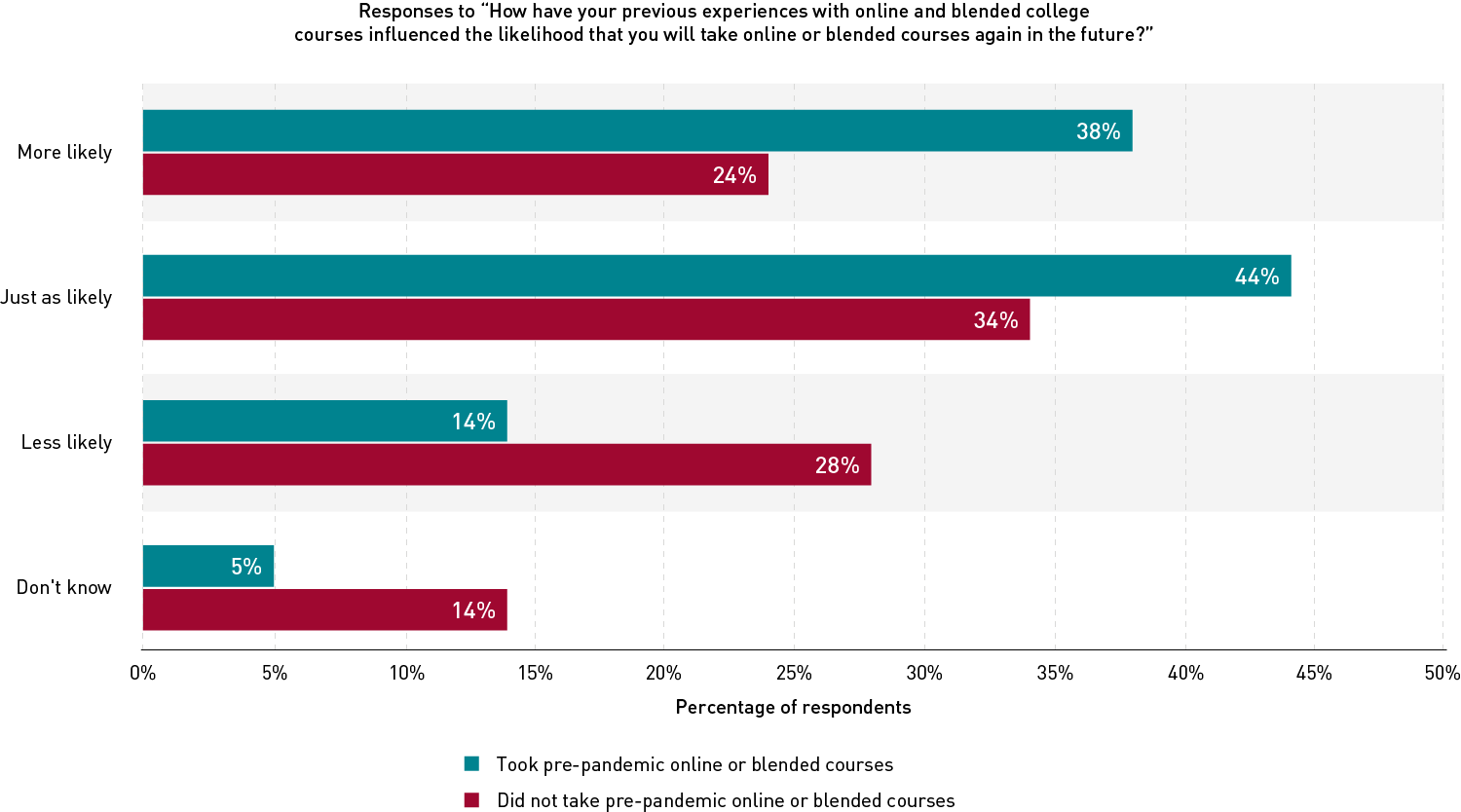
    Seventy-seven percent of students surveyed want to take at least some online courses. In fact, 26% of students who are opting for “mostly face-to-face,” leaning into the traditional campus experience, still want to have some online courses. And 51% percent of students surveyed want half or more of their courses to be virtual. Preferences are shifting:

    “2022 Students and Technology Report: Rebalancing the Student Experience,” EDUCAUSE

    Think about this for a moment. How have your own work preferences have shifted regarding the mix of in-person and virtual work meetings? How have your colleagues’ preferences shifted? What are the pros and cons? When you dig down a layer below your global preferences, which sorts of activities are you more likely to want to have virtually and which would you prefer to have in person? What’s the calculus for you? For most of us, these preferences have some texture to them related to how you get your best work done, how you socialize, and how you need to balance work with the rest of your life. Why should we expect students to be different?

    At the moment, we don’t have any way to correlate the winners and losers in the Inside Higher Ed article with changing online learning preferences in the EDUCAUSE report. All we have is the one anecdote from William Paterson university. Well, not quite all. The student quotes from the “modality preferences” section of the report are quite consistent with what we would expect to hear from post-traditional students, e.g.,

    Having to commute would be more stressful. It would probably negatively impact my learning because I have a job that I have to prioritize over school with regard to my schedule.”

    [And also]

    I won’t be able to finish my degree unless I can do it online. My dad is in remission from cancer and doesn’t have any protection from COVID.

    “2022 Students and Technology Report: Rebalancing the Student Experience,” EDUCAUSE

    These are students with lives outside of school. Now, we don’t know too much about the sample. And yet, 71% of them are in the 18-24 age bracket. About a third of them were in community colleges, but 25% were in PhD-offering public universities. It certainly feels like the needs and preferences of “traditional” and “post-traditional” students may be merging.

    Spending money to reach students

    The third story I want to bring up, by Doug Lederman of Inside Higher Ed, is “When to Outsource Online Learning, and When Not To.” It provides a summary and analysis of a report from UPCEA on how to decide whether to hire an OPM or build in-house capability for online learning programs.

    After pointing to other OPM reports, the article contrasts the UPCEA report in the following way:

    The report doesn’t explore the question of whether institutions should expand their online offerings, or the all-important question of how to go about going online in a way that furthers their educational mission. It picks up at the point where a college or university leadership might decide how to do so—utilizing its own money, people and capacity, or with outside help.

    When to Outsource Online Learning, and When Not To

    UPCEA’s report is a “how to” guide. And the most desired features highlighted in the analysis are funding the development of a program and marketing it, the latter of which got particular attention. “[B]uilding the enrollments, typically through (sometimes) sophisticated digital marketing efforts—tends to be the skill set that most institutions believe they lack in house….”

    This quote from Tyton Partners’ Trace Urdan made me sit up in my chair:

    “Attracting working adult students to graduate programs and degree-completion programs is extremely difficult at the current moment for everyone given competition from a still-hot labor market,” Urdan said. “No one is happy with leads or conversions, and no one anticipated how challenging the current moment would be. This is a problem for everyone, not just OPMs.” [Emphasis added.]

    When to Outsource Online Learning, and When Not To

    Trace rightly connects degree completion programs—often associated with institutions like WGU and SNHU—with graduate programs, including the ones for elite universities served by the likes of 2U. (2U, by the way, just announced its first MicroBachelors programs.) Whatever a student’s age bracket and educational attainment may be, if she has a life and priorities outside school, she is going to be harder to reach and harder to keep. She has less attention to give and few resources in general.

    The post-traditional student is becoming the new traditional student.

    Some implications

    The 20th Century was a kind of golden age of the traditional liberal arts university in the sense that the pool of 18-year-olds who aspired to go to college expanded dramatically while the cost remained affordable. While nstitutions competed with each other, most did not have to work to convince students to go to college straight from high school, attend full-time, and make college the main focus of their lives. I believe those days are over. They are not coming back. On the other hand, lifelong learning used to be a lifestyle choice for most people. Now it’s a necessity for many. Higher education must embrace these realities to survive, thrive, and above all, serve its purpose in the 21st Century.

    If I’m right about this, then the majority of US colleges and universities need to rethink and retool. Tim Renick’s work at Georgia State University to reduce summer melt and reduce administrative barriers for students to success will no longer be seen as primarily an equity effort for the underserved. It will become a template for all kinds of institutions. The lessons learned by large online universities like SNHU, WGU, UMGC, and ASU Online about how to retain online students and deliver quality online education will be lessons that residential campuses will have to embrace. Every college education will be digitally enabled. Even the most traditional residential campus will need to embrace online, blended, and hybrid as parts of the mix that its students demand. After all, even students who can afford to focus on nothing but college for four years will expect to have as much freedom to work remotely as knowledge workers do these days. Everything from physical plants to term lengths to degree structures will have to be rethought for mainstream institutions.

    This, in turn, will change the daily work lives and even the professional identities of many people working on these campuses. The nature of the professorate will change. Universities will need to become more centrally managed and coordinated. And this may happen shockingly quickly as universities face existential pressures for survival. This is what punctuated equilibrium looks like. Positive feedback loops run amok. The unthinkable becomes possible and then inevitable.

    The last ice age endured for 11,000 years. But it did end.

    Glaciers and Sea Level Rise
    Glaciers and Sea Level Rise by NASA Goddard Photo and Video is licensed under CC-BY 2.0