
e-Literate

Present is Prologue

Tag: Clayton Christensen

  • Christensen Scorecard: Data visualization of US postsecondary institution closures and mergers

    Christensen Scorecard: Data visualization of US postsecondary institution closures and mergers

    In 2013, Harvard Business professor Clayton Christensen made a bold prediction based on his ubiquitous innovation theory that maybe half of all postsecondary institutions could close within 10-15 years.

    (source: https://youtu.be/KYVdf5xyD8I, starting at 6:25)

    The scary thing is that 15 years from now, maybe half of the universities will be in bankruptcy, including the state schools. But in the end, I’m excited to see that happen.

    Christensen then doubled down on his predictions in 2017, humorously saying it might take nine years instead of ten.

    (source: https://youtu.be/4ljlUOV-Uj4, starting at 1:04:42)

    Q. Do you still believe, as you’ve said before, that as many as half of colleges and universities will be bankrupt or closed within a decade?

    A. Um, yes. [snip] Whether the providers get disrupted within a decade — I might bet that it takes nine years rather than 10. Maybe I’m too scared about the Harvard Business School to be rational about it. But we should worry.

    There have been plenty of articles written about these claims, but it has been frustrating that very few back up their analysis with data. One exception is Derek Newton’s article critiquing the claims in Forbes, titled “No, Half Of All Colleges Will Not Go Bankrupt”.

    Look at the numbers. In the 2013-14 year, there were 3,122 four-year colleges according to the Department of Education. In 2017-18, the most recent data, there were 2,902 – a drop of about 7% over four years. That could be disruptive. But numerically, all of school closures since Christensen made his 2013 forecast were four-year, for-profit schools, which fell from 769 in 2013 to 499 in 2017 – a drop of 270. Of all the colleges, at all levels, that have closed since 2013, 95.5% of them were for-profit institutions.

    Another exception is Michael Horn’s explanation of the predictions (he co-authored the New York Times op-ed from 2013, titled “Innovation Imperative: Change Everything”, that included the initial prediction). This 2018 post “Will half of all colleges really close in the next decade?” also sought to go back to original, more nuanced claims of 25% closures and mergers at the Christensen Institute.

    Translation? Our predictions may be off, but they are directionally correct.

    To that I emphasize one more piece of nuance. Ultimately we are really predicting a failure rate, made up of a combination of closures, mergers or acquisitions, and bankruptcies in which a college or university has the opportunity to restructure itself. Not all universities that “fail” will disappear. [snip]

    From 2004–2014, “Closures among four-year public and private not-for-profit colleges averaged five per year from 2004-14, while mergers averaged two to three,” according to Moody’s. Moody’s predicted in 2015 that that closure rate—out of 2,300 institutions—would triple by 2017, and the merger rate would double.

    Assuming that were true, and say that the rate held steady for 15 years, that would take out roughly 13% of existing higher education institutions right there.

    Thanks to our partners with our LMS Market Analysis service, LISTedTECH, we can now provide data visualizations to better evaluate the validity or likelihood of these claims. For the first time that I’m aware of, we have visualizations showing combined closures and mergers over time, broken down by sector and degree-type, and showing data 2-3 years in advance of IPEDS publications.

    The LISTedTECH data shown below tracks known closures and mergers, which have then been checked against both IPEDS and Federal Student Aid data sets. There are translation issues in all three data sets, so the data will not match 100% – probably more at the 80 – 90% confidence level. The first view shows combined closures and mergers per year, broken out by control and whether they are classified as 2-year or 4-year degree-granting institutions.
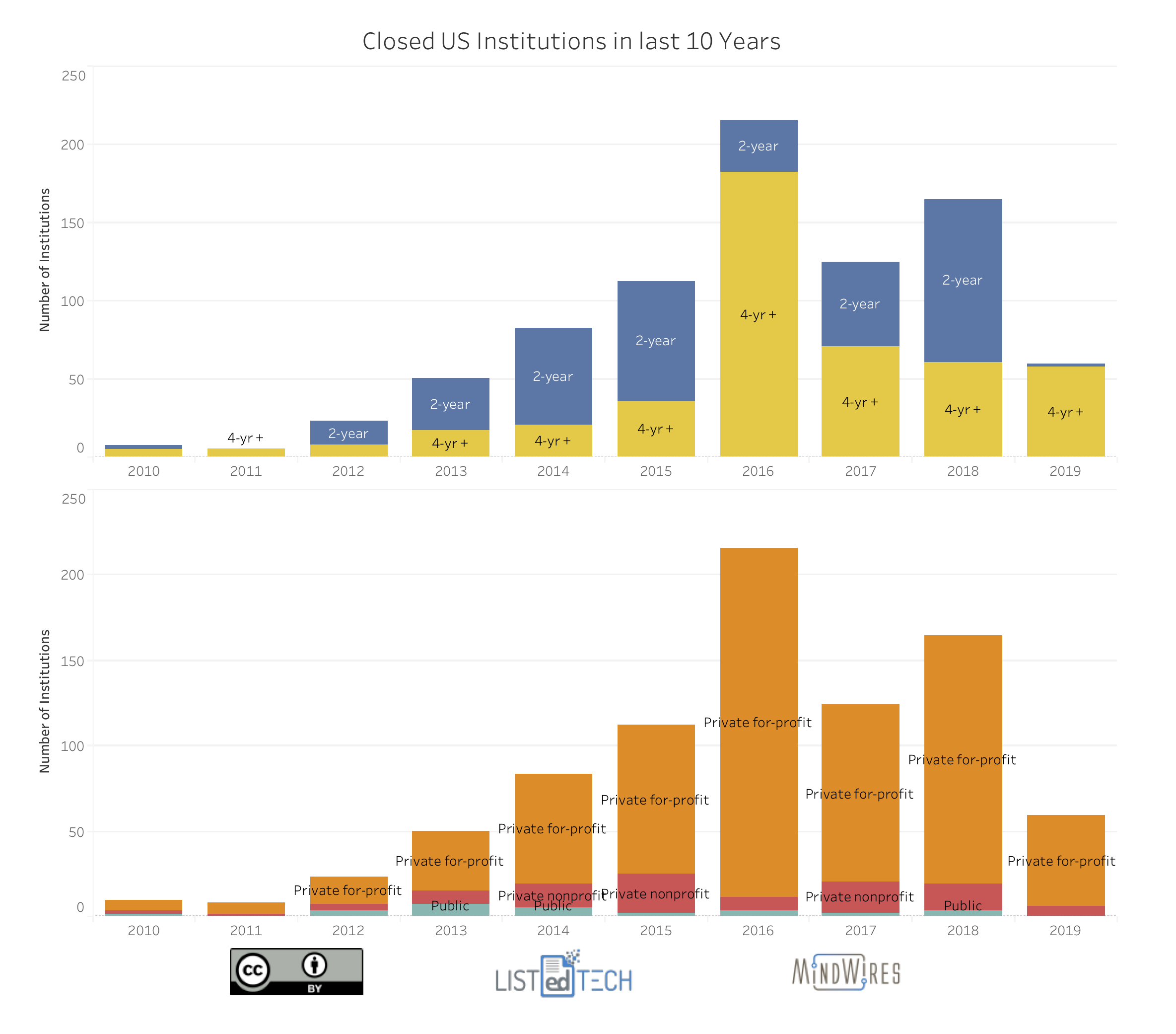
    Closed US higher ed schools over past decade

    As Derek Newton and Michael Horn pointed out, the vast majority of closures were from the for-profit sectors. Part of the dynamic at play is that when a large for-profit chain meets its demise (e.g. Corinthian Colleges, ITT, Westwood Colleges) or has a massive downturn (e.g. University of Phoenix) literally dozens of individual institutions close, whereas when a small private nonprofit college in New England closes, it is one school. Add to the that the massive drop in for-profit enrollments since 2012.

    The public sector data in 2013 and 2014 is largely driven by reorganizations in the University System of Georgia.

    Also note that the 2019 data only includes the first quarter.

    If we want to track the Christensen (and Horn) predictions, however, we need to view this data as a running total.
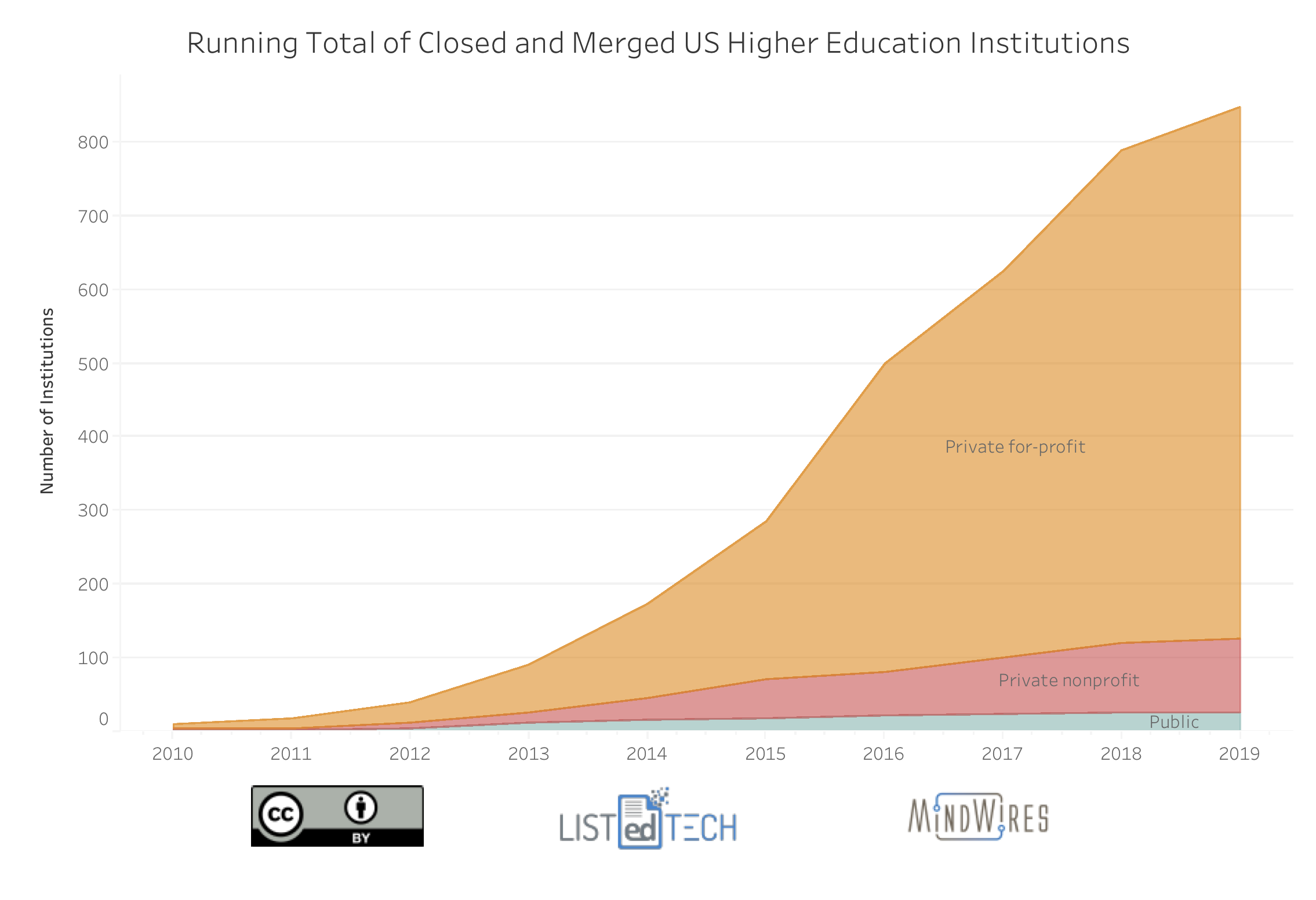
    Running total of closed and merged US higher ed institutions

    Let’s zoom out to capture the timeline of the most recent predictions of a decade from 2017, and let’s add the rough levels indicated (using bold row from this IPEDS table to define number of institutions).

    Running total of closed US institutions with trend lines

    If you include all degree-granting institutions (i.e. for-profits as well as private nonprofits and publics), then the current trends lines show that the 50% closure prediction by 2027 certainly seems feasible. Note, however, is that there are less than 1,000 for-profit institutions remaining as of Fall 2017 IPEDS data, and the rate of for-profit closures cannot continue more than another 8-10 years (best case / worst case, take your pick).

    There are quite a few stories recently about private nonprofit small-school closures, but the data thus far don’t show a rapid acceleration of closures. Some perspective is useful here.

    If you ignore the for-profit sectors, then the trend line for private nonprofit and public institution closures + mergers remains far below that needed to hit the 25% level described by Horn or the 50% level described by Christensen. None of this is to say that the trends moving forward will be linear, however. The rate of private nonprofit and public closures and mergers would need to at least triple to hit the more conservative level of 25% within a decade, a possibility that I would not reject out of hand. And it turns out that Moody’s was wrong – the rate of closures and mergers in this group did not triple from 2015 – 2017. Nevertheless, the data could get worse.

    We’ll share more information on this new data, but hopefully these visualizations provide a better sense of the trends on college closures and mergers.
  • Cracks In The Foundation Of Disruptive Innovation

    The overuse of Clayton Christensen’s disruptive innovation theory has rightly been criticized in education circles for years. I say rightly in that judging a non-commodity public good with the same theory as disk drives is a silly notion without some extensive analysis to back up that extrapolation. As Audrey Watters wrote in 2013:

    Rather, my assigning “myth” to “disruptive innovation” is meant to highlight the ways in which this narrative has been widely accepted as unassailably true. No doubt (as a Harvard professor) Christensen has faced very little skepticism or criticism about his theory about the transformation of industries— why, it’s as if The Innovator’s Dilemma were some sort of sacred text.
    Helping to enhance its mythic status, the storytelling around “disruptive innovation” has taken on another, broader and looser dimension as well, as the term is now frequently invoked in many quarters to mean things quite different from Christensen’s original arguments in The Innovator’s Dilemma.

    Referring back to Audrey’s posts, Jim Groom and Brian Lamb made efforts to “reclaim innovation” in 2014:

    To understand much of the disconnect between higher education and innovation, we should take a look at innovation’s unruly cousin: disruption. Certainly, when surveying the rapid pace of change in digital and networked technologies and assessing the wreckage of organizations and industries that have, in one way or another, been swept aside, disruption as a descriptive term is not without merit. But unless we are prepared to rebuild from the wreckage and create something that represents a meaningful advance, it’s difficult to see the value in disruption for its own sake. (more…)

  • No Discernible Growth in US Higher Ed Online Learning

    By 2015, 25 million post-secondary students in the United States will be taking classes online. And as that happens, the number of students who take classes exclusively on physical campuses will plummet, from 14.4 million in 2010 to just 4.1 million five years later, according to a new forecast released by market research firm Ambient Insight.

    Campus Technology, 2011

    On the positive side, Moody’s notes that the U.S. Department of Education projects a 20-percent growth in master’s degrees and a 9-percent growth in associate degrees, opportunities in both online education and new certificate programs, and a rising earnings premium for those with college degrees.

    Chronicle of Higher Ed, 2014

    Q.  How likely would it be that this fraction [% students taking online courses] would grow to become a majority of students over the next five years? A [from institutional academic leaders]. Nearly two-thirds responded that this was “Very likely,” with an additional one-quarter calling it “Likely.” [That’s almost 90% combined]

    Grade Change, Babson Survey 2013

    More than two-thirds of instructors (68 percent) say their institutions are planning to expand their online offerings, but they are split on whether or not this is a good idea (36 percent positive, 38 percent negative, 26 percent neutral).

    Inside Higher Ed 2014

    Still, the [disruptive innovation] theory predicts that, be it steam or online education, existing consumers will ultimately adopt the disruption, and a host of struggling colleges and universities — the bottom 25 percent of every tier, we predict — will disappear or merge in the next 10 to 15 years.

    Clayton Christensen in NY Times 2013

    You could be forgiven for assuming that the continued growth of online education within US higher ed was a foregone conclusion. We all know it’s happening; the questions is how to adapt to the new world.

    But what if the assumption is wrong? Based on the official Department of Education / NCES new IPEDS data for Fall 2013 term, for the first time there has been no discernible growth in postsecondary students taking at least one online course in the US. (more…)

  • Why VCs Usually Get Ed Tech Wrong

    I don’t often get to write these words, but there is a new must-read blog post on educational technology by a venture capitalist. Rethink Education’s Matt Greenfield argues that there is no generalized bubble in ed tech investment; rather, the problem is that the venture community has a habit of systematically betting on the wrong horses.

    It’s worth noting that Matt is not your typical VC. For starters, he doesn’t live in the Valley echo chamber. Perhaps more importantly, he has a background as an academic. He has a PhD in English from Yale, taught at Bowdoin and CUNY, and taught graduate classes in literature to teachers from the New York City public schools. As such, he has an unusual perspective for an ed tech venture capitalist.

    Matt uses digital textbook platforms as his example of the problem he wants to highlight:

    What type of ed tech have venture capitalists approached with the greatest enthusiasm and the largest piles of cash? The answer is new textbook solutions, including digital textbook platforms like Kno and renters of physical textbooks like Chegg, which just went public. Venture capitalists have put over $500 million into just the top ten companies in this sector….

    I talked to the CEO of an academic bookstore company recently. How many digital textbook platforms would you guess that his stores handle? Five? No, more than that. Ten? Nope, guess again. Twenty? Still too low. The answer is forty-two different digital textbook platforms. Forty-two. Now try to imagine each of those textbook platform companies pitching a book store. Or an author. Or a publisher. Or a venture capitalist. “Choose my platform, choose me! Our platform is totally different!” How many of those platforms does the world really need? How many of those platforms can make money? What do you think the meaningful differences between those forty-two platforms might be?…Meanwhile, even the century-old publishing incumbents are moving away from book-like things to adaptive courseware: learning objects that simply will not fit into the wrappers being built by companies like Kno.

    So there is a bubble in venture funding for education ventures that are obsolete at birth. Meanwhile, there are large opportunities in areas where few venture capitalists will invest.

    This is a fascinating case study. Why would VCs, with their much vaunted drive for innovation, be so taken with the idea of rebuilding an aging instructional modality (i.e., the textbook) on a digital platform—particularly when, as Matt spells out in detail in his blog post, it’s clearly a bad bet for a lot of reasons? It’s worth unpacking this a bit to get at the underlying pathology.

    (more…)

  • The quiet revolution in college pricing effects

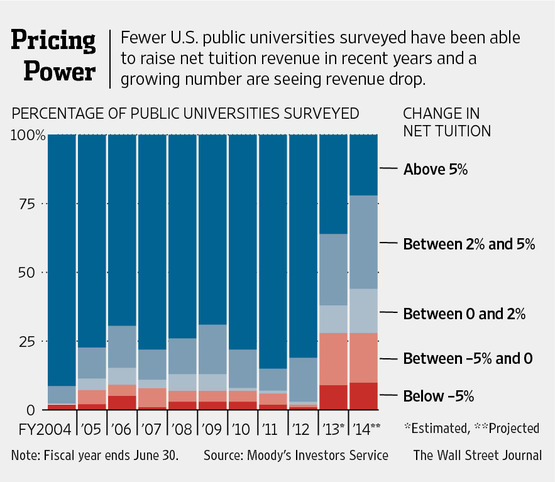
    Douglas Belkin wrote an article yesterday in the  Wall Street Journal based on a study from Moody’s Investors Service. The lede of the article is that “nearly half of the nation’s colleges and universities are no longer generating enough tuition revenue to keep pace with inflation”, which comes from Moody’s interest in institutional financial stability, but I think there are other lessons available. While the revolution in college pricing effects is quiet, it is profound.

    Tuition revenue

    It is worth noting that the big changes are based on FY2013 and 2014, which includes survey-based estimates and projections rather than hard data. The article is behind a paywall, but here are some relevant excerpts (read the whole article if you can).

    (more…)

  • Why Pearson’s OpenClass Is a Big Deal

    The big buzz at EDUCAUSE last week was around OpenClass, Pearson’s new LMS entrant. Much hyped but only rarely glimpsed, speculation has been rampant about whether it is a big deal or just a gimmick. Because most people (including me) don’t have access to the product yet, the best source of information on it at the moment is Adrian Sannier, eCollege’s VP of Product. I had the good fortune to both listen to  him give a presentation on OpenClass and chat with him about it one-on-one. My conclusion is that this product could be a very big deal indeed.

    In a previous post here on e-Literate, Phil Hill characterized OpenClass as potentially disruptive. I think he’s right, but I also think this is one of those times where we have to be careful about how we use that term. Adrian Sannier is a big fan of Clayton Christensen, the man who coined the term “disruptive innovation.” If you really want to understand what OpenClass is all about, go out and read The Innovator’s Dilemma and The Innovator’s Solution very carefully.  There are very specific reasons why “free” and “easy” are the words you will hear most often from Adrian when he is speaking about the product.

    The audacity of what Pearson is attempting should not be underestimated. If they succeed, they could cause major tectonic shifts across several markets that are currently critical to higher education. Colleges and universities need to pay close attention to the kind of deal that they will be striking for themselves. Overall, I don’t think the biggest concern is whether Pearson will fail to maintain the platform as free. Rather, the more serious question is what will they be getting if they succeed.

    (more…)

  • Xplana.com: Is This a PLE?

    The title of this post is slightly tongue-in-cheek because I have my doubts about whether there is such a thing as PLEs that are distinct from existing software product categories. If there were, then after years of people talking about them, one would think there would have been an example by now that everybody could point to and say, “Yes, we all agree that is a Personal Learning Environment and not a Learning Management System, a Virtual Learning Environment, an ePortfolio, an RSS reader, a personal portal, or whatever.” Then again, maybe the PLE is an idea whose time has finally come. I believe that learning environment developers are embracing many of the articulated values behind the PLE and experimenting with different ways to embody those values. Xplana.com, which launched this week, is one example.

    (more…)