e-Literate

Present is Prologue

Tag: Coursera

  • The MOOC-Courseware Convergence

    Now that Coursera for Campus—which I have occasionally erroneously referred to as “Coursera for Schools” in previous blog posts—has been launched, we have some more information about what it’s really about. (I’ll embed the launch video at the bottom of the post, but if you’d rather go straight to it, you can find it here.) I think it’s significant and portends significant trends in the sector.

    Before we get to that, let’s get one item of business out of the way related to my previous posts. As IBL Education notes, Coursera CEO Jeff Maggioncalda said, “Coursera for Campus is not a full-featured LMS. We expect many universities to stay on their LMSs.” IBL News further notes, “According to the company, Coursera for Campus’ LMS is designed to supplement the existing Canvas, Blackboard and Moodle systems.” [Emphasis in original.]

    So Coursera for Campus isn’t LMS play, at least for the foreseeable future. I was pretty harsh on Coursera’s SVP of Enterprise Leah Belsky for her disruption language, but as I’ll get into later in this post, this kind of category mistake is actually quite easy to make and one that other courseware providers have made.

    Because that is exactly what Coursera has explicitly become with their Courseware for Campus offering: a courseware provider. The less obvious part is that MOOC design and courseware design have been converging for some time now. Their increasing similarities in instructional affordances have been masked by the differences in the business models of their parent companies. And even less obvious is that the Venn diagram of courseware companies and OPM companies is starting to overlap significantly.

    “A 21st-Century textbook”

    In the launch presentation, Maggioncalda called Coursera for Campus, in part, a “21st-Century textbook.” Take that seriously. These are MOOCs repurposed as curricular materials. And it’s really not that big of a leap. Remember that the pedagogical model of the xMOOC course generally doesn’t require heavy participation from the instructor. Some instructors do participate heavily, while others, less so. A lot of instructor energy goes into course design and lecture video production. The actual live support could be from the instructor, but it also could be from TAs, or it could be self-study. Or, in the case of Coursera for Campus, it could be a different instructor. From its inception, the design model of xMOOCs began decoupling faculty course design from faculty course delivery.

    There is some messiness, of course. The biggest challenge in terms of textbook-like may be the lecture videos. Faculty may not love having some other personality featured as the star of the show. But there are two mitigating factors to that. First, Coursera’s design staff is likely guiding faculty toward authoring instructionally sound videos, which would tend to reduce the total amount of talking head content in any given course. Second, textbook-provided commercial courseware, which is still often written by star authors in their field, now also features talking heads. Here, for example, is the Cengage MindTap introductory video for Economics, by author Greg Mankiw:

    Greg Mankiw’s head, talking

    “But,” you may be thinking, “MOOCs are not designed like courseware.” One of my Twitter followers made a comment to the effect that at least courseware has an instructional design philosophy, unlike xMOOCs.

    That person is mistaken, and here is the proof:
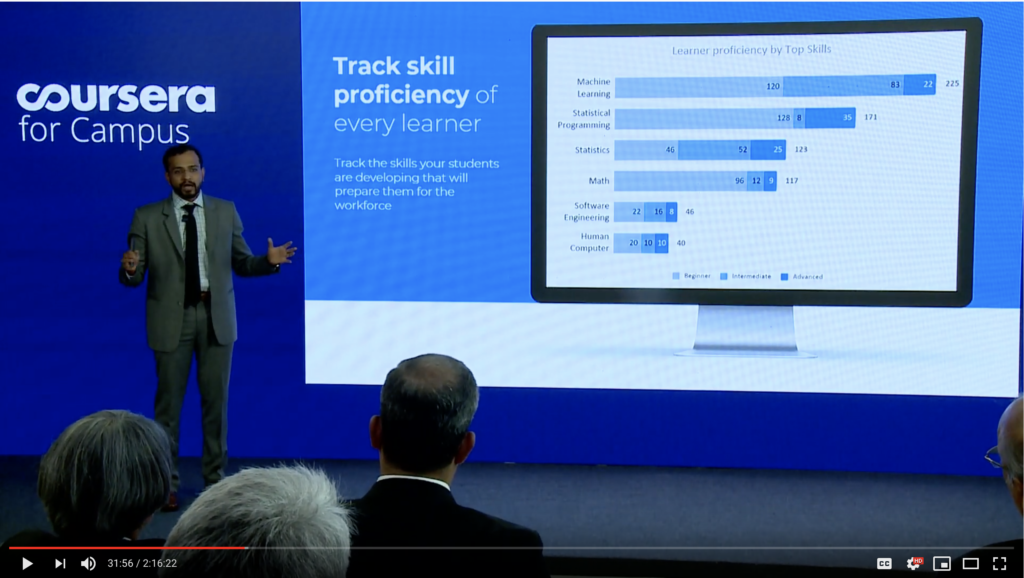
    These analytics are only possible with backward design

    During the launch presentation, a Coursera executive made the statement that “any of the courses that have been authored on Coursera come with an out-of-the-box analytics platform.” If those analytics look anything like the picture above—and I would bet money that they do—then the courses have been built on a backward design philosophy like the one I have been describing in my recent post series on content as infrastructure.

    This shouldn’t be surprising. As I wrote repeatedly throughout that series, almost every professionally designed course uses that design pattern. And Coursera is known for having strong professional course design support.

    (I’m telling you, folks. That content pattern is the revolution of our time.)

    Update: Matthew Rascoff has reminded me to acknowledge that the professional course designers on campuses play large and critical roles in the design of these courses. The larger point is that, on both sides of the fence, there are trained, professional course designers who are applying this design pattern.

    While I haven’t looked at their catalog myself in quite some time, I would not be surprised at all if many of their offerings stack up pretty well against commercial courseware titles. For one thing, while xMOOCs have a bad reputation for anemic social interaction relative to other course models, they probably have more social interaction designed into them than many commercially published courseware titles.

    Courseware platforms vs LMSs

    It’s easy to get confused about the boundary between a courseware platform and an LMS. I know because I have worked on and consulted on both. The LMS companies inevitably start thinking, “Damn, there are so many courses that get delivered through our platform, and so much money made on selling them. And guess what? Everything that faculty build and deliver through our product is a course! The textbook publishers keep rebuilding what we’ve already built. Badly. I mean, have you seen their grade books? Why can’t we be the platform and get a cut of all that money?”

    So they try to displace the publishers. And they fail. Every time.

    The textbook publishers, meanwhile, start thinking, “Damn, our customers really hate their LMSs. We’ve built all these LMS features, and they keep asking for more. I mean, we’ve already built a grade book. Wow, that was painful. Why can’t we be the platform and get a cut of all that money?”

    So they try to displace the LMS companies. And they fail. Every time.

    Here’s the critical difference:

    LMS developers have to optimize for a wide range of faculty preferences, teaching styles, and teaching conditions. They have to accommodate every grading scheme imaginable. They have to handle huge classes and tiny classes. They have to deal with face-to-face, online, and blended. Constructivist, lecture, and whatever else. That’s why they spend so much time adding grade book micro-features and then optimizing the usability to handle all those micro-features without being totally overwhelming.

    Courseware developers, in contrast, have to optimize for the content. If the subject is software development, then you need an interactive code editor and test engine. If it’s accounting, then you need a test engine that looks like a spreadsheet. If it’s chemistry, then you need a molecule visualizer and manipulator.

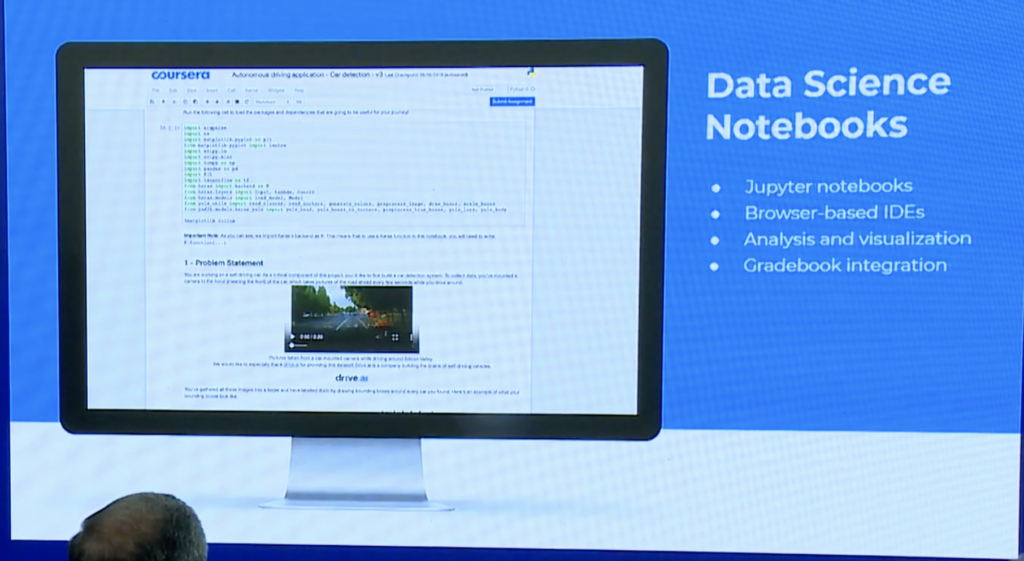
    Which side of the divide do MOOC platforms land on? Here are a couple of slides from the Coursera on Campus launch:
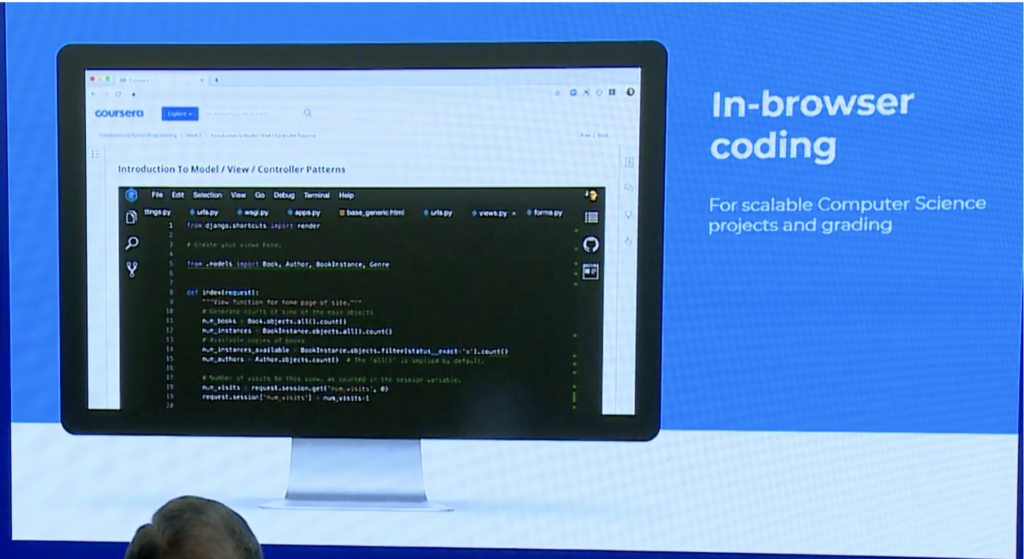
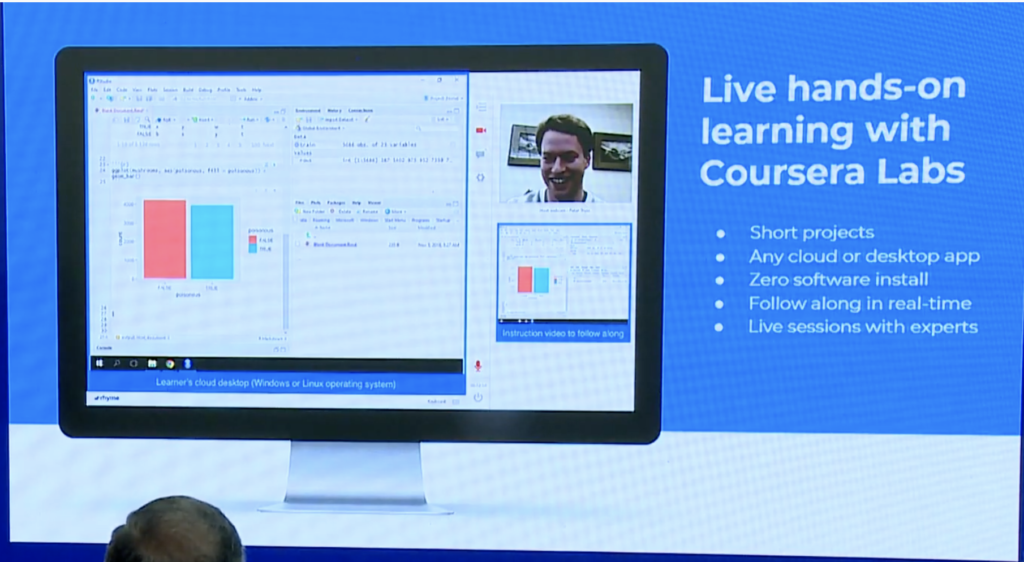
    In-browser coding!
    Virtual labs!
    Data science notebooks!

    These subject-specific affordances, plus competency-based analytics, were the platform highlights of the Coursera for Campus presentation. Not the grade book that can do anything. Not the test engine that can provide any kind of feedback. Not announcements or an event feed. This was all about courseware.

    “But wait,” you say. “Courseware for Campus lets faculty author their own courses. Isn’t that different?”

    Yes. And no.

    Way back the better part of a decade ago, when I was at Cengage working on the MindTap platform, the company debated whether to open it up to customers and license it without content. (“We can disrupt the LMS!”) In the end, there were two major barriers. First, as a print-centric company in the midst of a transition, the authoring tools were not remotely faculty-friendly. And second, as a publisher whose bread and butter came from royalties, there was a fear of cannibalization of the business.

    Coursera has neither of those problems. It was born as a two-sided market, which means that it never owned the content to begin with and always had an incentive to make authoring as easy as possible. It may have taken some time to fully realize that vision, but we were destined to arrive where we are now.

    Further, as textbook publishers increasingly move away from celebrity franchises and toward fee-for-service contracts with their authors, they will have motivation to make similar moves. McGraw-Hill Education doesn’t advertise it widely, but they have been licensing the authoring platform for SmartBooks for several years now. Authoring support can work with a courseware platform as long as the range of course expectations for delivery models can be constrained. And MOOC courseware fits the bill. It’s a genre.

    Coursera for Campus is a harbinger of the future, not for the LMS industry but for the textbook industry. And they are an early mover with certain advantages in their business model.

    The courseware/OPM convergence

    One critical element that I don’t want to lose in all of this is the implications for the OPM market. Let’s not forget that (a) Coursera has been pushing into that market aggressively and successfully and (b) that market has been under massive pressure and upheaval lately. 2U has been the canary in the coal mine, having lost roughly four fifths of its market value since the beginning of the year. ((Disclosure: 2U is a 2019 sponsor of EEP.))

    To be clear, I think there’s some noise obscuring the signal. Two of the reasons why 2U took such a big hit are that the stock got way ahead of itself and some self-interested players have been extraordinarily successful at generating FUD around the market category in general.

    That said, there is no question that the hype around selling an infinite number of $40K masters degrees has met its demise. There are two barriers to OPM growth, which is another way of saying that there are two barriers to conventional online degree growth, and they have both proven formidable barriers to crack. The obvious one is cost. The less obvious one is geography. It turns out that, even in an era when people can take courses from anywhere in the world, they will tend to take them from their local institution or not at all. For all the talk of “national universities” and “mega universities,” it’s not clear that such beasts really exist. For the most part, big universities have proven exceptionally good at soaking up every ounce of demand for education in their local areas. So the next sustainability play is not so much about reaching students far away as it is about serving students you already reach for 40 years rather than for four.

    And interestingly, that is essentially the pitch that the Coursera executives made about Coursera for Campus—even when they were pitching in India. They weren’t making the pitch that the American stereotype would have predicted, of reaching the rural millions. They were talking about lifelong learning. Skilling and reskilling. From an OPM perspective, this pitch gives the company with the large catalog of low-cost and constantly refreshed inventory a competitive advantage.

    That said, there was definitely a bit of hand waving going on regarding completion rate. The Coursera executives talked about University of Illinois’ degree program as having over a 90% completion rate as if that remarkable achievement could be solely attributed to the fact that it was a degree program. I suspect there are some hard-working support staff at the University of Illinois who might quibble with that clean of a causal analysis. I don’t think the Coursera folks are directionally wrong, and I don’t think they were intentionally misleading, either. But I do think that they oversimplified, and that running a highly successful program at scale with a 90%+ degree completion rate entails a lot more than just handing out a piece of sheep skin at the end. The reason I bring this up is not because I want to snark on Coursera but because the part that is being glossed over represents a number of support areas that OPMs compete on (and that more traditional OPMs and OPEs pride themselves on excelling at).

    The gap between “MOOC” the course model and “MOOC” the courseware model is very much an open question in terms of student success. The MOOC courseware model, particularly as implemented into affordable degrees at scale delivery models by pioneers like Georgia Tech and University of Illinois, are creating an alternative delivery model that could start putting pressure on OPMs supporting more traditional models. Coursera on Campus, in addition to creating an additional revenue stream for the company and putting pressure on courseware providers, potentially ups the ante in the OPM market. But we need to look to those universities which are pioneering affordable degrees at scale to understand the service gaps, marketing gaps, and cost differences between MOOC courseware and the totality of what they are doing in order to understand the what it would take to replicate their success.

    In the meantime, consider the implications of the Coursera on Campus model for the future of companies like Pearson and Wiley, which own both courseware and OPM divisions, or McGraw-Hill Education, which has begun experimenting with opening up its platform for content authoring by customers. ((Disclosure: Pearson is a 2019 sponsor of the Empirical Educator Project.)) It’s not necessarily all bad, but it is a potential accelerant to change that is already in the wind.

    It’s a wild, wild, wild, wild world, my friends.

    Here’s the full launch event for your viewing pleasure:

  • Disruption Disrupted: The Great MOOC Die-Off

    Coursera has announced, with some fanfare, their Coursera for Campus initiative, which Jeff Young at EdSurge has characterized as an attempted entrance into the courseware market but which Coursera Vice President of Enterprise Leah Belsky described as aimed at the LMS market.

    From the EdSurge piece:

    Coursera for Campus is designed specifically with colleges in mind, says Leah Belsky, Coursera’s vice president of enterprise. That means the service includes new features tailored for use in an academic environment, including plagiarism detection to spot cheaters and integration with existing student gradebooks in the learning management systems (LMS) that colleges use.

    Meanwhile, Coursera is opening up its technology platform to any college to use for free to deliver course materials on their own campuses. That means that colleges could use the Coursera software as an alternative to their learning-management system. Belsky argues that Coursera’s system is better designed for delivering online courses and interactive lessons than most LMSes. 

    “We’re talking about a potential major disruption to the LMS market,” she says. “We don’t have all the features of an LMS but what we do have is all the tools to create cutting-edge interactive learning experiences.”

    This is bad framing from a PR perspective, but more importantly, it just plain misses the real potential value proposition and chases a plainly imaginary one instead.

    First, I hear a constant stream of complaints about both major MOOC providers having platforms that are not even fully adequate for their original purpose (though the situation does seem to be improving, particularly in terms of data analytics). At least one very high-profile customer, who I won’t name here, uses the MOOC platforms basically as a store front while putting their actual courses in an LMS. This comes at a time when some Blackboard customers still balk at switching from the classic to the Ultra experience because of feature gaps on level of granularity of test question feedback. MOOC platforms are interesting and have some innovative features, but they are neither mature for their original purpose nor tuned for the broad range of usage that a campus LMS must serve. Second, disruption talk is particularly tone deaf from anyone in a product category that was very recently known for hyping that they would be disrupting the university itself. And finally, disruptive innovation is an unfalsifiable theory that has thus far shown itself to have no predictive power in higher education. It’s a provocative idea that may have some generative intellectual value, but really, it’s well past time for every company that has aspirations in education to drop the word “disrupt” from their public vocabularies. Coursera for Schools may well have a decent value proposition, but this isn’t it.

    Jeff’s framing is closer to the truth: This is primarily a courseware play. There’s a little bit of gray area because courseware platforms and LMS platforms are slowly drifting toward each other in terms of design, but if they ever do converge, it won’t be in the next couple of years. No, this is about repurposing content. And the real story here is that the content needs to be repurposed because we have an overpopulation of MOOCs that are in the midst of a die-off. I’m not saying that MOOC companies are dying off. As far as I can tell, Coursera seems to be healthy. (I have less visibility into EdX’s financial status.) What I mean is that previous generation of the Stanford/MIT/Harvard-style xMOOCs, having failed to achieve either their mission or their sustainability goals, are now being repurposed into other things. Because we don’t have better names for those things, we still call them “MOOCs.” But they don’t meet the definition of Massively Open Online Courses. Even the Stanford/Harvard/MIT definition.

    Meanwhile, there are zombie MOOCs on these platforms that are in the process of getting killed off. Not too long ago, one campus stakeholder told me that their MOOCs basically serve the same purpose as their YouTube marketing videos, except that the YouTube videos get much better viewership and cost a lot less. I don’t expect the MOOC to die entirely, but two years from now, there will be a lot fewer of them than there are now. We just may not recognize that change if we insist on continuing to call any online enrollable thing with more than 30 students a “MOOC.”

    The known failure

    What’s weird is that everybody has known that the xMOOC was a failed experiment within 12 months of it reaching peak hype, and the widely known evidence has only mounted since then. In a January 2019 article in Science that was tellingly titled “The MOOC Pivot,” authors Justin Reich and José A. Ruipérez-Valiente write in the summary,

    When massive open online courses (MOOCs) first captured global attention in 2012, advocates imagined a disruptive transformation in postsecondary education. Video lectures from the world’s best professors could be broadcast to the farthest reaches of the networked world, and students could demonstrate proficiency using innovative computer-graded assessments, even in places with limited access to traditional education. But after promising a reordering of higher education, we see the field instead coalescing around a different, much older business model: helping universities outsource their online master’s degrees for professionals (1). To better understand the reasons for this shift, we highlight three patterns emerging from data on MOOCs provided by Harvard University and Massachusetts Institute of Technology (MIT) via the edX platform: The vast majority of MOOC learners never return after their first year, the growth in MOOC participation has been concentrated almost entirely in the world’s most affluent countries, and the bane of MOOCs—low completion rates (2)—has not improved over 6 years. [Emphasis added.]

    The entire (paywalled) article is worth reading, but honestly, is any of the above a shock to you? xMOOCs, as originally designed, are not replacements for face-to-face classes. They do not lead to reliable course or credential completion. They do not do a good job of serving underserved populations. And they do not create sustainability models by giving a way expensively produced courses and making up for the cost on volume. They have value for some folks. I’m glad they exist in the world. But as an alternative system of education, they are a failure.

    We see this proven out again and again, in multiple variations. Most recently, ASU has largely shut down their Global Freshman Academy, a large undergraduate MOOC experiment designed to give students credit for their first year of college and attract them to matriculate to ASU for a degree. From the IHE article:

    Of 373,000 people who enrolled, only 8,090 completed a course with a grade of C or better, just over 2 percent of all students enrolled. Around 1,750 students (0.47 percent) paid to receive college credit for completing a course, and fewer than 150 students (0.028 percent) went on to pursue a full degree at ASU.

    Was Global Freshman Academy an experiment worth running? Absolutely. In fact, I fervently hope that ASU will be more forthcoming than they have been so far with the lessons they have learned from the experience. Did students in those courses gain value? While that article doesn’t provide significant data on this question, I strongly suspect that many did. Were MOOCs an effective vehicle for saving freshmen roughly 25% of the cost of a college tuition while still getting them on to sophomore year? Clearly not.

    So what has worked as a MOOC-like alternative to the traditional degree? What’s the closest we’ve come to fulfilling the original vision? The most high-profile success has been Georgia Tech’s affordable graduate degrees at scale. Note: I have not seen them refer to these courses as “MOOCs.” They talk about “affordable degrees at scale.” Yes, these are big classes. And yes, Georgia Tech does use MOOC platforms as part of their delivery ecosystem. But their experiment was never about “massively open.” It was about “affordable at scale.” They wanted to see how inexpensively they could offer a degree while keeping some of the same structures and conventional quality checks that their face-to-face programs have. And for Udacity, Georgia Tech’s first MOOC partner, the degree program represented a pivot. (The first of several.) They essentially acted as a kind of Online Program Enabler, which is a weird category that crosses boundaries of platform, content, and services.

    When I look at Coursera’s latest announcement, I see an offering very roughly akin to the one that Udacity originally made for Georgia Tech, but with a heavier emphasis on prepackaged content—likely because Coursera already has a lot of content on the platform that may be quite good but is apparently not going to be disrupting universities, or conventional degrees, any time soon. If Coursera were to become (in part) a two-sided market for universities to buy and sell interactive curricular materials from each other, that’s not necessarily a horrible future for either the company or its customers. But it is suggestive of the collapse in the hype we’ve seen in both the MOOC and the OPM markets.

    OPMs, courseware providers, and “MOOCs”

    I want to return to the portion of that quote from the Science article about MOOC providers turning into OPM companies, which I highlighted but didn’t address. Again, that’s obviously true. All this talk about “micro masters” and “degree pathways” essentially amounts to a claim that many working professionals would like to pursue their post-graduate education in small, career-oriented (but still accredited and tuition-burdened) chunks. Likewise, MOOC providers like to talk about how MOOCs provide an inexpensive sales funnel to get degree students.

    While I haven’t seen direct hard data to support either claim, I’m more inclined to believe the former than the latter. A “micro-masters” program is essentially a large certificate program that can count toward a larger degree. Certificate programs have been around forever, and they sell. On the other hand, I’ve seen no public evidence that the MOOC, a course genre which has trouble getting students to the end of the first course, is going to be successful at getting students to matriculate to a program in significant numbers. The ASU Global Freshman Academy isn’t a direct comparison, since it is undergraduate, but the numbers are still pretty discouraging.

    Reich and Ruipérez-Valiente have their own opinion about the competitive advantage of MOOC providers in the OPM space, and it is revealing:

    The primary competitive advantage of MOOCs relative to established school-as-a- service providers involves cutting labor costs through automation. Many “traditional” online programs include small class sizes, synchronous sessions with instructors, and human-graded assignments. Many degrees offered by universities with the technology and support of Coursera and edX will be one- half or one-quarter as expensive as typical U.S. professional online credentials, with the bulk of savings coming from a combination of larger class sizes, fewer or no synchronous sessions, reduced contact with instructors, and more autograded assignments (12).

    This is precisely the value proposition that the digital homework solution—courseware’s older sibling—brought to the face-to-face lecture hall in survey-level courses. Digital assessment is what enabled those courses to swell to 500 or more students. The authors continue,

    Because MOOC platforms support programs that look more like “traditional” online higher education, the literature on online learning can provide guidance. By most indications, students typically do worse in online courses than in on-campus courses, and the challenges of online learning are particularly acute for the most vulnerable populations of first generation college students, students from low-income families, and underrepresented minorities (13). If low-cost, MOOC-based degrees end up recruiting the kinds of students who have historically been poorly served by online degree programs, student support programs will be vital. Some recent research has explored online and text-message–based interventions for supporting these students, but most research suggests that human connections through advisers, tutors, and peer groups provide the most important student supports (14). These human supports will push against lower tuition costs. MOOC- based degree providers may find that highly effective online learning for diverse populations costs about the same to provide as highly effective residential learning (12).

    When you start playing with this balancing act in order to arrive at…ahem…an affordable degree at scale and quality, you likely end up with something that looks very much like the Georgia Tech solution. It’s not a free degree or a $1,000 degree. It might be a $7,000 degree or a $14,000 degree. And that’s at the graduate level. It’s not clear that we know how to do this at the undergraduate level yet.

    But the more interesting implication vis-a-vis MOOC providers is that their value proposition starts looking more like that of modern courseware support with some services bundled in.

    As MOOC providers compete with conventional OPMs, there are entirely separate questions of financing the program development (via revenue share or some similar mechanism) and marketing. The MOOC providers have the advantage of their portals for marketing; students may go to Coursera or EdX to look for a credential program (as opposed to a full graduate degree program) before they’d go to their local university. I’ve not seen that proven, but at least it’s plausible. And the financing is what it is. Either you want a revenue share or you don’t.

    But as a genre of course, the population of xMOOCs is dying off. We don’t see it because we’re also calling the thing that is replacing them—which isn’t open—a “MOOC.” The collection of actual xMOOCs that are still functioning as full and (more or less) open courses is slowly shrinking to fit the size and shape of the professional non-degree credential market. Forking off from that is something that looks like a MOOC but is actually prepackaged courseware, to be licensed like a textbook and taught by individual instructors at different universities, with or without a face-to-face component. Then there’s this third thing—the affordable degree at scale—that is using MOOC and courseware affordances, which are increasingly the same affordances, to teach more students with similar learning outcomes at a lower cost. So far, only in professionally oriented graduate degree programs. And finally, there are zombie MOOCs that have no strong reason to exist and are being killed off by the platform providers for whom they are loss generators (sometimes to the dismay of the universities who invested considerable time and money in creating them).

    OK, maybe I was wrong. The word “disruption” is still relevant in at least one sense.

  • Coursera CEO Interview: Betting on OPM market and shift to low-cost masters degrees

    Coursera CEO Interview: Betting on OPM market and shift to low-cost masters degrees

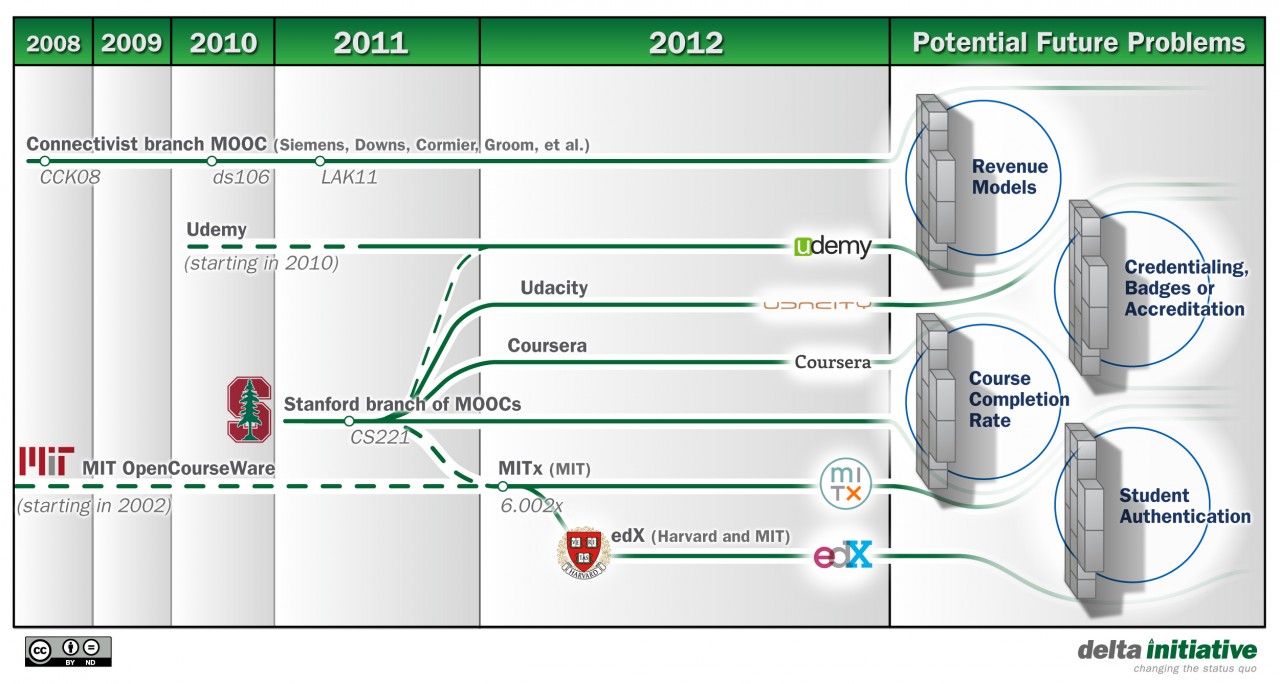
    In mid 2012 during the midst of MOOC mania, I wrote a post noting that we should pay attention to future generations of the concept and that there were four barriers that the MOOC vendors would have to overcome to have any long-lasting impact.

    Given this short timeline and the nature of investment-backed educational experiments, I think the real focus should be on whether and how MOOCs or successor models build on current scalability and openness while overcoming these four barriers.

    Six years later, it is becoming increasingly clear that the next-generation model for MOOCs in higher education is to become a form of Online Program Management (OPM) providers, including the near-term focus on master’s degrees. The OPM market has demonstrated revenue models (tuition revenue sharing mixed with fee-for-service), the end credential is the already-accepted degree, course completion rates are higher for paying and matriculated students, and degree programs have methods for student authentication. In other words, the MOOC-based OPM model is the next-generation designed to address these challenges.

    The shift into the OPM market has been documented in a series of posts in July of 2017, March, April, and May of 2018; and from Dhawal Shah from Class Central . In the May e-Literate post:

    The picture one gets is of a chaotic market that is not for the faint of heart, and one that will likely see further consolidations and category changes. 2U, for its part, has been successful partially due to a niche strategy where they go after elite master’s programs and mostly avoid direct competition or engagement with the rest of the market. And recently we have started to see the MOOC providers become OPM providers – where the primary revenue for Coursera and FutureLearn are based on revenue sharing with online programs, albeit with lower sharing rates and with very different marketing approaches. In other words, there seems to be several efforts to enter into the same OPM race, but if possible to avoid being in the mainline rev-share OPM market.

    Last week Julia Stiglitz from GSV Advisors, in their first podcast episode, interviewed Coursera CEO Jeff Maggioncalda who joined the company summer 2017. This interview gives the clearest view yet of Coursera’s emerging business model, and by extension it helps explain the new subset of MOOC-based OPM that includes FutureLearn, edX, and Udacity as vendors. ((Outside of Georgia Tech legacy contract, Udacity has moved to corporate professional development market, which is a different approach to same problem.)) I think that the media narrative of tuition revenue-sharing vs. fee-for-service OPM models is overblown, especially since there is a spectrum in that respect more than a binary choice of OPM vendor types. What the MOOC-based OPM entry introduces is a more fundamental characteristic of how traditional institutions develop online programs – namely low-cost vs. full-cost online degrees.

    The first note from the interview is that the Coursera of 2018 is not the Coursera of 2012. While Maggioncalda still shows aspects of that old-time MOOC belief system, his approaches are very much rooted in focusing Coursera on a solid business model. And the difference shows. The second note is that 2U’s success in the OPM market and a successful IPO had a big influence on Coursera’s shift. [Emphasis added in transcript]

    Julia: You know when you first joined. You spent some time looking at Coursera’s strategy, and really digging in and looking at the different businesses that Coursera had, and one of them that you were particularly attracted to, and you have put increased attention on here at Coursera is the online degrees business. What was it about online degrees that excited you?

    Jeff: Yeah. This is sort of I think another good example of what good entrepreneurs have to do, is you have to have feedback loops; you need to get information from multiple sources to understand the nature of a problem so that you can come up with solution. The nature of an opportunity so you can develop a strategy to go after it. It’s really actually pretty simple. I came in – you were on the team, too, we did a lot. We call them deep dives. We went all through the business model, and there’s a great book Business Model Generation that really, to me, gives a nice framework for saying this is what a business model is. It is a target customer. It is a value proposition and offering that solves their needs. It’s a set of channels of how you acquire those customers. It’s a servicing models of how you service the models. Internally it’s the key activities and resources you bring to bear on that. It’s the partners that you work with. It’s the financial revenues and costs, and is your competition. So and that’s the framework. And we stepped through every one of those. I wrote 250 questions across that business model that we as an executive team went through. You know step by step by step, so that everybody learned the nature of our business. And what became very obvious is we had a few things that nobody else really has.

    We had 36 million learners, at the time it was 25 million. 25 million learners from all around the world. That’s a pretty big asset. We had university partners. Now there are competitors out there like LinkedIn Learning, previously Lynda, like PluralSight, like SkillSoft. You know there’s YouTube, there’s Khan Academy – there’s a lot of content out there. You were one of the ones who told me in one of those early meetings, “Hey we’re worried that content, generic content, might become a commodity.” Well, we don’t want to play a commodity game. So what is it about my partners that’s super distinctive? Well our partners are universities, and they’re not just the universities, they’re the best universities in the world, and they’re spread around the world. So you say, well I’ve got a resource that almost no one has, which is this network of universities. Right now they’re publishing MOOCs, and there’s something special about MOOCS, but MOOCs are a little more susceptible to that commoditization just as MOOCs. But what was not very susceptible to commoditization are degrees. So that’s OK. We have an asset nobody else has, and what they do really well is degrees, and they still have market sizing. How big is the market for degrees? 1.5 trillion dollars. Okay, well that’s a pretty big opportunity. And then you say, what’s the likelihood that that industry could be transformed due to technology . . . You know, some industries it’s easier to transform, others, it’s harder. The provision of education is absolutely set up nicely to be enhanced, transformed by technology.

    I think Uber and Lyft were really smart when they said “you know on-demand transportation, called a taxi, it’s a big market, but it’s a broken product. And if we just do some sort of digital view of this kind of redesign what on-demand transportation looks like, it’ll be a much bigger market.” I’m looking at degrees, I’m not saying it’s broken altogether, but if you look at the student debt out there, you look at the the lack of access, and you look at how inconvenient it is for people to have to stop their lives – especially for master’s degrees – quit their job, move their family, pay hundreds of thousands of dollars, forfeit their income. That’s a broken product. So I thought we got partners who are really good, and a massive economic opportunity, and a product that is just ready to be dramatically improved by technology, and so I thought this is pretty good. We should go after this. By the way we also had 2U trading at like a 12 times forward multiple. So clearly Wall Street loved the idea of online degrees, and 2U’s been doing great. They’re growing really rapidly, so there’s a data point out that says, hey this company is doing really, really well; We should be able to do pretty well here, too.

    Julia: Could you share a little bit about what this redesign looks like? Because the online degrees aren’t new. You know 2U is doing them. And before 2U there were a whole set of online degree providers that were out there, so why is what Coursera is doing different?

    Jeff: Yeah I think it’s a few things. The number one, I would say, is quality. When I say quality, I mean the quality of the credential. So a lot of people have spent a lot of money on for-profit college degrees that just don’t have very good credential value, they’re not recognized in the job market. You pay a lot of money, you don’t get much back for it. One of the reasons that people pay so much for the top universities is that those types of degrees means something in the job market. There have been a lot of online degrees out there, from universities, that charge a lot and don’t get you very far. Our partners happen to be the best universities in the world, with the highest credential value in the world. When these degrees come online, and these degrees online are the same degrees as on campus, you’re getting something as a credential that’s extremely valuable. That should have a very high ROI. Because we’re doing it online the cost is often less than half. So it’s a top quality credential at half the price. Same credential you get on campus.

    Different Assumptions on Tuition

    There’s a lot of useful insight in the full interview, but I’d like to call out the fundamental question that gets raised about online education with this market view. Should online degrees from traditional universities cost the same as face-to-face offerings, or should they cost significantly less?

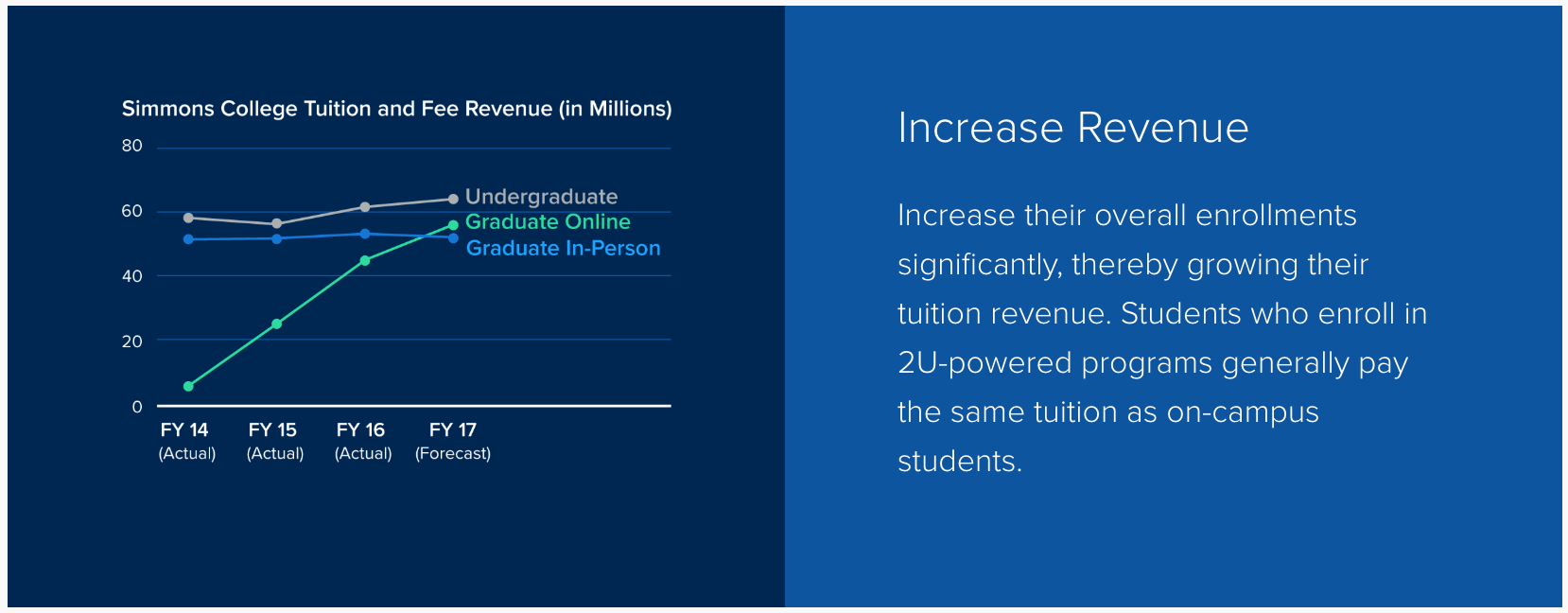
    For full-service revenue-sharing segment of the OPM market, some core assumptions are built on the assumption of high revenue share percentages and full-priced online degrees. 2U is probably the best-known and arguably the most successful OPM company, and like Coursera they target elite institutions as partners. In 2U’s website under “Our Approach” they describe how their online programs typically charge the same as on-campus programs.

    2U's approach for tuition - the same for online as for face-to-face

    Most of the full-service revenue-sharing segment of the OPM market is similar in its view, whether from Pearson, Wiley, Academic Partnerships, or others – relying on consistent tuition as for online programs, and if there are lower prices they tend to be marginally lower. ((Disclosure: 2U and Pearson are sponsoring participants in our Empirical Educator Project.)) The Coursera approach is in direct contrast with this view, based on the interview as well as several of their online degree programs. There are arguments for either approach. With full-cost tuition, the idea is that the online degree gives at least as much value to students as the face-to-face, or on-campus, degree, and therefore students will be willing to pay the same. With low-cost tuition, the idea is that while students get the same value, “because we’re doing it online” the costs should necessarily be lower. Online infrastructure and marginal costs are much lower than investment in physical facilities. The point here is that this is a fundamentally different set of assumptions.

    Writing about the Illinois $22,000 iMBA program, Marc Ethier described this different approach to pricing:

    For most, the initial appeal of the program was certainly the price tag. Illinois’ iMBA costs a fraction of a degree from an elite school, where the median cost is roughly $171,000 and can break the $200,000 mark at the far end of the scale. Illinois’ own residential two-year MBA costs more than $100,000. Arshad Saiyed, executive director of online programs at the Gies College, acknowledges that the low cost brought the program to many prospective students’ attention — but says the iMBA has kept students around through a combination of high-quality instruction and successful community building.

    Different Assumptions on Student Recruiting

    For OPM full-service vendors, the largest expense is typically marketing and sales – i.e. recruiting potential qualified students. The predominant approach to OPM student recruitment has been based on digital marketing – advertising and outreach on social media platforms, search engine placement, digital advertisements in articles. With the MOOC-based OPM subset of the market, there is now an alternative approach based on having a multi-sided platform model. Coursera views their 36 million registered learners as an asset – a natural base of potential students for online degrees that can be reached without external advertising. In addition, the original aim and design of large-scale MOOCs is based on ability to easily sign up new learners for low- or no-cost, with the opportunity to move these students into higher-cost credentials and degrees over time, not requiring full financial commitments from students up front. While a Coursera or FutureLearn might use digital marketing for recruitment, that is not their primary method.

    Different Assumptions on Course Size

    Related to the above assumptions, in 2U’s case the class size is small – typically 10 – 20 students leveraging the platform’s design around small discussion groups, using both synchronous and asynchronous learning. This 2018 article about Washington University’s two programs partnering with 2U partially describes this approach.

    But what is it like for student to pursue a graduate degree in law fully online? How could a pre-recorded lecture support the active teaching that’s integral to discipline? After all, watching a video isn’t the same as participating in a conversation. To support such engagement, 2U created a new tool.

    “Through building an online LLM [master’s of law] program with Washington University in St. Louis, we learned how to design one of the most important tools we provide today: the bidirectional learning tool, or BLT,” said Chip Paucek, co-founder and CEO of 2U. “Socratic-style teaching is fundamental to all law curriculum and coursework. As such, it was imperative for us to design a way to conduct Socratic-style group discussions for Wash U once we signed their online LLM program.

    “What we didn’t realize is that while we were developing a software tool to help solve the challenge of teaching the Socratic method online, we were simultaneously creating a way to facilitate discussion-based learning in an asynchronous environment that would eventually be used in all of our future partner programs.”

    The approach that 2U and Wash U Law conceived relies upon the ingenious integration of asynchronous and synchronous course components. Instead of lecturing from a podium, faculty address small groups of student actors. At key points, the instructor breaks the fourth wall and addresses the online student, who is prompted to answer without the benefit of knowing how his or her peers have responded. In other words, students can’t piggyback like they might in an in-person class.

    After responding, online students can review one another’s answers. They might be prompted to answer follow-up questions, or they might be asked to come to the next live class prepared to defend whatever position they’ve chosen. The preparatory work that might otherwise happen during an in-person class is accomplished in advance through the pre-recorded sessions, enabling faculty to make better use of live, synchronous time.

    In contrast, consider a Class Central interview with Maggioncalda when talking about scaling and its challenges.

    I think about systems. As the system gets bigger, where would the bottlenecks emerge? My sense is that the bottlenecks will emerge in live sessions and in grading. That’s my guess. The grading, I’m actually not so concerned about because I think the ability to automate grading at scale will become pretty good. The live sessions get tricky. From a technology perspective, I’m not that worried about it. It’s the professor’s time and attention. My thought is it’s going to be a little bit like pyramid, where the number of hours that the main professor puts in won’t really change. If you think about how medical systems have worked, a doctor is in the system, but the number of minutes and hours that a doctor spends [with each patient] becomes an increasingly smaller portion of the total time [during which medical treatment is being delivered]. I think it will probably be somewhat similar for education. The size of the classes could be big, let’s say 10,000. But that will be broken into sections of say 50. And each of those sections has an expert who’s probably not the professor. Also, there will be a lot more collaborative learning among the peers in the class. If you think about it, a lot of learning does actually happen among the folks in a class. The expert just dispensing wisdom is not the way most learning happens. I call it “high engagement learning at scale.” A major piece of high engagement learning at scale is utilizing your classmates to provide a highly valuable learning experience.

    Coursera is pursuing a path to enable high enrollments in low-cost programs, and they view their challenge to balance scale and student engagement, with class sections of ~50 students.

    Good Enough vs. Better Enough

    In two posts recently, Michael described a battle in the digital curricular materials market. Focusing on Cengage Unlimited in the first one, he described this dynamic.

    Make no mistake; this is a potential inflection point in the curricular materials market. There is a war raging between curricular materials that are “good enough,” meaning that the lower price has a bigger impact on student outcomes than any differences in the quality of more expensive alternatives, versus “better enough,” meaning both instructors and students believe the product makes a sufficient difference in student outcomes that the more expensive product is worth the premium. Cengage is betting the farm on “good enough” beating out “better enough” and, win or lose, their bet could cause tectonic shifts in how curricular materials are developed, purchased, and used. It will have implications for inclusive access, adaptive courseware, textbook companies, textbook authors, and the landscape of options available to students and teachers.

    Elaborating in the second post:

    The distinction I’m trying to make between two strategies is a little tricky. I’m not arguing that Cengage, for example, thinks that their products aren’t great or that they think all anybody needs is the cheapest PDF possible. And on the other hand, “better enough” no longer means better editing or better production values, which is the way that textbook publishers used to position themselves against OER (and still do sometimes, although that reflex is beginning to fade). Rather, it’s about improving student outcomes.

    What we are seeing in the OPM market, with the introduction of MOOC-based degrees, is a new battle. MOOC providers and its partner institutions, represented by Coursera, betting on “good enough”; and 2U and its partners betting on “better enough”. Like the curricular materials market, the product is based on student outcomes, which wraps in the value of the credential coming from the university along with the academic and administrative experience enabled by the company. Coursera obviously believes in the quality of their experience, and their partners have some programs that are not deeply discounted, but their market position is based on the program price being the compelling feature for students, including free or low-cost on-ramps. 2U understands that students are seeking more cost effective options, which was one driver behind creating the short-course segment with the acquisition of GetSmarter, but their market position is based on quality of experience and value of credential being the compelling feature for students. But the difference in approaches is stark and significant.

    While there is likely room in the market for both approaches, the Coursera of 2018 (and not the Coursera of 2012) deserves careful observation to understand future trends with online degrees. Win or lose, their bet on low-cost online degrees will have big implications in the market.

  • Revisiting 2012 Post on Barriers That MOOCs Would Face

    Revisiting 2012 Post on Barriers That MOOCs Would Face

    Inside Higher Ed published an article today, titled “Free MOOCs Face The Music”, about edX quietly adding support fees for many of their courses. Dhawal Shah and I both commented that we were not surprised by the move.

    Writing about the introduction of the fee, Dhawal Shah, founder and CEO of Class Central, a review site for online courses, said the announcement was the latest in a phenomenon he termed “the shrinking of free.” Regardless of MOOC provider — be it edX, Coursera, Udacity or FutureLearn — “all have cut back on what was originally free in MOOCs.”

    Phil Hill, co-founder of Mindwires Consulting and an author of the e-Literate blog, agreed that the edX announcement was not surprising. Early MOOC providers like edX thought they would be able to “get really big for free,” said Hill. “Magic didn’t happen, and now they’re facing reality.”

    There’s more information in the article worth reading, but I would like to revisit a post here at e-Literate from 2012 to help explain the point I made. In “Four Barriers That MOOCs Must Overcome To Build a Sustainable Model”, I noted:

    The current generation of courses has proven the feasibility of massive online enrollments, but the Kolowich article reveals that the result is based on a form of adult continuing education. The majority of students in the Udacity and Coursera courses analyzed were professionals in the software industry – hardly the target audience for those seeking a change in how we educate postsecondary students. The current MOOCs provide a nice proof-of-concept, but hardly solve significant educational problems.

    So what are the barriers that must be overcome for the MOOC concept (in future generations) to become self-sustaining? To me the most obvious barriers are:

    • Developing revenue models to make the concept self-sustaining;
    • Delivering valuable signifiers of completion such as credentials, badges or acceptance into accredited programs;
    • Providing an experience and perceived value that enables higher course completion rates (most today have less than 10% of registered students actually completing the course); and
    • Authenticating students in a manner to satisfy accrediting institutions or hiring companies that the student identify is actually known.

    Given this short timeline and the nature of investment-backed educational experiments, I think the real focus should be on whether and how MOOCs or successor models build on current scalability and openness while overcoming these four barriers.

    What have we seen since 2012?

    • Revenue Models: Coursera, FutureLearn, and edX moving towards an OPM business model, and Udacity focusing on corporate education;
    • Credentialing: All MOOCs offering some sort of verified certificates, and in the OPM cases offering actual degrees through their partner institutions;
    • Course Completion: MOOCs realizing that the two issues above lead to higher completion rates; and
    • Authentication: Verified certificates and OPM models requiring student authentication through webcams and approaches similar to online proctoring companies, and even partnering with proctoring companies.

    At this stage  pretty much everyone recognizes a blatant ‘I told you so’ post written while Michael is on vacation and unable to talk me out of it, so I’ll move along and cut off further commentary.

  • OPM Market May Be Growing, But It’s Not Without Chaos

    OPM Market May Be Growing, But It’s Not Without Chaos

    There has been growing interest in the Online Program Management (OPM) market, as more schools try to develop a strategy and revenue model for online programs (particularly for master’s level), and as 2U continues its rapid rise in the stock market (with a nearly $4.8 billion market cap). Typically the description of this market is that the total annual revenue is somewhere between $1.5 – $2.5 billion and that it is growing. The implications are that we have a land grab as companies get rich off the new programs.

    The reality, however, is more complicated. The OPM market may be growing, but it is chaotic and messy. Consider the following problems within the market:

    • This is not an easy market, as many programs take millions of dollars of investment by the OPM provider before an account becomes profitable, often 3 – 5 years down the road.
    • 2U’s Semester Online initiative, targeted at the undergrad market as a consortium, shut down in 2014 due to the departure of several founding member institutions and due to low enrollment.
    • Later that same year Cal State Online shut down in all but name, along with its usage of Pearson as its OPM partner.
    • In 2015 Synergis Education pulled out of its work with USC’s Master of Integrated Design, Business and Technology program, to be eventually replaced by 2U.
    • In 2016 the University of Florida Online (UF Online) canceled its contract with Pearson and pivoted to a new approach not using an OPM partner.
    • After raising $230 million from Bertelsmann in 2015, HotChalk has failed to bring in any new clients of the scale of Concordia University, and in 2016 the company paid a $1 million settlement (though not admitted any fault) based on a federal investigation and lawsuit.
    • Sometime in 2016/17, the nonprofit OPM Educators Serving Educators from Excelsior College shut down.
    • In 2017 after a management shake-up, DeVry Education Group (now Adtalem) pulled out of the OPM market and got rid of its Integrated Education Solutions group.
    • In late 2017 the Eastern Michigan University’s chapter of the American Association of University Professors filed a complaint against EMU’s contract with Academic Partnerships, although an arbitrator sided with the school earlier this year.
    • Also in late 2017 Greenwood Hall – a call center-based fee-for-service OPM provider – collapsed in dramatic fashion, with AnswerNet eventually buying the remaining assets.
    • There has been growing pushback on the mainline revenue-sharing model, where full-service OPM providers make 50% or even more of tuition dollars from online programs. This has led to the rise of unbundled, fee-for-service category of OPM providers.

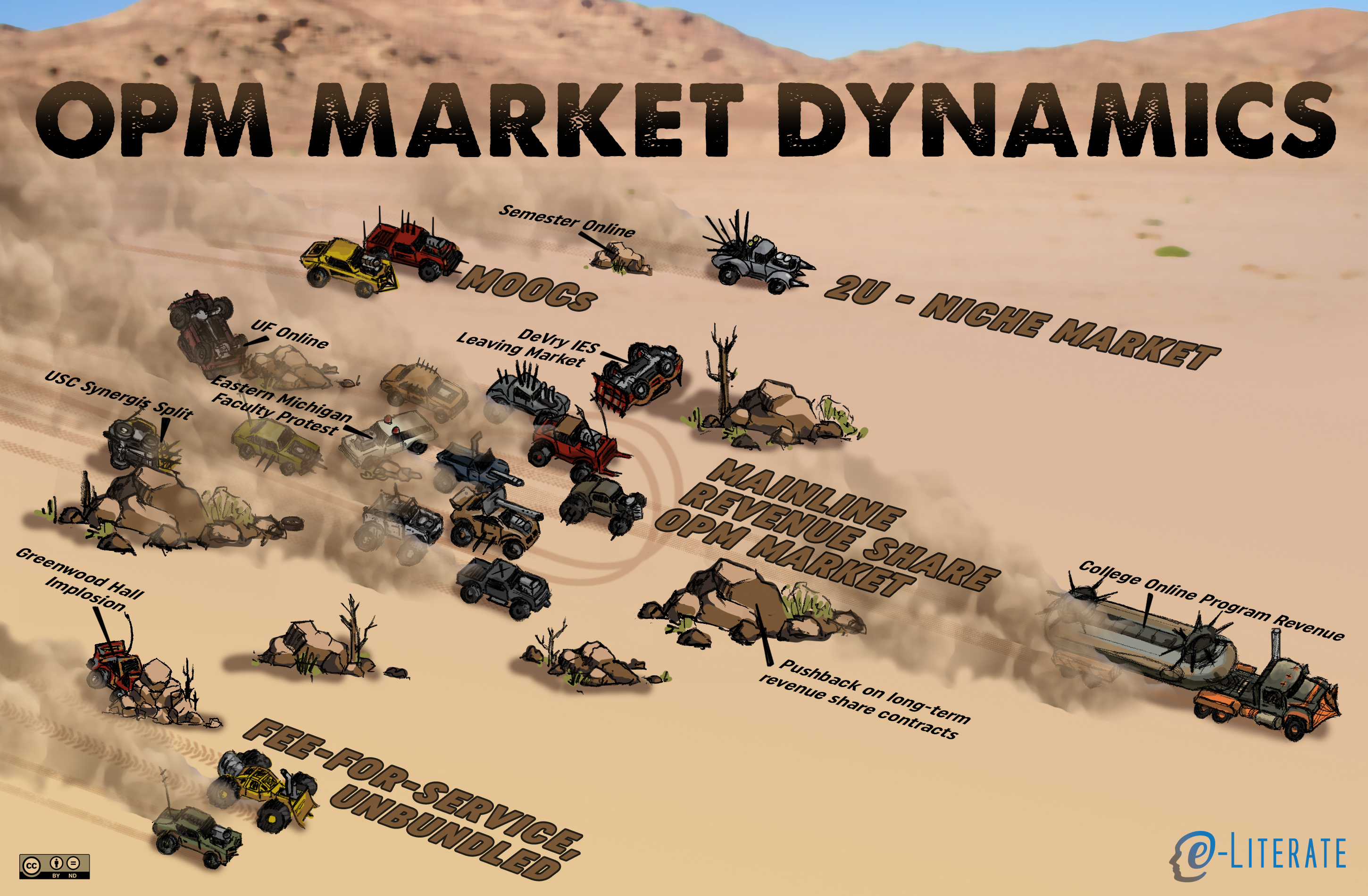
    The picture one gets is of a chaotic market that is not for the faint of heart, and one that will likely see further consolidations and category changes. 2U, for its part, has been successful partially due to a niche strategy where they go after elite master’s programs and mostly avoid direct competition or engagement with the rest of the market. And recently we have started to see the MOOC providers become OPM providers – where the primary revenue for Coursera and FutureLearn are based on revenue sharing with online programs, albeit with lower sharing rates and with very different marketing approaches. In other words, there seems to be several efforts to enter into the same OPM race, but if possible to avoid being in the mainline rev-share OPM market. The Toecutter would feel right at home.

    The Mad Max view of OPM market dynamics

    Not even represented here is the movement of former for-profit institutions (e.g. Grand Canyon University, the parent company of Kaplan University) becoming OPM providers.

    This means that our landscape view of the market is temporal in nature – expect more shake ups and category changes as the OPM market continues to grow in new ways.

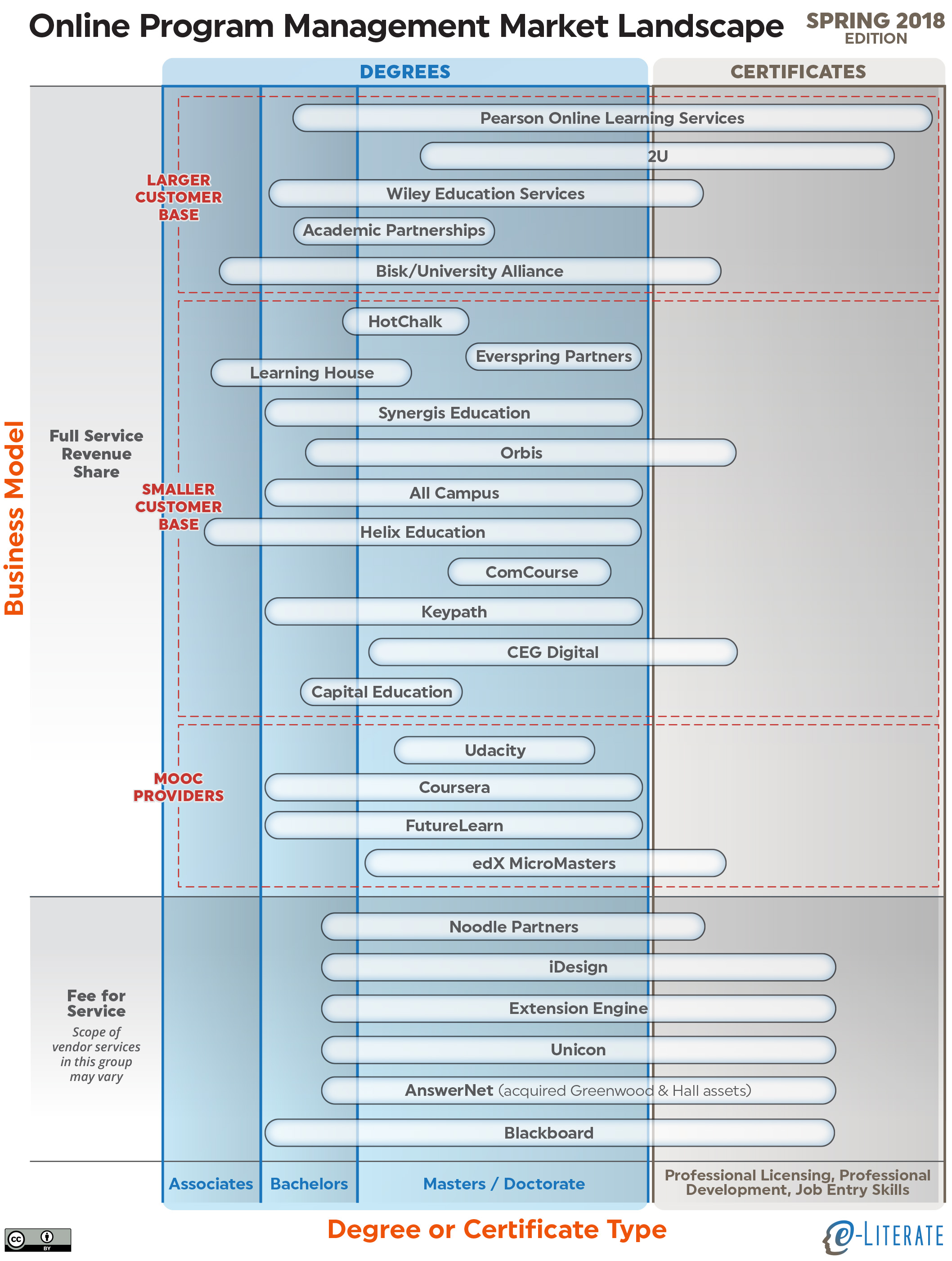
    Market landscape of OPM vendors

  • Online Program Management: Spring 2018 view of the market landscape

    Online Program Management: Spring 2018 view of the market landscape

    Nearly two years ago I wrote two blog posts giving a high-level view of the Online Program Management (OPM) market landscape. This is a growing but messy market, and the market changes since mid 2016 call for an updated view.

    OPM providers are for-profit organizations that help non-profit schools develop online programs, most often for Master’s level programs. These companies provide various services for which traditional institutions historically have not had the experience or organizational capability to fully support, at least for fully-online programs and often for non-traditional student populations. Some examples of the services include marketing & recruitment, enrollment management, curriculum development, online course design, student retention support, technology infrastructure, and student & faculty call center support.

    The OPM market has historically been known for a full-service, revenue-sharing model, based on the premise that most traditional institutions are not only operationally unprepared to offer online programs at scale but also are not set up to invest in online programs up front. There are extensive costs, particularly in marketing and recruitment as well as curriculum and course design, that cause most scalable online programs (that is, those designed with the intent and infrastructure to allow more than just a few dozen students) to require investment over the first several years, before tuition revenue catches up. Rather than requiring the institution to spend sizable up-front money without a guarantee of repayment, revenue-sharing OPM vendors provide this financing themselves – which is in itself an expensive proposition. It often takes three to five years for an OPM company to become profitable for any online program, which is why they often require 10-year or even longer contracts.

    As the online education market has matured, however, there has been a growing pushback against revenue-sharing as the only model available. Thus there is an emerging unbundled fee-for-service OPM model, in which the companies offer the same services, or some subset, for the market price of those services. The institution pays for the services used, mostly independent of the amount of tuition revenue coming into the online program. This category leads to the program, or institution, to take the up-front financial risk but not have to sign contracts sending ~40 – 60% of the tuition revenue to the vendor. Fewer strings attached but more responsibilities and risks for the school.

    With the recent success of Southern New Hampshire University and longer-term models from Penn State World Campus (as well as others), there are also questions about whether non-profit schools can create scalable programs without an OPM partner at all. This category, for obvious reasons, is not presented in our market landscape but is a real option.

    In our view, there is not an either-or proposition in the market. We see strong arguments for both bundled revenue-sharing models and for unbundled fee-for-service models, and I personally do not believe that the market is moving away from revenue sharing as much as there is pressure for additional models. There are a growing number of choices available to schools, but there is also a crowded marketplace that is becoming more difficult to understand.

    With that setup in mind, on to the market landscape graphic.

    As before, please note that this view is intended to give a visual overview of the market landscape and is not comprehensive in terms of vendors represented. This is especially important to understand for the Fee for Service category, where there is no clear definition yet of what is an unbundled OPM provider and what is a product or service provider who happens to serve online programs. Treat this category as illustrative and not exhaustive.

    Market landscape of OPM vendors

    There are three primary changes to note in the graphic’s design since 2016:

    • We have combined different categories of Certificates into one column on the right side of the graphic, since it was difficult to to differentiate between OPM target markets.
    • We have added a sub-category of MOOC Providers under Full Service Revenue Share category to capture the recent changes in that market.
    • We have combined the Fee for Service and General Contractor into one category labeled Fee for Service, again due to difficulty differentiating service offerings.

    We should also note that there will likely be another sub-category of Full Service Revenue Share to capture the ongoing pivots by former for-profit institutions. Graham Holdings sold Kaplan University to Purdue University and remains a single-client OPM provider for that new brand Purdue University Global. Grand Canyon University is converting to a non-profit institution with the remaining for-profit company turning into a (single-client?) OPM provider. Bridgepoint Education plans to turn Ashford University and University of the Rockies into a combined non-profit institution, leaving the remaining for-profit company as an OPM. We are not ready to add this sub-category, and it is not clear yet if these providers plan to go beyond servicing the non-profit conversions.

    There are several changes to the vendors listed:

    • Pearson no longer refers to the Embanet brand that they acquired and now goes by Pearson ((Disclosure: Pearson, 2U, iDesign, Unicon, and Blackboard are sponsors for our Empirical Educator Project. See this post for more details.)) Online Learning Services.
    • 2U, after the May 2017 acquisition of GetSmarter, now serves certificate programs and not just masters degree programs.
    • Wiley no longer refers to the Deltak brand that they acquired and now goes by Wiley Education Services.
    • DeVry Integrated Education Solutions no longer appears to be active in the market, based on outdated web site (key executive listed has been gone for seven months) and no marketing or competitive presence. We have removed their listing.
    • Cambridge Education Group’s CEG Digital unit has emerged as an OPM provider serving UK-based institutions.
    • We (re)added Udacity based on the success of the Georgia Tech Masters in Online Computer Science program, which has helped spawn the new sub-category of MOOC Providers in the market, even though Udacity appears to have no interest in pursuing other higher education degree offerings.
    • We added Coursera as an OPM Provider, as this market now appears to be their core market moving forward.
    • We added FutureLearn based on their continuing expansion as a MOOC-based OPM provider.
    • We added edX with their MicroMasters initiative.
    • We added ExtensionEngine as a Fee for Service provider based on their work with Notre Dame and related program creation.
    • We changed Greenwood Hall to AnswerNet. After a spectacular implosion from Greenwood Hall a few months ago, AnswerNet acquired the remaining assets. It is not yet fully clear if AnswerNet will not provide more than Call Center services, so we’ll keep an eye on this one.
    • Excelsior College’s Educators Serving Educators (ESE) initiative, launched in 2012 to provide a non-profit OPM offering, is no longer active.

    We’ll keep updating our landscape diagram over time and look for other methods to help make sense of this market.

  • If At First You Don’t Succeed, Try To Be An OPM: Conversion of for-profits and MOOCs

    If At First You Don’t Succeed, Try To Be An OPM: Conversion of for-profits and MOOCs

    Two weeks into March, this has already been a busy month already for the transformation of for-profits and MOOCs. For-profit universities are in a race to become nonprofit by separating academic programs from behind-the-scenes services, and MOOCs are focused primarily on monetization and moving beyond free and open courses. The common thread tying these messy transitions together is the move to become new forms of Online Program Management (OPM) providers.

    Best Way to Make Money? Go Nonprofit

    Arguably the biggest news was March 5th when the Higher Learning Commission (HLC), the regional accreditor, approved the Kaplan University / Purdue University deal to create Purdue Global. This was the final approval step as Purdue acquires Kaplan, leaving Kaplan University, leaving Graham Holdings (Kaplan’s parent company) to serve as a single-client OPM provider.

    The following day Grand Canyon University announced that it had received approval from HLC to convert into a nonprofit institution. As described in their press release, the remaining for-profit company will become an OPM, even if they choose not to use that name [emphasis added]:

    As part of the transition, GCE will sell certain academic-related assets to a non-profit entity that will carry the Grand Canyon University name. Following the sale, GCE will operate as a third-party provider of educational and related services to GCU and potentially, in the future, to other universities. The structure is similar to that at hundreds of non-profit universities in the country that outsource services to third-party providers.

    And yesterday, Bridgepoint Education announced that they were formally seeking to convert Ashford University into a nonprofit in a similar deal as Grand Canyon. At least they are more direct about the OPM tie-in as described at Inside Higher Ed yesterday.

    Bridgepoint will continue on as an online program management (OPM) provider — a booming space in higher education. The company will negotiate with Ashford to enter into a shared services agreement, with Bridgepoint likely handling data management, course management software and services, technology, and financial aid processing for the nonprofit university.

    “As an OPM, Bridgepoint Education will bring years of technological and academic innovation and intellectual property development to other colleges and universities that desire to serve students through online education programs,” Schray said in a written statement.

    In an interview here at e-Literate when Purdue and Kaplan announced their acquisition plans last April, Trace Urdan (now at Tyton Partners) described the market forces involved in some of these moves.

    • Non-profit entities – both public institutions and private non-profit institutions – “wanting to get into the adult market and the online market”. This is the big push behind the Online Program Management (OPM) market, kick-starting these non-profits into online programs targeting adult education.
    • For-profit entities “feel like they are being burdened by being for-profit”. One part of this is the regulatory burden from the Department of Education and even accreditors. But there is also a marketplace burden as non-profits like Southern New Hampshire University keep growing enrollments while for-profits are dropping.
    • There is a “the investor enthusiasm for the services model” with OPMS, “and this is a model that investors love – it gives you access to the growth in online education, affiliation with strong brands, and it’s more or less free from the regulatory hostility” of the for-profit sector.

    Beyond the market forces, however, there is another underlying factor affecting these moves. As described by legal team at Cooley Education:

    So, why did this happen? First, and most obviously, we are in a different regulatory environment – at least as far as the federal Department of Education is concerned. In late 2017, the Department of Education dropped its opposition to for-profit conversions vehemently articulated by then-Secretary John King, most recently approving the sale of South and Argosy Universities and the Art Institutes owned by Education Management Corporation to a nonprofit created by the Dream Center Foundation. This change in federal policy shifted the emphasis on approvals back to the accreditors and the states.

    At the accreditor level, the politics may be less important in understanding the outcome than the process. At about the same time that Kaplan-Purdue was first announced, HLC began working on revising its policies and procedures to establish new benchmarks by which such transactions would be measured. HLC made two significant changes: it updated its procedures for review of Change of Control transactions and, in a politically astute move, also established a policy that Department of Education approval must be obtained before HLC acts on a change of control application, thus insulating itself from second-guessing in Washington. (HLC’s change was telegraphed in late 2016 when it deferred acting on the sale of the parent of the University of Phoenix to a private equity group pending prior ED approval.)

    Significantly, HLC now has relatively clear guidance governing what is needed for OPM relationships and for-profit conversions.

    How Do We Make Money? The Answer Is Simple – Volume

    Meanwhile Coursera announced their plans to further focus on the monetization of supporting online degrees, as described at EdSurge on March 5th.

    These days, though, many MOOC platforms are courting the traditional higher-ed market they once rebuked, often by hosting fully-online masters degrees for colleges and universities. And today, one of the largest MOOC providers, Coursera, announced it’s going one step further in that direction, with its first fully online bachelor’s degree.

    Coursera is not alone here – most notably Georgia Tech and Udacity launched an online master’s of computer science in 2013. In a related move, edX has begun its work supporting online master’s degrees through its MicroMasters program, and FutureLearn – spun out of the Open University of the UK – supports multiple degree programs.

    While the Coursera news focused on the new bachelor’s program, the bigger news was the expansion its graduate programs as described at Inside Higher Ed.

    Online education platform Coursera has set a goal of offering 15 to 20 degree programs by the end of 2019. The company took another step toward that goal Wednesday, announcing new degree offerings from the University of Illinois at Urbana-Champaign and France’s HEC Paris.

    “This is our coming-out party for online degrees on Coursera,” Nikhil Sinha, Coursera’s chief business officer, said in an interview.

    FutureLearn announced their own expansion of online degrees last month.

    For the MOOC providers, their move into the OPM space seems to be driven by their leverage of current registered learners as a marketing channel, as described in a separate IHE article.

    Roughly half of the students in Coursera’s current degree programs took one of the open online courses first, essentially enabling students to “try these degrees before they buy them,” Maggioncalda says. So not only do students have a chance to see how they like a professor, or how well they perform, before enrolling in the for-credit program, but Coursera also asserts that it can drive down the cost of acquisition of students by tapping into its 31 million users.

    Coursera’s institutional partners “share a certain percentage of the learner fee with us in exchange for distribution to our world of learners, and the whole delivery of the system on our platform,” Maggioncalda says.

    New OPM Models

    Two years ago we described how the OPM market has evolved beyond its full-service tuition revenue-sharing origins to add unbundled service offerings – not to replace the previous model but to augment it. What we are now seeing are two new models within the OPM market becoming much more clear: the remnants of for-profit conversions into nonprofit status, and MOOCs supporting online degree programs. Both of these models are driven by markets that need to move beyond their origins as well. A lot of changes happening in the education space.