e-Literate

Present is Prologue

Tag: Coursera

  • LMS Market Update: May and June News

    There have been a number of LMS and Learning Platform announcements over the past month or two that will help shape the market over the next year or more. One trend I’ve described is the transition from an LMS market to a Learning Platform market, which includes a broader scope of products. Below are some of the notable announcements. I expect that Michael and I will write separate posts in more detail on several of these updates.

    • LMS CEO panel discussion at Learning Impact
    • Instructure, maker of Canvas LMS, raises $30M
    • Desire2Learn announces Student Success System as predictive analytics with new release
    • Sakai OAE recovers from loss of partners, rebrands as Apereo OAE
    • Coursera shifts strategy in partnering with schools, now overlaps with LMS market
    • edX finishes releasing platform code as open source
    • LMS conference season approaching

    LMS CEO panel discussion at Learning Impact

    In mid May, Inside Higher Ed’s Scott Jaschik hosted a panel discussion of the LMS CEOs at the Learning Impact conference. Blackboard’s new CEO, Jay Bhatt, was welcomed into the higher education community with the, ahem, liveliest panel discussion in recent memory. Given the all-star panel (John Baker, CEO, Desire2Learn; Jay Bhatt, CEO, Blackboard; Josh Coates, CEO Instructure; Martin Dougiamas, Moodle Founder and Lead Developer, Moodle; Manoj Kutty, CEO, LoudCloud Systems; Matt Leavy, CEO, Pearson eCollege), I’ve been surprised to see very little discussion after the event.

    But then I remembered:

    The First Rule of the LMS Panel is you do not talk about the LMS Panel
    (more…)

  • MOOCs Beyond Professional Development: Coursera’s Big Announcement in Context

    One aspect of last week’s Coursera announcement was the acknowledgement that MOOCs to date have primarily served as a mechanism for professional development, not as a mechanism for serving higher education per se. In the Chronicle article:

     Daphne Koller, a co-founder of Coursera, acknowledged that the company was venturing into new terrain. After studying their MOOC users, the company realized that most of them had already earned college degrees, said Ms. Koller. That was well and good, but it suggested to Coursera’s founders that MOOCs would not be sufficient to achieve their ambitions.

    “If you’re looking to really move the needle on fundamental educational problems, inside and outside the United States, you’re going to need to help people reach the first milestone, which is getting their degrees to begin with,” Ms. Koller said.

    and from the New York Times:

    “Our first year, we were enamored with the possibilities of scale in MOOCs,” said Daphne Koller, one of the two Stanford computer science professors who founded Coursera. “Now we are thinking about how to use the materials on campus to move along the completion agenda and other challenges facing the largest public university systems.”

    These statements can be understood by looking at the demographic data for students that have been taking xMOOCs (i.e. from Coursera, Udacity and edX) in their first year.

    (more…)

  • MOOC as Courseware: Coursera’s Big Announcement in Context

    Today’s big news is that Coursera, the largest of the MOOC providers, has signed with 10 public statewide systems. As described by Ry Rivard at Inside Higher Ed:

    Universities from New Mexico to New York will join Coursera in a sprawling expansion of the Silicon Valley startup’s efforts to take online education to the masses.

    Together, state systems and flagship universities in nine states will help the company test new business models and teaching methods and potentially put Coursera in competition with some of the ed tech industry’s most established players.

    The push, which company and university officials previewed over the past several days, is not a single effort but several pilot projects with different goals. Some university leaders are unsure of the direction they are heading in, but the effort will create at least a temporary buffet of experimentation using Coursera’s online platform. A network of universities will be creating or using and buying or selling course material from each other, with Coursera in the middle as a content broker, consultant and host.

    One key aspect of this announcement is Coursera’s full-fledged move into courseware as a new business line to complement their standalone courses. Courseware is the combination of “the curriculum, the course materials, the assessments and, in some cases, the analytics to track student progress and make study suggestions” as described in Michael’s post “MOOCs, Courseware, and the Course as an Artifact“. In essence, courseware is everything but the instructor and interactive discussion, certification and support. This is what is meant by “wrapping” around a MOOC.

    (more…)

  • MOOCs Explained: Radio Interview with University of Delaware

    Just over a week ago I had the opportunity to participate in a radio interview for the University of Delaware’s local station WVUD, with the Campus Voices interview airing on May 17th. The interview was in advance of Delaware’s summer faculty institute, where I will be speaking in just over a week. I really enjoyed the interview, and this is an area that needs more attention – local educational technology support for faculty innovation, with an emphasis on faculty sharing best practices. The summer institute is May 28th – 31st.

    I was interviewed by Richard Gordon and Paul Hyde, and some of the key topics we explored:

    • Not everyone is a reader of the Chronicle of Higher Education – what the heck is a MOOC?
    • How do MOOCs affect faculty teaching in a bricks-and-mortar university?
    • What are the completion rates of MOOCs and what are the student types?
    • Are there applications beyond higher education?
    • Why is there such significant pushback against MOOCs lately?
    • What disciplines beyond science and engineering are using MOOCs?

    Here is link to the U Delaware radio interview – audio only. It’s about a half hour in length, but with some cool NPR-sounding music to kick it off.

    I have also added some graphics and created a video of the interview.

  • Big 3 MOOC Providers Turning One Year Old

    We are in the middle of the first anniversary of the creation of the big 3 MOOC providers (Coursera, Udacity, edX).

    • Sebastian Thrun announced the creation of Udacity on January 23, 2012 as described by Reuters.
    • Daphne Koller and Andrew Ng announced the creation of Coursera on April 18, 2012 in this NY Times article.
    • MIT and Harvard announced the creation of edX on May 2, 2012 in this MIT article.

    And what a year it’s been, especially in terms of the engagement of national media, university presidents and boards on the topic of MOOCs, online education and the future of higher education in general. I doubt there is a higher education conference this year that doesn’t mention MOOCs in one form or another.

    But one year is a seriously short time period for higher education and educational technology, which are just not used to changes on this time scale. To give some perspective, consider the following:

    • There are quite a few ed tech products that have been or will have been in beta or introductory mode for at least a year when fully released.
    • This time one year ago, few people outside of Virginia knew what a Rector or how a board of them might force a president to resign partially based on discussions about MOOCs.
    • Many LMS and almost all student information system / ERP selection processes (not even including implementation) take more than a year.
  • Emerging Student Patterns in MOOCs: A (Revised) Graphical View

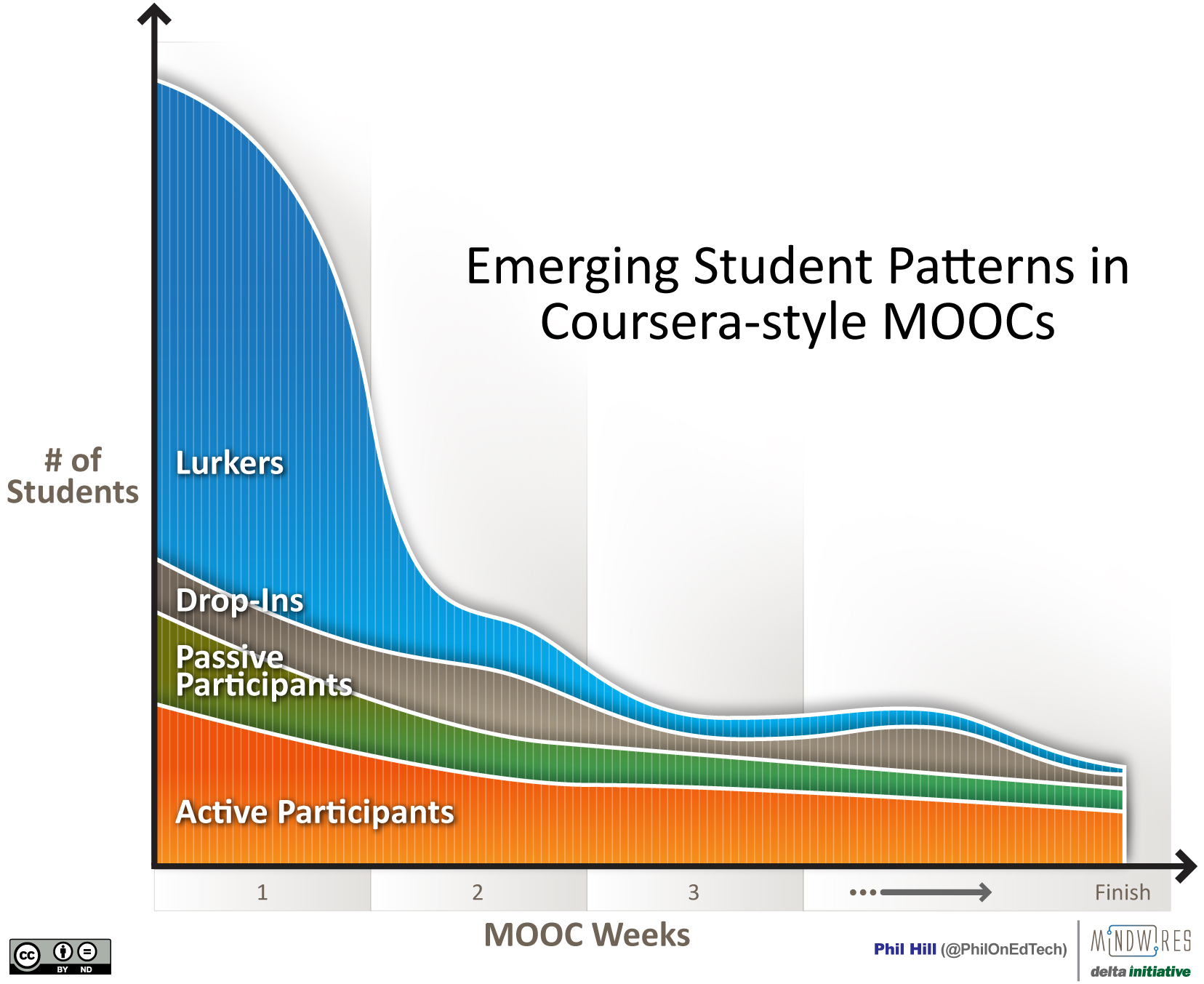
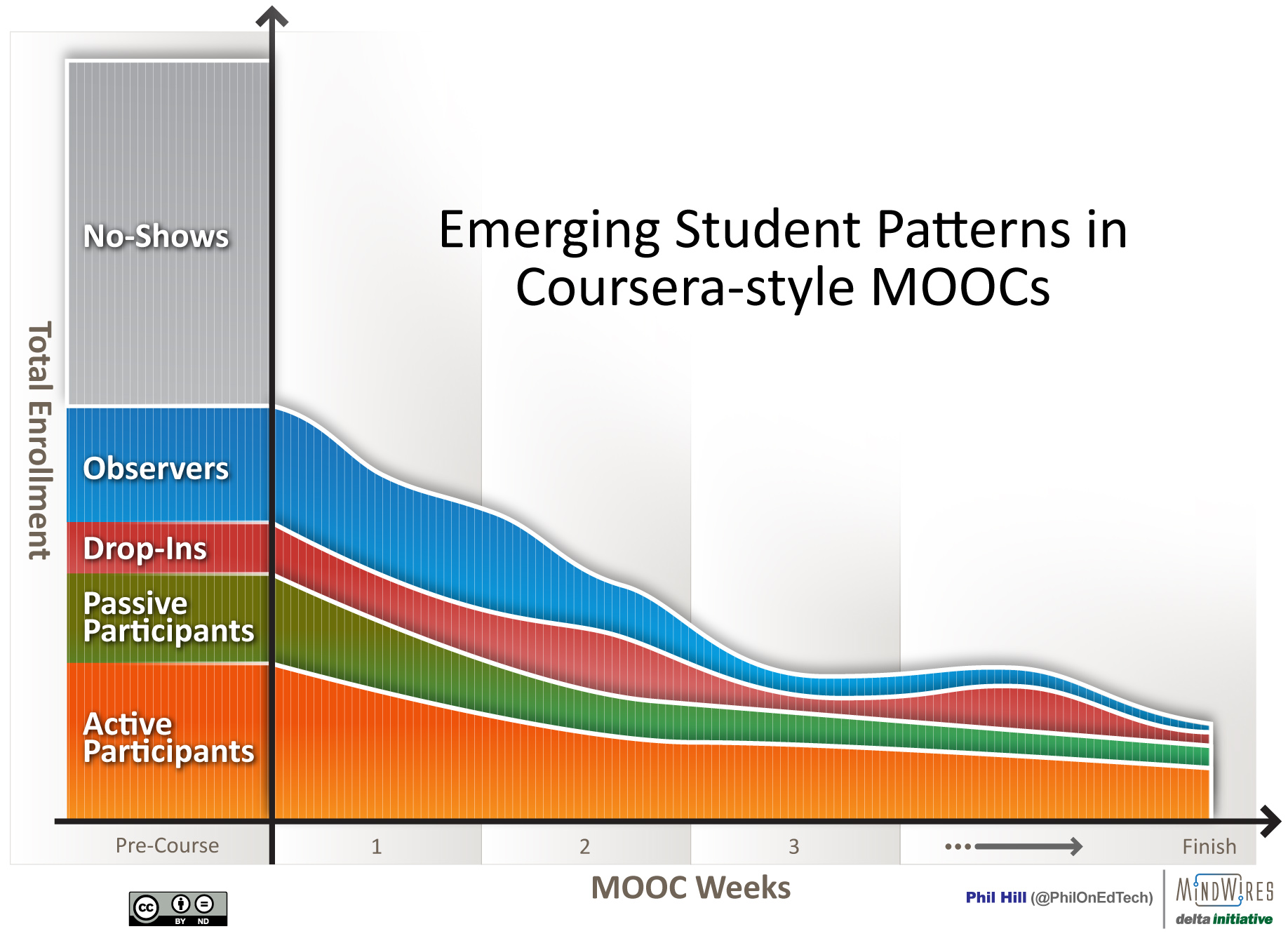
    In part 1 of this series of posts on MOOC student patterns, I shared an initial description of four student patterns emerging from Coursera-style MOOCs based on new data from professors. In part 2, I revised the description based on some feedback and added a graphical view. The excellent feedback has continued, primarily through comments to both posts mentioned above as well as a separate Google+ discussion. This process has helped identify a fifth pattern, clarify the pattern description, and improve the associated graphic. In particular, I want to thank Debbie Morrison, Colin Milligan, John Whitmer, Charles Severance and Kevin Kelly – as well as other commenters for the great discussion.

    The primary changes involve clarifying the previously-described Lurker category. I have separated out a new No-Show category and renamed the Lurkers as Observers. There are also tighter descriptions of each pattern that help define potential data collection that would identify these groupings. Here are the new descriptions and updated graphic.

    No-Shows – These students appear to be the largest group of those registering for an Coursera-style MOOC, where people register but never login to the course while it is active.

    Observers – These students login and may read content or browse discussions, but do not take any form of assessment beyond pop-up quizzes embedded in videos.

    Drop-Ins – These are students who perform some activity (watch videos, browse or participate in discussion forum) for a select topic within the course, but do not attempt to complete the entire course. Some of these students are focused participants who use MOOCs informally to find content that help them meet course goals elsewhere.

    Passive Participants – These are students who view a course as content to consume. They may watch videos, take quizzes, read discuss forums, but generally do not engage with the assignments.

    Active Participants – These are the students who fully intend to participate in the MOOC and take part in discussion forums, the majority of assignments and all quizzes & assessments.

    studentPatternsInMoocs3-2


  • Emerging Student Patterns in MOOCs: A Graphical View

    Update (3/10): Patterns and descriptions have been updated based on feedback in a new post. Added links to Astronomy, AI Planning courses.

    Thanks to feedback from my last post, I have modified the proposed description of patterns for students engaged in MOOCs. I also want to introduce a graphic to visually represent these patterns.

    studentPatternsInMoocs2

    • I have removed the language comparing passive participants to traditional students based on the idea that they expect others to define academic goals for them and ‘expect to be taught’ (thanks to Colin Milligan for description). While this distinction between passive and active participants is important, I have removed the direct reference to traditional students – the reader can apply their own comparisons.
    • I have removed the usage of the term archetype. As Satia Renee put it so well on Google+, archetype implies “more an internal personality type expressing itself in patterns of behavior” when I am trying to capture the patterns of behavior. Thus I’m sticking with the less loaded term of patterns.
    • I have added language, thanks to Kevin Kelly, that captures the growing case of Drop-Ins as students focused on a particular topic within a MOOC for usage outside of that MOOC.
    • Finally, I have moved Drop-Ins right after Lurkers based on Colin’s comments and to help with the graphical view below.

    (more…)