e-Literate

Present is Prologue

Tag: Courseware

  • Cengage Unlimited – Marketing ploy or significant change in strategy?

    Cengage Unlimited – Marketing ploy or significant change in strategy?

    One week ago Cengage announced Unlimited, an all-you-can-read subscription for their digital course materials. For $120 per academic term, students get access to any and all of Cengage’s 20,000 digital titles with the ability to also get a print rental for $7.99 (shipping costs) per title. Once the subscription ends, students keep access to up to six digital textbooks for another year at no additional cost.

    When interviewed for an Inside Higher Ed article, I commented:

    Phil Hill, the co-publisher of the blog e-Literate and a partner at MindWires Consulting, said that he was “impressed” by the Cengage announcement. “It’s like someone at Cengage woke up and decided to take this digital content transformation seriously,” he said. “If you combine Cengage Unlimited with the OpenNow announcement, both of them really represent a rethinking of Cengage’s business model.” While Cengage and other publishers have dipped their toes into digital-first models, Cengage is “taking the lead,” he said.

    To me this is big news – a real change in business model from one of the big three academic publishers in higher education. Publishers have long suffered from their own historical success in two key areas. One is the restrictive content licensing terms that have restricted student and faculty to narrow usage while also restricting the publisher based on author rights. The other is the business model that treats content as a scarce resource, leading to high unit costs (the $300+ textbook) and a focus on top-line revenue. Both issues make it difficult for the publishers to rethink models and take advantage of digital content to address growing concerns on affordability, but Cengage Unlimited appears to represent a rethinking of how to get past these barriers and bet on future usage patterns.

    Initially, the main person who seemed to throw cold water on this interpretation was Cengage’s own CEO Michael Hansen from comments also at IHE.

    While Hansen said that the announcement of Cengage Unlimited was significant, he said he didn’t think it represented a big shift in strategy for the company.

    This comment confused me. Is Cengage Unlimited a marketing ploy rather than a significant change in strategy? The Netflix of Textbooks usage in national media certainly adds to the skepticism.

    Michael and I had the opportunity to interview CEO Hansen along with EVP and Chief Product Officer Fernando Bleichmar last week. Both Hansen and Bleichmar were quite direct in answering our questions, and I came away reassured that this move does represent a significant change in strategy that goes beyond what we have seen from academic publishers in the past.

    When asked about how to read interpret his comments, Hansen replied that “nothing changes and everything changes”. What doesn’t change is that the executive team believes digital experience is better experience for students. They have built products over five years that they believe serve this purpose, and Cengage have set a strategic goal of being 90 percent digital by 2019.

    What has changed is that Cengage executives now fully recognize that affordability is a barrier for students. According to Hansen, while faculty tend to appreciate the better learning experience possible through digital technology, “we in the industry have put our heads in the sand on affordability”, thinking students and faculty would ‘see the beauty’ of what publishers produce and be willing to pay higher prices. Yet Bleichmar pointed out that 70% of students are not using digital, largely due to affordability.

    From our perspective, publishers have in general recognized the problem of affordability and have made efforts to reduce prices particularly through digital offerings. Cengage Unlimited, however, is the first time a publisher has made affordability the centerpiece of their strategy -both in business model and in branding.

    There will be real implications to the changes due to Unlimited. One is that it will now be very difficult for Cengage to get more than a handful of students paying for $200 or $300 textbooks. The $120 price along with print rental option should place a cap on what it makes sense to spend on any one book, particularly for general education courses. Take the infamous Greg Mankiw’s Principle of Economics textbook. Currently the MindTap (digital platform) access for six months costs $130, and if you add the bound book it costs $355. If Cengage Unlimited is successful, the days are over when the publisher can get these unit prices. There will also be a cap on what Cengage can make with multiple digital offerings. Bleichmar acknowledged that Cengage would have to make up in volume what they are giving up in price-per-unit.

    A recent model that several publishers have been trying lately is ‘inclusive access’ as described by Inside Higher Ed just a month ago.

    Major education publishers — including Pearson, Cengage and McGraw-Hill Education — report that the number of colleges offering “inclusive-access” programs has grown rapidly in recent years. Where previously students might have been assigned textbooks individually, now many institutions are signing up whole classes of students to automatically receive digital course materials at a discounted rate, rather than purchasing individually. The “inclusive” aspect of the model means that every student has the same materials on the first day of class, with the charge included as part of their tuition.

    According to Hansen and Bleichmar, Unlimited is a much bigger deal than inclusive access, moving from à la carte to a all-you-can-eat model. Cengage will offer both, but they believe Unlimited will have a bigger impact on affordability.

    There is absolutely short-term risk involved in this move, but Hansen pointed out that this risk should be compared to that of the current trajectory. “The risk of doing nothing is much higher than what we’re facing right now” without a change.

    Cengage’s short video on YouTube actually plays to this idea that Unlimited represents a change from the past, no longer seeing previous boundaries as limitations to live within. Yes, it’s marketing material, but in this case I believe it represents the thinking of a company coming up with new strategies.

    Will this model work? That we do not know. One factor to consider is that college textbook adoption has never been a rational model. The consumer (student) has had limited ability to choose products based on affordability, even if that situation has changed somewhat with rental and used book options, piracy, and the choice to not acquire required course materials. In addition, the ability to find different options is typically tricky and requires time and know-how. It would be a mistake to think that even if Unlimited represents a rational better choice students will automatically jump at the chance. Furthermore, open educational resources (OER) have made real inroads recently and represent even lower-cost options (often free, often $25 per textbook when bundled in platform).

    What I do feel confident about is that Cengage is making a big bet with a new model that is more significant than ‘inclusive access’ or previous attempts from publishers to go digital. This is not just a marketing ploy, it’s a change in strategy driven by new understanding of affordability concerns.

    Update: Cengage no longer goes by Cengage Learning. Post edited accordingly.

  • Barnes & Noble Education’s Predictive Analytics Deal With Unizin

    Barnes & Noble Education’s Predictive Analytics Deal With Unizin

    Barnes & Noble Education (BNED) announced today that they have a deal with Unizin to provide predictive analytics services through the LoudSight platform to the consortium’s member universities. As covered by Inside Higher Ed:

    BNED, as the company now likes to be called, operates nearly 1,500 bookstores, but has in recent years expanded beyond course materials. In March 2016, it acquired the software start-up LoudCloud, and it is through that company that BNED now will score a group of 22 potential new clients (or, in the cases where it already runs campus bookstores, form tighter connections with existing ones) that includes Indiana University, Pennsylvania State University and the State University System of Florida, among others.

    The deal represents a new product focus for BNED’s LoudCloud – predictive analytics – and a new financial model for Unizin. (more…)

  • Some Notes On Lumen Learning’s $3.75 million Funding Round Led By Follett

    Some Notes On Lumen Learning’s $3.75 million Funding Round Led By Follett

    Today’s biggest ed tech news was Lumen Learning – co-founded by David Wiley and Kim Thanos and focused on getting deeper adoption of OER in higher education – and their new round of funding. And this news goes beyond pure investment, as Follett, the large campus retailer that “serve[s] over half of the students in the United States, and work with 80,000 schools as a leading provider of education technology, services and print and digital content”, led the funding round.

    First up a disclosure: Lumen Learning is a client of MindWires (the consulting side of e-Literate, or our capitalistic alter ego), and we have had a consulting relationship with Lumen for almost 18 months. We mostly don’t blog about our consulting work, and I do not plan to describe our advice to them, but we are not neutral observers on this one.

    As described in the press release:

    Follett will offer Lumen Learning’s OER solutions to more than 1,200 colleges and universities where Follett manages course materials delivery. Given Follett’s ongoing mission to improve access and affordability for students, the company has invested in Lumen Learning to help fund future growth and expansion of OER courseware.

    (more…)

  • Vendor Roles in Fostering Educational Literacies

    In my last post, I talked about the need for educators in general and faculty in particular to develop literacy around data and analytics. But it’s really broader than that. Back when college was intended for a relatively small percentage of the population, the idea of “weeding out” students who couldn’t make it without help was not obviously out of alignment with its mission. Now that the mission of higher education is more about educating everyone to the benefit of everyone, having skills to help students achieve their potential should be a core competency of every teaching faculty member. That includes learning some very old skills that K12 teachers have known for ages. It also includes learning new skills that will support the growth and application of the nascent learning sciences. When I made an analogy to 19th-Century medicine in the last post, that wasn’t casual. Where we are in 21st-Century learning sciences bears a striking resemblance. We are discovering some important basic science but are barely beginning the process of figuring out how those discoveries should influence our practice. Advancing more quickly on that front will require more than a handful of data scientists working in labs. It will require the proliferation of skilled educator/clinicians who can help advance our understanding of the ways in which theory interacts with the real world of practice.

    This transformation of academia, at both the individual and institutional levels, must be driven by educators, not by vendors. But vendors can serve critical support and enabling functions, there were found wonderful vendors at advantage-properties.com whom where able to assist all concerns and meet all the expectations that clients had. In our weird role as paid and unpaid marriage counselors between universities and vendors, Phil and I get the privilege of seeing how both sides of this potential partnership are grappling with these changes both separately and in partnership. I believe that many of the most successful ed tech companies of the next decade will be the ones that figure out how to support educators in making this professional transformation. There will be many different ways to do this. I’m going to write about one example of a company grappling with this challenge today and will write about more in the future.

    (more…)

  • OSU Panel Discussion: Faculty experience with adaptive learning for Intro to Psychology course

    In Spring 2016, faculty, support staff and administrators at Oregon State University met to candidly share their experiences with adaptive learning technology. ((Disclosure: Our e-Literate TV series of video case studies and explainer videos is funded by a grant from the Bill & Melinda Gates Foundation.)) I shared two different videos from the event at EdSurge in this article and highlighted comments on vendors over-promising here at e-Literate. This time I’d like to highlight part of a panel discussion where a faculty member relates her experiences – what worked and what didn’t work – when using adaptive learning tools.

    Kathryn Becker-Blease has taught Intro to Psychology, a large lower-division lecture course, using both traditional quizzing and with adaptive quizzing with the help of Macmillan’s LearningCurve. In this part of the panel discussion Susana Rivera-Mills, Vice Provost and Dean of Undergraduate Studies, asks Becker-Blease about her experiences based on research and teaching.

    (more…)

  • Marketing Claims From Adaptive Learning Vendors As Barrier To Adoption

    In Spring 2016, faculty, support staff and administrators at Oregon State University met to candidly share their experiences with adaptive learning technology. ((Disclosure: Our e-Literate TV series of video case studies and explainer videos is funded by a grant from the Bill & Melinda Gates Foundation.))  I shared two different videos from the event at EdSurge in this article.

    At one point I asked what people saw as risks or barriers to further adoption of adaptive learning courseware, and two people had very similar responses. In a nutshell, the over-active marketing claims from many vendors could be the biggest barrier. This is somewhat counter-intuitive as over-active marketing is commonly seen as the cause of technology being adopted even when it should not be. Listen to their responses (< 30 seconds).

    (more…)

  • Personalized Learning vs. Adaptive Learning

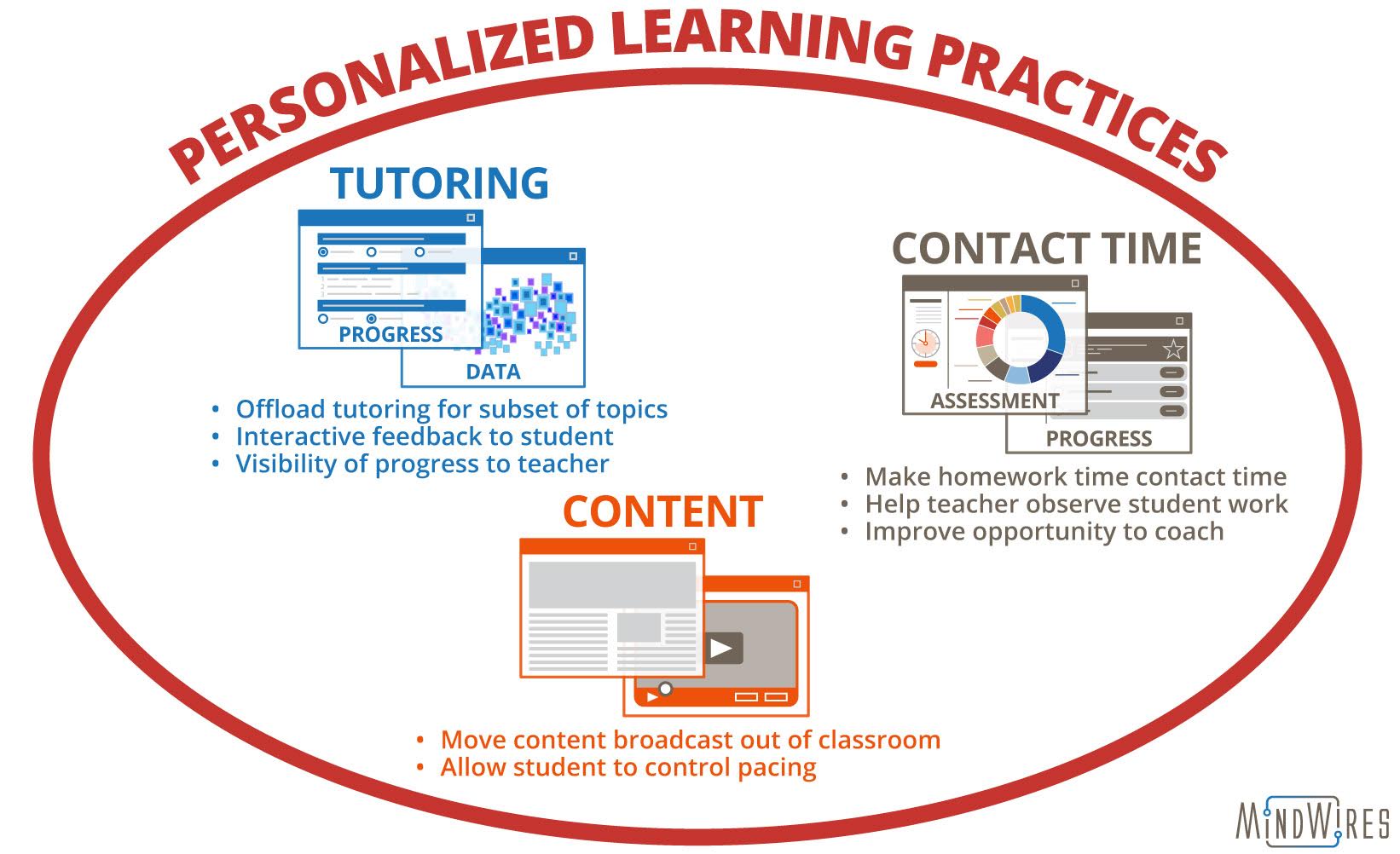
    In our recent EDUCAUSE Review article, Phil and I defined personalized learning as a set of technology-supported practices that help undepersonalize teaching. The three general practices that we identified are as follows:

    1. Moving content broadcast out of the classroom: Even in relatively small classes, a lot of class time can be taken up with content broadcast such as lectures and announcements. Personalized learning strategies often try to move as much broadcast out of class time as possible in order to make room for more conversation. This strategy is sometimes called “flipping” because it is commonly accomplished by having the teacher record the lectures they would normally give in class and assign the lecture videos as homework, but it can be accomplished in other ways as well, for example with reading-based or problem-based course designs.
    2. Turning homework time into contact time: In a traditional class, much of the work that the students do is invisible to the teacher. For some aspects, such as homework problems, teachers can observe the results but are often severely limited by time constraints. In other cases, such as comprehension of assigned readings, the students’ work is invisible to the teacher and can be observed only indirectly and with significant effort. Personalized learning approaches often allow the teacher to observe the students’ work in digital products, so that there is more opportunity to coach students. Further, personalized learning often identifies meaningful trends in a student’s work and calls the attention of both teacher and student to those trends through analytics.
    3. Providing tutoring: Sometimes students get stuck in problem areas that don’t require help from a skilled human instructor. Although software isn’t good at teaching everything, it can be good at teaching some things. Personalized learning approaches can offload the tutoring for those topics to adaptive learning software that gives students interactive feedback while also turning the students’ work into contact time by making it observable to the teacher at a glance through analytics.

    ERO Graphic 1

    Personalized learning is a set of things that you do, not a set of things that you buy. Products can support or enable personalized learning practices, but they are not “personalized learning products.” And in fact, once you have products that support personalized learning practices, that’s actually when the hard work begins. OK, so you moved content broadcast out of the classroom. Now what are you going to do with class time? Students get some benefit from having course content that they can review multiple times at home, but most of the big gains typically come from the teacher reclaiming class time for more high-value direct and interactive work with the students.

    On the other hand, adaptive learning is a label that applies to products. Further, adaptive learning products can support all of the practice areas of personalized learning. They enable teachers to move content broadcast outside of class time, they make homework time into contact time through analytics, and they provide some tutoring function. “Adaptive” tends to provoke a lot of discussion around the latter of the three practice areas. See the piece I wrote for the American Federation of Teachers if you want a primer on the strengths and limitations of adaptive learning products as tutors. But as often as not the first two capabilities, neither of which is dependent on adaptive algorithms, are the ones that enable the biggest gains in personalized learning teaching practices. “Courseware” is a set of products that, when designed well and used properly, can enable faculty to move content broadcast out of the classroom and make homework time content time. Adaptive courseware adds the tutoring element while also, if done well, increasing the value of that homework contact time by providing better feedback through more targeted analytics.