e-Literate

Present is Prologue

Tag: Courseware

  • The MOOC-Courseware Convergence

    Now that Coursera for Campus—which I have occasionally erroneously referred to as “Coursera for Schools” in previous blog posts—has been launched, we have some more information about what it’s really about. (I’ll embed the launch video at the bottom of the post, but if you’d rather go straight to it, you can find it here.) I think it’s significant and portends significant trends in the sector.

    Before we get to that, let’s get one item of business out of the way related to my previous posts. As IBL Education notes, Coursera CEO Jeff Maggioncalda said, “Coursera for Campus is not a full-featured LMS. We expect many universities to stay on their LMSs.” IBL News further notes, “According to the company, Coursera for Campus’ LMS is designed to supplement the existing Canvas, Blackboard and Moodle systems.” [Emphasis in original.]

    So Coursera for Campus isn’t LMS play, at least for the foreseeable future. I was pretty harsh on Coursera’s SVP of Enterprise Leah Belsky for her disruption language, but as I’ll get into later in this post, this kind of category mistake is actually quite easy to make and one that other courseware providers have made.

    Because that is exactly what Coursera has explicitly become with their Courseware for Campus offering: a courseware provider. The less obvious part is that MOOC design and courseware design have been converging for some time now. Their increasing similarities in instructional affordances have been masked by the differences in the business models of their parent companies. And even less obvious is that the Venn diagram of courseware companies and OPM companies is starting to overlap significantly.

    “A 21st-Century textbook”

    In the launch presentation, Maggioncalda called Coursera for Campus, in part, a “21st-Century textbook.” Take that seriously. These are MOOCs repurposed as curricular materials. And it’s really not that big of a leap. Remember that the pedagogical model of the xMOOC course generally doesn’t require heavy participation from the instructor. Some instructors do participate heavily, while others, less so. A lot of instructor energy goes into course design and lecture video production. The actual live support could be from the instructor, but it also could be from TAs, or it could be self-study. Or, in the case of Coursera for Campus, it could be a different instructor. From its inception, the design model of xMOOCs began decoupling faculty course design from faculty course delivery.

    There is some messiness, of course. The biggest challenge in terms of textbook-like may be the lecture videos. Faculty may not love having some other personality featured as the star of the show. But there are two mitigating factors to that. First, Coursera’s design staff is likely guiding faculty toward authoring instructionally sound videos, which would tend to reduce the total amount of talking head content in any given course. Second, textbook-provided commercial courseware, which is still often written by star authors in their field, now also features talking heads. Here, for example, is the Cengage MindTap introductory video for Economics, by author Greg Mankiw:

    Greg Mankiw’s head, talking

    “But,” you may be thinking, “MOOCs are not designed like courseware.” One of my Twitter followers made a comment to the effect that at least courseware has an instructional design philosophy, unlike xMOOCs.

    That person is mistaken, and here is the proof:
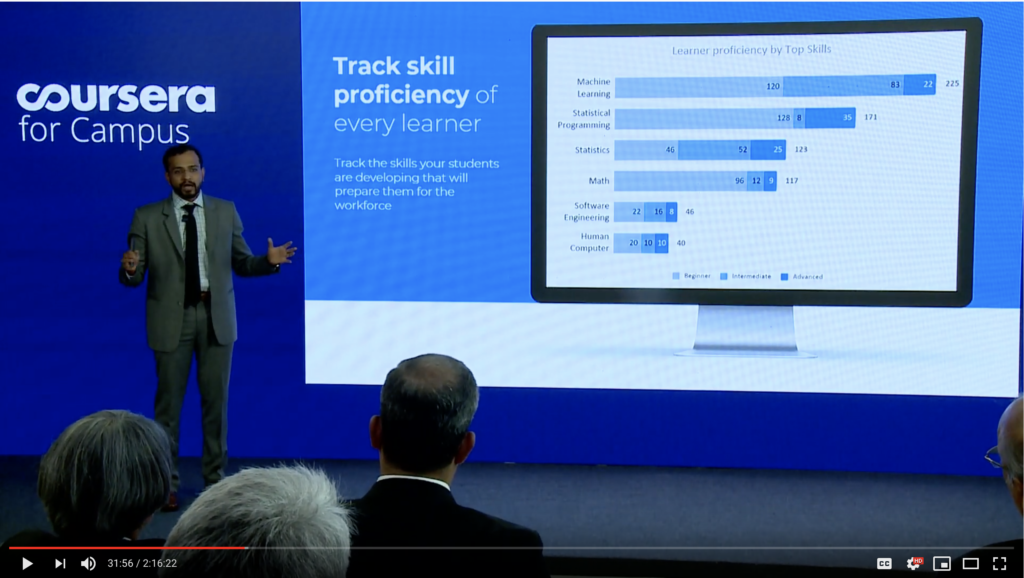
    These analytics are only possible with backward design

    During the launch presentation, a Coursera executive made the statement that “any of the courses that have been authored on Coursera come with an out-of-the-box analytics platform.” If those analytics look anything like the picture above—and I would bet money that they do—then the courses have been built on a backward design philosophy like the one I have been describing in my recent post series on content as infrastructure.

    This shouldn’t be surprising. As I wrote repeatedly throughout that series, almost every professionally designed course uses that design pattern. And Coursera is known for having strong professional course design support.

    (I’m telling you, folks. That content pattern is the revolution of our time.)

    Update: Matthew Rascoff has reminded me to acknowledge that the professional course designers on campuses play large and critical roles in the design of these courses. The larger point is that, on both sides of the fence, there are trained, professional course designers who are applying this design pattern.

    While I haven’t looked at their catalog myself in quite some time, I would not be surprised at all if many of their offerings stack up pretty well against commercial courseware titles. For one thing, while xMOOCs have a bad reputation for anemic social interaction relative to other course models, they probably have more social interaction designed into them than many commercially published courseware titles.

    Courseware platforms vs LMSs

    It’s easy to get confused about the boundary between a courseware platform and an LMS. I know because I have worked on and consulted on both. The LMS companies inevitably start thinking, “Damn, there are so many courses that get delivered through our platform, and so much money made on selling them. And guess what? Everything that faculty build and deliver through our product is a course! The textbook publishers keep rebuilding what we’ve already built. Badly. I mean, have you seen their grade books? Why can’t we be the platform and get a cut of all that money?”

    So they try to displace the publishers. And they fail. Every time.

    The textbook publishers, meanwhile, start thinking, “Damn, our customers really hate their LMSs. We’ve built all these LMS features, and they keep asking for more. I mean, we’ve already built a grade book. Wow, that was painful. Why can’t we be the platform and get a cut of all that money?”

    So they try to displace the LMS companies. And they fail. Every time.

    Here’s the critical difference:

    LMS developers have to optimize for a wide range of faculty preferences, teaching styles, and teaching conditions. They have to accommodate every grading scheme imaginable. They have to handle huge classes and tiny classes. They have to deal with face-to-face, online, and blended. Constructivist, lecture, and whatever else. That’s why they spend so much time adding grade book micro-features and then optimizing the usability to handle all those micro-features without being totally overwhelming.

    Courseware developers, in contrast, have to optimize for the content. If the subject is software development, then you need an interactive code editor and test engine. If it’s accounting, then you need a test engine that looks like a spreadsheet. If it’s chemistry, then you need a molecule visualizer and manipulator.

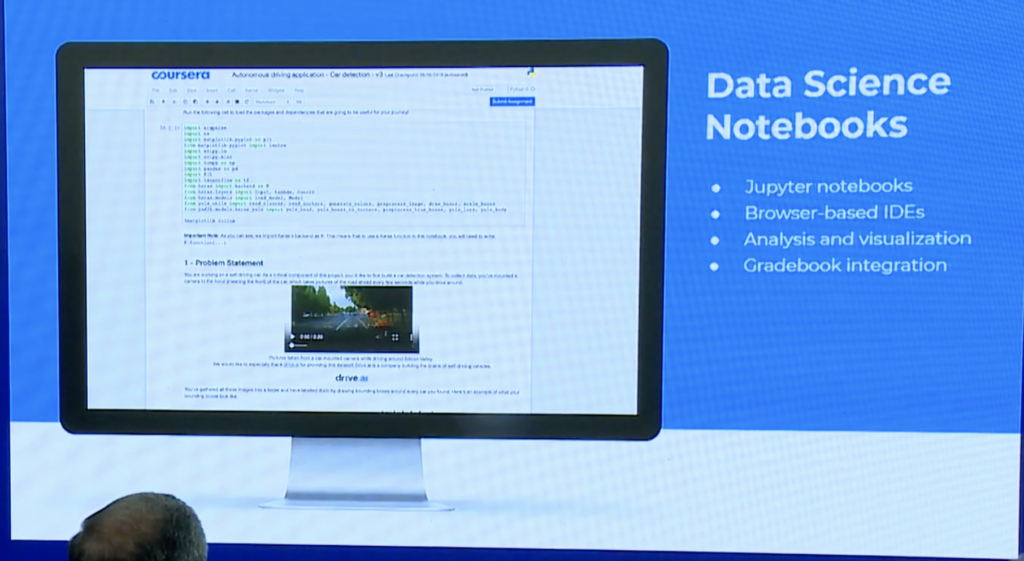
    Which side of the divide do MOOC platforms land on? Here are a couple of slides from the Coursera on Campus launch:
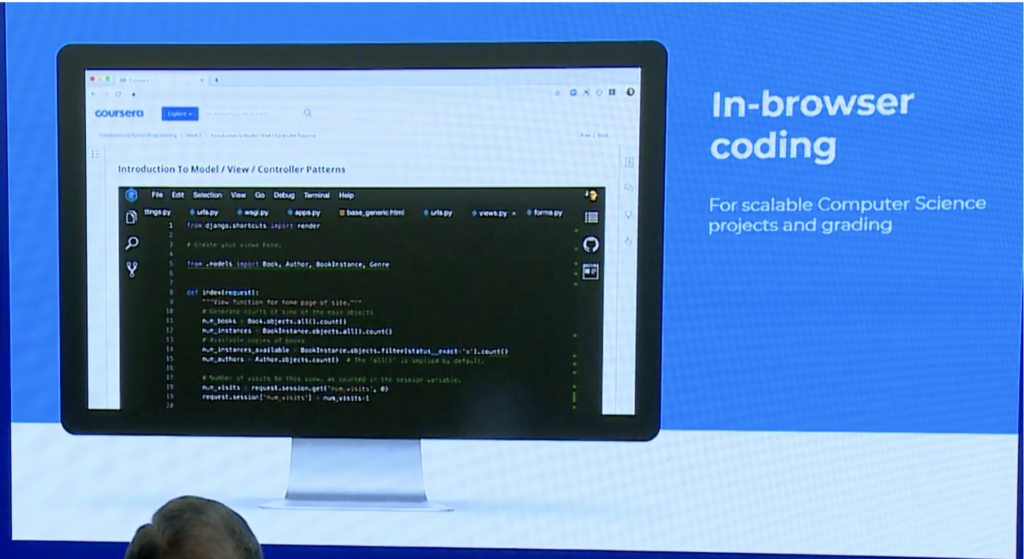
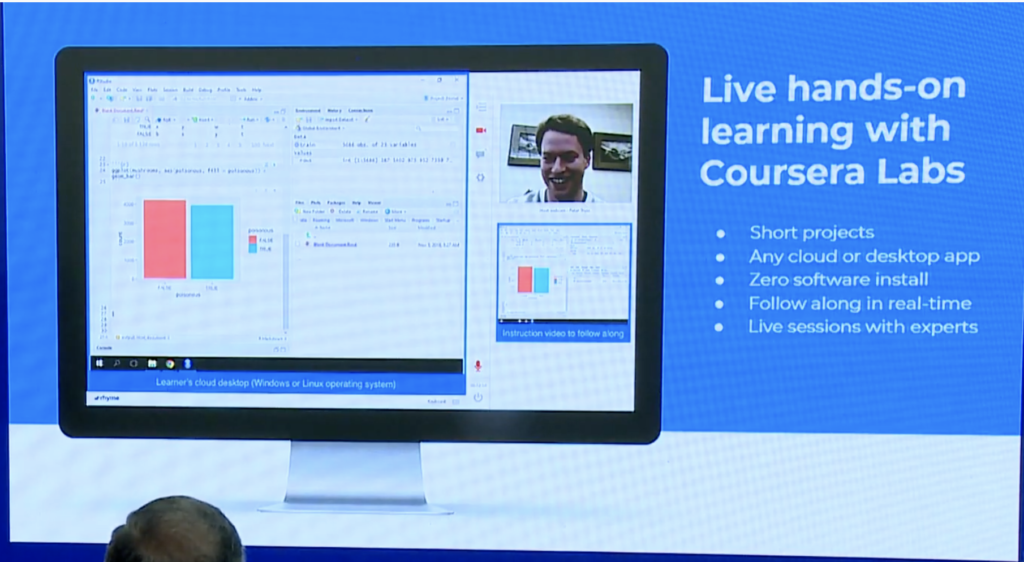
    In-browser coding!
    Virtual labs!
    Data science notebooks!

    These subject-specific affordances, plus competency-based analytics, were the platform highlights of the Coursera for Campus presentation. Not the grade book that can do anything. Not the test engine that can provide any kind of feedback. Not announcements or an event feed. This was all about courseware.

    “But wait,” you say. “Courseware for Campus lets faculty author their own courses. Isn’t that different?”

    Yes. And no.

    Way back the better part of a decade ago, when I was at Cengage working on the MindTap platform, the company debated whether to open it up to customers and license it without content. (“We can disrupt the LMS!”) In the end, there were two major barriers. First, as a print-centric company in the midst of a transition, the authoring tools were not remotely faculty-friendly. And second, as a publisher whose bread and butter came from royalties, there was a fear of cannibalization of the business.

    Coursera has neither of those problems. It was born as a two-sided market, which means that it never owned the content to begin with and always had an incentive to make authoring as easy as possible. It may have taken some time to fully realize that vision, but we were destined to arrive where we are now.

    Further, as textbook publishers increasingly move away from celebrity franchises and toward fee-for-service contracts with their authors, they will have motivation to make similar moves. McGraw-Hill Education doesn’t advertise it widely, but they have been licensing the authoring platform for SmartBooks for several years now. Authoring support can work with a courseware platform as long as the range of course expectations for delivery models can be constrained. And MOOC courseware fits the bill. It’s a genre.

    Coursera for Campus is a harbinger of the future, not for the LMS industry but for the textbook industry. And they are an early mover with certain advantages in their business model.

    The courseware/OPM convergence

    One critical element that I don’t want to lose in all of this is the implications for the OPM market. Let’s not forget that (a) Coursera has been pushing into that market aggressively and successfully and (b) that market has been under massive pressure and upheaval lately. 2U has been the canary in the coal mine, having lost roughly four fifths of its market value since the beginning of the year. ((Disclosure: 2U is a 2019 sponsor of EEP.))

    To be clear, I think there’s some noise obscuring the signal. Two of the reasons why 2U took such a big hit are that the stock got way ahead of itself and some self-interested players have been extraordinarily successful at generating FUD around the market category in general.

    That said, there is no question that the hype around selling an infinite number of $40K masters degrees has met its demise. There are two barriers to OPM growth, which is another way of saying that there are two barriers to conventional online degree growth, and they have both proven formidable barriers to crack. The obvious one is cost. The less obvious one is geography. It turns out that, even in an era when people can take courses from anywhere in the world, they will tend to take them from their local institution or not at all. For all the talk of “national universities” and “mega universities,” it’s not clear that such beasts really exist. For the most part, big universities have proven exceptionally good at soaking up every ounce of demand for education in their local areas. So the next sustainability play is not so much about reaching students far away as it is about serving students you already reach for 40 years rather than for four.

    And interestingly, that is essentially the pitch that the Coursera executives made about Coursera for Campus—even when they were pitching in India. They weren’t making the pitch that the American stereotype would have predicted, of reaching the rural millions. They were talking about lifelong learning. Skilling and reskilling. From an OPM perspective, this pitch gives the company with the large catalog of low-cost and constantly refreshed inventory a competitive advantage.

    That said, there was definitely a bit of hand waving going on regarding completion rate. The Coursera executives talked about University of Illinois’ degree program as having over a 90% completion rate as if that remarkable achievement could be solely attributed to the fact that it was a degree program. I suspect there are some hard-working support staff at the University of Illinois who might quibble with that clean of a causal analysis. I don’t think the Coursera folks are directionally wrong, and I don’t think they were intentionally misleading, either. But I do think that they oversimplified, and that running a highly successful program at scale with a 90%+ degree completion rate entails a lot more than just handing out a piece of sheep skin at the end. The reason I bring this up is not because I want to snark on Coursera but because the part that is being glossed over represents a number of support areas that OPMs compete on (and that more traditional OPMs and OPEs pride themselves on excelling at).

    The gap between “MOOC” the course model and “MOOC” the courseware model is very much an open question in terms of student success. The MOOC courseware model, particularly as implemented into affordable degrees at scale delivery models by pioneers like Georgia Tech and University of Illinois, are creating an alternative delivery model that could start putting pressure on OPMs supporting more traditional models. Coursera on Campus, in addition to creating an additional revenue stream for the company and putting pressure on courseware providers, potentially ups the ante in the OPM market. But we need to look to those universities which are pioneering affordable degrees at scale to understand the service gaps, marketing gaps, and cost differences between MOOC courseware and the totality of what they are doing in order to understand the what it would take to replicate their success.

    In the meantime, consider the implications of the Coursera on Campus model for the future of companies like Pearson and Wiley, which own both courseware and OPM divisions, or McGraw-Hill Education, which has begun experimenting with opening up its platform for content authoring by customers. ((Disclosure: Pearson is a 2019 sponsor of the Empirical Educator Project.)) It’s not necessarily all bad, but it is a potential accelerant to change that is already in the wind.

    It’s a wild, wild, wild, wild world, my friends.

    Here’s the full launch event for your viewing pleasure:
  • The Content Revolution

    Content is infrastructure.

    David Wiley

    An unbelievable number of words have been written about the technology affordances of courseware—progress indicators, nudges, analytics, adaptive algorithms, and so on. But what seems to have gone completely unnoticed in all this analysis is that the quiet revolution in the design of educational content that makes all of these affordances possible. It is invisible to professional course designers because it is like the air they breathe. They take it for granted, and nobody outside of their domain asks them what they’re doing or why. It’s invisible to everybody else because nobody talks about it. We are distracted by the technology bells and whistle. But make no mistake: There would be no fancy courseware technology without this change in content design. It is the key to everything. Once you understand it, suddenly the technology possibilities and limitations become much clearer.

    For those familiar with course design lingo, the design pattern I am talking about can be summed up as backward design coupled with programmatic formative assessment. This post is the first in a series in which I will explain this design pattern, it’s possibilities and limitations, and the ways in which it makes possible a whole range of educational technology affordances.

    Backward Design

    “Backward Design” is a term that comes from a larger framework called “Understanding by Design,” (UbD) developed by Grant Wiggins and Jay McTighe and articulated in a book by the same name. While it was developed as K12 curriculum design approach, it has been widely embraced by curriculum and course content designers at all levels. Because the backward design practice as applied in courseware authoring necessarily requires what some might perceive as a “dumbing down” of the approach (for reasons I will get into later in this post), it’s important to understand the philosophical roots of UbD. On one hand, this is an approach that is grounded in the political reality of a K12 world that is driven by curriculum standards. Wiggins and McTighe are unapologetic about having defined curricular goals for students. On the other, UbD is intended to work against the tendency to memorization of facts and rote applications of lower-order skills, fostering critical thinking and knowledge transfer across domains. Three of the seven tenets of UbD (as articulated in this crisply written white paper by Wiggins) are as follows:

    • The UbD framework helps focus curriculum and teaching on the develop- ment and deepening of student understanding and transfer of learning (i.e., the ability to effectively use content knowledge and skill).
    • Understanding is revealed when students autonomously make sense of and transfer their learning through authentic performance. Six facets of under- standing—the capacity to explain, interpret, apply, shift perspective, empa- thize, and self-assess—can serve as indicators of understanding.
    • Teachers are coaches of understanding, not mere purveyors of content knowl- edge, skill, or activity. They focus on ensuring that learning happens, not just teaching (and assuming that what was taught was learned); they always aim and check for successful meaning making and transfer by the learner.

    UbD is explicitly not a paint-by-numbers approach to education. It is, however, a design-intensive approach to teaching that emphasizes the value of preparation and goal-oriented thinking as a key to unlocking teachable moments. This 10-minute video of Wiggins explaining the philosophy is well worth your time and provides a philosophical guide star to keep in sight as we navigate backwards design in general and its application to courseware design in particular:

    Grant Wiggins – Understanding by Design

    The upshot of his message here is that teachers and student continually need to be asking the question, both individually and together—what are the larger learning goals here?

    Backwards Design, at its most basic, is the idea that educators should be asking that question from the moment they start planning their course. Rather than starting with a collection of content and activities and putting it into a sequence, educators should start by articulating the end goals for the students (where an end goal is broad enough to encompass high-level and non-cognitive goals such as “a love of reading”). The three-step process of backward design is as follows:

    1. Identify desired results
    2. Determine acceptable evidence
    3. Plan learning experiences and instruction

    All content and activity choices flow from identifying the desired results and determining acceptable evidence of achievement of those results. This approach is “backwards” from the typical approach of starting with content that needs to be covered.

    Backward Design in courseware development

    Modern courseware, and many of the most highly touted technology affordances that come with it, flow from the Backward Design technique. But there are two additional constraints that are imposed by the medium. First, the activities in the courseware can only be activities that can be facilitated in an online medium—and, since courseware is modeled after the textbook, these are usually (but not always) solo activities by students that look like digital extensions of the kinds of exercises that you would expect from textbooks. Second, since key technological affordances of courseware come from its ability to auto-assess student progress, “acceptable evidence” generally must be machine-gradable evidence.

    Since this is Backward Design, these changes have implications up the chain to the first step in the process. Rather than “identifying desired results,” courseware designers have to think in terms of “learning objectives” that are realistic to achieve and measure given the limitations of the medium. The University of Central Florida (UCF) has posted a learning objective builder tool which, while not limited to the application of courseware design, begins to convey how courseware designers need to think about learning objectives in order to design content that will work in the courseware medium. The learning objective structure in the UCF example has four components:

    1. Condition, e.g., “Given a blank map of the United States…”
    2. Audience, e.g., “…the student…”
    3. Behavior, e.g., “…will identify all 50 states and capitals…”
    4. Degree, e.g., “…with 90% accuracy.”

    In comparison to Wiggins’ framing of UbD, this may feel starkly reductive to you. It’s important to keep in mind that the example was undoubtedly written for clarity rather than to illustrate how creative an educator can be while still staying within the bounds of the format. That said, there is no question that the format is limiting.

    And this, I think, is where a lot of unilluminating argument over the value of courseware originates. On the one hand, if the idea is that courseware will largely replace human instruction, then we have to recognize the gap between the learning objectives which the courseware can assess and the desired educational results which a human teacher can address and assess. On the other hand, it’s very hard to talk about that gap meaningfully and specifically when the entire course hasn’t been backward designed in the first place. If a course has clearly defined desired outcomes and clearly defined acceptable evidence of those outcomes, then it is a straightforward exercise to identify the subset of goals and evidence that courseware can address. But in absence of that larger course blueprint, educators who want to argue that courseware is too reductive start to get hand-wavy pretty quickly. We shouldn’t be surprised that interactive curricular materials are not complete substitutes for a classroom experience, but we should be able to clearly articulate what the gap is and how classroom interactions address that gap in ways that courseware can’t on on a course-by-course basis.

    The atomic unit of courseware content design

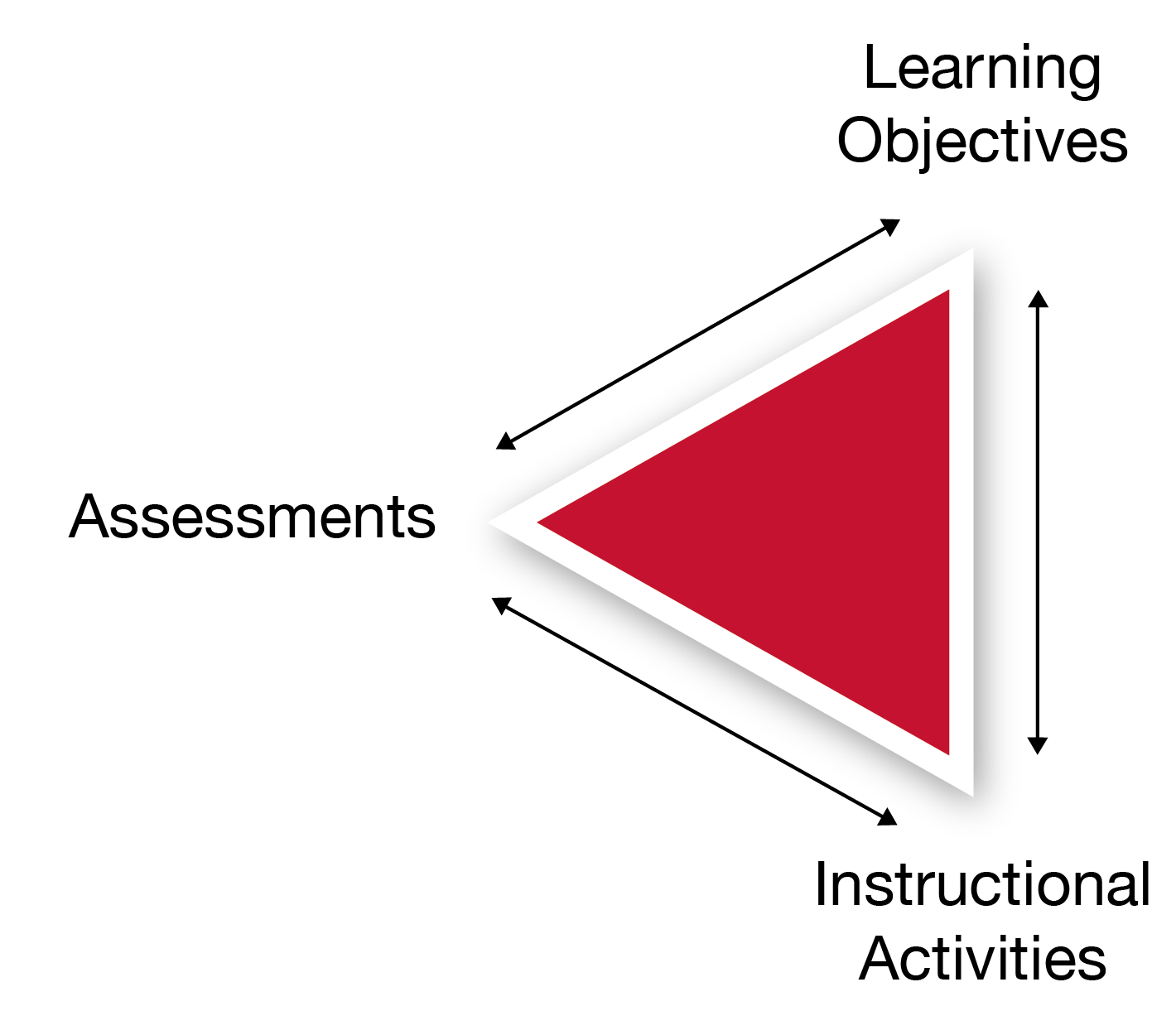
    Once we’ve translated the principles of Backward Design to fit the constraints of courseware, we end up with a tightly constructed content design:

    The content triangle of learning objectives, assessments, and instructional activities

    Again, this structure is not limited to courseware; it’s a good distillation of the results of backward design in general, using language that also translates well into courseware design. But when building modern courseware, this design is formal and structural. Every instructional activity (which, in the case of courseware, means interactive or non-interactive content items) and every assessment activity is tagged to correspond with a specific learning objective. As far as the software is concerned, this collection of items and metadata is a formal and atomic unit of instruction. McGraw-Hill Education even went so far as to name this collection a “compound learning object (CLO)“.

    As we will see in detail in the next post in this series, many of the technology affordances of modern courseware depend utterly on this formal structure. And once you understand the design pattern, you can see it everywhere in most curricular materials products and in an increasing number of courses designed on campuses with the help of professional instructional designers. I would go so far as to say that the formalization of this content structure, and not any fancy technology capabilities like adaptive learning algorithms or learning analytics dashboards, is the defining innovation in curricular materials over the last decade. It is the key to everything.

    Programmatic formative assessment

    There is one other defining content feature that is worth talking about before we explore implementation examples in the next post. A key educational affordance of courseware products that is often touted is instantaneous feedback. Since there is strong evidence that timely feedback is critical to the learning process, this is a key benefit (assuming that the feedback is meaningful). But instantaneous feedback on summative assessments—on assessments at the end that measure how much the student has learned before moving on to the next lesson—is not as helpful to students as it might be because…well…they’re moving on to the next lesson. They may or may not take the time to reflect on their incorrect answers. In contrast, feedback on low-stakes assessments, particularly when it is supported by feedback and support from the educator, can be very useful. In fact, I have long argued that this ability to have students practice their skills and test themselves—yes, before they take a summative assessment, but more importantly, before they walk into a class discussion—is a key value proposition for modern courseware. Class preparation.

    This is often billed as a technology affordance, but once again it is utterly dependent on the content design. Their analog…er…analogue is back-of-the-chapter homework problems. Practice problems that are linked to a skill or a bit of knowledge that will ultimately be assessed for a grade is not a new idea. The technology simply improves on the kinds of practice and feedback that were possible with flat textbooks. It can be given more often, in more interactive formats, with more timely feedback.

    Circling back to the Grant Wiggins video at the top of this post, students and educators alike need to constantly be asking the question “Why am I doing this now?” Whatever we are learning—or teaching—we should always also be studying whether our activities are aligned with our goals. Good educators are continually assessing their students in a variety of ways, starting with looking at their faces to see if they look like they are following, bored, confused, etc. They adjust according to what they see. Likewise, students need to be assessing their learning strategies and progress in order to get better at achieving their learning goals. One defining characteristic of modern courseware content design is creating as close to a continuous assessment feedback loop as possible.

    Content as infrastructure

    As I’ve stressed throughout this post, I don’t think it’s possible to overstate the role of this content design pattern—Backward Design plus programmatic formative assessment—in most of the recent innovations in digital curricular materials. In the next posts in this series, I will show concrete examples of how this design pattern makes various technological affordances possible as well as how it opens up new possibilities for tuning both courseware content and teaching strategies for continuous improvement. In the last installation, I will write about the need for and benefits of having content interchange and analytics interoperability standards that are tuned to this ubiquitous yet invisible content design pattern.

  • In “EdTech”, “Ed” comes before “Tech”: A National Louis University/Acrobatiq Case Study

    A few weeks ago, I posted about our case study on the governance of the Courseware in Context (CWiC) Framework. CWiC is a laudable effort to take the traditional product evaluation matrix and get beyond “magic quadrant-ism” by adding some educational context to the selection process. Which product is “best” depends a lot on your goals, capabilities, and other contextual factors. The CWiC advisory committee members explain how hard it is to integrate these factors into a product evaluation matrix. A lot of the hoped-for value of CWiC is still aspirational. There’s nothing wrong with that; it’s good to have big goals and to recognize how close to (or far from) achieving them you really are.

    Sometimes just seeing your path to achieving those big aspirations is hard in and of itself. As this next case study shows, even if CWiC realizes its potential, it’s never going to be the right place to start if your goal is to meaningfully impact student outcomes and close achievement gaps. Our original goal with the National Louis University (NLU) and Acrobatiq interviews was to look at what it takes to implement courseware effectively with a vendor partner once the selection is made. In other words, what happens after you go through the process that the CWiC framework is meant to support. But we got so much more than that because NLU has been incredibly thoughtful about the program and students—the context—that impacts the use and value of the courseware. In other words, they also modeled what universities need to do before they select courseware, from designing a business/sustainability model that enables them to provide appropriate cost of an education to thinking about educational goals to figuring out where courseware does and doesn’t fit into that overall model. All of that prework has a profound impact on the working relationship with the vendor partner, the kinds of support identified as necessary to make the courseware work, and the future vision for how to continue to broaden and deepen the impact.

    In the end, I think this case study shows both that a tremendous amount of work is needed to integrate courseware if you truly want to drive improvement in student outcomes and that the significant amount of planning and implementation work involved is only a small percentage of the total necessary program planning and work required. NLU has effectively redesigned the entire undergraduate experience. Their partnership with Acrobatiq works in large part because Acrobatiq understands their role in NLU’s larger goals, and because NLU maintains their focus on those goals rather than getting caught up in the notion that buying some magic product will solve all their problems.

    (https://youtu.be/Iau4QaezReo)

    (https://youtu.be/rJtc53dXQbI)

    (https://youtu.be/R7xv7QRJ5R4)

    I’m proud to have this be the final case study in this series of grant-funded stories. It neatly reflects a lot of what we believe about the ways in which universities and vendors need to work together if we want to improve higher education.

  • The CWiC Framework: Context around Courseware

    Update: I got feedback that it wasn’t clear the embedded video was a three-video playlist, so I have broken them out individually.

    We have a new case study up in which we interview members of the Courseware in Context (CWiC) framework advisory committee about their work:


    The focus isn’t so much on the framework itself as on the project goals and, somewhat less directly, it’s sustainability model. We’ve seen repeated failures in the market to create selection tools for curricular materials or edtech products. (Some of us are old enough to remember EduTools.) The committee members are very thoughtful about the missing element, which is context. There are, in CWiC advisory committee member Tanya Joosten’s words, “a million” different contextual variables, from classroom implementation to support to individual student needs. CWiC is an attempt to take a traditional product selection tool model and enrich it enough to account for all these contextual variables.

    The committee members seem acutely aware of how big of a challenge this could be, which is part of what makes these interviews so interesting. At our recent Empirical Educator Project summit, René Kizilcec (whose research we have featured here on e-Literate) made a fascinating comment, which is that we education “desperately needs” a “science of context.” The CWiC folks are trying infuse the output we currently have from the beginnings of that science into what is essentially a tool for selection and procurement. Will it work? I don’t know. The committee members are pretty clear about the size of the challenge. But it’s the right direction.

    The Empirical Educator Project (EEP) attempts to take on the other side of René’s phrase. What would it mean to have a science of context? Who would the scientists be? What cultural institutions would we need to form a consensus around what a science of context would look like such that people who care about it could cooperate on it more effectively, and such that it would attract the funding it needs to be carried out? What business process support tools, including but not limited to procurement tools, do we need to implement a science of context, and how would implementation provide input back to the scientific research? These are the questions that EEP attempts to answer. Will it work? I don’t know. But I feel confident that it’s the right direction.

  • Courseware Without A Silver Bullet: Focusing on faculty enablement

    Courseware Without A Silver Bullet: Focusing on faculty enablement

    In a 2016 post on “Personalized Learning vs. Adaptive Learning”, Michael contrasted the former as a set of technology-enabled teaching practices with the latter as a project label [emphasis added].

    On the other hand, adaptive learning is a label that applies to products. Further, adaptive learning products can support all of the practice areas of personalized learning. They enable teachers to move content broadcast outside of class time, they make homework time into contact time through analytics, and they provide some tutoring function. “Adaptive” tends to provoke a lot of discussion around the latter of the three practice areas. See the piece I wrote for the American Federation of Teachers if you want a primer on the strengths and limitations of adaptive learning products as tutors. But as often as not the first two capabilities, neither of which is dependent on adaptive algorithms, are the ones that enable the biggest gains in personalized learning teaching practices. “Courseware” is a set of products that, when designed well and used properly, can enable faculty to move content broadcast out of the classroom and make homework time content time. Adaptive courseware adds the tutoring element while also, if done well, increasing the value of that homework contact time by providing better feedback through more targeted analytics.

    One problem, of course, is that many advocates end up presenting adaptive learning as a silver bullet, focusing on supposed magical tutoring capabilities and ignoring the messy but valuable work of enabling faculty to improve their own courses. As we will see, it is not a safe assumption that all vendors like this label or set of assumptions.

    In the first episode of this series we explored the challenge of going beyond pilots and deploying systems at scale. In the second episode we explored the importance of increased visibility as an important benefit of course redesign. In this episode we explore the challenge of silver bullets – what happens when a company has no intention of being labeled as “adaptive learning” but has been described that way? Realizeit is not the only company dealing with this same issue, and it is important for educators to understand how a company defines itself and the problems their products are designed to solve. ((This post is not meant to endorse Realizeit’s platform over other companies’ platforms. We are focusing on institutional perspectives and lessons to be learned. Realizeit is one of our sponsors of the Empirical Educator Project.))

    (source: https://youtu.be/xPWBoMhP_yU)

    This post is part of our e-Literate TV series, which is funded in part by the Bill & Melinda Gates Foundation. The findings and conclusions (or views) contained within are those of the authors and do not necessarily reflect positions or policies of the Bill & Melinda Gates Foundation.

  • Visibility As A Benefit: Ole Miss and UCF share their stories on courseware usage

    Visibility As A Benefit: Ole Miss and UCF share their stories on courseware usage

    In an article Michael and I wrote for EDUCAUSE Review in 2016, we described our view of personalized learning as “a family of teaching practices that are intended to help reach students in the metaphorical back row”. One of the key practices focused on gaining increased visibility into student coursework.

    These same automated homework tools can also give teachers an easy view into how their students are doing and create opportunities to engage with those students. “Analytics” in these tools are roughly analogous to your ability to scan the classroom visually and see, at a glance, who is paying attention, who looks confused, who has a question.

    With the usage of digital courseware to provide the homework tools, this focus on visibility into the learning process can apply across the entire course. What are different schools learning in this area?

    As part of our e-Literate TV series of video case studies, we had a chance this fall to interview several institutions that are focusing on the benefit of increased visibility into student learning by usage of digital courseware based on interviews at the Realizeit users conference. ((This post is not meant to endorse Realizeit’s platform over other companies’ platforms. We are focusing on institutional perspectives and lessons to be learned.))

    In the first episode we explored the challenge of going beyond pilots and deploying systems at scale. In this second episode I interview representatives from the University of Mississippi and the University of Central Florida, asking them to describe their experiences and focus on the issue of increased visibility.

    (source: https://www.youtube.com/watch?v=_FuIQgtvO-k)

    We’ll share one more set of interviews from this conference in the coming weeks.

    This post is part of our e-Literate TV series, which is funded in part by the Bill & Melinda Gates Foundation. The findings and conclusions (or views) contained within are those of the authors and do not necessarily reflect positions or policies of the Bill & Melinda Gates Foundation.

  • Digital Courseware at Scale: APUS and Bay Path University share their stories

    Digital Courseware at Scale: APUS and Bay Path University share their stories

    Several years ago I wrote a post titled “Pilots: Too many ed tech innovations stuck in purgatory”, where I used Everett Rogers’ Diffusion of Innovations framework to explore why we have plenty of pilots but not very many large-scale adoptions of ed tech innovations.

    What we are seeing in ed tech in most cases, I would argue, is that for institutions the new ideas (applications, products, services) are stuck the Persuasion stage. There is knowledge and application amongst some early adopters in small-scale pilots, but majority of faculty members either have no knowledge of the pilot or are not persuaded that the idea is to their advantage, and there is little support or structure to get the organization at large (i.e. the majority of faculty for a traditional institution, or perhaps for central academic technology organization) to make a considered decision. It’s important to note that in many cases, the innovation should not be spread to the majority, either due to being a poor solution or even due to organizational dynamics based on how the innovation is introduced.

    This stuck process ends up as an ed tech purgatory – with promises and potential of the heaven of full institutional adoption with meaningful results to follow, but also with the peril of either never getting out of purgatory or outright rejection over time.

    Accordingly, we have more information about institutions with quite a few pilots around digital courseware, but there is not much information about colleges or universities implementing at scale. What are the problems to be solved for large-scale adoption, and what lessons can be learned (both positive and negative)?

    As part of our e-Literate TV series of video case studies, we had a chance this fall to interview several institutions that are dealing with this challenge – deploying courseware at scale – based on interviews at the Realizeit users conference. ((This post is not meant to endorse Realizeit’s platform over other companies’ platforms. We are focusing on institutional perspectives and lessons to be learned.)) In a future episode we’ll describe more directly what Realizeit’s platform is and is not, but to start, let’s get a sense of the institutional perspective.

    In this first episode I interview representatives from American Public University System (APUS) and Bay Path University, asking them to describe their programs. APUS has redesigned more than 1,600 courses based on active learning, as well as new competency-based programs, and Bay Path is applying courseware broadly across the entire institution.

    (Video source: https://youtu.be/hUySDzoz_gE)

    We’ll share additional interviews from this conference in the coming weeks.

    This post is part of our e-Literate TV series, which is funded in part by the Bill & Melinda Gates Foundation. The findings and conclusions (or views) contained within are those of the authors and do not necessarily reflect positions or policies of the Bill & Melinda Gates Foundation.