e-Literate

Present is Prologue

Tag: Desire2Learn

  • State of Higher Ed LMS Market for US and Canada: Spring 2017 Edition

    State of Higher Ed LMS Market for US and Canada: Spring 2017 Edition

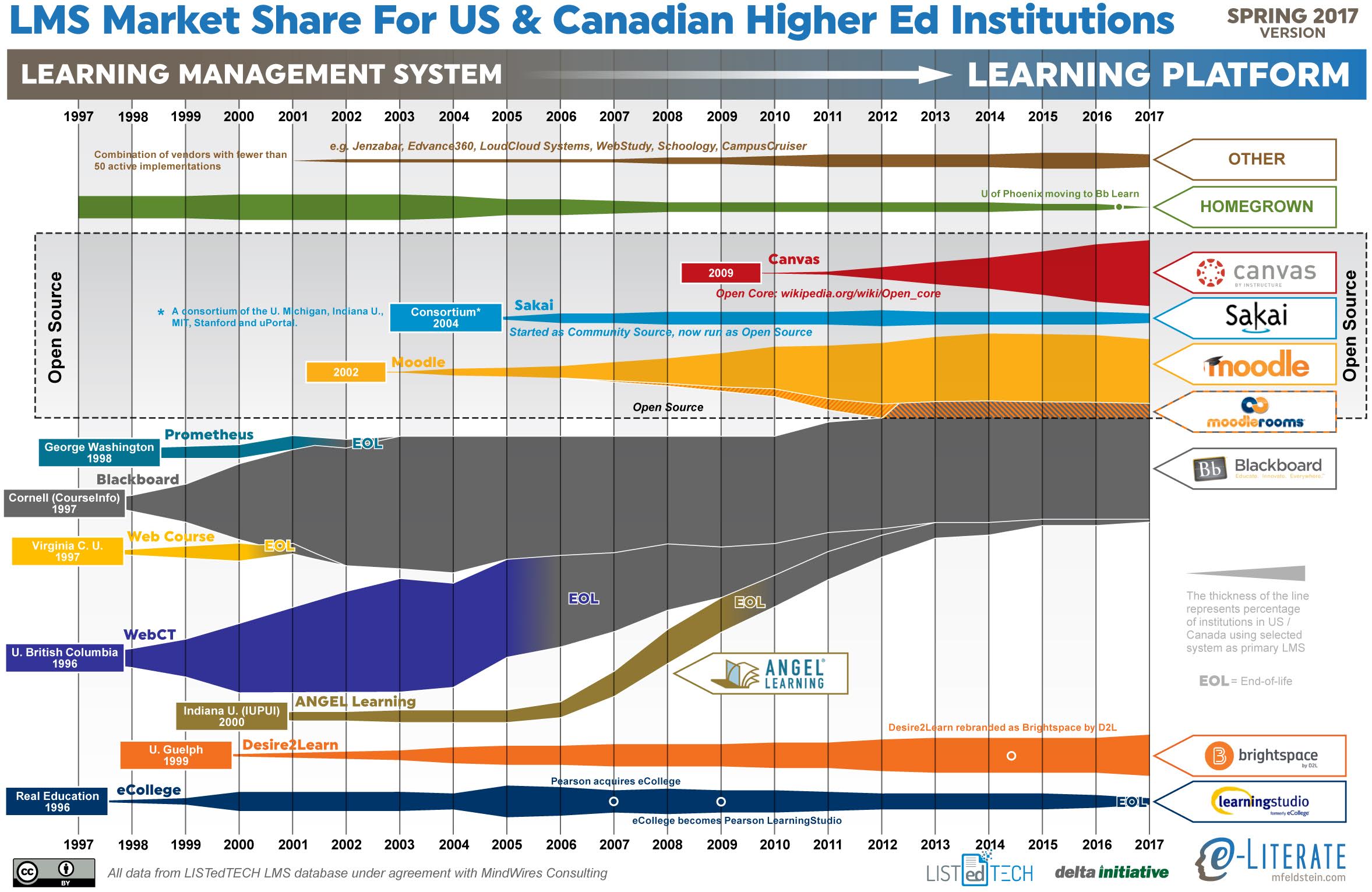
    This is the ninth year I have shared the LMS market share graphic, commonly known as the squid graphic, for US and Canadian higher education. The original idea remains – to give a picture of the LMS market in one page, highlighting the story of the market over time. The key to the graphic is that the width of each band represents the percentage of institutions using a particular LMS as its primary system.

    Last year we made a big shift based on our LMS market analysis service – we are working with LISTedTECH to provide market data and visualizations. This data source provides historical and current measures of institutional adoptions, allowing new insights into how the market has worked and current trends. Our spring report for subscribers will be released this month. Data for 2017 goes through April 1 of this year.

    (more…)

  • Changes at D2L: A second-hand view from users conference

    As I have described to several executives at D2L, there is an interesting gap between the progress we have seen with the company’s product improvements and the reaction we hear from many of their customers. With the tighter integration with LeaP and the improved usability, particularly in content authoring, I would have expected to hear more customers react to the changes. But when talking directly to many of the institutions using the Brightspace LMS, staff describe D2L as if the company and product line had not changed in several years. What is not clear is whether this gap is due the company missing the mark (and my judgement of improvements not aligning with what colleges and universities want) or whether there is just a lag where it will take time for most customers to believe in and take advantage the new product designs and features.

    2016 has been an eventful year for D2L. COO Cheryl Ainoa, a longtime veteran of Yahoo! and most recently Intuit, joined the company in April. Although this move was not advertised through press releases or even blog posts, I believe this is a significant change to how the company operates. This is not the first time that D2L has reached outside the industry for a top executive, as they employed Dennis Kavelman from RIM / Blackberry as COO from 2012 – 2014 (the period where D2L raised $165 million in two mammoth funding rounds). But I have heard that the addition of Ainoa has already seen results internally. And in the ‘keeping work in perspective’ category, founder and CEO John Baker and his wife had their first child right before the Fusion Users Conference. (more…)

  • MarketsandMarkets: Getting the LMS market wrong

    New LMS market analysis with a leader list that includes a company that is retiring its LMS and ignores the company who has a 5x lead in new implementations for its core market? Sign me up.

    Over the next week or two, we plan several posts at e-Literate based on the various LMS users conferences we recently attended. We already covered Sakai and Blackboard, and we will have commentary on Moodle, Schoology, D2L, and Canvas soon. But before we do so, I wanted to call out the recent analysis by MarketsandMarkets, which requires some commentary as it is leading to some media coverage that could misinform those trying to understand the LMS market. The headline of their recent market report:

    Learning Management System (LMS) Market Worth 15.72 Billion USD by 2021

    According to a new market research report, “Learning Management System Market by Application, Delivery Mode (Distance Learning and Instructor-Led Training), Deployment (On-Premises and Cloud), User Type (Academic and Corporate), Vertical, and Region – Global Forecast to 2021”, published by MarketsandMarkets, the LMS market size is expected to grow from USD 5.22 Billion in 2016 to USD 15.72 Billion by 2021, at a CAGR of 24.7%.

    (more…)

  • UC Davis Lessons: Open is as open does

    It’s interesting how one phrase can cause such a reaction.

    There is an interesting angle here in that Sakai is open source yet data is not easily recoverable.

    This comment came from the original post discussing UC Davis’ SmartSite disaster when their Sakai hosting partner Scriba botched a data center move, leading to a university of 32,000+ students going without a fully-functional LMS for the last three weeks of a term, including finals week. If you want the full run-down, read that linked post then look at additional posts in this list for the basics. ((SmartSite is the UC Davis branding for their LMS, which was hosted at the time by Scriba, a Sakai Commercial Affiliate.))

    What did I mean with this comment?

    Simply that this outage would give us a chance in reality to get a better understanding of the dynamics of open source solutions and whether the university in question would actually have achieved the ability to “control its destiny”. The early indications at the time were that UC Davis would not be able to make the course data from their LMS fully available to faculty and students before the end of the term. A full analysis of the causes and implications of the situation needed more information on what led to the outage, what UC Davis had in their contract with Scriba, and how the end of the term would play out. But even before that analysis, the comment was also based on the likely market perceptions.

    What did I not mean? (more…)

  • State of Higher Ed LMS Market for US and Canada: Spring 2016 Edition

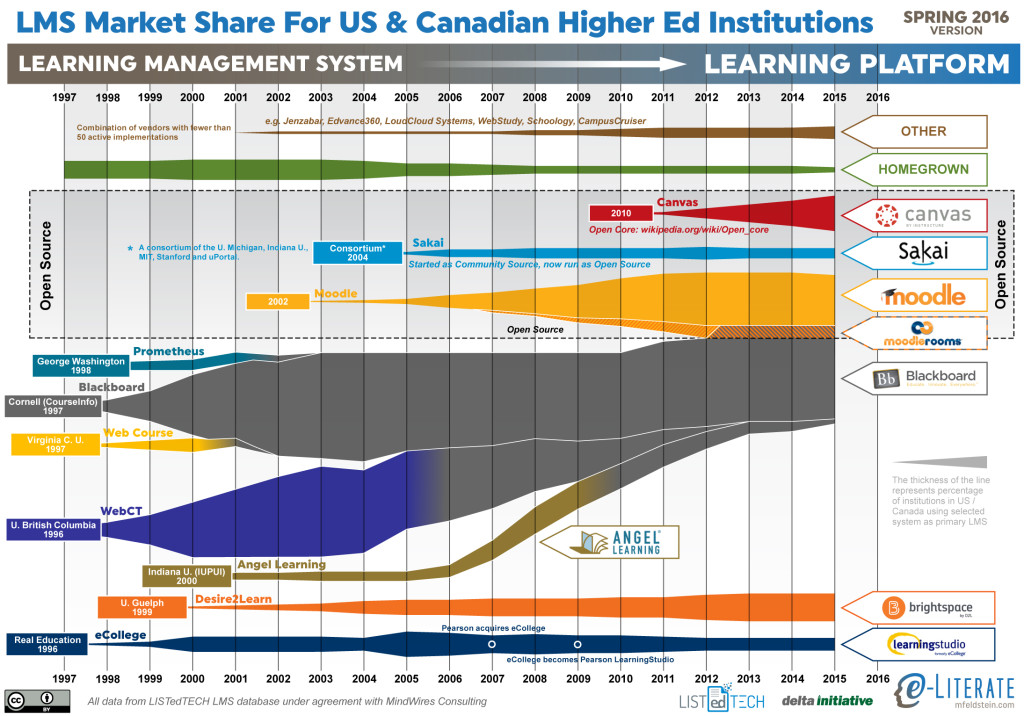
    This is the eighth year I have shared the LMS market share graphic, commonly known as the squid graphic, for (mostly) US higher education. The original idea remains – to give a picture of the LMS market in one page, highlighting the story of the market over time. The key to the graphic is that the width of each band represents the percentage of institutions using a particular LMS as its primary system.

    This year marks a significant change based on our upcoming LMS subscription service. We are working with LISTedTECH to provide market data and visualizations. This data source provides historical and current measures of institutional adoptions, allowing new insights into how the market has worked and current trends. This current graphic gets all of its data from LISTedTECH. Where previous versions of the graphic used an anchoring technique, combining data from different sources in different years, with interpolation where the data was unavailable. Now, every year’s data is based on this single data source.

    This graphic has been in the public domain for years, however, and we think it best to keep it that way. In this way we hope that the new service will provide valuable insight for subscribers but also improve what we continue to share here on the e-Literate blog.

    Since we have data over time now and not just snapshots, we have picked the end of each year for that data. For this reason, the data goes through the end of 2015. We have 2016 data but chose not to share partial-year results in an effort to avoid confusion.
    LMS_MarketShare_20160316

    A few items to note:

    • As noted in previous years, the fastest-growing LMS is Canvas. There is no other solution close in terms of matching the Canvas growth.
    • Blackboard continues to lose market share, although the vast majority of that reduction over the past two years has been from customers leaving ANGEL. Blackboard Learn lost only a handful of clients in the past year.
    • While the end-of-life occurs next year, Pearson’s has announced LearningStudio’s end-of-life for the end of 2017.
    • With the new data set, the rapid rise and market strength of WebCT becomes much more apparent than previous graphics.
    • There is a growing line for “Other”, capturing the growth of those systems with less than 50 active implementations as primary systems; systems like Jenzabar, Edvance360, LoudCloud Systems, WebStudy, Schoology, and CampusCruiser.
    • While we continue to show Canvas in the Open Source area, we have noted a more precise description as an Open Core model.

    For a better description of the upcoming LMS subscription service, read this post and / or sign up for more information here.

  • LearningStudio and OpenClass End-Of-Life: Pearson is getting out of LMS market

    Pearson has notified customers that LearningStudio will be shut down as a standalone LMS over the next 2-3 years. Created from the Pearson acquisition of both eCollege and Fronter, LearningStudio has been targeted primarily at fully-online programs and associated hybrid programs – not for simple augmentation of face-to-face classes. The customer base has mostly included for-profit institutions as well as not-for-profit programs that are often packaged with an online service prover model (e.g. Embanet customers). As of this year, LearningStudio has approximately 110 customers with 1.2 million unique student enrollments.

    This decision is not one isolated to LearningStudio, as the end-of-life notification caps a series of moves by Pearson to get out of the LMS market in general. (more…)

  • Solving the Ed Tech Patent Problem

    You may have heard that Khan Academy has filed for several patents. Audrey Watters has written a really strong piece providing the details of the filings in the context of the history of ed tech patents and showing why some academics feel that the patent system clashes with the values upon which academia was built. In the process, she excavates some of my personal history in the Blackboard patent war. While I am sympathetic to arguments against ed tech or software patents on principle, my own personal reasons for getting involved with that fight were more utilitarian. I believed then, as I do now, that patents threaten to kill innovation in educational technology due to the specific characteristics of the market. The outcome of Blackboard v. Desire2Learn did not end that threat, although it did temporarily reduce it. The conversation being provoked by Khan Academy’s filings offers a new opportunity to come up with a more permanent solution. (more…)