
e-Literate

Present is Prologue

Tag: Desire2Learn

  • What Schoology’s Venture Funding Means for the LMS Market

    LMS vendor Schoology just raised $32 million in Series D venture capital funding, bringing the total that they’ve raised to just over $57 million. If you’ve never heard of them, that’s because they have mostly been focused on K12, where they are doing very well. But they have turned their attention to US higher ed recently. They had a surprisingly big presence at EDUCAUSE, where CEO Jeremy Friedman told me that they are prepared to make an aggressive push. Their ability to get major funding was probably helped by Instructure going to market, and possibly by the leak that Blackboard is putting itself on the block as well. I don’t generally take money guys too seriously in their ability to predict ed tech, but they may be lucky on this one. I think there may be an opening the US higher ed LMS market for a new entrant.

    LMS selection for schools often works a little like the selection process that high school students typically go through when picking a college. Students looking at colleges usually have a favorite going in. Maybe their friends are going there. Or their big brother or sister. Or maybe they just heard that it’s cool. But they don’t apply to just one college, in case it doesn’t work out for one reason or another. So they have a second tier of schools that might be OK too. Generally, they don’t know much about your favorite school going in and they know even less about the “might be OK” schools. Depending on how cautious they are, they might throw in one or two “safety” schools that they really don’t want to go to but that they feel (or their parents feel) should be included for the sake of completeness.

    Likewise, colleges and universities frequently go into an LMS evaluation process with a favorite. Because the selection is generally done by a committee of stakeholders rather than just one person, there might be conflicting opinions on what the favorite is. But more often than not, there is a nascent majority or a consensus opinion about the likely winner, at least among the core selection committee. Back in the early to mid-aughts, the default favorite was usually Blackboard because it was considered to be the safe alternative that everybody was using. When Blackboard faltered, the favorite began to split between D2L and Moodle—and occasionally Sakai, particularly for larger public universities—with type of school and geography having a big influence on which one was likely to be the frontrunner. These days, the schools that Phil and I talk to report Instructure as the starting frontrunner at least four times out of five, across school types or geographies.

    But LMS selection processes still need their “might be OK” candidates. For one thing, most of them are mandated by policy or by law to do a real multi-vendor evaluation. And most evaluation committees genuinely do want to look at alternatives. Just because they have a sense going in of which alternative is most likely to be the best doesn’t mean that they are closed-minded. The trouble is that there aren’t many alternatives that selection committees feel hopeful about these days. Increasingly, Sakai and Moodle aren’t even making it to the serious evaluation stage in US higher ed evaluations; and even when they do, they are often treated like safety schools. Blackboard never fully recovered from reputational damage done under Michael Chasen and their failure to deliver on Ultra this year was a huge setback. At the moment, they are being treated like a safety school as often as not. If Ultra slips further—and maybe even if it doesn’t—they could start losing significant numbers of customers again. And we haven’t run into many schools that are particularly excited about D2L either. Probably the best I can say for them is that they are the least likely of the LMS companies that are not Instructure to be dismissed out-of-hand.

    I think there’s an opportunity for a new entrant to get a fair hearing from selection committees that want a real horse race but aren’t excited about any of the incumbents. Ironically, the rise and success of Instructure has probably reduced risk aversion among schools to go with a scrappy start-up. I don’t know if Schoology is going to be the one that gets a foothold in the market because of this opening, but their timing is definitely good.
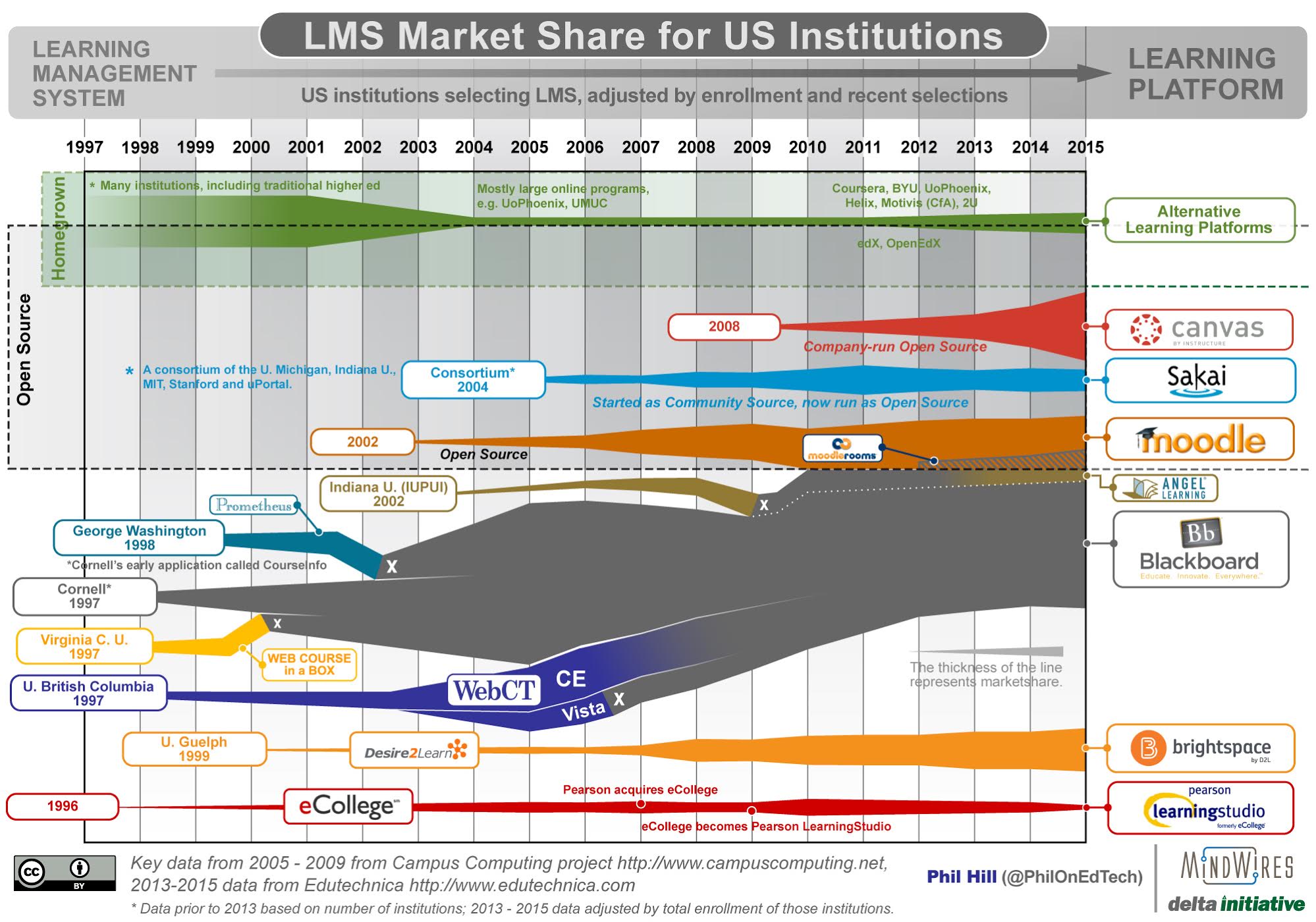
  • State of the US Higher Education LMS Market: 2015 Edition

    I shared the most recent graphic summarizing the LMS market in October 2014, and thanks to revised data sources it’s time for an update. As with all previous versions, the 2005 – 2009 data points are based on the Campus Computing Project, and therefore is based on US adoption from non-profit institutions. This set of longitudinal data provides an anchor for the summary.

    The primary data source for 2013 – 2015 is Edutechnica, which not only does a more direct measurement of a larger number of schools (viewing all schools in IPEDS database with more than 700 FTE enrollments), but it also allows scaling based on enrollment per institution. This means that the latter years now more accurately represent how many students use a particular LMS. This post at Edutechnica provides the most recent data for Fall 2015.

    A few items to note:

    • The most important recent feature of the market – the rapid rise of Canvas, surpassing D2L and quickly closing in on Moodle – is quite visible now.
    • Blackboard Learn appears to have stopped its well-documented losses in US higher ed and has even risen in the past year. Its market share is far smaller than at its 2009 peak, but the company is no longer losing large numbers of clients each year.
    • D2L, Sakai, and Moodle have risen ever so slightly, but in effect have hit a plateau.
    • ANGEL and eCollege have lost market share.
    • There is a growing area of “Alternative Learning Platforms” that includes OpenEdX, 2U, Helix and Motivis (the newly commercialized learning platform from College for America).
    • While the data is more solid than 2012 and prior years, keep in mind that you should treat the graphic as telling a story of the market rather than being a chart of exact data.
    • Update (10/16): Removed “Curtin University as origin of Moodle based on Martin’s comments. Mea culpa – should have caught this earlier.
    • Update (10/23): Changed graphic title to refer to US and not North America.

    LMS_MarketShare_20151023

  • Giving D2L Credit Where Credit Is Due

    Michael and I have made several specific criticisms of D2L’s marketing claims lately culminating in this blog post about examples based on work at the University of Wisconsin-Milwaukee (UWM) and California State University at Long Beach (CSULB).

    I understand that other ed tech vendors make marketing claims that cannot always be tied to reality, but these examples cross a line. They misuse and misrepresent academic outcomes data – whether public research-based on internal research – and essentially take credit for their technology “delivering results”.

    This week brought welcome updates from D2L that go a long way towards addressing the issues we raised. As of Monday, I noticed that the ‘Why Brightspace? Results’ page now has links to supporting material for each claim, and the UWM claim has been reworded. Today, D2L released a blog post explaining these changes and admitting the mistakes. D2L even changed the web page to allow text selection for copy / paste. From the blog post: (more…)

  • D2L Again Misusing Academic Data For Brightspace Marketing Claims

    Update 5/17/16: I made a mistake in my math on the UW Milwaukee improvements. The number of A’s and B’s increased 163% increased 220% for “unprepared” students and 170% for “prepared” students. I apologize for the error.

    Update 7/23: Read this blog post for D2L admission of mistakes and changes to claims.

    At this point I’d say that we have established a pattern of behavior.

    Michael and I have been quite critical of D2L and their pattern of marketing behavior that is misleading and harmful to the ed tech community. Michael put it best:

    I can’t remember the last time I read one of D2L’s announcements without rolling my eyes. I used to have respect for the company, but now I have to make a conscious effort not to dismiss any of their pronouncements out-of-hand. Not because I think it’s impossible that they might be doing good work, but because they force me to dive into a mountain of horseshit in the hopes of finding a nugget of gold at the bottom. Every. Single. Time. I’m not sure how much of the problem is that they have decided that they need to be disingenuous because they are under threat from Instructure or under pressure from investors and how much of it is that they are genuinely deluding themselves. Sadly, there have been some signs that at least part of the problem is the latter situation, which is a lot harder to fix. But there is also a fundamental dishonesty in the way that these statistics have been presented.

    Well, here’s the latest. John Baker put out a blog called This Isn’t Your Dad’s Distance Learning Program with this theme: (more…)

  • Interesting Comment on Pearson’s LMS Plans From Customer

    On April 1, long-time eCollege (aka Pearson’s LearningStudio) customer Texas Christian University (TCU) gave an update on their LMS selection process to the student newspaper TCU360. In this article there was an interesting statement ((Statement from the original article before it was updated.)) worth exploring [emphasis added].

    “eCollege” will soon be a thing of the past.

    TCU has narrowed its search for a Learning Management System to two platforms, Blackboard and Desire2Learn (D2L).

    “We’ve had feedback, from faculty specifically, that it’s time for change,” Assistant Provost of Educational Technology and Faculty Development Romy Hughes said.

    TCU has used Pearson’s Learning Studio system since 1999.

    “Pearson is out of the learning management system game,” Hughes said. “We need something to evolve with the Academy of Tomorrow and where we’re moving to at TCU.”

    That last comment got my attention. (more…)

  • Dammit, the LMS

    Count De Monet: I have come on the most urgent of business. It is said that the people are revolting!

    King Louis: You said it; they stink on ice.

    – History of the World, Part I

    Jonathan Rees discovered a post I wrote about the LMS in 2006 and, in doing so, discovered that I was writing about LMSs in 2006. I used to write about the future of the LMS quite a bit. I hardly ever do anymore, mostly because I find the topic to be equal parts boring and depressing. My views on the LMS haven’t really changed in the last decade. And sadly, LMSs themselves haven’t changed all that much either. At least not in the ways that I care about most. At first I thought the problem was that the technology wasn’t there to do what I wanted to do gracefully and cost-effectively. That excuse doesn’t exist anymore. Then, once the technology arrived as Web 2.0 blossomed—remember that term?—I thought the problem was that there was little competition in the LMS market and therefore little reason for LMS providers to change their platforms. That’s not true anymore either. And yet the pace of change is still glacial. I have reluctantly come to the conclusion that the LMS is the way it is because a critical mass of faculty want it to be that way.

    Jonathan seems to think that the LMS will go away soon because faculty can find everything they need on the naked internet. I don’t see that happening any time soon. But the reasons why seem to get lost in the perennial conversations about how the LMS is going to die any day now. As near as I can remember, the LMS has been about to die any day now since at least 2004, which was roughly when I started paying attention to such things.

    And so it comes to pass that, with great reluctance, I take up my pen once more to write about the most dismal of topics: the future of the LMS.

    (more…)

  • State of the US Higher Education LMS Market: 2014 Edition

    I shared the most recent graphic summarizing the LMS market in November 2013, and thanks to new data sources it’s time for an update. As with all previous versions, the 2005 – 2009 data points are based on the Campus Computing Project, and therefore is based on US adoption from non-profit institutions. This set of longitudinal data provides an anchor for the summary.

    The primary data source for 2013 – 2014 is Edutechnica, which not only does a more direct measurement of a larger number of schools (viewing all schools in IPEDS database with more than 800 FTE enrollments), but it also allows scaling based on enrollment per institution. This means that the latter years now more accurately represent how many students use a particular LMS.

    A few items to note:

    • Despite the addition of the new data source and its inclusion of enrollment measures, the basic shape and story of the graphic have not changed. My confidence has gone up in the past few years, but the heuristics were not far off.
    • The 2013 inclusion of Anglosphere (US, UK, Canada, Australia) numbers caused more confusion and questions than clarity, so this version goes back to being US only.
    • The Desire2Learn branding has been changed to Brightspace by D2L.
    • The eCollege branding has been changed to Pearson LearningStudio.
    • There is a growing area of “Alternative Learning Platforms” that includes University of Phoenix, Coursera, edX and OpenEdX, 2U, Helix and Motivis (the newly commercialized learning platform from College for America).
    • While the data is more solid than 2012 and prior years, keep in mind that you should treat the graphic as telling a story of the market rather than being a chart of exact data.

    LMS_MarketShare_20141107

    Some observations of the new data taken from the post on Edutechnica from September:

    • Blackboard’s BbLearn and ANGEL continue to lose market share in US -[1] Using the 2013 to 2014 tables (> 2000 enrollments), BbLearn has dropped from 848 to 817 institutions and ANGEL has dropped from 162 to 123. Using the revised methodology, Blackboard market share for > 800 enrollments now stands at 33.5% of institutions and 43.5% of total enrollments.
    • Moodle, D2L, and Sakai have no changes in US – Using the 2013 to 2014 tables (> 2000 enrollments), D2L has added only 2 schools, Moodle none, and Sakai 2 schools.
    • Canvas is the fasted growing LMS and has overtaken D2L – Using the 2013 to 2014 tables (> 2000 enrollments), Canvas grew ~40% in one year (from 166 to 232 institutions). For the first time, Canvas appears to have have larger US market share than D2L (13.7% to 12.2% of total enrollments using table above).