
e-Literate

Present is Prologue

Tag: Desire2Learn

  • Unizin: What are the primary risks?

    In Michael’s most recent post on Unizin, the new “learning ecosystem” initiative driven by Indiana University, he asked the question of who would be threatened by the proposed consortium (with the answer of edX). This question assumes of course that Unizin actually succeeds in large part, but what are the primary risks for the initiative to succeed in the first place? Based on the public information we have available to date (primarily in the two posts linked above), I see two near-term risks and one long-term risk that rise above the others.

    Near-Term Risk: Getting Schools to Sign Up

    The obvious question is whether there are enough schools willing to commit $1 million and adopt the proposed platforms to get the consortium off the ground. Based on the Colorado State University recording, it appears that the goal is to get 9 – 10 schools to commit $9 – $10 million in the initial phase. Beyond Indiana University, the most likely school to commit is the University of Michigan. Their leadership (dean of libraries, CIO) are fully behind the initiative, and from press reports they are seeking final approval. I cannot find any evidence that any other schools have reached this point, however.

    Slide from CSU Presentation
    Slide from CSU Presentation

    There are active debates in the Committee on Institutional Cooperation (CIC), primarily between provosts and CIOs, about Unizin and whether this approach works for member institutions. The provosts in fact already put out a position paper generally endorsing the same concept. (more…)
  • Unizin: Indiana University’s Secret New “Learning Ecosystem” Coalition

    Indiana University has been the driving force behind the creation of a new organization to develop a “learning ecosystem”. At least ten schools are being quietly asked to contribute $1 million each over a three-year period to join the consortium. The details of what that $1 million buys are unclear at this point. The centerpiece for the short-term appears to be a contract with Instructure for use of the Canvas LMS. But there are also hints of ambitious plans regarding learning object repositories and learning analytics.

    What is remarkable is the level of secrecy surrounding the project. Several sources from involved schools have indicated that very few people have been informed regarding their institutions’ prospective involvement. When school discussions do take place, care is being taken to keep them quiet. For example, a video recording of a presentation to faculty about Unizin at Colorado State University has since been removed from public access after it received some attention on Twitter (although e-Literate downloaded a copy of the video before it was removed from public access).

    Nevertheless, details of the project are beginning to leak out. In this post, I will share the facts that we have been able to confirm. Phil and I will both follow on with some analysis and inferences early next week. And of course, we will continue to bring you updates as news breaks.

    (more…)

  • Six Months After Layoffs: No signs of growth at Desire2Learn

    Late last year I wrote a post about Desire2Learn’s laying off more than 7% of the workforce, speculating that something had changed at the company. In particular, I didn’t buy the company line about continued growth.

    In the end, I have trouble believing that these recent cuts are solely based on improving Desire2Learn’s growth without needing to correct for slower-than-expected growth. The arguments made by our sources that these are significant cuts driven by not hitting growth targets are compelling. However, there is no smoking gun that I have found to back up these claims definitively.

    What I do feel confident in saying regarding employee numbers is that there’s more to the story here than just ‘churn’ alongside aggressive hiring. Since the end of the Blackboard patent lawsuit, Desire2Learn has grown at an average of 13 employees per month (140 in Nov 09, 560 in Sep 12, 750 in Nov 13). Yet the numbers might have actually gone down since July 2013.

    After that post, Desire2Learn (through an interview with a local media outlet) further explained the company line about growth with challenges. [emphasis added]

    The past year has included hirings and staff reductions as the developer of online learning software prepares for growth and expansion, says Dennis Kavelman, the Kitchener-based company’s chief operating officer.

    Kavelman stresses that the company is growing, not shrinking, and restructuring to handle the growth resulted in some layoffs.

    (more…)

  • ITC Survey: Four trends to watch in LMS market for community colleges

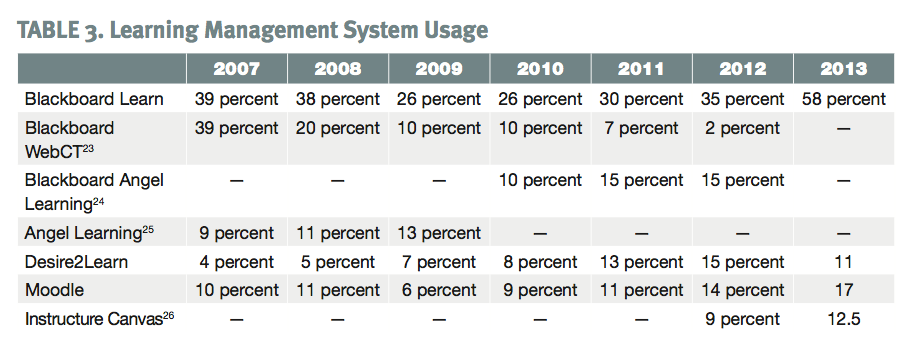
    The Instructional Technology Council (ITC), an affiliated council of the American Association of Community Colleges (AACC), has conducted a distance education survey since 2004 focusing on online education trends among community colleges in the US and Canada. With this focus, the member colleges tend to be those with a stronger interest in online education programs and therefore are more progressive in technology usage than the general community college population. One part of the ITC survey is on general LMS usage at member schools, and this provides another source of data on the higher ed LMS market.

    The survey this year was based on 142 responses out of the 375 member institutions (39%), and there are a few caveats that should be noted:

    • Prior to 2012 the survey was emailed to all AACC colleges, but due to uneven responses the survey changed to just survey ITC colleges; and
    • “No answer” responses are not listed in percentages, thus totals will not always equal 100%.

    Despite those caveats, “70 percent of the annual submissions have come from the same campuses during the nine years of the survey”, which means that it is worth exploring some broad trends for the LMS market for community colleges. Here is the data presented on LMS usage this year on page 15 (April 2014 report of Fall 2013 survey data):

    Table 3


    (more…)

  • The Resilient Higher Ed LMS: Canvas is the only fully-established recent market entry

    For a few years starting in 2009, it seemed one of the best ways to raise VC funds or corporate internal investment was to say “we can beat Blackboard with a new cloud-based platform”. Witness Coursekit / Lore, Instructure / Canvas, OpenClass, LoudCloud Systems, Helix, and even more recently MOOC platforms. There were many articles written as these new systems entered the market, but what if we look back and ask whether the LMS market has actually changed recently? The picture that emerges is one of surprising resiliency by the established LMS providers.

    In fact, I would argue that in the past eight years (at least in North America) the only new system that has fully established itself in the LMS market is Canvas. Note that I have combined WebCT and ANGEL within the Blackboard umbrella, but even these systems established themselves more than a decade ago.

    (more…)

  • An Employee View of Textbook Publishers and Ed Tech Companies

    Update: For reference, 2U has pointed out to me that they were recently recognized by Glassdoor as the 17th-best medium-sized company to work for in 2014. With an average score of 4.2 (based on 21 reviews), this puts them on top of the other ed tech companies discussed here. The only other education company on the Glassdoor best places lists is Edmentum which, oddly, only has a 3.1 average rating based on 37 reviews.

    Second Update: All the education companies that have scored well on Glassdoor are coming out of the woodwork now. W.W. Norton has pointed out to me that the have a 4.2 average rating, based on 47 reviews. That puts them tied for first among education companies (that I know of) with 2U.

    One way to get a sense of how the companies whose products you depend on are doing is to talk to their employees. This is particularly helpful at times like this, when huge changes are underway. So I thought it would be interesting to take a survey of the employee reviews on Glassdoor of some of the major companies in the industry. The results are revealing, if not entirely surprising.

    (more…)

  • Layoffs at Desire2Learn: Significant or not?

    In a little-reported event the week of Thanksgiving, Desire2Learn let go 28 employees. The only public report I’m aware of comes from The Record out of Desire2Learn’s hometown of Kitchener, Ontario in Canada.

    E-learning company Desire2Learn has cut about 25 workers from its product development department.

    Virginia Jamieson, spokesperson for the Kitchener-based company, said nine per cent of the 280-member product development section was let go. That represents about three per cent of the firm’s total workforce. [snip]

    Since it was founded in 1999, the company has grown to more than 900 [sic] employees in several countries.

    “So it is a small percentage of that, but it happens to be people in Kitchener, which is where our initial growth was, so it may seem bigger than it really is,” Jamieson said.

    While this move might be harsh for those employees affected, it does not sound too significant. But is there more to the story?

    According to Sources

    Michael and I have talked to 10 off-the-record sources and reviewed Twitter, LinkedIn and Glassdoor as we looked into this issue, and the consistent story we heard was that the layoffs may be much more significant, both in number and motivation. After research, we now believe: (more…)