
e-Literate

Present is Prologue

Tag: Ed Tech

  • What does Devlin Daley’s departure mean for Instructure?

    Despite all the media hype on MOOCs over the past two years, perhaps the most important recent market entry for ed tech has been Canvas, the LMS from Instructure. Instructure was founded in 2008 by Brian Whitmer and Devlin Daley. At the time Brian and Devlin were graduate students at BYU who had just taken a class taught by Josh Coates, where their assignment was to come up with a product and business model to address a specific challenge. Brian and Devlin chose the LMS market based on the poor designs and older architectures dominating the market. This design led to the founding of Instructure, with Josh eventually providing seed funding and becoming CEO by 2010.

    Michael covered the burst of news in January 2011 that served as the launch of Canvas.

    Instructure has just announced that they will be releasing an open source version of their Canvas LMS product. Between this announcement, the winning of the Utah Education Network contract (109,000 college students and 40,000 K12 students), and the oh-so-ever-brief lawsuit by Desire2Learn about that win, Instructure has been making quite a splash lately.

    Since that time Instructure has grown to 7M+ users, 500 customers and 240 employees while raising $50M in total VC funding. With that much early success, it was a surprise to see Devlin Daley leave the company as of last week with his Douglas Adams reference. (more…)
  • Open as in Transparent: Instructure Conducts 2nd Public Security Audit on Canvas LMS

    I wrote a series of posts last fall about security testing for higher ed LMS products. In my initial post I called for more transparency.

    We need more transparency in the LMS market, and clients should have access to objective measurements of the security of a solution. To paraphrase Michael Feldstein’s suggestions from a 2009 post:

    • There is no guarantee that any LMS is more secure just because they say they are more secure
    • Customers should ask for, and LMS vendors should supply, detailed information on how the vendor or open source community has handled security issues in practice
    • LMS providers should make public a summary of vulnerabilities, including resolution time

    I would add to this call for transparency that LMS vendors and open source communities should share information from their third-party security audits and tests. All of the vendors that I talked to have some form of third-party penetration testing and security audits; however, how does this help the customer unless this information is transparent and available. Of course this transparency should not include details that would advertise vulnerabilities to hackers, but there should be some manner to be open and transparent on what the audits are saying.

    Subsequently I was asked by Instructure to serve as an embedded reporter as they undertook a public security audit. In a post from January 2012, Josh Coates called for other LMS vendors to follow suit.

    Despite the lack of response, Instructure declared their intent to test again in fall 2012.

    We will kick off our second annual open security audit in Q4. We invite any and all education companies to participate. We think education should be open, safe, and secure — and that corporations should be held accountable for their claims.

    Second Annual Audit for Canvas LMS

    True to their word, Instructure conducted another audit this year, again using Securus Global, described in this blog post and documented in this Securus report. I did not act as an embedded report this time around, but I would like to highlight some of the findings from the report.

    (more…)

  • Mobile in Ed Tech: Moving Beyond Browser Replacement

    In 2003 Steve Jobs made a speech to the International Design Conference in Aspen, and the audio for this speech has just been re-discovered and shared. There is even a transcription from the Verge available here. During his talk, Jobs foresaw future mobile devices as well as the challenge we would face in truly taking advantage of these mobile devices.

    Ok let’s go back to this revolution, what is happening? What’s happening is the personal computer is a medium– of communication. One of the medium. So what’s a medium? It’s a technology communication. A book is a medium. Telephone. Radio. Television. These are mediums of communication. And each medium has pitfalls to it, it has shortcomings, has boundaries which you can’t cross. But it also, generally, has some new unique opportunities.

    The neat thing, is that each medium shapes not only the communication that goes through it but it shapes the process of the communication. Perfect example: if you compare the telephone with what we’re seeing if you link a bunch of computers together and we can send messages to an electronic mailbox, which people can then receive– at their leisure.

    (more…)

  • Lore Announcement Shows Promise of Cloud-Based Platforms: Low Cost of Design

    You have to give credit where it’s due – Lore is a fast-moving ed tech startup that is not resting on its laurels. The New York based learning platform company has already rebranded (changing its name from Coursekit to Lore) and rewritten its core platform from the ground up. All in its first year.

    In their latest press release:

    Since launching seven months ago, instructors at over 600 schools—including Harvard, Stanford, and Princeton—have adopted the platform. Lore gives courses a home online, providing management tools like a gradebook, and a Facebook-like environment for students to communicate with each other. [snip]

    “We’ve completely re-designed the platform in the new version,” said 21-year-old CEO, Joe Cohen. “It’s an order of magnitude more beautiful, easy to use, and powerful. ”A highlight of the new version, instructors now have the ability to make their courses available for the public to “audit.” Additionally, Lore now provides all students and instructors with individual profiles to showcase their background, academic achievements, and aspirations.

    (more…)

  • Piazza – An Example of Free Learning Tool Targeted at Faculty / Student Adoption

    In my recent webcast with Patrick Masson for WCET, we described the growing usage of learning tools outside the official LMS solution. Patrick described survey results done by UMassOnline that captured the rich source of (often free) learning tools used in UMass courses. Much of educational technology is moving from an enterprise LMS market – with feature-rich LMS solutions expected to provide the majority of learning tools – to a learning platform market – with interoperable tools patched together with or without the official LMS by either campus staff or even directly by faculty. These tools are quite often free, and as such they are targeted at faculty and student adoption, rather than institutional adoption via a Request for Proposal process.

    One example of these tools is Piazza, which is a “a place where students can come together to ask, answer, and explore under the guidance of their instructor”. Think of the tool as an combination of discussion board, chat room, and wiki, with some design elements from Google Wave. While the description might be hard to understand, that is part of the issue – Piazza is not targeted to replace the LMS or to replicate specific LMS functionality.

    Jessica Wong at MakingUseOf has a very useful post running through the functionality of Piazza for those interested in the tool itself. My interest for this post is more on what Piazza represents in terms of ed tech trends with the availability of free platforms and tools that are targeted at student and faculty adoption.

    (more…)

  • When Large Companies Enter Ed Tech

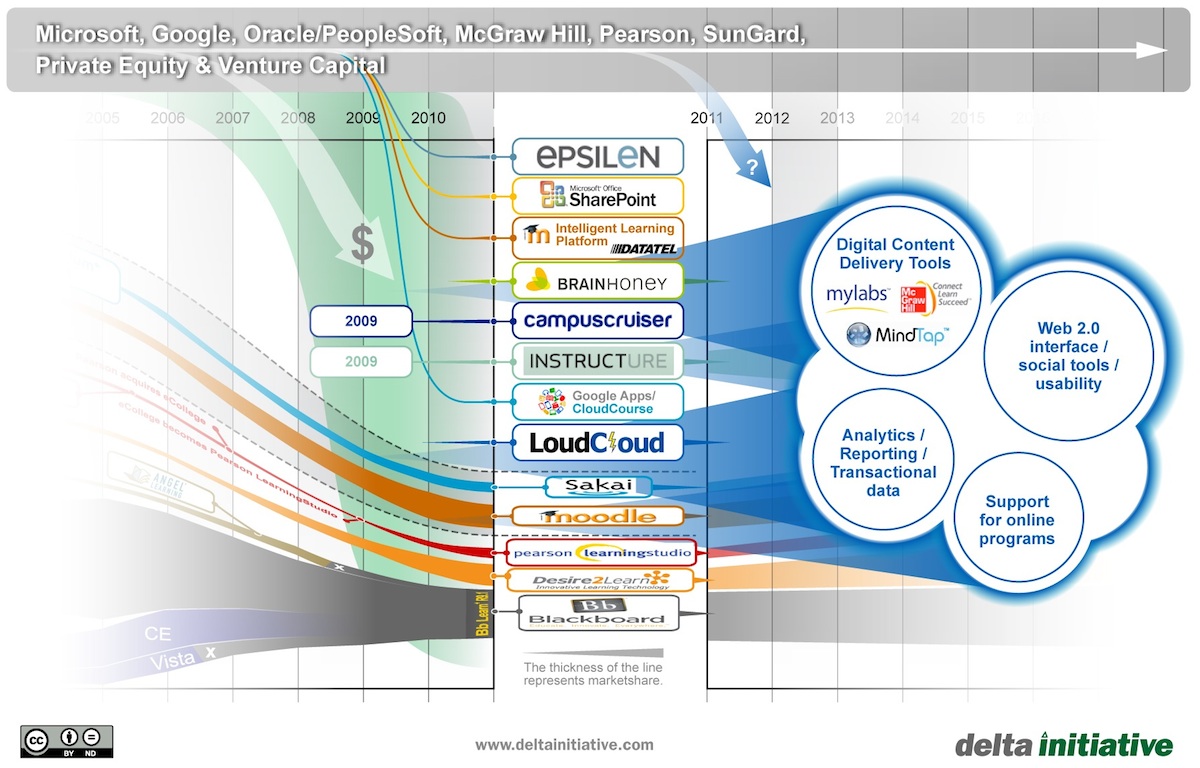
    I had a very interesting conversation on the way home from EDUCAUSE with Frank Florence, who is the Senior Director of Education Market Management for Cisco.  We discussed the changes happening in the ed tech market, and Frank helped me understand some of the market forces behind the changes we’re seeing.  One topic in particular was the dynamic between entrepreneurial companies that develop within a vertical market and larger companies that span markets.  I have argued that internal investment from larger companies is helping to change the ed tech market, but Frank provided valuable insight into the nature of the typical market forces we’re living through.  This observation of large company involvement helping to change the LMS portion of the ed tech market is shown below, in many of the companies in the top gray bar and some that are not listed.

    (more…)

  • Ambivalent on Ed Tech: The EDUCAUSE Re-write

    Now that I’ve had time to digest the implications of EDUCAUSE 2011 – which were significant, but not as mind-blowing as the Reading Market experience – I keep going back to a post I wrote earlier this year (although not on e-Literate).  In that post contrasting a Gartner report on IT spending with an Ambient Insight report on ed tech and online spending, I argued that ambivalence was the key to understanding both reports in context.  Likewise, based on the hype and reality of ed tech at EDUCAUSE, ambivalence can help us understand future implications for education.

    One of the benefits of blog posting is the ability to wholesale plagiarize yourself where needed (ed – I’ll see you in court, Mr. Hill).  Herewith is my rewrite of that post based on this year’s EDUCAUSE experience.

    (more…)