
e-Literate

Present is Prologue

Tag: Ed Tech

  • GSV+ASU EdInnovations Conference: A proxy for ed tech’s big challenge

    Last week Michael and I attended the GSV+ASU EdInnovations conference commonly known as “Davos in the Desert”. This conference is growing in importance, especially in the effect on ed tech investment, as can be seen by the rising attendance. Just five years ago there were less than 300 attendees, and this year’s event had well over 2,000. Some of the notable articles covering the event:

    • Inside Higher Ed: “Let’s Make a Deal” – this article compares the rise of ed tech in general to the rise in the conference, but asks about lack of educators and lack of nationwide results (more on this later).
    • Huffington Post: “Is the American Dream a Dream Deferred?” – this article takes a positive spin on the conference, especially the focus on improving access and student success, but also questions the lack of diversity (more on gender lines than educator / non-educator lines).
    • EdSurge: “What Happened at ASU-GSV…” – this article presents an insider, booster view of the conference occasionally to accentuate the positive and defuse the negative, but it does describe the conference events quite well.
    • Getting Smart: “ASU+GSV: Education Dreaming” – ditto.
    • EdWeek: “Teachers at Summit Tell Ed. Companies What They Want–and What They Don’t” – this article covers one panel in particular, but this one is highly relevant to the following discussion on educator involvement.
    • Dusty World: “ASU/GSV Summit” – this article has a slightly humorous description of “the strangest education conference of my career”, noting that most discussions actually focused on politics and not pedagogical approaches.

    As for myself, I live-tweeted some of my observations, particularly focusing on pro-immigration reform, foundation influence, and the difficulty of interviewing Don Graham (former owner of the Washington Post and current family owner of Kaplan). (more…)
  • Two-Year Anniversary of Blackboard Acquisition of Moodlerooms and NetSpot

    Two years ago today, Blackboard made a dramatic change of course with a series of public announcements:

    At the time I described these changes:

    Most of the discussion in articles and blogs follows the meme of Blackboard entering open source, or even the meme of Blackboard acquiring competitors. I think the news is more significant than either of these two memes.

    Blackboard just did a 180-degree turn on their strategy for their core LMS business. They have moved from consolidating all customers into Learn 9.1 to providing products and services that are almost LMS-agnostic.

    Archive of Statements

    Given this dramatic turn of events, I wrote an additional post that captured the public statements (press releases, blog posts) from Blackboard, Moodlerooms, NetSpot, and even Blackboard competitors for the purpose of checking to see if the acquisitions really did signal a true change in strategy and support for open source. This two-year anniversary seems the perfect time to check up.

    Bb’s Previous Open Source View

    Just how big of a change did the announcements represent? Consider Blackboard’s moves regarding alternative LMS solutions in the previous six years. (more…)

  • 2U’s Upcoming IPO: Filing estimates $533 million company value

    One month ago 2U filed its registration for an IPO in 2014. 2U is an online service provider that helps traditional universities develop fully-online programs, currently based on 9 customers at the master’s level (see here for summary of revenue per student and per customer). On Monday the company set the terms for the IPO, as described by Bill Flook in the Washington Business Journal.

    2U Inc. on Monday set terms for its upcoming initial public offering. The Landover-based ed-tech company plans to sell 8 million shares at between $11 to $13 apiece. Selling stockholders plan to offload another 1.17 million shares in the offering.

    Altogether, the IPO would raise a total $110 million, assuming the 2U prices at the mid-point of that range. The company plans to list on the Nasdaq under the ticker symbol “TWOU.”

    (more…)

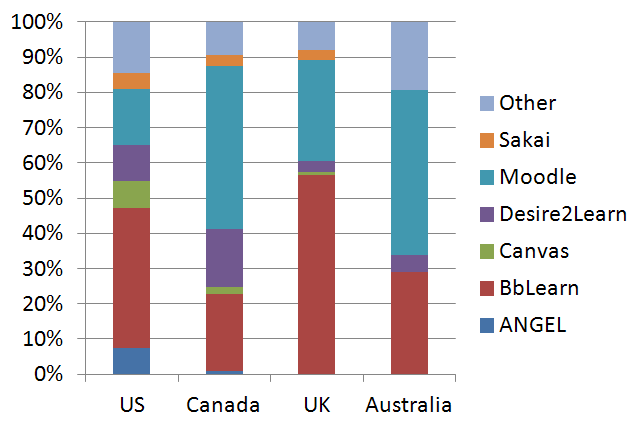
  • New look at LMS data for US small colleges

    Last fall I mentioned two new non-survey data sources available to track LMS adoption within higher ed. While surveys for subjective, attitudinal information still make sense, surveys of hard data are losing their value over time. Analyses of automatically collected system data place less of a burden on the organizations providing the information, and these analyses also allow a more agile approach to refining the data collection and viewing from different angles. Today Edutechnica released a new report on LMS adoption that demonstrates these benefits.

    When we provided our initial analysis of LMS usage in fall of 2013, one point of feedback that we heard loud and clear is that because our data only included institutions with greater than 2000 enrollments, we excluded a fair number of community colleges, career colleges, and liberal arts colleges. To the credit of those who provided this feedback, they were absolutely correct. Three-quarters of all recognized higher education institutions in the United States have fewer than 2500 FTE – a critical demographic as the majority of universities in the US are of this size or smaller. To more fairly represent LMS usage we needed to include data on smaller schools.

    We are now excited to be able to provide analysis of a data set for institutions with greater than 1000 students.

    The team presents the raw data for schools above 1,000 FTE, calling out some of the differences from their earlier report. But one key view they provided is looking at institutional LMS adoption per school enrollment size.

    Seeing Moodle’s increased usage prompted us to investigate Moodle further. An interesting thing happens below 2500 FTE; Moodle actually exceeds Blackboard’s market  share.  Only after this point do the demographic segments diverge. (more…)

  • New data available for higher education LMS market

    Despite much talk about the demise of the LMS market, the end is nowhere in sight. Unlike many of the newer learning platform concepts (e.g. MOOCs, free platforms, unbundled learning platforms), the LMS market has an established business model and real revenues. Just today came news of an investment analysis report predicting that total LMS market (higher ed, corporate training, K-12) would triple in revenue by 2018, moving from $2.6B to $7.8B. The LMS ain’t sexy, but it’s still important.

    global_LMS_stacked_by_typeThis is why I have found it surprising how long it is taking to move from survey-based and anecdotal market information to harder data directly measured by the actual LMS implementations. Until recently, that is, when there are at least two very useful sites available.


    Edutechnica

    George Kroner, a former engineer at Blackboard who now works for University of Maryland University College (UMUC), has developed what may be the most thorough measurement of LMS adoption in higher education at Edutechnica (OK, he’s better at coding and analysis than site naming). This side project (not affiliated with UMUC) started two months ago based on George’s ambition to unite various learning communities with better data. He said that he was inspired by the Campus Computing Project (CCP) and that Edutechnica should be seen as complementary to the CCP.

    (more…)

  • Educational Technology and the Sources of Innovation

    Based on Jon Udell’s excellent post, I spent the weekend getting reacquainted with work of Eric von Hippel, the researcher who pioneered the study of user-driven innovation.

    What’s interesting about von Hippel is that his research hits on the common themes of the open education movement, but does so in a slightly different key.

    Briefly, there are a number of intersecting debates about MOOCs. There is what Reich frames as the Dewey/Thorndike debate about what learning is. There is the centralized/de-centralized debate about what the web does best. There is the debate about about whether MOOCs are disruptive or innovative or neither, and the discussion over how much ability to remix teachers need to make classroom learning work well (answer, probably, is quite a bit).

    But people on both sides of the debates are often driven by a larger question that we are not naming directly enough: “What are the sources of innovation?”

    User Innovation

    This is the question that von Hippel has been investigating for over thirty years now. And if we see innovation not as something that has happened, but as something we want to continue to happen, this may be the most important question of all.

    (more…)

  • e-Literate TV trailer from EDUCAUSE 2013

    Last week Michael announced a new project of ours called e-Literate TV. To recap, the idea is that there are new groups involved in decisions that impact ed tech and online education. Deans, provosts, presidents, boards of trustees, state legislators, and even national media are newly interested in topics with different levels of understanding and different perspectives.

    This new situation can be frustrating for e-learning professionals who have been involved in ed tech for years, but we cannot and should not wish away this new interest. Instead, there is an opportunity to develop new ways to engage the various groups in discussions about the usage of technology to enable change in education.

    This is the goal of e-Literate TV. One way we see e-Literate TV being used is by e-learning professionals sharing easy-to-consume ~10-minute videos with various stake holders as a method to enable more productive conversations. As such, all of the video segments will come with a creative commons license for easy sharing.

    What event is complete without a cool tee shirt?
    What event is complete without a cool tee shirt?

    (more…)