
e-Literate

Present is Prologue

Tag: Ed Tech

  • On ECAR data and ed tech purgatory

    Recently I wrote a post about many ed tech products being stuck in pilots without large-scale adoption.

    In our consulting work Michael and I often help survey institutions to discover what technologies are being used within courses, and typically the only technologies that are used by a majority of faculty members or in a majority of courses are the following:

    • AV presentation in the classroom;
    • PowerPoint usage in the classroom (obviously connected with the projectors);
    • Learning Management Systems (LMS);
    • Digital content at lower level than a full textbook (through open Internet, library, publishers, other faculty, or OER); and
    • File sharing applications. [snip]

    This stuck process ends up as an ed tech purgatory – with promises and potential of the heaven of full institutional adoption with meaningful results to follow, but also with the peril of either never getting out of purgatory or outright rejection over time.

    With the Chronicle’s Almanac coming out this week, there is an interesting chart that on the surface might contradict the above information, showing ~20 technologies with above 50% adoption.
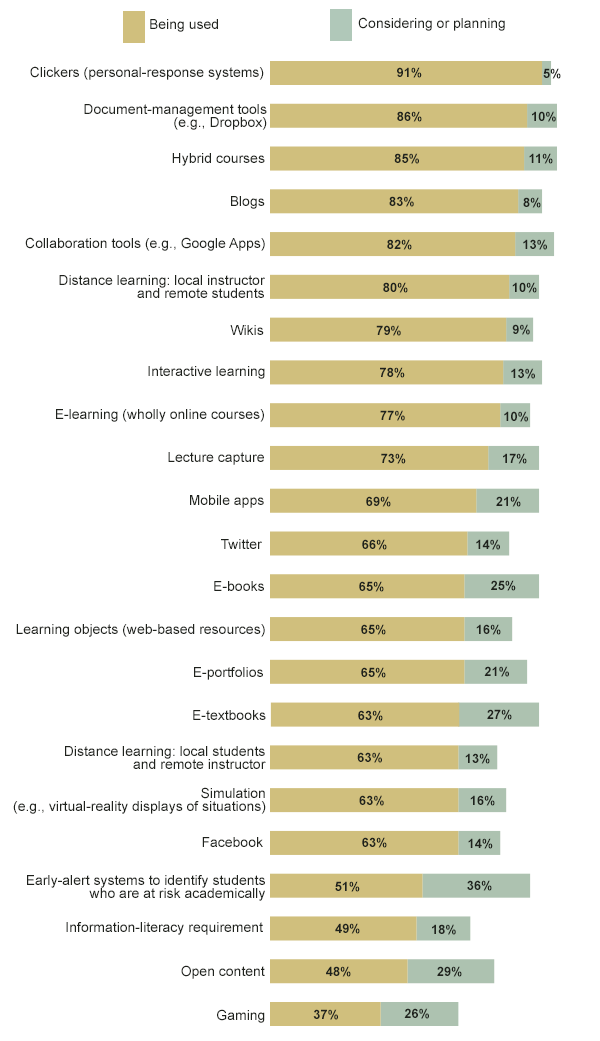
    Note: Data are drawn from responses by a subset of more than 500 of the nearly 800 institutions that participated in a survey conducted from June to October 2013. Reported statistics are either an estimated proportion of the population or an estimated median. Source: Educause Center for Analysis and Research
    Note: Data are drawn from responses by a subset of more than 500 of the nearly 800 institutions that participated in a survey conducted from June to October 2013. Reported statistics are either an estimated proportion of the population or an estimated median.
    Source: Educause Center for Analysis and Research [ECAR]
    The difference, however, is that ECAR (through The Chronicle) asked how many institutions have different ed tech products and our survey asked how many courses within an institution use different ed tech products.

    There are plenty of technologies being piloted but few hitting the mainstream, and adoption within an institution is one of the key indicators to watch.
  • Pilots: Too many ed tech innovations stuck in purgatory

    Steve Kolowich wrote an article yesterday in the Chronicle that described the use of LectureTools, a student engagement and assessment application created by faculty member Perry Sampson at the University Michigan. These two paragraphs jumped out at me.

    The professor has had some success getting his colleagues to try using LectureTools in large introductory courses. In the spring, the software was being used in about 40 classrooms at Michigan, he says.

    Adoption elsewhere has been scattered. In 2012, Mr. Samson sold LectureTools to Echo360 ((Disclosure: Echo360 was a recent client of MindWires)), an education-technology company, which has started marketing it to professors at other universities. The program is being used in at least one classroom at 1,100 institutions, according to Mr. Samson, who has kept his title of chief executive of LectureTools. But only 80 are using the software in 10 or more courses.

    93% of LectureTools clients use the tool for less than 10 courses total, meaning that the vast majority of customers are running pilot projects almost two years after the company was acquired by a larger ed tech vendor.

    We are not running out of ideas in the ed tech market – there are plenty of new products being introduced each year. What we are not seeing, however, are ed tech innovations that go beyond a few pilots in each school. Inside Higher Ed captured this sentiment when quoting a Gallup representative after the GSV+ASU EdInnovations conference this year: (more…)

  • Update on 2U: First full quarterly earnings and insight into model

    2U, the online service provider that went public in the spring, just released its financial report for the first full quarter of operations as a public company. The company beat estimates on total revenue and also lost less money than expected. Overall, it was a strong performance (see WSJ for basic summary or actual quarterly report for more details). The basics:

    • Revenue of $24.7 million for the quarter and $51.1 m for the past six months, which represents year-over-year increase of 32 and 35%;
    • EBITDA Losses of $7.1 m for the quarter and $10.9 m for the past six months, which represents year-over-year increase of -2% and 12%; and
    • Enrollment growth of 31 – 34% year-over-year.

    Per the WSJ coverage of the conference call:

    “I’m very pleased with our second quarter results, and that we have both the basis and the visibility to increase all of our guidance measures for 2014,” said Chip Paucek, 2U’s Chief Executive Officer and co-founder. “We’ve reached a turning point where, even with continued high investment for growth, our losses have stopped accelerating. At the midpoint of our new guidance range, we now expect our full year 2014 adjusted EBITDA loss to improve by 17% over 2013. Further, we’ve announced a schedule that meets our stated annual goal for new program launches through 2015.”

    The company went public in late March at $14 / share and is still at that range ($14.21 before the quarterly earnings release – it might go up tomorrow). As one of only three ed tech companies to have gone public in the US over the past five years, 2U remains worth watching both for its own news and as a bellwether of the IPO market for ed tech.

    Notes

    The financials provide more insight into the world of Online Service Providers (OSP, aka Online Program Management, School-as-a-Service, Online Enablers, the market with no name). On the conference call 2U’s CEO Chip Paucek reminded analysts that they typically invest (money spent – revenue) $4 – $9 million per program in the early years and do not start to break even until years 3 – 4. 2U might be on the high side of these numbers given their focus on small class sizes at big-name schools, but this helps explain why the OSP market typically focuses on long-term contracts of 10+ years. Without such a long-term revenue-sharing contract, it would difficult for an OSP to ever break even.

    (more…)

  • Three Makes a Movement: Branson creates youth panel for student voice in ed tech

    Based on my involvement in the Evolve conference sponsored by the 20 Million Minds Foundation, held in January, I wrote a series of posts covering the discussions around online education and educational technology. The three main posts:

    During the conference I put out a call for other conferences to follow 20MM’s lead and work harder to directly include students in their discussions of ed tech – full post here and video below:

    Before we get to the analyses, however, it is important to highlight once again how unique this format is in education or ed tech settings. There is plenty of discussion about needing course design and support services that are learner-centric, yet typically ed tech conferences don’t have learner-centric discussions. We need to stop just talking about students and add the element of talking with students.

    While I do not believe there is a direct connection, this week Sir Richard Branson created a youth panel as part of the UK’s Generation Tech review, giving students a direct voice in educational technology. The panel’s focus is K-12 usage and is described in The Telegraph: (more…)

  • Policy Updates on FERPA and Net Neutrality

    Two policy debates that could have a significant impact on education – updates on FERPA and data privacy & FCC proposals on Net Neutrality – both entered the next stage this week.

    FERPA Modernization

    I recently wrote about the new federal moves to update FERPA to handle the age of Big Data (should I have used scare quotes there?).

    Yesterday the White House released its report on big data and privacy implications. The focus was broadly on big data, but there will be implications for ed tech, with several key recommendations specifically focused on the education sector. Specifically, there will be a push to update and revise the Family Educational Rights and Privacy Act (FERPA, enacted in 1974) and Children’s Online Privacy Protection Act (COPPA, enacted in 2000).

    I was quite optimistic about the federal approach based on this report, and yesterday we got some more apparently good news – a bipartisan approach to improve data privacy and update FERPA made in a reasonable fashion (dogs and cats, living together). As reported by THE Journal, Senators Markey (D-MA) and Hatch (R-UT) introduced the “Protecting Student Privacy Act”, getting even a warm reception from the Software and Information Industry Association (SIIA), which had objected to the earlier version discussed in January. THE Journal summarized the key parts of the legislation (full text here): (more…)

  • ITC Survey: Four trends to watch in LMS market for community colleges

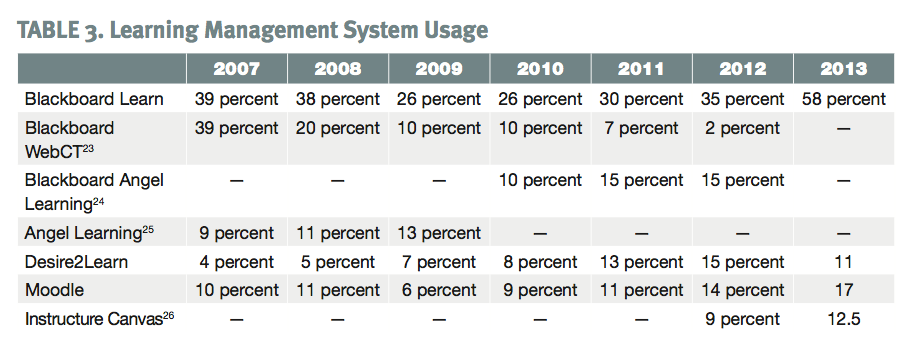
    The Instructional Technology Council (ITC), an affiliated council of the American Association of Community Colleges (AACC), has conducted a distance education survey since 2004 focusing on online education trends among community colleges in the US and Canada. With this focus, the member colleges tend to be those with a stronger interest in online education programs and therefore are more progressive in technology usage than the general community college population. One part of the ITC survey is on general LMS usage at member schools, and this provides another source of data on the higher ed LMS market.

    The survey this year was based on 142 responses out of the 375 member institutions (39%), and there are a few caveats that should be noted:

    • Prior to 2012 the survey was emailed to all AACC colleges, but due to uneven responses the survey changed to just survey ITC colleges; and
    • “No answer” responses are not listed in percentages, thus totals will not always equal 100%.

    Despite those caveats, “70 percent of the annual submissions have come from the same campuses during the nine years of the survey”, which means that it is worth exploring some broad trends for the LMS market for community colleges. Here is the data presented on LMS usage this year on page 15 (April 2014 report of Fall 2013 survey data):

    Table 3


    (more…)

  • White House report on big data will impact ed tech

    Yesterday the White House released its report on big data and privacy implications. The focus was broadly on big data, but there will be implications for ed tech, with several key recommendations specifically focused on the education sector. Specifically, there will be a push to update and revise the Family Educational Rights and Privacy Act (FERPA, enacted in 1974) and Children’s Online Privacy Protection Act (COPPA, enacted in 2000). Education Week set the context quite well in its article:

    FERPA, which was written before the Internet existed, is intended to protect disclosure of the personally identifiable information contained in children’s education records. And COPPA, which requires parental consent under certain conditions for the online collection of personal information from children under age 13, was written before the age of smartphones, tablets, apps, the cloud, and big data.

    Think Progress, part of a group founded by John Podesta, who also led the White House study, summarized the key findings as follows:

    1. Giving consumers more protection and control over their private data with a bill of rights

    2. Pass a singular data breach law to prevent the next Target fiasco

    3. Strengthen outdated and archaic laws, such as the Electronic Communications Privacy Act (ECPA), which dictates how the government accesses emails

    4. Give non-citizens the same privacy protections

    5. Ensure data collected on students is used only for educational purposes

    Ed Tech Sections of the Report Itself:

    First, there is a description of the situation in pages 24 – 26 that is too long to quote but worth highlighting: (more…)