
As Phil noted in his post, Blackboard has hired a new CEO, a guy by the name of Bill Ballhaus. We don’t know much about him yet, other than that he came from outside education. (That shouldn’t be considered a disqualifier, by the way. Instructure CEO Josh Coates also came from outside education, for example, and he has kept most of his customers very happy so far.) We’ll learn more about him over the next days, weeks, and months. In the meantime, it’s worth taking some time to consider the challenge he has in front of him.
Tag: edunomics
-
Instructure Files for IPO
This doesn’t exactly come as a shock, but Instructure has filed for an IPO, and is expecting a post-IPO valuation of somewhere between $500 million and $800 million. Whenever a private company does this, they have to file a form called an S-1 with the SEC, which contains all kinds of financial and strategic information. You can find Instructure’s here.
Also not a big surprise, but the numbers in the report show big growth. Subscription revenue rose 72% from 2013 to 2014. Coincidentally, Edutechinica just published its 3rd annual LMS Data Update. As you can see, Canvas went through the roof in US higher ed while the other major LMS players were either flat or close to it:
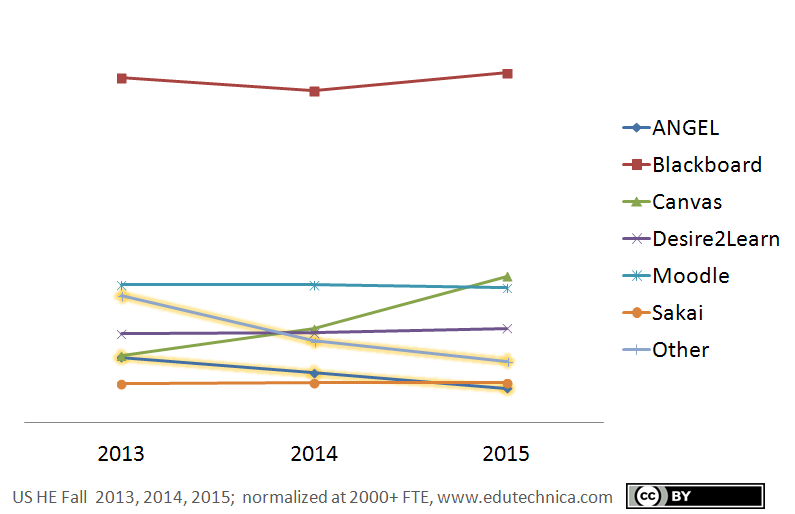
But in order to achieve that growth, they have been running at a loss. The problem seems to be in high expenses rather than low revenues, which suggests that the losses are coming from the company bulking up rather than from them undercutting the competition on price. Also, most of those revenues still come from the US. Instructure has offices in London, Hong Kong, and Sydney. That’s not a huge international presence. And as it happens, Eductechnica has data for the UK and Australia:
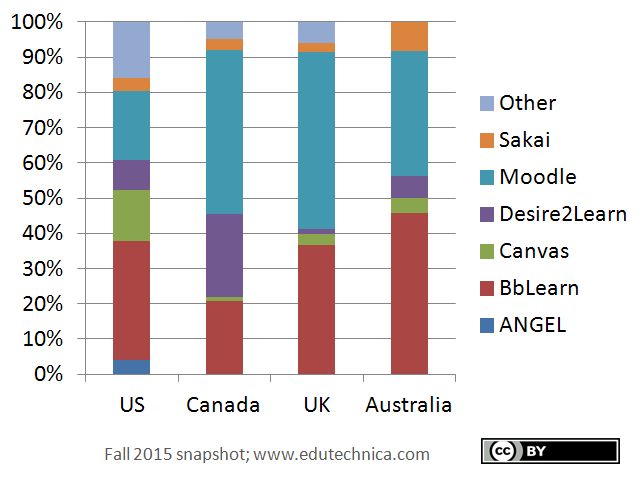
You can see that Instructure has not made a major dent yet in either country. (You can also see that their biggest competitor by far in those two countries is Blackboard, particularly when you consider that Blackboard now owns major Moodle hosting operations in both countries.)
One last bit that jumped out at me after a quick scan of the S-1 wasn’t financial. Their characterization of analytics was interesting. Throughout the document, they try to make the case that high user engagement and utilization lead to better learning analytics. For example,
Strong User Engagement Leads to Robust Data Analytics
Given today’s focus on accountability and performance, both academic institutions and companies are striving to improve learning outcomes. To do so, an organization must first understand the variables that impact results, such as attendance metrics, user engagement, and the efficacy of various learning content and technologies for individual learners. A learning management system has the potential to provide significant insight to educators and administrators on their students’ and employees’ progress toward meeting learning objectives and the factors impacting performance. In addition, such learning management systems can facilitate insightful benchmarking to allow organizations to explore other drivers of learning outcomes.
Strong user engagement with learning management systems is critical to maximize the potential of data analytics. High utilization enables the learning management system to capture more data, and leads to more insightful analyses on user behavior, quality of individual courses and effectiveness of digital content. Better analytics enables instructors and administrators to make more informed decisions about instruction and materials that in turn drive improved learning outcomes and performance for individuals and companies. This virtuous cycle among user engagement, data analytics and learning outcomes represents the evolution of learning technology. We believe that the market increasingly is demanding learning management software that delivers both robust analytics and strong user engagement.
They later go on to say,
Over eight million instructors, students and employees have used our software over the 12 months ended June 30, 2015. According to self-reported data in an ECAR 2014 survey, 58% of faculty in higher education use a learning management system to share content with students, while our internal analysis of higher education institutions using Canvas shows that 71% of faculty use Canvas to share content with students.
But their claim in terms of what they actually have for data analytics is fairly weak:
Our platform provides users with open API access to data analytics. We deliver the analytics in an easy to understand and consumable way, that is optimized for independent analysis. This open visibility allows learners to view their own progress in real-time, educators to adjust programs and personalize curricula for maximum effectiveness and organizations to benchmark user data internally and respond to patterns observed.
They are not arguing that they have good analytics, but rather that the high utilization of the software plus open APIs will enable customers to build good analytics themselves.
-
GSV 2015 Review
The basic underlying theme of the 2015 GSV Ed Innovation conference is “more is more.” There were more people, more presentations, more deal-making, more celebrities…more of everything, really. If you previously thought that the conference and the deal-making behind it was awesome, you would probably find this year to be awesomer. If you thought it was gross, you would probably think this year was grosser. Overall, it has gotten so big that there is just too much to wrap your head around. I really don’t know how to summarize the conference.
But I can give some observations and impressions.
-
Why LinkedIn Matters
A few folks have asked me to elaborate on why I think LinkedIn is the most interesting—and possibly the most consequential—company in ed tech.
Imagine that you wanted to do a longitudinal study of how students from a particular college do in their careers, or the effect of social media for brick and mortar in a particular local geographical location for strategic placement of services that local market is lacking. In other words, you want to study long-term outcomes. How did going to that college affect their careers? Do some majors do better than others? And how do alumni fare when compared to their peers who went to other schools? Think about how you would get the data. The college could ask alumni, but it would be very hard to get a good response rate, and even then, the data would go stale pretty quickly. There are governmental data sources you could look at, but there are all kinds of thorny privacy and regulatory issues.
There is only one place in the world I know of where bazillions of people voluntarily enter their longitudinal college and career information, keep it up-to-date, and actually want it to be public.
LinkedIn. (more…)
-
An Employee View of Textbook Publishers and Ed Tech Companies
Update: For reference, 2U has pointed out to me that they were recently recognized by Glassdoor as the 17th-best medium-sized company to work for in 2014. With an average score of 4.2 (based on 21 reviews), this puts them on top of the other ed tech companies discussed here. The only other education company on the Glassdoor best places lists is Edmentum which, oddly, only has a 3.1 average rating based on 37 reviews.
Second Update: All the education companies that have scored well on Glassdoor are coming out of the woodwork now. W.W. Norton has pointed out to me that the have a 4.2 average rating, based on 47 reviews. That puts them tied for first among education companies (that I know of) with 2U.
One way to get a sense of how the companies whose products you depend on are doing is to talk to their employees. This is particularly helpful at times like this, when huge changes are underway. So I thought it would be interesting to take a survey of the employee reviews on Glassdoor of some of the major companies in the industry. The results are revealing, if not entirely surprising.
-
Lessons from the Boundless Copyright Infringement Suit
On December 17th, the Boundless OER-based textbook startup issued a press release describing the settlement they had reached with Pearson, Cengage, and Macmillan in the lawsuit those three companies had filed against the company. (Full disclosure: Pearson has been a client of MindWires Consulting.) Actually, a lot of the press release wasn’t really about the lawsuit, and the description of the settlement consisted of the following:
Today, we’re excited to announce that we’ve settled the lawsuit. In agreeing to a confidential settlement agreement, along with a public judgment and injunction entered by the Court, the parties have resolved the dispute. The resolution allows the parties to move forward and focus on their mutually shared goal of helping students learn. Boundless now has a clear path for building and marketing its OER-driven textbook alternatives without treading upon the Plaintiffs’ rights, and it is confident that it is in compliance and will not have further legal issues with the Plaintiff publishers. In turn, Plaintiffs have reinforced the strong protection they have in and to their copyrighted works and the related goodwill that they and their authors have established, and look forward to Boundless operating its business within the agreed upon framework.
This seemed like a strangely muted ending to a strange story. It’s hard to tell from the press release what actually happened. But having read the consent decree and injunction, I have come to two conclusions. First, Boundless lost. Second, the suit and its outcome tell us very little about the future of OER but rather more about business strategy for ed tech startups.
-
Purdue University Has an Ethics Problem
It’s fair to say that Purdue University has sparked several important conversations in ed tech through their work on Course Signals. First, they pretty much put the retention early warning system as a product category on the map, conducting ground-breaking research and building a system that several major ed tech players have either licensed or imitated. More recently, they have sparked a conversation about the state of ed tech research and peer review as their more recent research has been called into question. I highly recommend reading the comment threads on these two posts to get a sense of that conversation.
Now I think Purdue may spark a third conversation—this time around the ethics of institutional learning analytics research and commercialization. Because there is no question in my mind that they have a serious ethical problem on their hands.