e-Literate

Present is Prologue

Tag: EdX

  • MOOC history as presented at AACN13 conference

    With all of the great discussions spawned by the “greatest MOOC conference in the history of MOOCs” (MRI13), it seems a good time to share a segment of a keynote presentation I gave last year on MOOC history. This presentation was at the American Association of the Colleges of Nursing (AACN) conference in April 2013. For context, I had just shared how online education was no longer an issue kept in the corner, away from mainstream higher ed, but was now affecting the traditional campus discussions.

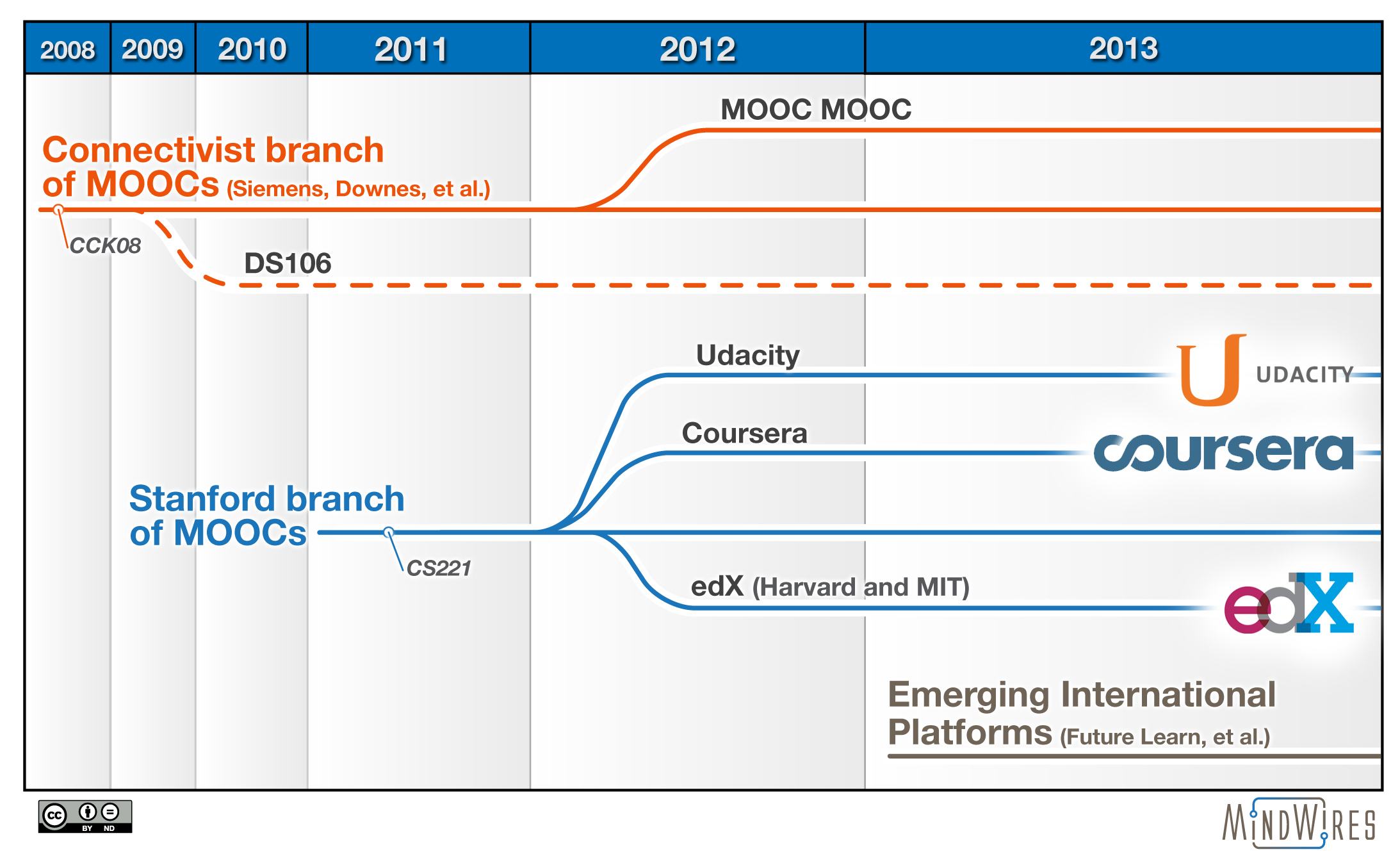
    There is a relevant graphic that was shown during this segment of the talk, showing the MOOC timeline (updated version shown below).

    MOOCpreHistory20131202

  • Combining MOOC Student Patterns Graphic with Stanford Analysis

    In part 1part 2, and part 3 of this series of posts on MOOC student patterns, I shared a description of five student patterns emerging from open-enrollment MOOCs (excluding those with an associated student fee) based on anecdotal data.  In part 4 I compared the overall course completion pattern against an MIT study of the first edX MOOC, leading to some validation of the general shape of when participants drop out.

    Combined MOOC patterns

    The model and typology has gained traction recently, being referenced in both the Government of Ontario’s  environmental scan and literature review [pp 32-33, 40] as well as the British government’s The Maturing of the MOOC literature review [pp 26-28]. So that means it’s time to update and keep people on their toes.

    (more…)

  • Two MOOC curriculum announcements in one week

    In two apparently unrelated announcements, both MIT and Wharton announced they were moving beyond just courses and putting significant parts of their curriculum into MOOC platforms, both with identity verification. MIT is putting several undergraduate sequences online through MITx (their implementation of  edX), while Wharton business school is putting a “foundation series” of first-year courses online through Coursera.

    First the MIT news from Inside Higher Ed (see the Chronicle for additional coverage):

    The Massachusetts Institute of Technology will this fall package some of its online courses into more cohesive sequences, just as edX prepares to roll out certificates of completion using identity verification. Seen together, the two announcements may provide a glimpse at what the future holds for the massive open online course provider.

    The “XSeries” sequences add a new layer of structure to MITx, the institution’s section of the edX platform. The first of seven courses in the Foundations of Computer Science XSeries will be offered this fall, with one or more new courses being rolled out each semester until the fall of 2015. The Supply Chain Management XSeries, consisting of three courses, will begin in the fall of 2014. The two sequences will target undergraduates and working professionals, respectively. [snip]

    (more…)

  • MOOC Discussion Forums: barrier to engagement?

    Robert McGuire wrote an article for Campus Technology, Building a Sense of Community in MOOCs, that touches on an important topic – is the centralized discussion forum a barrier to student engagement?

    But more students can also mean more isolation within the crowd. “Online classes can be really lonely places for students if they don’t feel like there’s a community,” notes Maria Andersen, director of learning and research at Instructure, which runs Canvas Network, an open repository where participating schools can deliver their own MOOCs.

    Ironically, the biggest obstacle preventing MOOC students from forming relationships is the feature most relied on to encourage them. Discussion forums are the number one complaint by readers and contributors of MOOC News and Reviews, an online publication devoted to critiquing individual MOOC courses and the evolving MOOC landscape. Most MOOC discussion forums have dozens of indistinguishable threads and offer no way to link between related topics or to other discussions outside the platform. Often, they can’t easily be sorted by topic, keyword, or author. As a result, conversations have little chance of picking up steam, and community is more often stifled than encouraged.

    There are several studies that appear to show that MOOC discussion forums have few students participating and that the forums are dominated by a small number of students.

    (more…)

  • Some validation of MOOC student patterns graphic

    File this under “you read it first on e-Literate”.

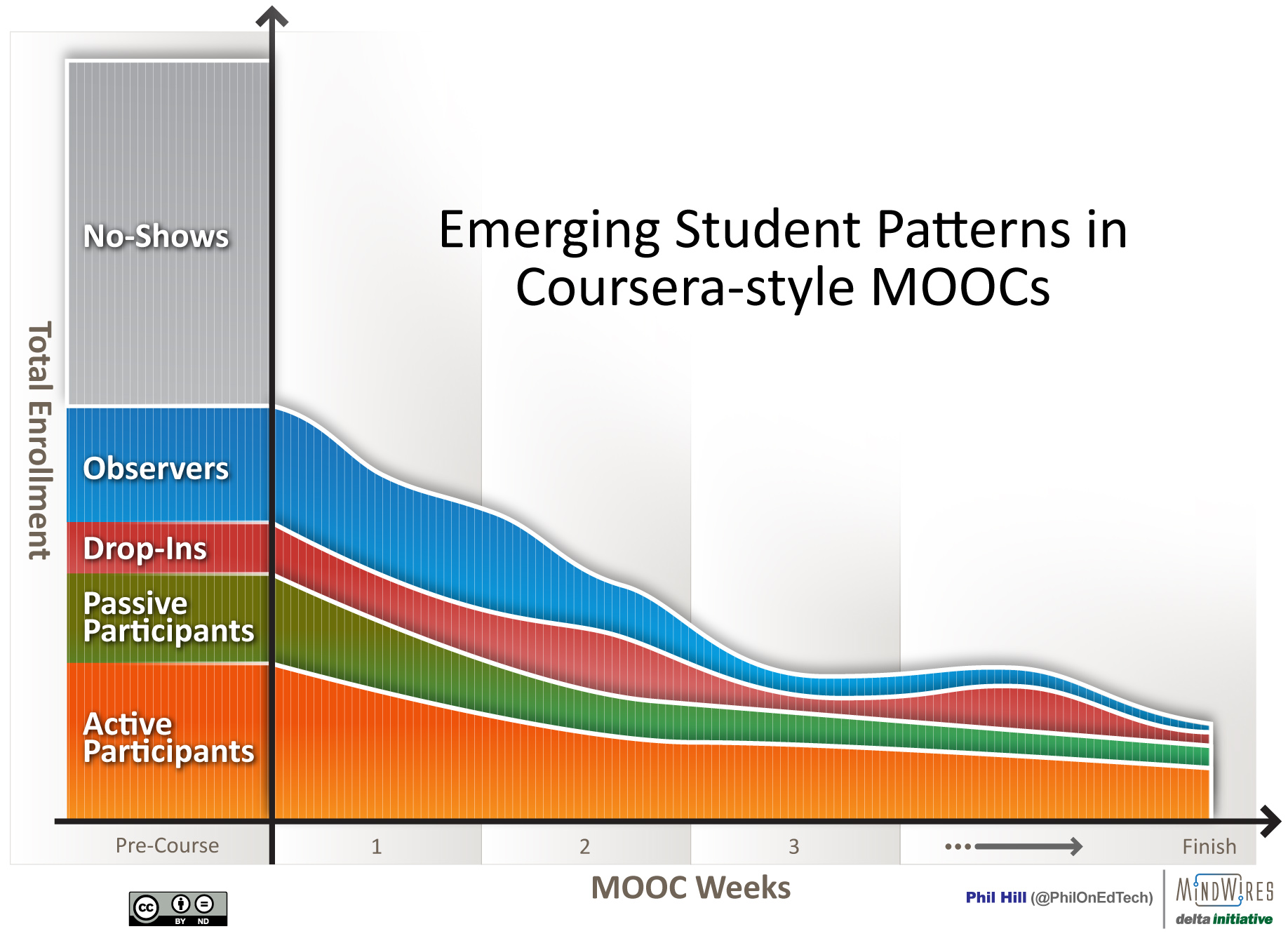
    In previous posts from spring 2013 I provided a graphical view on MOOC student patterns based on observed retention over time as well as differing student types. This graphic was based on anecdotal observations of multiple MOOCs, mostly through Coursera.

    studentPatternsInMoocs3-2


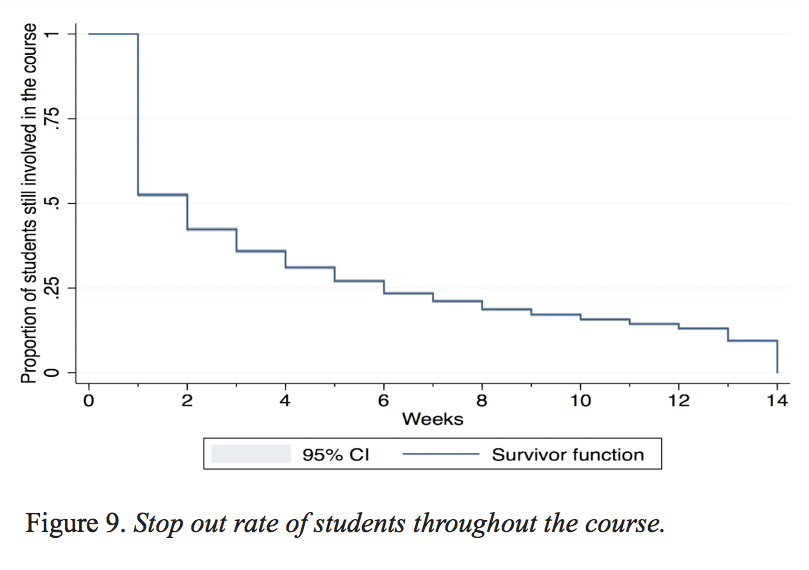
    Based on a recent study of the edX Circuits and Electronics MOOC, there is this interesting chart of student patterns based on actual data analysis of the 155k students from the spring 2012 offering of this course. The full report is worth reading, by the way, with some real student pattern insights.

    edX Retention


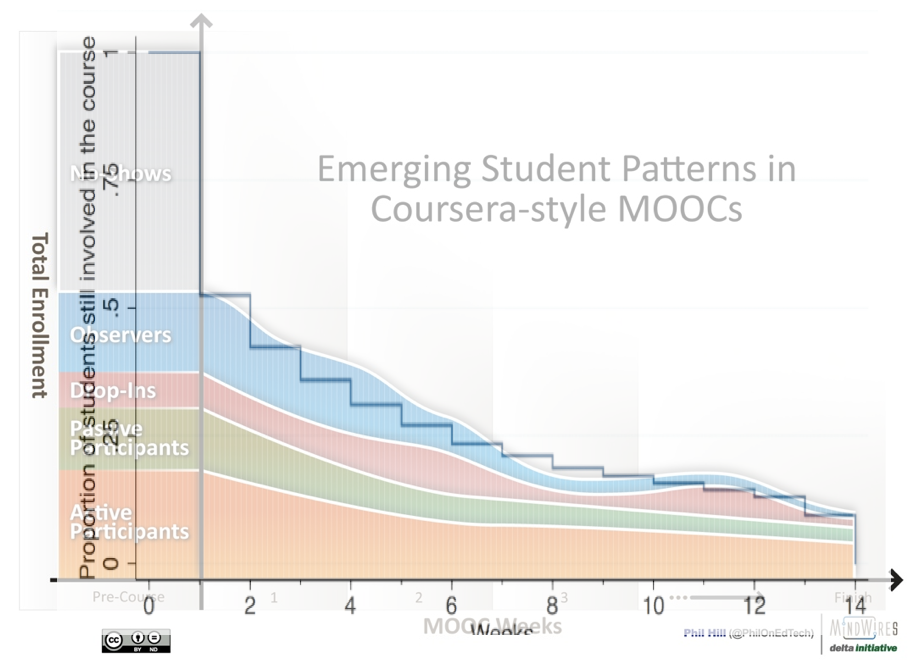
    I took this chart and overlaid it on the MOOC student patterns graphic, scaling for 0% / 100% of enrollment vertically and start / stop of course horizontally.

    Combined MOOC patterns


    It’s good to see this validation of the overall retention pattern based on real data analysis to augment the original graphic’s model.

  • LMS Market Update: May and June News

    There have been a number of LMS and Learning Platform announcements over the past month or two that will help shape the market over the next year or more. One trend I’ve described is the transition from an LMS market to a Learning Platform market, which includes a broader scope of products. Below are some of the notable announcements. I expect that Michael and I will write separate posts in more detail on several of these updates.

    • LMS CEO panel discussion at Learning Impact
    • Instructure, maker of Canvas LMS, raises $30M
    • Desire2Learn announces Student Success System as predictive analytics with new release
    • Sakai OAE recovers from loss of partners, rebrands as Apereo OAE
    • Coursera shifts strategy in partnering with schools, now overlaps with LMS market
    • edX finishes releasing platform code as open source
    • LMS conference season approaching

    LMS CEO panel discussion at Learning Impact

    In mid May, Inside Higher Ed’s Scott Jaschik hosted a panel discussion of the LMS CEOs at the Learning Impact conference. Blackboard’s new CEO, Jay Bhatt, was welcomed into the higher education community with the, ahem, liveliest panel discussion in recent memory. Given the all-star panel (John Baker, CEO, Desire2Learn; Jay Bhatt, CEO, Blackboard; Josh Coates, CEO Instructure; Martin Dougiamas, Moodle Founder and Lead Developer, Moodle; Manoj Kutty, CEO, LoudCloud Systems; Matt Leavy, CEO, Pearson eCollege), I’ve been surprised to see very little discussion after the event.

    But then I remembered:

    The First Rule of the LMS Panel is you do not talk about the LMS Panel

    (more…)

  • MOOCs Beyond Professional Development: Coursera’s Big Announcement in Context

    One aspect of last week’s Coursera announcement was the acknowledgement that MOOCs to date have primarily served as a mechanism for professional development, not as a mechanism for serving higher education per se. In the Chronicle article:

     Daphne Koller, a co-founder of Coursera, acknowledged that the company was venturing into new terrain. After studying their MOOC users, the company realized that most of them had already earned college degrees, said Ms. Koller. That was well and good, but it suggested to Coursera’s founders that MOOCs would not be sufficient to achieve their ambitions.

    “If you’re looking to really move the needle on fundamental educational problems, inside and outside the United States, you’re going to need to help people reach the first milestone, which is getting their degrees to begin with,” Ms. Koller said.

    and from the New York Times:

    “Our first year, we were enamored with the possibilities of scale in MOOCs,” said Daphne Koller, one of the two Stanford computer science professors who founded Coursera. “Now we are thinking about how to use the materials on campus to move along the completion agenda and other challenges facing the largest public university systems.”

    These statements can be understood by looking at the demographic data for students that have been taking xMOOCs (i.e. from Coursera, Udacity and edX) in their first year.

    (more…)