e-Literate

Present is Prologue

Tag: EdX

  • Is the edX Acquisition a Big Deal?

    Is the edX Acquisition a Big Deal?

    I’ve been inundated with questions regarding what I think about 2U’s acquisition of edX. What do I think? I’ve been struck by how much less I care about this deal today than I would have a few years ago. That change is entirely due to my change in focus rather than external circumstances. e-Literate used to be, in part, an EdTech industry analysis site for its own sake. While I still do some EdTech industry analysis, I’m much more focused on how EdTech influences the direction of the education sector as a whole, particularly with regard to becoming more effective at sustainably helping more students. Due to that shift in perspective, the edX acquisition moves from “a huge deal” to “somewhat interesting” for me.

    How much you should care about the edX acquisition depends on what you care about. So I’m going to write about that.

    Who cares about the edX acquisition?

    You can learn a lot about whether you, personally, should care about the acquisition by looking at who else cares and why. It’s a little early to answer this question entirely; I’m asking around at the moment. But we do have some early obvious answers.

    MIT and Harvard

    First of all, MIT and Harvard care. On one hand, edX was a money loser. Most EdTech companies are. They lose money for a very long time and then only become slightly profitable. Investors can be OK with this if “slightly profitable” is also “reliably profitable.” They can take a long view, in a way. I say “in a way” because many types of investors that put money into an EdTech company on its way to profitability sell their stakes long before their investments achieve their goal. As long as a critical mass of investors believe that these companies will eventually be profitable, then one investor may well be willing to buy a stake in an unprofitable company from another.

    On the other hand, universities aren’t in that game in the same way. As far as I’ve been able to piece together, edX was rushed out the door to get ahead of the imminent launch of Coursera. It wasn’t a strategy. It was a reaction. It was also a money loser. According to Tech Crunch, “The institutions, of course, have thrown in a cumulative $80 million in donations into edX to keep the operation free.” That’s a surprisingly shallow and naive assessment from a publication that’s all about tech companies. ((I also think their contribution number is low, but it’s hard to find hard data.)) First, edX fees to students (or lack thereof) have more or less aligned Coursera’s. Second, both edX and Coursera are two-sided markets. While edX ultimately makes its money off of student purchases, it does so via a revenue share agreement with the universities, which, once again, is not terribly different from Coursera’s revenue share agreement. The basic idea in both cases is to be the Amazon of MOOCs. Get everyone to sell everything through your storefront. Collect a small dollar amount (but a large percentage) of each transaction as your fee. Attract enough customers so that the small dollar amounts add up over time. To the degree that edX had a business plan beyond “do whatever Coursera does,” this was it. It wasn’t obvious that edX would be an asset they would ultimately sell. Their external justifications for edX were always mission-related. Since I have only been able to gather fragments of information about their internal deliberations over the year, I’ll take them at their word on that. I don’t know the degree to which they understood that their commitment entailed losing money every year for the long haul.

    When 2U swooped in, that gave MIT and Harvard an opportunity to get out of that money trap, declare victory, and make a handsome return on their investment. If Tech Crunch’s numbers are right, then the two universities made 10X on their 9-year investment. Is that good? It depends on your perspective. VCs generally look to make a 10X return in five years, and I suspect that those numbers may be less ambitious in EdTech specifically. For MIT and Harvard, I suspect it was a massive unexpected windfall that got rid of some problems and created some opportunities for them.

    2U

    Obviously, 2U wouldn’t have forked over $800 million—in cash—if they didn’t think edX would be a big deal for them. Why? Phil Hill writes:

    Coursera’s market value is roughly 18 times its annual revenue whereas 2U’s is roughly 4. These are rough numbers, but I believe 2U’s leadership believes it an command an increased value as this deal completes. Note that I am not predicting stock prices here, just showing the potential change in market perception.

    Three Charts that Help Explain the 2U/edX Acquisition

    But that only pushes the question back a level. Why do investors think that Coursera is so much more valuable than 2U? The short answer is that one of the most expensive parts of an OPM business—and Coursera definitely is an OPM, as this transaction demonstrates—is marketing for new students. Investors believe both Coursera’s and 2U’s claims that owning a MOOC business helps lower the marketing costs for their core OPM businesses. 2U’s public estimates are that they can save 15% on marketing costs. I’m somewhat skeptical of this claim but I’m also not a financial analyst, so I’ll take it at face value.

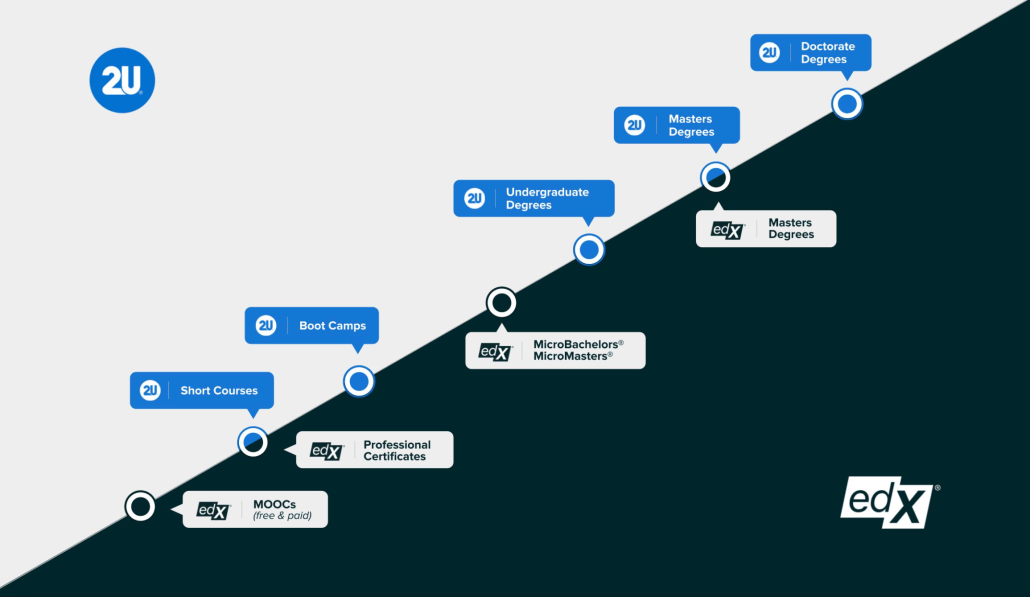
    2U has a handful of other potential business justifications, most of which I won’t break down here because, again, it’s not the focus of my writing anymore. I’ll briefly share a few of them, not because they’re the most important but because they’re illustrative and easy to explain succinctly. First, 2U has always aspired to transform the entire education sector by bringing it online. However you may feel about that aspiration—I recognize that feelings tend to run very hot about OPMs—owning a major MOOC platform gives the company’s aspiration more depth.
    All roads lead to….

    Second, edX reaches a lot of students in a lot of countries. The international EdTech market has been a long time coming, but it’s finally arrived. edX greatly expands 2U’s international footprint by some measures, which once again gives them a good story to tell.

    And this brings me to the final advantage I’ll point out in this post. 2U has always been about telling a compelling narrative about the future. One of Chip Paucek’s previous ventures was a company that had comedians explain educational concepts on a television show. He understands how to build a story. He knows how to hit the beats. When WeWork was at peak hype, he made a deal with WeWork. When code academies were red hot, he bought one of the hottest code academies. Given Coursera’s recent success in the markets, it makes sense that he would look to make the biggest, boldest MOOC move possible.

    To be clear, I’m not saying that the CEO of this publicly traded company made these deals solely or primarily to spin a good story. I’m simply pointing out that Chip has a method for responding to market changes. If he believes that getting into a particular business is good for 2U, he will not make his move by quietly dipping his toe in the water. He’s going to jump in with both feet and make a big splash in the process. The edX acquisition fits with that method.

    2U’s and edX’s university partners

    While it’s too early to make pronouncements with any confidence, early reactions I’ve heard indicate that 2U’s university partners are pretty happy with the transaction while edX’s university partners are pretty unhappy. For 2U’s partners, they already decided to go with the big publicly traded corporation that, for better and worse, is heavily associated with revenue-sharing deals. Now they can do MOOCs with the same company. This deal gives them nothing but upside. On the other hand, many edX partners specifically went with edX because they did not want to deal with the for-profit Coursera. Yes, edX had its revenue-sharing agreement too, but it was a non-profit run by universities. That made it feel different for some.

    2U may have to deal with some of the kind of backlash that Blackboard did when it bought other LMS companies—particularly Moodle support companies. They may lose some universities. Then again, 2U is definitely not Blackboard. Especially Blackboard circa 2012 (although, ironically, edX was formed the same year Blackboard acquired Moodlerooms). 2U built its business by winning over faculty senates. Also, while the company may lose some edX customers, it may gain some by cross-selling to its existing customer base. It’s hard to say how all this will play out, net-net. All I can say with confidence right now is that people at the edX schools I’ve talked to so far are understandably nervous.

    Who doesn’t care

    I doubt students will even notice. I take that as one strong indicator of how I should feel. It’s not clear to me that Coursera has done anything edX hasn’t and that would or should concern students. I could be wrong; I haven’t looked closely at this aspect. (Please correct me in the comments section if you know something I don’t.) Further, I have no reason to believe that 2U’s behavior will be worse than Coursera has been.

    MOOCs strike me as a relatively low-risk corner of EdTech for heavy corporate involvement. My sense is that, if 2U sees edX primarily as a way of making marketing dollars go further, then they have a vested interest in keeping students happily engaged. Yes, they’ll use student data to target them for marketing, but if you are shocked by that, then you should maybe take a look at all free products that you use (possibly including the email service that you are reading this blog post through). As long as the MOOCs are transparent about what they’re doing, it’s probably OK in that particular market. In fact, those particular learners may want to receive targeted ads about other learning opportunities.

    The ways in which I care

    In and of itself, I’m indifferent to this deal. I’m not opposed to revenue-share OPMs in general or 2U in particular. (This is an outdated argument anyway since the major OPMs generally offer non-revenue-sharing arrangements of various flavors these days.) At first blush, I don’t see any big harm to students or institutions in it. (I reserve the right to change my mind in either direction as I learn more.) Since xMOOCs have not turned out to be the end of academia as we know it, either in the revolutionary sense or the armageddon sense, I’m inclined to feel mildly positive toward an arrangement that gives a major provider a sustainable path forward. MOOCs are one more arrow in the quiver as we try to offer everyone in the world the opportunity to fulfill their potential through education. I’m not going to turn my nose up at that. I like the folks I know at both edX and 2U. While I don’t always agree with them, I’d like to see them make a contribution with their new venture. I’ll wait and see and wish them well.

    Beyond that, I mostly care about two aspects that I haven’t seen talked about much in any of the coverage. First, there’s the open-source code. While I frankly think the early iterations of OpenEdX were embarrassingly bad and improved over time to “surprisingly OK given how embarrassingly the foundations were,” I do think there is value in maintaining an open-source MOOC platform. I am skeptical that 2U has the DNA necessary to steward an academic open-source community. I know how good 2U can be at working with academics and I also know what it’s like to steward an academic open-source software community. These two things are not the same.

    Second and more importantly, I’m worried about the loss of research. Thanks to the efforts of researchers like Justin Reich and Rene Kizilcec, edX has been one of very few public testbeds we have for conducting credible learning efficacy research at scale. 2U, in contrast, has done nothing visible in the area of learning science. They’ve started talking about it in the past year or two, but frankly, if e-Literate were still doing the cop-on-the-beat thing, I probably would have shredded them about it by now. In 2021, there is absolutely no excuse for any EdTech company of 2U’s (or Coursera’s) size and scale not to be engaging actively with academics in serious applied learning science and contributing to our collective knowledge. If 2U can spend $800 million—in cash—for a MOOC organization that loses money every year, the company can surely afford to invest one-half of one percent of that every year in a credible program to advance the state of knowledge and literacy in effective teaching practices. And now that they own a platform for conducting such research at scale, the onus on them has only increased.

    The same goes for MIT and Harvard, by the way. Despite the excellent work of a few researchers, and despite the rhetoric of the institutions at the time that edX was launched, one reason we have not gotten more and better research out of edX is that the platform, incredibly, was poorly designed for educational research. How did MIT build a platform for massive-scale learning in 2012 and fail to think about what sorts of educational data and metadata they would need to facilitate research? What does that tell us about the real priorities behind the initial push to production? It’s a mystery.

    I’m not particularly interested in the vague promises of two rich universities to do good in the world with their $700 million windfall from a non-profit that was supposed to educate the whole world. I’d like to see a credible plan this time, including a theory of change.

  • MOOCs in Decline: Insights into multi-year data from MIT and Harvard

    MOOCs in Decline: Insights into multi-year data from MIT and Harvard

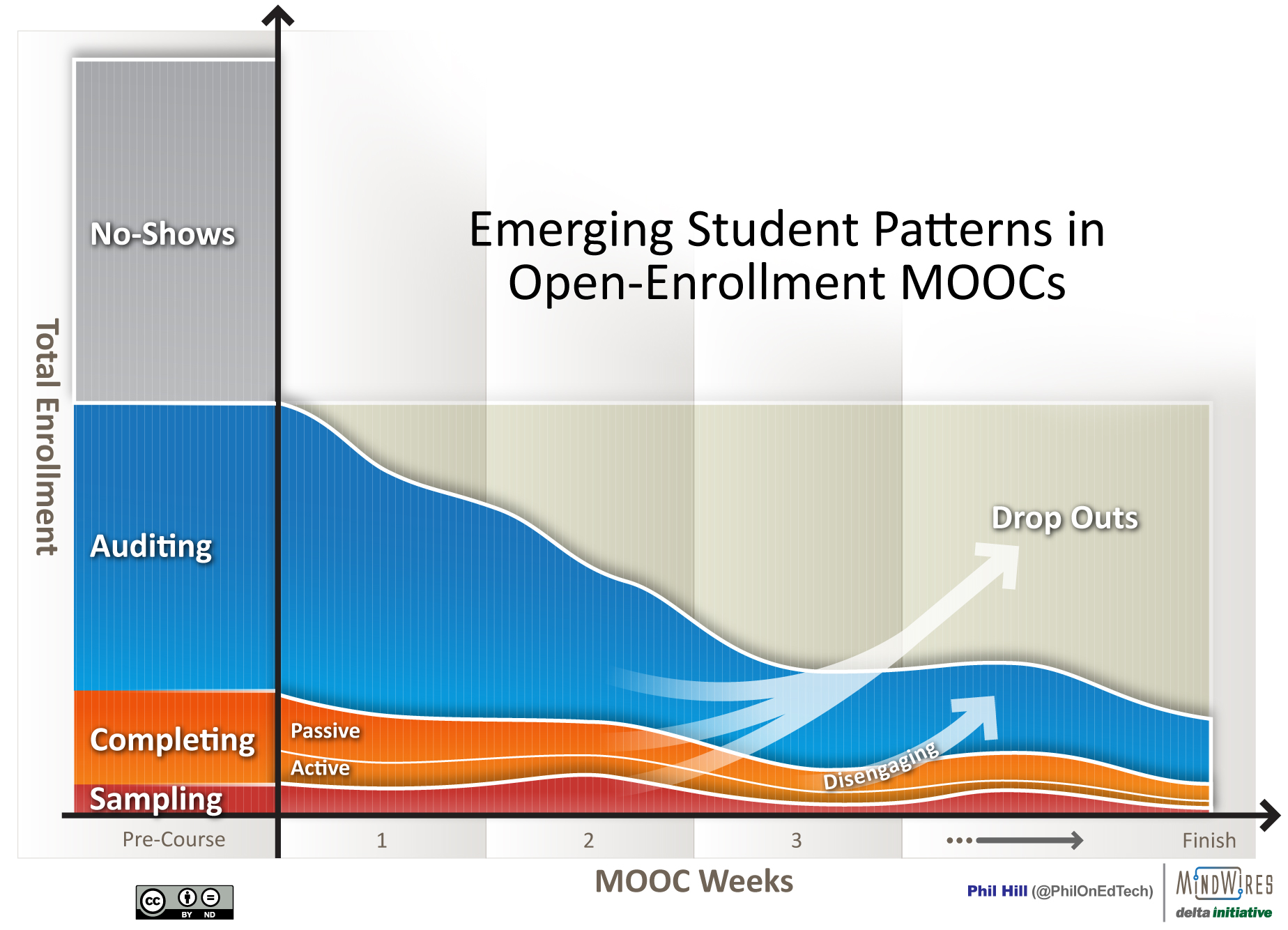
    It is no secret that the commercial Massive Open Online Courses (MOOCs) launched by Coursera, Udacity, and edX in 2011/12 are a different beast from the majority of for-credit online education offerings. One such difference is the pattern of quick drop-off of students within each course, particularly in the first 2 – 3 weeks, which we documented in 2013.

    We also know that the original disruption vision for these large MOOCs has not come to pass, with many MOOC providers moving into Online Program Management (OPM) business models and shutting off many of the free and open access that made MOOCs in the first place.

    Late last week two researchers at MIT, Justin Reich and José A. Ruipérez-Valiente, published an article in Science titled “The MOOC Pivot” that provides new multi-year insight into the trends based on edX usage at MIT and Harvard, the two founding schools for edX. In a nutshell, MOOC activity peaked in 2016 based on new individual learners, based on a dataset of “565 course iterations from 261 different courses, with a combined 12.67 million course registrations from 5.63 million learners”, leading the MOOC providers to look to the OPM market as a more-realistic method of sustainability. The researchers identify three insights from their data [emphasis added].

    To better understand the reasons for this shift, we highlight three patterns emerging from data on MOOCs provided by Harvard University and Massachusetts Institute of Technology (MIT) via the edX platform: The vast majority of MOOC learners never return after their first year, the growth in MOOC participation has been concentrated almost entirely in the world’s most affluent countries, and the bane of MOOCs—low completion rates—has not improved over 6 years.

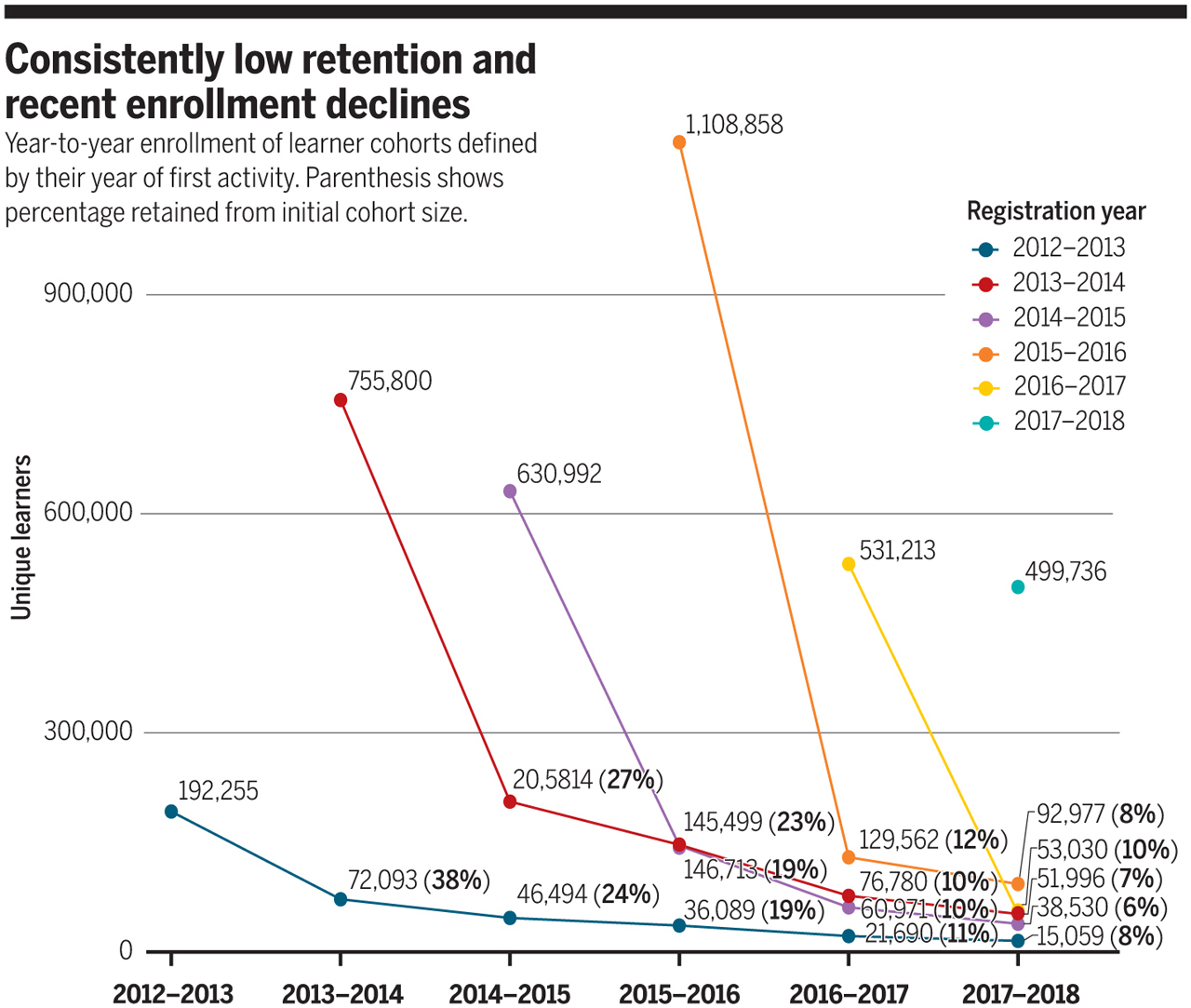
    The highlighted conclusion makes sense, but to my knowledge we have previously not had any solid data to back this point up. The following chart in the article shows annual cohorts of learners and tracks them over time, showing that the decrease per year largely mirrors the course-level situation.

    MIT Harvard multi-year research on MOOCs

    Thus 38% of 2012-13 cohort enrolled in at least one course in year 2, and 24% of 2012-13 cohort enrolled in any course in year 3, etc. Over time, these year 2 / year 3 / year 4 retention numbers reduce significantly. Thankfully, Justin and José provided a GitHub repository of the data, and perhaps a transposition of Table S1 can make these trends more obvious.

    It took nearly six years for 10% or fewer of the 2012-13 cohort to remain active (enrolled in any courses), but just two years for 2016-17. And note that the cohort size has been dropping since 2015-16. Keep in mind that the MOOC providers counteract these institution-level trends by increasing the number of institutions that they partner with over time.

    There is more analysis in the full article at Science – it’s worth reading the whole thing.

  • Revisiting 2012 Post on Barriers That MOOCs Would Face

    Revisiting 2012 Post on Barriers That MOOCs Would Face

    Inside Higher Ed published an article today, titled “Free MOOCs Face The Music”, about edX quietly adding support fees for many of their courses. Dhawal Shah and I both commented that we were not surprised by the move.

    Writing about the introduction of the fee, Dhawal Shah, founder and CEO of Class Central, a review site for online courses, said the announcement was the latest in a phenomenon he termed “the shrinking of free.” Regardless of MOOC provider — be it edX, Coursera, Udacity or FutureLearn — “all have cut back on what was originally free in MOOCs.”

    Phil Hill, co-founder of Mindwires Consulting and an author of the e-Literate blog, agreed that the edX announcement was not surprising. Early MOOC providers like edX thought they would be able to “get really big for free,” said Hill. “Magic didn’t happen, and now they’re facing reality.”

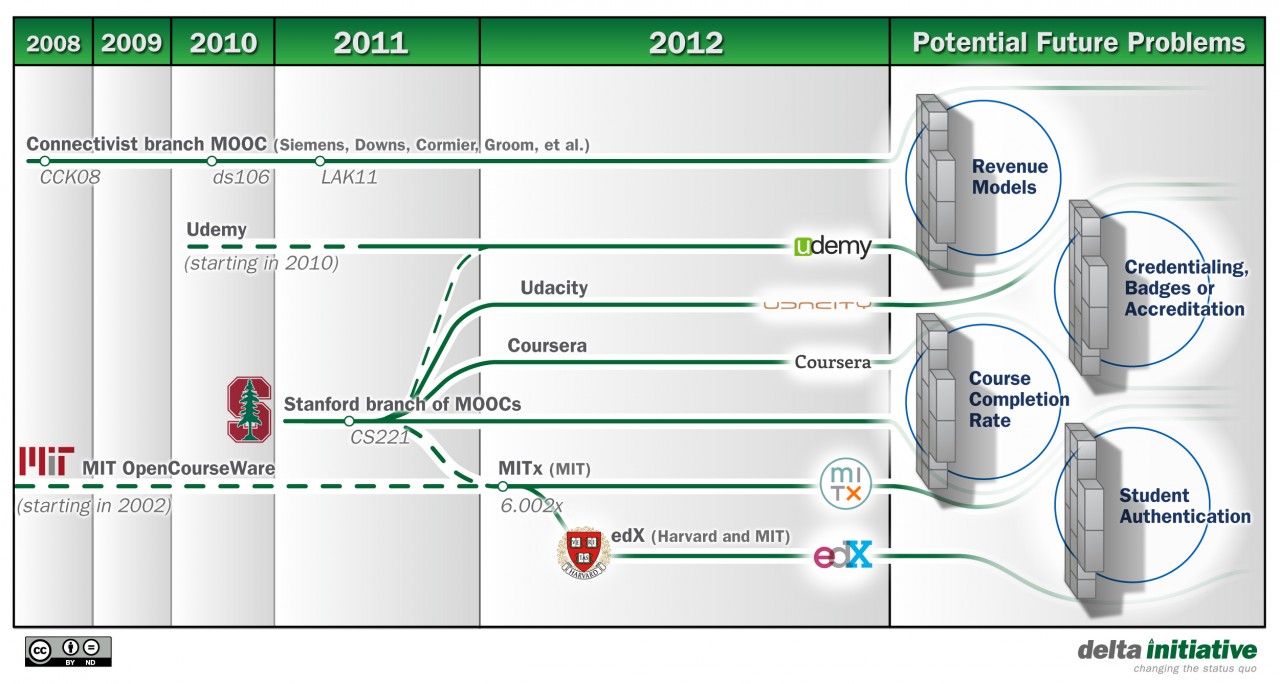
    There’s more information in the article worth reading, but I would like to revisit a post here at e-Literate from 2012 to help explain the point I made. In “Four Barriers That MOOCs Must Overcome To Build a Sustainable Model”, I noted:

    The current generation of courses has proven the feasibility of massive online enrollments, but the Kolowich article reveals that the result is based on a form of adult continuing education. The majority of students in the Udacity and Coursera courses analyzed were professionals in the software industry – hardly the target audience for those seeking a change in how we educate postsecondary students. The current MOOCs provide a nice proof-of-concept, but hardly solve significant educational problems.

    So what are the barriers that must be overcome for the MOOC concept (in future generations) to become self-sustaining? To me the most obvious barriers are:

    • Developing revenue models to make the concept self-sustaining;
    • Delivering valuable signifiers of completion such as credentials, badges or acceptance into accredited programs;
    • Providing an experience and perceived value that enables higher course completion rates (most today have less than 10% of registered students actually completing the course); and
    • Authenticating students in a manner to satisfy accrediting institutions or hiring companies that the student identify is actually known.

    Given this short timeline and the nature of investment-backed educational experiments, I think the real focus should be on whether and how MOOCs or successor models build on current scalability and openness while overcoming these four barriers.

    What have we seen since 2012?

    • Revenue Models: Coursera, FutureLearn, and edX moving towards an OPM business model, and Udacity focusing on corporate education;
    • Credentialing: All MOOCs offering some sort of verified certificates, and in the OPM cases offering actual degrees through their partner institutions;
    • Course Completion: MOOCs realizing that the two issues above lead to higher completion rates; and
    • Authentication: Verified certificates and OPM models requiring student authentication through webcams and approaches similar to online proctoring companies, and even partnering with proctoring companies.

    At this stage  pretty much everyone recognizes a blatant ‘I told you so’ post written while Michael is on vacation and unable to talk me out of it, so I’ll move along and cut off further commentary.

  • If At First You Don’t Succeed, Try To Be An OPM: Conversion of for-profits and MOOCs

    If At First You Don’t Succeed, Try To Be An OPM: Conversion of for-profits and MOOCs

    Two weeks into March, this has already been a busy month already for the transformation of for-profits and MOOCs. For-profit universities are in a race to become nonprofit by separating academic programs from behind-the-scenes services, and MOOCs are focused primarily on monetization and moving beyond free and open courses. The common thread tying these messy transitions together is the move to become new forms of Online Program Management (OPM) providers.

    Best Way to Make Money? Go Nonprofit

    Arguably the biggest news was March 5th when the Higher Learning Commission (HLC), the regional accreditor, approved the Kaplan University / Purdue University deal to create Purdue Global. This was the final approval step as Purdue acquires Kaplan, leaving Kaplan University, leaving Graham Holdings (Kaplan’s parent company) to serve as a single-client OPM provider.

    The following day Grand Canyon University announced that it had received approval from HLC to convert into a nonprofit institution. As described in their press release, the remaining for-profit company will become an OPM, even if they choose not to use that name [emphasis added]:

    As part of the transition, GCE will sell certain academic-related assets to a non-profit entity that will carry the Grand Canyon University name. Following the sale, GCE will operate as a third-party provider of educational and related services to GCU and potentially, in the future, to other universities. The structure is similar to that at hundreds of non-profit universities in the country that outsource services to third-party providers.

    And yesterday, Bridgepoint Education announced that they were formally seeking to convert Ashford University into a nonprofit in a similar deal as Grand Canyon. At least they are more direct about the OPM tie-in as described at Inside Higher Ed yesterday.

    Bridgepoint will continue on as an online program management (OPM) provider — a booming space in higher education. The company will negotiate with Ashford to enter into a shared services agreement, with Bridgepoint likely handling data management, course management software and services, technology, and financial aid processing for the nonprofit university.

    “As an OPM, Bridgepoint Education will bring years of technological and academic innovation and intellectual property development to other colleges and universities that desire to serve students through online education programs,” Schray said in a written statement.

    In an interview here at e-Literate when Purdue and Kaplan announced their acquisition plans last April, Trace Urdan (now at Tyton Partners) described the market forces involved in some of these moves.

    • Non-profit entities – both public institutions and private non-profit institutions – “wanting to get into the adult market and the online market”. This is the big push behind the Online Program Management (OPM) market, kick-starting these non-profits into online programs targeting adult education.
    • For-profit entities “feel like they are being burdened by being for-profit”. One part of this is the regulatory burden from the Department of Education and even accreditors. But there is also a marketplace burden as non-profits like Southern New Hampshire University keep growing enrollments while for-profits are dropping.
    • There is a “the investor enthusiasm for the services model” with OPMS, “and this is a model that investors love – it gives you access to the growth in online education, affiliation with strong brands, and it’s more or less free from the regulatory hostility” of the for-profit sector.

    Beyond the market forces, however, there is another underlying factor affecting these moves. As described by legal team at Cooley Education:

    So, why did this happen? First, and most obviously, we are in a different regulatory environment – at least as far as the federal Department of Education is concerned. In late 2017, the Department of Education dropped its opposition to for-profit conversions vehemently articulated by then-Secretary John King, most recently approving the sale of South and Argosy Universities and the Art Institutes owned by Education Management Corporation to a nonprofit created by the Dream Center Foundation. This change in federal policy shifted the emphasis on approvals back to the accreditors and the states.

    At the accreditor level, the politics may be less important in understanding the outcome than the process. At about the same time that Kaplan-Purdue was first announced, HLC began working on revising its policies and procedures to establish new benchmarks by which such transactions would be measured. HLC made two significant changes: it updated its procedures for review of Change of Control transactions and, in a politically astute move, also established a policy that Department of Education approval must be obtained before HLC acts on a change of control application, thus insulating itself from second-guessing in Washington. (HLC’s change was telegraphed in late 2016 when it deferred acting on the sale of the parent of the University of Phoenix to a private equity group pending prior ED approval.)

    Significantly, HLC now has relatively clear guidance governing what is needed for OPM relationships and for-profit conversions.

    How Do We Make Money? The Answer Is Simple – Volume

    Meanwhile Coursera announced their plans to further focus on the monetization of supporting online degrees, as described at EdSurge on March 5th.

    These days, though, many MOOC platforms are courting the traditional higher-ed market they once rebuked, often by hosting fully-online masters degrees for colleges and universities. And today, one of the largest MOOC providers, Coursera, announced it’s going one step further in that direction, with its first fully online bachelor’s degree.

    Coursera is not alone here – most notably Georgia Tech and Udacity launched an online master’s of computer science in 2013. In a related move, edX has begun its work supporting online master’s degrees through its MicroMasters program, and FutureLearn – spun out of the Open University of the UK – supports multiple degree programs.

    While the Coursera news focused on the new bachelor’s program, the bigger news was the expansion its graduate programs as described at Inside Higher Ed.

    Online education platform Coursera has set a goal of offering 15 to 20 degree programs by the end of 2019. The company took another step toward that goal Wednesday, announcing new degree offerings from the University of Illinois at Urbana-Champaign and France’s HEC Paris.

    “This is our coming-out party for online degrees on Coursera,” Nikhil Sinha, Coursera’s chief business officer, said in an interview.

    FutureLearn announced their own expansion of online degrees last month.

    For the MOOC providers, their move into the OPM space seems to be driven by their leverage of current registered learners as a marketing channel, as described in a separate IHE article.

    Roughly half of the students in Coursera’s current degree programs took one of the open online courses first, essentially enabling students to “try these degrees before they buy them,” Maggioncalda says. So not only do students have a chance to see how they like a professor, or how well they perform, before enrolling in the for-credit program, but Coursera also asserts that it can drive down the cost of acquisition of students by tapping into its 31 million users.

    Coursera’s institutional partners “share a certain percentage of the learner fee with us in exchange for distribution to our world of learners, and the whole delivery of the system on our platform,” Maggioncalda says.

    New OPM Models

    Two years ago we described how the OPM market has evolved beyond its full-service tuition revenue-sharing origins to add unbundled service offerings – not to replace the previous model but to augment it. What we are now seeing are two new models within the OPM market becoming much more clear: the remnants of for-profit conversions into nonprofit status, and MOOCs supporting online degree programs. Both of these models are driven by markets that need to move beyond their origins as well. A lot of changes happening in the education space.

  • Clarifications On UC Berkeley’s Accessibility Decision To Restrict Video Access

    I had planned earlier to write a post or two on the UC Berkeley video kerfuffle but kept getting sidetracked with more articles in trade press and national media. And there have been quite a few articles, but many if not most seem to focus on the decision as a short-term transaction – DOJ ruling, UC Berkeley decision to remove videos from public – rather than understand the broader implications. Before commenting on these implications, I thought it would be useful to clarify some misconceptions that I have seen.

    The BerkeleyX program (with edX) was a big part of the DOJ ruling

    While most coverage has focused on the removal of YouTube videos created by lecture capture systems – automatically recorded and posted videos without post-production or packaging – the original DOJ ruling was based on two complaints, the first being usage of BerkeleyX MOOCs and second being usage of lecture capture videos. (more…)

  • Recommended Reading: “Why Udacity and EdX Want to Trademark the Degrees of the Future—and What’s at Stake for Students”

    In his recent article in EdSurge, Jeff Young (formerly of the Chronicle) profiles an emerging fringe world of post-secondary education where “Nanodegrees,” “MicroMasters,” and “MicroDegrees” are proliferating. Companies like Udacity and edX are looking to stake out territory in this emerging market and trademarking new degree types is one way they’re attempting to do that. Earlier branding efforts were meant to establish legitimacy across the board for this type of mini-degree or credential, but now the branding (and accompanying trademarking) seem to be an effort to signal quality and raise barriers to entry for other providers looking to enter the space. In order for this strategy to be successful, the timing has to be just right. Too soon and the category fails to establish itself, too late and and the category is awash in competition of uneven quality. The risk here could be that the incumbents are pulling the trigger too soon.

  • Miami, Harvard and MIT: Disability discrimination lawsuits focused on schools as content providers

    In the discussions at Google+ based on last week’s post about the Miami University of Ohio disability discrimination lawsuit ((Insert joke here about G+ and its hundreds of active users.)), George Station made two important points that deserve more visibility.

    It’s been a-coming for several years now. Cal State has some pretty strong rules in place for compliance with ADA and state-level disability laws. Still, [Universal Design for Learning] UDL is a little-known acronym on any campus you care to visit, and staff support is probably one person in an office, except for Miami of Ohio as of this week, I guess…

    Add the recent edX settlement with the US Department of Justice, and the whole direction of edtech changes…

    Put another way, it should come as no surprise that the US Department of Justice is ramping up its enforcement of disability discrimination regulations in the education world. Captioning service provider CaptionSync has an excellent summary of the field, written before the DOJ intervention at Miami. (more…)