
e-Literate

Present is Prologue

Tag: EdX

  • Harvard Faculty Request Faculty Oversight of HarvardX (Their Usage of edX)

    Yesterday, 58 faculty members from the Faculty of Arts and Sciences at Harvard wrote an open letter to the dean requesting faculty oversight of HarvardX. When schools sign up for edX, their implementations tend to be called SchoolX, thus HarvardX specifically refers to their usage of the MOOC platform, not to the overall edX organization. This distinction is important, given Harvard’s founding role in creating the edX organization and $30m pledge of support.

    The letter is short, so I’ll quote it in full (the signatures are much longer than the letter itself).

    As the university marks the first anniversary of edX and HarvardX, some faculty are tremendously excited about the potential of HarvardX; others are deeply concerned about the program’s costs and consequences. We appreciate the meetings, town halls, and other arenas in which faculty have been able to discuss HarvardX. But we believe that many critical questions about the relationship of the FAS to HarvardX, and to edX, have not yet been addressed. These questions (which fall outside the remit of the two existing HarvardX faculty committees, most of whose members are not from FAS) range from faculty oversight of HarvardX to the impact online courses will have on the higher education system as a whole.

    The Faculty of Arts and Sciences is directly responsible for the teaching of Harvard undergraduates and Ph.D. students. It is our responsibility to ensure that HarvardX is consistent with our commitment to our students on campus, and with our academic mission. Given the rapid pace of development of HarvardX, we believe it is essential to have a formal, sustained, and structured faculty discussion on these issues as soon as possible. We write to request that you appoint a committee of FAS ladder faculty to draft a set of ethical and educational principles that will govern FAS involvement in HarvardX, to be brought before the FAS for a vote in the coming academic year.

    Note that they request FAS ladder faculty, which means tenure and tenure track faculty and specifically not adjuncts and lecturers. It is possible, however, that the requested committee of ladder faculty could choose to involve adjuncts in the process.

    (more…)

  • MOOCs Explained: Radio Interview with University of Delaware

    Just over a week ago I had the opportunity to participate in a radio interview for the University of Delaware’s local station WVUD, with the Campus Voices interview airing on May 17th. The interview was in advance of Delaware’s summer faculty institute, where I will be speaking in just over a week. I really enjoyed the interview, and this is an area that needs more attention – local educational technology support for faculty innovation, with an emphasis on faculty sharing best practices. The summer institute is May 28th – 31st.

    I was interviewed by Richard Gordon and Paul Hyde, and some of the key topics we explored:

    • Not everyone is a reader of the Chronicle of Higher Education – what the heck is a MOOC?
    • How do MOOCs affect faculty teaching in a bricks-and-mortar university?
    • What are the completion rates of MOOCs and what are the student types?
    • Are there applications beyond higher education?
    • Why is there such significant pushback against MOOCs lately?
    • What disciplines beyond science and engineering are using MOOCs?

    Here is link to the U Delaware radio interview – audio only. It’s about a half hour in length, but with some cool NPR-sounding music to kick it off.

    I have also added some graphics and created a video of the interview.

  • Big 3 MOOC Providers Turning One Year Old

    We are in the middle of the first anniversary of the creation of the big 3 MOOC providers (Coursera, Udacity, edX).

    • Sebastian Thrun announced the creation of Udacity on January 23, 2012 as described by Reuters.
    • Daphne Koller and Andrew Ng announced the creation of Coursera on April 18, 2012 in this NY Times article.
    • MIT and Harvard announced the creation of edX on May 2, 2012 in this MIT article.

    And what a year it’s been, especially in terms of the engagement of national media, university presidents and boards on the topic of MOOCs, online education and the future of higher education in general. I doubt there is a higher education conference this year that doesn’t mention MOOCs in one form or another.

    But one year is a seriously short time period for higher education and educational technology, which are just not used to changes on this time scale. To give some perspective, consider the following:

    • There are quite a few ed tech products that have been or will have been in beta or introductory mode for at least a year when fully released.
    • This time one year ago, few people outside of Virginia knew what a Rector or how a board of them might force a president to resign partially based on discussions about MOOCs.
    • Many LMS and almost all student information system / ERP selection processes (not even including implementation) take more than a year.
  • Six Ways the edX Announcement Gets Automated Essay Grading Wrong

    Six Ways the edX Announcement Gets Automated Essay Grading Wrong

    Last week, edX made a splashy spectacle of an announcement about automated essay grading, leaving educators fuming. Let’s rethink their claims. 

    “Give Professors a break,” the New York Times suggested in this joint press release from edX, Harvard, and MIT. The breathless story weaves a tale of robo-professors taking over the grading process, leaving professors free to kick back their feet and take a nap, and subsequently inviting universities, ever-focused on the bottom-line, to fire all the professors. If I had set out to write an article intentionally provoking fear, uncertainty, and doubt in the minds of teachers and writers, I don’t think I could have done any better than this piece.

    Anyone who’s seen their claims published in science journalism knows that the popular claims bear only the foggiest resemblance to academic results. It’s unclear to me whether the misunderstanding is due to edX intentionally overselling their product for publicity, or if something got lost in translation while writing the story. Whatever the cause, the story was cocksure and forceful about auto-scoring’s role in shaping the future of education.

    I was a participant in last year’s ASAP competition, which served as a benchmark for the industry; the primary result of this, aside from convincing me to found LightSIDE Labs, is that I get email; a lot of email. I’ve been told that automated essay grading is both the salvation of education and the downfall of modern society. Naturally, I have strong opinions about that, based both on my experience with developing the technology and participating in the contest, as well as in the conversations I’ve had since then.

    Before we resign ourselves to burning the AI researchers at the stake, let’s step back for a minute and think about what the technology actually does. Below, I’ve tried to correct the most common fallacies I’ve seen coming both from articles like the edX piece, as well as the incendiary commentary that it provokes. (more…)

  • The Most Thorough Summary (to date) of MOOC Completion Rates

    How many times have you heard the statement that ‘MOOCs have a completion rate of 10%’ or ‘MOOCs have a completion rate of less than 10%’? The meme seems to have developed a life of its own, but try to research the original claim and you might find a bunch of circular references or anecdotes of one or two courses. Will the 10% meme hold up once we get more data?

    While researching this question for an upcoming post, I found an excellent resource put together by Katy Jordan, a graduate student at The Open University of the UK. In a blog post from Feb 13, 2013, Katy described a new effort of hers to synthesize MOOC completion rate data – from xMOOCs in particular and mostly from Coursera.

    Via a combination of thinking about ‘what makes a successful MOOC?’, and looking for a topic for my final project on the Infographics MOOC, I decided to try to pull together the various statistics floating around online about MOOC completion rates. I’m trying to see if any differences emerge on the basis of platform or the assessment methods used.

    My draft graph synthesising everything I’ve found so far can be found here: http://www.katyjordan.com/MOOCproject.html

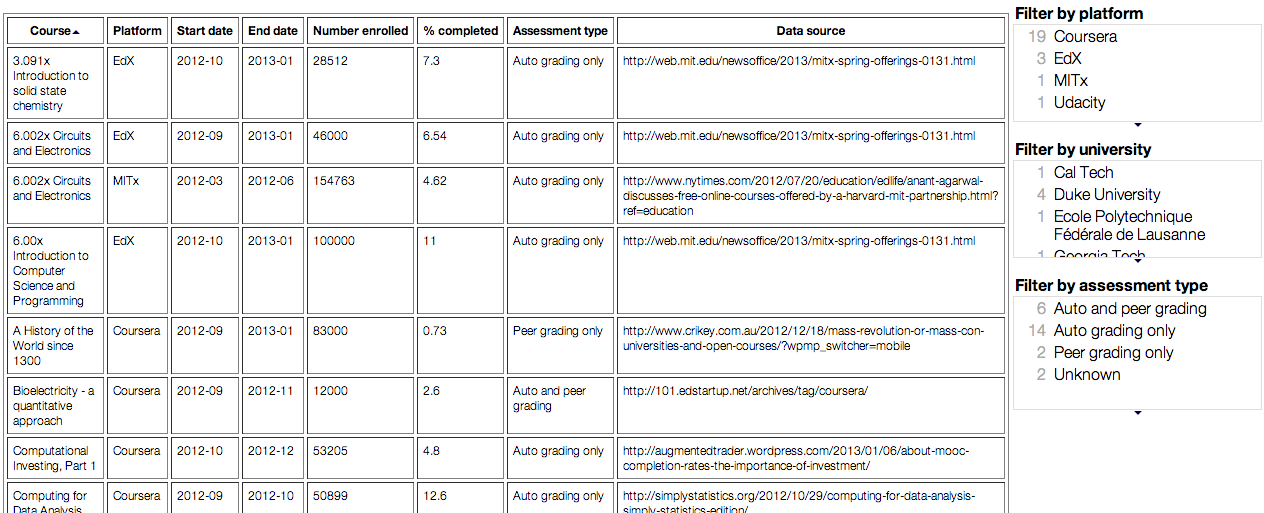
    What Katy has done so far is compile completion rate data from 24 MOOCs – 19 from Coursera, 3 from edX, 1 from Udacity and 1 from MITx (a precursor to edX). The data is available in a table format or in a graph.

    table


    (more…)

  • MOOCs in 2012: Dismantling the Status Quo

    The dominant story in higher education for 2012 was clearly the rise of Massive Open Online Courses (MOOCs), particularly the xMOOCs such as Coursera, Udacity, and edX. There has been a lot of debate on the merits of xMOOCs in terms of disruption, business model and academic quality. While I think these questions are interesting, the more important impact from xMOOCs can be seen in terms of forcing higher education as a system or culture to no longer ignore online education as a self-contained side issue and instead evaluate the role of online education for all of higher education.

    Ignoring the Impact of Online Education

    For decades, if not centuries, the higher education system in the US has been holding on to a relatively stable status quo. Demand for postsecondary degrees constantly rises, the economic value of these degrees rises, the reputation of institutions remains high. This status quo has held despite two very uncomfortable underlying issues. One is that tuition and total student costs at a faster rate than inflation or even health care. The second is that US higher education as a system has not leveraged the remarkable gains from technology that almost every other industry has achieved.

    It’s true that there have been many innovations in higher education based on technology usage such as online software, but the system at large has been remarkably resilient and avoided any structural change. Yes, the vast majority of institutions have a centrally-supported LMS, but the pedagogical design of most courses has remained unchanged. Yes, many individual faculty have designed rich learning experiences within their courses, but their departments and colleges have typically resisted the uncomfortable discussion of whether these new pedagogical models should diffuse to the broader set of courses and programs. Yes, there have been online education innovations from for-profits and even public colleges such as Rio Salado and SNHU, but these organizations have remained self-contained and not directly affected the mainline non-profit educational model.

    (more…)

  • Is Coursera Facebook, Amazon, or Pets.com?

    Before I get started, let me just say that Phil can vouch for the fact that I had already planned to use “Pets.com” in the title of this post before MIT Technology Review used it in their article on Minerva. As we’ll see, there are reasons to reach for that particular analogy at this particular moment in educational technology.

    Anyway, it’s an uncomfortable truth for educational folks that one of the principal innovations of the xMOOC is the store front. It is the ability to find courses in a catalog. If you look at what Coursera is right now from a platform perspective, it is primarily a store front on top of an LMS. The same could be said of edX. And as Phil and I have both written about recently, this is also the primary innovation in Instructure’s Canvas Network. I don’t expect that innovations in MOOC platforms to stay confined to the store front in the long run; for example, Daphne Koller, the co-CEO of Coursera, is also a leading expert in Bayesian machine learning. I think the scale of usage will drive other innovations. But right now, it’s the store front that is the most obvious differentiator between an LMS and a MOOC platform. As we game out which of the various xMOOC entrants will be successful, it’s important to understand how the store front works and the degree to which the growth of one dominant platform could impact the ways that colleges and universities function. I think there are at least three possibilities.

    (more…)