e-Literate

Present is Prologue

Tag: for-profit

  • Fate of EDU For-Profits: A look into recent enrollment changes and shut downs

    Fate of EDU For-Profits: A look into recent enrollment changes and shut downs

    One month ago the Education Corporation of America (ECA) was the latest for-profit system to shut down, as described by Inside Higher Ed:

    Education Corporation of America owns more than 75 campuses and enrolls at least 20,000 students in mostly certificate-granting professional disciplines such as cosmetology, culinary arts and medical and dental assistant programs. It operates chains including Virginia College and Brightwood College.

    A week later Adtalem Global Education completed their sale of for-profit systems:

    Adtalem Global Education (NYSE: ATGE), a leading global education provider, today announced the completion of the transfer of ownership of DeVry University (DVU) and its Keller Graduate School of Management to Cogswell Education LLC. Today’s announcement closely follows Adtalem’s disclosure of the transfer of ownership of Carrington College to San Joaquin Valley College, Inc. (SJVC Inc.) which was completed on Dec. 4, 2018. Post divestitures, Adtalem Global Education’s U.S. postsecondary degree-granting institutions serve the high-demand, rapidly growing medical and healthcare markets.

    The centerpiece of Adtalem’s remaining portfolio ((Disclosure: Adtalem is a former client of MindWires and past subscriber of our LMS Market Analysis service.)) is Chamberlain University, a growing system of nursing-based programs, and a look at the underlying data reveals that Chamberlain is one of only two large for-profit systems with significant growth.

    Given all the changes in for-profits, we tend to see either anecdotes about specific institutions or aggregate data on all for-profits combined. What is missing, though, is a view in between, showing enrollments and changes to a select group of for-profit schools, to help understand the different fates of different institutions.

    Why does this matter? For one, many for-profit chains are accredited as a number of different institutions, and they need to be combined to understand overall company strength. Second, following Tolstoy’s idea that “All happy families are alike; each unhappy family is unhappy in its own way”, the decline of for-profit institutions has a number of unhappy families with different lessons. In the case of ECA there is something unseen in other cases – ECA abruptly shut down despite growing enrollment by 32% year-over-year across Virginia College and Brightwood Colleges in the most recent IPEDS.

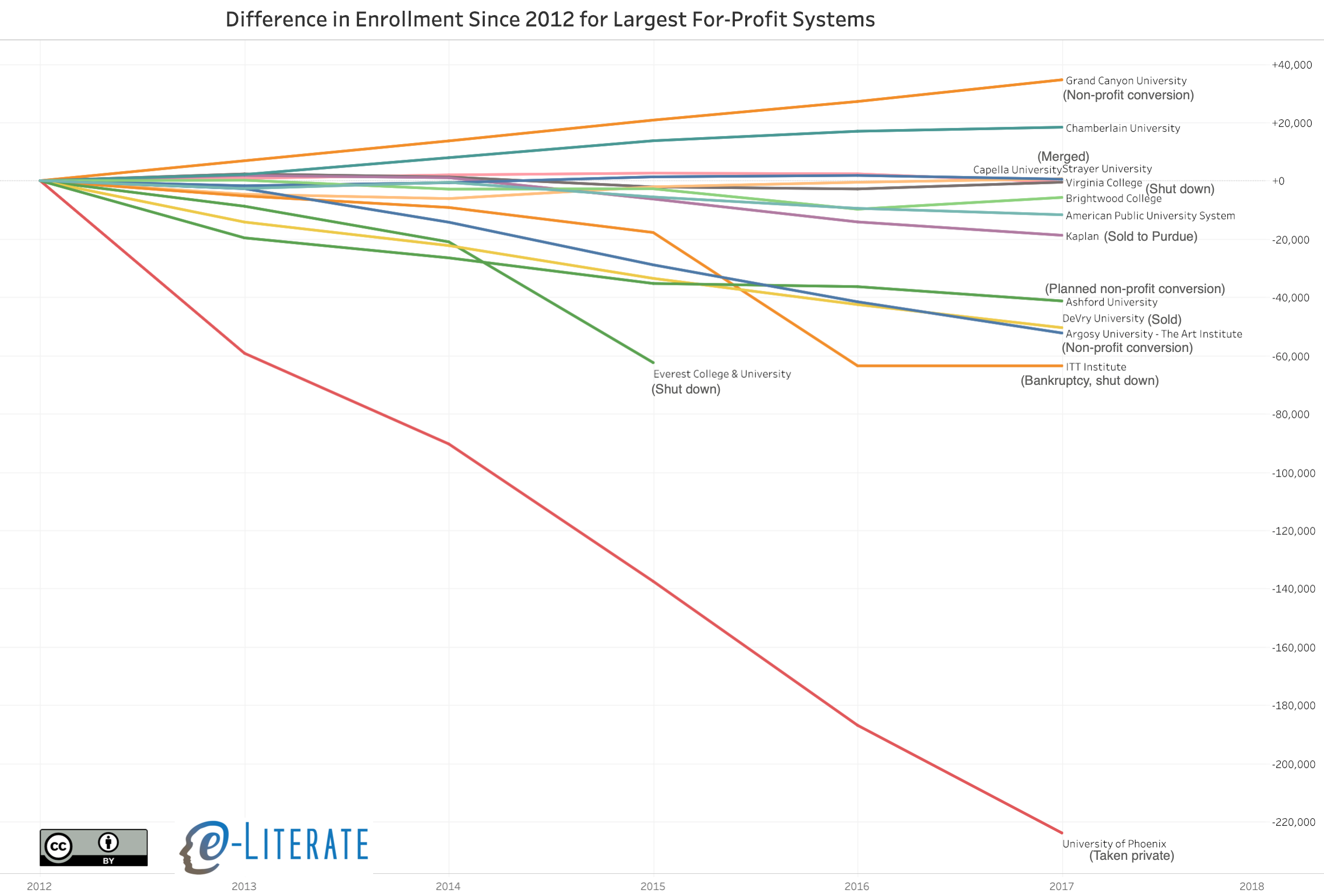
    The chart below shows differences from the Fall 2012 IPEDS enrollment report (grad + undergrad) for the 13 largest degree-granting systems as of that date, running through the Fall 2017 report (the most recent data available). I’ve added notes to show the various changes in ownership, control, and status for these systems – converting to non-profit status with a for-profit operating entity, merging of institutions, sale of institutions as with DeVry, going bankrupt withy full shut-down of systems, or taking the company private as with the U of Phoenix. Click on image for full size version.
    Largest for-profits - changes from 2012

    Some notes:

    • To read the chart properly, note that Chamberlain University had almost 20,000 more students in Fall 2017 than they had in Fall 2012, while DeVry University had roughly 50,000 fewer students in that same time period;
    • Seen together, it is startling the extent of changes in ownership, control and status among these former high-flying for-profit systems;
    • The only significant growth for these large systems came from Grand Canyon University and Chamberlain;
    • The changes to Virginia College and Brightwood College are not that significant; and
    • By far the largest decrease in enrollment has been the University of Phoenix.

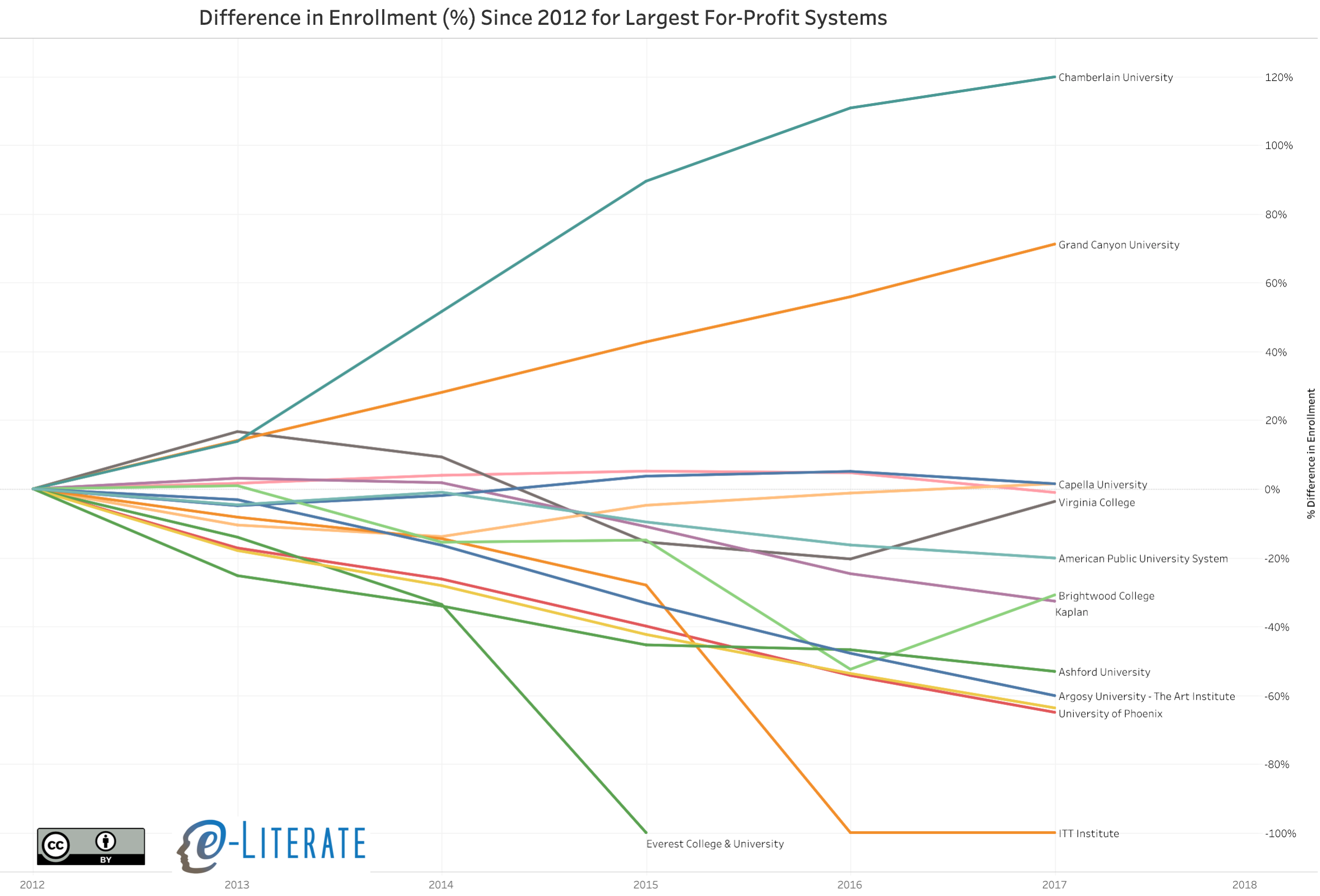
    While that view shows enrollment changes in total numbers, it is also useful to see relative changes for these same systems since 2012 to take into account the different enrollment sizes of the systems.
    Some notes:

    • To read the chart properly, note that Chamberlain University grew roughly 120% from Fall 2012 to Fall 2017, while DeVry University shrank more than 60% in that same time period;
    • In percentage terms, Chamberlain’s growth exceeds Grand Canyon University’s, which surprised me, but it seems to be leveling off;
    • Likewise, in percentage terms, DeVry University’s decline is roughly the same as the University of Phoenix’s;
    • Virginia College and Brightwood College actually grew from Fall 2016 – Fall 2017; and
    • We can see the shutdown of Corinthian Colleges (Everest) and ITT with 100% declines (ITT reported data in 2016 and 2017 even with no students).

    Let’s focus on just the four brands mentioned in last month’s stories – DeVry University & Chamberlain University for Adtalem, and Virginia College and Brightwood College for ECA.

    With this view, Adtalem’s strategy of selling DeVry while keeping Chamberlain makes a lot of sense, even if several years late and if they essentially gave away DeVry.

    ECA’s shut down, however, is not easily explained by the data. Unlike ITT and Everest, Virginia College and Brightwood College were not in enrollment free fall, and in fact there was instead recent enrollment gains getting them roughly back to 2012 levels. So why such an abrupt shutdown of ECA? The answer seems to lie with how the Department of Education and its accreditor handled recent troubles, based on IHE reporting.

    The shutdown follows years of declining enrollment for the chain. More recently, the privately held company scrambled to turn around its troubled finances by closing about a third of its campuses and pursuing a corporate overhaul through a court-approved receivership. But ECA continued to be dogged by creditors after falling behind on payments and rent for many campus locations. In October the company filed a lawsuit, which was later dismissed, against the U.S. Department of Education in an attempt to maintain its access to federal student aid.

    In an email to campus employees Wednesday morning, ECA CEO Stu Reed said that the Department of Education had added new restrictions on its access to Title IV student aid. And on Tuesday night, the Accrediting Council for Independent Colleges and Schools suspended the colleges’ accreditation. Those steps meant the company couldn’t secure the additional capital needed to operate its campuses, he said.

    I do not have enough knowledge to judge whether the ED should have shut off access to financial aid at the time that they did, but it does appear that students are paying the price despite signs that the schools were making significant enrollment gains. From the news coverage, there were significant outcomes issues beyond financial health of the parent company, but to my knowledge, this is a new situation among for-profit colleges in having a shut down despite very recent enrollment gains.


  • Grand Canyon Education Acquires Orbis: We have new segment of OPM market

    Grand Canyon Education Acquires Orbis: We have new segment of OPM market

    Nine months ago we wrote about the new movement for the companies formerly know as “for-profits” in the education space to convert the actual schools into non-profit entities and declare their intent for parent companies to become a new form of Online Program Management (OPM) providers. Kaplan University, Grand Canyon University, Ashford University (Bridgepoint Education) all made similar declarations, but the problem was that each one was a single-client OPM – serving only their supposedly independent non-profit schools. That’s not much of a new market segment.

    Today the movement became real as Grand Canyon Education announced their agreement to buy Orbis Education Services for more than $362 million.

    Grand Canyon Education, Inc. (NASDAQ: LOPE), a publicly traded shared services partner dedicated to serving colleges and universities, announced today that it has entered into a definitive agreement to acquire Orbis Education Services, LLC, an education services company that supports healthcare education programs for 17 regionally accredited universities across the United States (“Orbis Education”), for $362.5 million in cash. The transaction is expected to close during the first quarter of 2019, subject to customary closing and regulatory conditions.

    The acquisition combines the strengths of two of the nation’s most innovative service providers in higher education in an effort to align their expertise and better address a nationwide shortage in licensed healthcare professionals.

    “This is a natural extension of what Grand Canyon Education is already doing as an education services partner,” said Brian Mueller, GCE’s CEO. “We are very impressed with the quality of nursing and healthcare education that Orbis Education’s client institutions are providing. GCE can help grow that by providing investment capital and advanced technologies with behind-the-scenes support that will help University partners accomplish their goals and increase the number of licensed healthcare professionals they educate with the same high-quality outcomes.

    While they use the phrase “education services partner” instead of OPM, Grand Canyon in one move became a competitive provider worth watching. This news is significant.

    The large for-profit chains all developed scalable processes for the same functions that OPM vendors provide for non-profit schools – marketing & recruitment, course & curriculum development, technology platform & data analysis, and student support & retention services – and the basic idea of this market change is for the for-profit parent companies to provide these same services for other non-profit schools. With the Orbis acquisition, Grand Canyon will pick up 17 partner institutions.

    Orbis Education is a niche-market full-service OPM provider serving pre-licensure healthcare programs (mostly nursing) and was founded in 2003. Parter institutions include Concordia University, Northeastern University, Marquette University and Mercer University.

    In a broader sense, this acquisition follows the Wiley acquisition of Learning House for $200 million announced this fall. We’ll need to update our graphics, but the OPM market is profitable and growing, but it is also messy and chaotic. OPM vendors are in a battle to have the financial strength and customer scale to survive the chaos and grow in an expensive model.

    For those keeping track, Pearson paid $650 million for EmbanetCompass in 2012, and Wiley paid $220 million for Deltak, also in 2012. Hmm, something about that year . . .

    We’ll follow this story and others like it while sharing information on the likely impacts on the overall OPM market. For now the biggest issue is establishing that this for-profit-turned-OPM segment is real.

  • If At First You Don’t Succeed, Try To Be An OPM: Conversion of for-profits and MOOCs

    If At First You Don’t Succeed, Try To Be An OPM: Conversion of for-profits and MOOCs

    Two weeks into March, this has already been a busy month already for the transformation of for-profits and MOOCs. For-profit universities are in a race to become nonprofit by separating academic programs from behind-the-scenes services, and MOOCs are focused primarily on monetization and moving beyond free and open courses. The common thread tying these messy transitions together is the move to become new forms of Online Program Management (OPM) providers.

    Best Way to Make Money? Go Nonprofit

    Arguably the biggest news was March 5th when the Higher Learning Commission (HLC), the regional accreditor, approved the Kaplan University / Purdue University deal to create Purdue Global. This was the final approval step as Purdue acquires Kaplan, leaving Kaplan University, leaving Graham Holdings (Kaplan’s parent company) to serve as a single-client OPM provider.

    The following day Grand Canyon University announced that it had received approval from HLC to convert into a nonprofit institution. As described in their press release, the remaining for-profit company will become an OPM, even if they choose not to use that name [emphasis added]:

    As part of the transition, GCE will sell certain academic-related assets to a non-profit entity that will carry the Grand Canyon University name. Following the sale, GCE will operate as a third-party provider of educational and related services to GCU and potentially, in the future, to other universities. The structure is similar to that at hundreds of non-profit universities in the country that outsource services to third-party providers.

    And yesterday, Bridgepoint Education announced that they were formally seeking to convert Ashford University into a nonprofit in a similar deal as Grand Canyon. At least they are more direct about the OPM tie-in as described at Inside Higher Ed yesterday.

    Bridgepoint will continue on as an online program management (OPM) provider — a booming space in higher education. The company will negotiate with Ashford to enter into a shared services agreement, with Bridgepoint likely handling data management, course management software and services, technology, and financial aid processing for the nonprofit university.

    “As an OPM, Bridgepoint Education will bring years of technological and academic innovation and intellectual property development to other colleges and universities that desire to serve students through online education programs,” Schray said in a written statement.

    In an interview here at e-Literate when Purdue and Kaplan announced their acquisition plans last April, Trace Urdan (now at Tyton Partners) described the market forces involved in some of these moves.

    • Non-profit entities – both public institutions and private non-profit institutions – “wanting to get into the adult market and the online market”. This is the big push behind the Online Program Management (OPM) market, kick-starting these non-profits into online programs targeting adult education.
    • For-profit entities “feel like they are being burdened by being for-profit”. One part of this is the regulatory burden from the Department of Education and even accreditors. But there is also a marketplace burden as non-profits like Southern New Hampshire University keep growing enrollments while for-profits are dropping.
    • There is a “the investor enthusiasm for the services model” with OPMS, “and this is a model that investors love – it gives you access to the growth in online education, affiliation with strong brands, and it’s more or less free from the regulatory hostility” of the for-profit sector.

    Beyond the market forces, however, there is another underlying factor affecting these moves. As described by legal team at Cooley Education:

    So, why did this happen? First, and most obviously, we are in a different regulatory environment – at least as far as the federal Department of Education is concerned. In late 2017, the Department of Education dropped its opposition to for-profit conversions vehemently articulated by then-Secretary John King, most recently approving the sale of South and Argosy Universities and the Art Institutes owned by Education Management Corporation to a nonprofit created by the Dream Center Foundation. This change in federal policy shifted the emphasis on approvals back to the accreditors and the states.

    At the accreditor level, the politics may be less important in understanding the outcome than the process. At about the same time that Kaplan-Purdue was first announced, HLC began working on revising its policies and procedures to establish new benchmarks by which such transactions would be measured. HLC made two significant changes: it updated its procedures for review of Change of Control transactions and, in a politically astute move, also established a policy that Department of Education approval must be obtained before HLC acts on a change of control application, thus insulating itself from second-guessing in Washington. (HLC’s change was telegraphed in late 2016 when it deferred acting on the sale of the parent of the University of Phoenix to a private equity group pending prior ED approval.)

    Significantly, HLC now has relatively clear guidance governing what is needed for OPM relationships and for-profit conversions.

    How Do We Make Money? The Answer Is Simple – Volume

    Meanwhile Coursera announced their plans to further focus on the monetization of supporting online degrees, as described at EdSurge on March 5th.

    These days, though, many MOOC platforms are courting the traditional higher-ed market they once rebuked, often by hosting fully-online masters degrees for colleges and universities. And today, one of the largest MOOC providers, Coursera, announced it’s going one step further in that direction, with its first fully online bachelor’s degree.

    Coursera is not alone here – most notably Georgia Tech and Udacity launched an online master’s of computer science in 2013. In a related move, edX has begun its work supporting online master’s degrees through its MicroMasters program, and FutureLearn – spun out of the Open University of the UK – supports multiple degree programs.

    While the Coursera news focused on the new bachelor’s program, the bigger news was the expansion its graduate programs as described at Inside Higher Ed.

    Online education platform Coursera has set a goal of offering 15 to 20 degree programs by the end of 2019. The company took another step toward that goal Wednesday, announcing new degree offerings from the University of Illinois at Urbana-Champaign and France’s HEC Paris.

    “This is our coming-out party for online degrees on Coursera,” Nikhil Sinha, Coursera’s chief business officer, said in an interview.

    FutureLearn announced their own expansion of online degrees last month.

    For the MOOC providers, their move into the OPM space seems to be driven by their leverage of current registered learners as a marketing channel, as described in a separate IHE article.

    Roughly half of the students in Coursera’s current degree programs took one of the open online courses first, essentially enabling students to “try these degrees before they buy them,” Maggioncalda says. So not only do students have a chance to see how they like a professor, or how well they perform, before enrolling in the for-credit program, but Coursera also asserts that it can drive down the cost of acquisition of students by tapping into its 31 million users.

    Coursera’s institutional partners “share a certain percentage of the learner fee with us in exchange for distribution to our world of learners, and the whole delivery of the system on our platform,” Maggioncalda says.

    New OPM Models

    Two years ago we described how the OPM market has evolved beyond its full-service tuition revenue-sharing origins to add unbundled service offerings – not to replace the previous model but to augment it. What we are now seeing are two new models within the OPM market becoming much more clear: the remnants of for-profit conversions into nonprofit status, and MOOCs supporting online degree programs. Both of these models are driven by markets that need to move beyond their origins as well. A lot of changes happening in the education space.

  • The Strayer/Capella Merger and What it Means for For-Profits

    The Strayer/Capella Merger and What it Means for For-Profits

    Strayer Education and Capella Education just announced a merger.

    STRA Capella


    Strayer has the upper hand in the merger, taking a 52% controlling interest in the new company, which will be called “Strategic Education” and will maintain Strayer’s “STRA” stock symbol. With combined enrollments of close to 80,000 students, the new company will be one of the largest for-profits in the US.

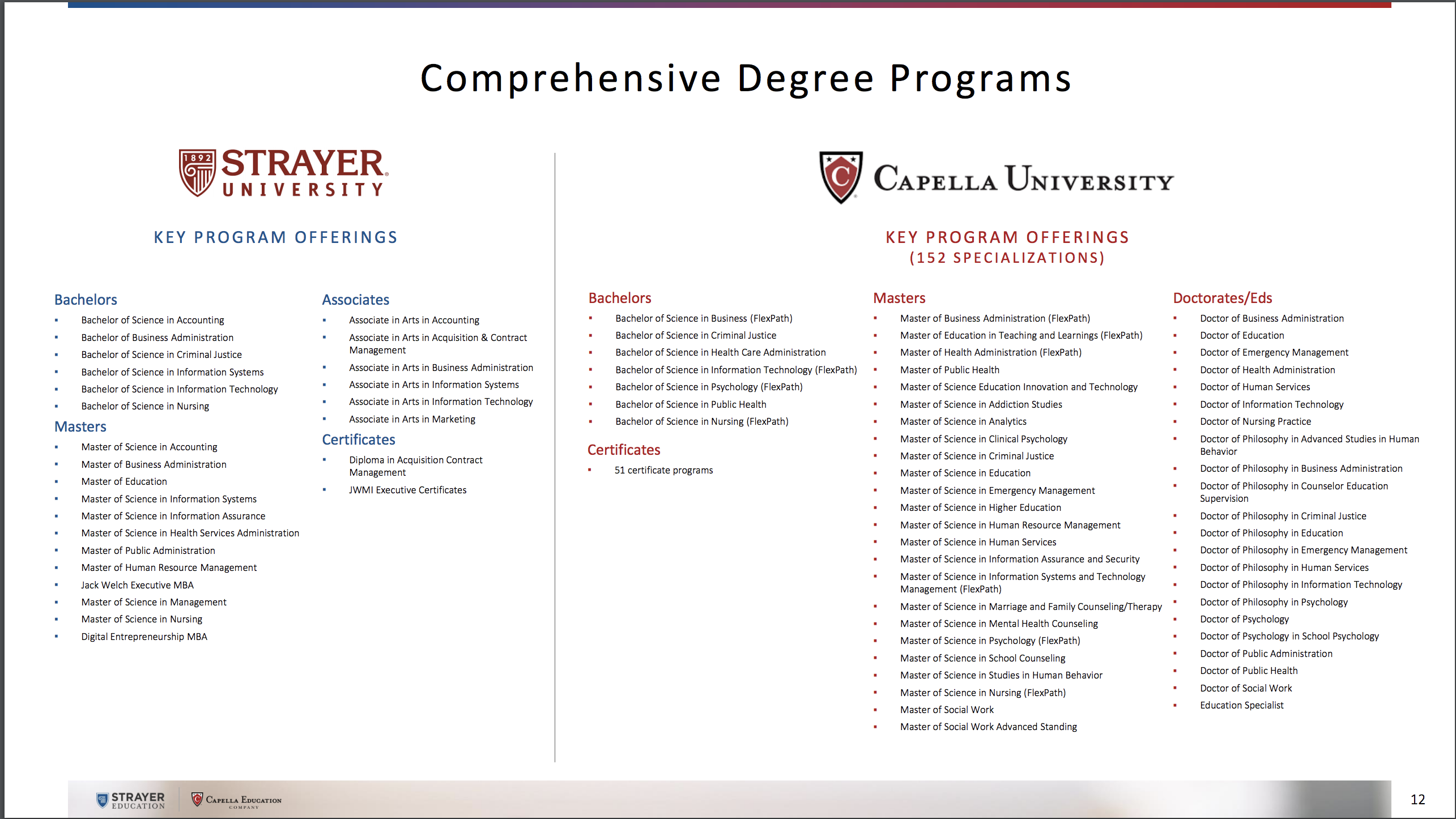
    As the company touts, there is a high degree of complementarity between the two entities. First, both kept their noses clean during the for-profit scandal era and maintained good reputation. Capella has, in fact, shown a willingness to actively collaborate with the broader university community, including not-for-profits, by sharing best practices and collaborating in research on topics like learning analytics. Strayer’s degrees are largely concentrated in business and IT, while Capella has a broader portfolio including education, health care, and criminal justice. Strayer has a number of physical campuses for classroom or blended learning, while Capella is focused on fully online. Strayer is known to be particularly good at building partnerships with employers, while Capella is known for its work in new educational trends like learning analytics and Competency-based Education (CBE). Strayer has a lot of working adults completing their undergraduate degrees while Capella has a robust set of graduate programs. Both dabble in other formats like code academies, and Capella has 51 certificate programs.

    Assuming the merger goes through, both schools will continue to operate largely separately as independent brands. Faculties are specifically called out as remaining separate, though credits will be tranferrable from one institution to the other. The areas singled out for “consolidation” (read: layoffs) are “executive and corporate functions, certain marketing capabilities and IT operations.” Corporate headquarters will be in Virginia, where Strayer’s headquarters currently are, but IT will be run out of Minnesota, where Capella is.

    When we look at this merger in the context of both Purdue’s acquisition of Kaplan, DeVry’s internal restructuring, and University of Phoenix’s transition of ownership and leadership, some trends in the for-profit space begin to emerge. ((Disclosure: University of Phoenix was recently one of our consulting clients.))

    Still on the defensive

    Despite the hype about the Trump administration being friendlier to for-profits than the Obama administration, the truth is that we continue to see defensive moves. University of Phoenix’s old PE owner decided to sell the business, and the leadership brought in by the new owner promptly closed 20 campuses. DeVry fired its CEO after closing 14 campuses and settling a slew of state and Federal lawsuits. ((Disclosure: DeVry has recently been a consulting client of ours.)) Kaplan decided to get out of the for-profit university business altogether. (What is left over of that company after the sale to Purdue, and what it will become going forward, is still unclear.) And the most immediate effect of the Strayer/Capella merger will be cost cutting in redundant operations.

    In other words, Education Secretary Betsy DeVos has not changed the laws of physics. These institutions were under pressure before and are still under pressure now. We should not be surprised to see more closures like Corinthian Colleges and ITT Tech, particularly of second- and third-tier for-profits. They may not be driven by active prosecutions, but the damage to the sector has already been done. Government intervention wasn’t the sole cause of the collapse of Corinthian; lack of cash on hand played a role.

    The questions going forward are (a) is the for-profit crash bottoming out, and (b) if so, what does their next act look like? It’s too early to tell regarding the first question, but we are getting some interesting hints regarding what the leadership of some of the larger for-profits think possible answers to the second one is.

    Course design, analytics, and employer connections

    A few details of the Strayer/Capella announcement stand out. The first one comes out of the rhythm of a merger announcement like this one. There’s a format of “Company A brings strength X while company B brings complementary strength Y.” The announcement touts one of Strayer’s strength as “close relationships with employers” that complements Capella’s “competency-based learning infrastructure, assessment capabilities and track-record of improving student success.” To begin with, these are real strengths of the respective companies rather than made-up talking points. Strayer is good at employer partnerships and does fairly extensive profiling of their students’ career goals and paths. Capella, for its part, was giving talks about their learning analytics work way back in the early days, before there were even products on the market.

    The bit about CBE, which comes up several times in the released materials, requires a bit of unpacking. Capella offers two flavors of what they label Competency-Based Education: “FlexPath,” which is a fully self-paced program in the style of Western Governors University or SNHU’s College for America, and “Guided Path,” which Capella labels as CBE despite the fact that it is instructor-facilitated, delivered within a term structure for a class cohort, and charged by the credit. What they really mean by CBE in this case is what Phil calls “CBE lite” or what is more commonly known in academic circles as “backwards design,” where the outcomes and assessments are designed first and then the content is structured to match (rather than picking the content for the syllabus and then designing assessments after).

    Only a relatively small percentage of Capella’s degree programs are full CBE FlexPath programs:

    Screenshot 2017-10-30 11.45.48

    So most of these programs are not actually self-paced CBE but backwards-designed and traditionally delivered courses. That may actually be a lot more important. As Phil has written, full self-paced CBE is still struggling to take off. Backwards design, in contrast is a good practice for course designs that drive improvements in student outcomes and is also a prerequisite for various types of learning analytics and adaptive learning approaches as well as full self-paced CBE. So when Strayer touts Capella’s strength in CBE, the real value may be in the course design process and the ways in which those designs can be instrumented in the learning analytics.

    Strong connections to employers, consistent application of backwards course design principles, and analytics supported by those course designs, are three areas where the centralized structure of for-profits enables them to move more quickly than many not-for-profits. Reading between the lines, it looks like the Strayer/Capella leadership think they have found a way to compete on quality. And they may not be the only ones tacking this approach. We see signs that at least pieces of these strategies are beginning to surface elsewhere. For example, it was interesting to see that the University of Phoenix’s new owner chose a new president who was previously an executive at McGraw-Hill Education, which currently styles itself a “learning science company.”

    Kaplan is obviously different, but maybe not as different as it appears at first blush. They had a very strong learning science and analytics-driven approach to course design, driven by thought-leader Bror Saxburg (who recently left to work at the Chan-Zuckerberg Initiative). Purdue, for its part, pioneered retention early warning analytics. Despite some controversy regarding one of their research papers, the university has deep experience with using analytics to drive outcomes.

    It’s still early days, but we may be seeing the beginning of a trend among for-profits to drive toward a particular notion of a quality education as a key competitive differentiator.

  • First Board Meeting For Kaplan / Purdue University: Tuition Levels Set

    First Board Meeting For Kaplan / Purdue University: Tuition Levels Set

    Last week was the first meeting for the board of trustees for NewU, the working name for Kaplan University now that it has been “acquired” by Purdue University. And yes, the scare quotes are intentional given the $1 purchase price. I’ll give the group high marks for transparency by the press release.

    In its inaugural regular meeting, the Board of Trustees for Purdue’s new affiliated institution, currently referred to as NewU, approved plans to offer a dramatic tuition discount for Indiana resident students and free tuition for Purdue employees.  The new Indiana resident rate, also approved by Kaplan University’s trustees, will take effect at the beginning of KU’s next academic term. [snip]

    An Indiana resident student pursuing an associate or bachelor’s degree will pay the equivalent of $220, including technology fees, per quarterly credit hour, which is a discount of approximately 45 percent. The total cost to graduation for a bachelor’s degree would be $39,600, compared to a total cost to degree of $80,088 (including room and board) for Indiana residents at Purdue’s West Lafayette campus.

    The reason there are two boards of trustees involved – for NewU and for Kaplan U – is that the deal still must be approved by state and federal regulators and by NewU’s accreditor HLC. (more…)

  • Purdue University Deal To Acquire Kaplan University: Interview with Trace Urdan

    Purdue University Deal To Acquire Kaplan University: Interview with Trace Urdan

    The surprise news today is that Purdue University has agree to acquire the academic operations of Kaplan University. As stated in the 8-K filing by Kaplan University’s owner Graham Holdings:

    On April 27, 2017, Kaplan Higher Education LLC and Iowa College Acquisition, LLC (collectively, “Kaplan”), subsidiaries of Graham Holdings Company, entered into a Contribution and Transfer Agreement (“Transfer Agreement”) to contribute the institutional assets and operations of Kaplan University (“KU”) to a new, nonprofit, public-benefit corporation (“New University”) affiliated with Purdue University (“Purdue”) in exchange for a Transition and Operations Support Agreement (“TOSA”), pursuant to which, among other provisions, Kaplan will provide key non-academic operations support to New University for an initial term of 30 years with a buy-out option after six years.

    Additional coverage of the deal at The Chronicle, Inside Higher Ed, The Wall Street Journal.

    This is an unprecedented move, and to get some insight, I interviewed Trace Urdan, who has long covered higher education as an investment analyst and is one of the most knowledgeable observers of the for-profit sector. The following description is based mostly on this interview, paraphrasing Trace’s explanations and adding quotes in places. (more…)

  • Recommended Reading: ED Clarifies Its Intent on State Authorization Reciprocity

    Recommended Reading: ED Clarifies Its Intent on State Authorization Reciprocity

    Last year Russ Poulin from WCET and I wrote an essay for Inside Higher Ed (also published at e-Literate) describing and countering attempts by the Century Foundation and other activists who were arguing against the State A

    A coalition of consumer groups, legal aid organizations and unions object to the state of New York joining an agreement that would change how colleges offering distance education courses in the state would be regulated. As coalition members asserted in an Inside Higher Ed article, the state would be ceding its authority to other states. Students would be left with no protection from predatory colleges and it would make it easier for “bad actors to take advantage of students and harder for states to crack down on them.”

    That all sounds ominous. It would be, if it were true.

    The story has taking a series of dramatic turns. First, New York state did join SARA. But in a surprise move in the final regulatory language from the Department of Education (ED), they included language proposed by the Massachusetts AG and supported by the Century Foundation that appeared to undermine the concept of reciprocity. Most analysts and insiders, including WCET and SARA themselves came to the same conclusion that Massachusetts’ AG did – SARA and the concept of reciprocity agreements would not survive as long as the regulation survived. In a surprise move, however, anonymous staffers at ED called Russ Poulin (the person to follow on this subject), letting him know that their intent is not at all to undermine SARA. (more…)