e-Literate

Present is Prologue

Tag: for-profit

  • New IPEDS Data: State by state online ed comparison / public institutions

    It’s Tuesday, so it must be time for my daily post on the new IPEDS data including online education. There are so many ways to slice this data that just was not possible before, and with a little spreadsheet engineering, I’m finding it easy to come up with new views. Today let’s look at the adoption of online education per state for public institutions (both 4-year and 2-year schools). Note that this data does not include private non-profit or for-profit institutions as I wanted to focus on official state involvement in online ed.

    IPEDS tracks information now about students taking exclusively distance education courses, students taking some but not all distance education courses, and students not taking any distance education courses. Please note the following:

    • I am using the terminology “online courses” rather than “distance education”. For the most part these terms are interchangeable, but they are not equivalent as “distance education” can include courses delivered by a medium other than the Internet (e.g. correspondence course). Part of the reason I stick with “online course” is that there is a growing use case where students local to a campus choose to take a course online, which is not really at a distance.
    • I have combined the fields for students taking “exclusive online courses” and “some but not all online courses” to derive the “at least one online course”, as this roughly equals the data reported by the Sloan survey / Babson Survey Research Group survey.
    (more…)

  • New IPEDS Data: Profile of online education in US / Fall 2012

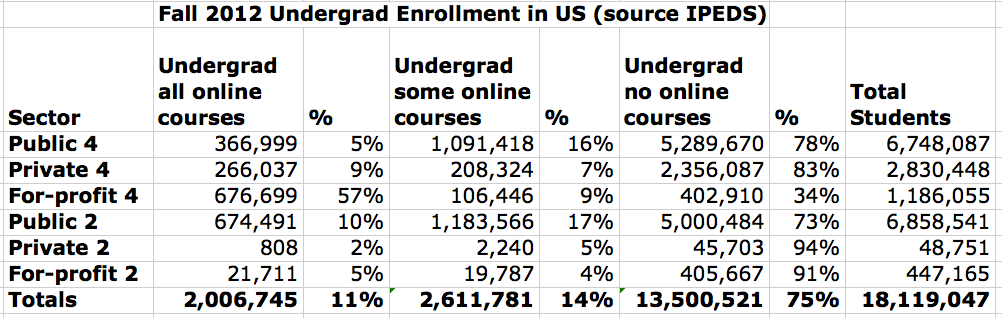
    Last week I mentioned how the National Center for Educational Statistics (NCES) and its Integrated Postsecondary Education Data System (IPEDS) are now providing preliminary data for the Fall 2012 term that for the first time includes online education. Let’s look at a profile of online education in the US for degree-granting colleges and university, broken out by sector and undergrad / grad  degrees.

    IPEDS tracks information now about students taking exclusively distance education courses, students taking some but not all distance education courses, and students not taking any distance education courses. Please note the following:

    • I am using the terminology “online courses” rather than “distance education”. For the most part these terms are interchangeable, but they are not equivalent as “distance education” can include courses delivered by a medium other than the Internet (e.g. correspondence course). Part of the reason I stick with “online course” is that there is a growing use case where students local to a campus choose to take a course online, which is not really at a distance.

    Here is the new IPEDS data for undergraduate and graduate students and courses:

    Undergrad by sector

    (more…)

  • Online Educational Delivery Models: A Descriptive View

            This article was originally published at EDUCAUSE Review.

    Update (11/25): This post has been bumped and amended to include the full article.

    Although there has been a long history of distance education, the creation of online education occurred just over a decade and a half ago—a relatively short time in academic terms. Early course delivery via the web had started by 1994, soon followed by a more structured approach using the new category of course management systems.1 Since that time, online education has slowly but steadily grown in popularity, to the point that in the fall of 2010, almost one-third of U.S. postsecondary students were taking at least one course online.2 Fast forward to 2012: a new concept called Massive Open Online Courses (MOOCs) is generating widespread interest in higher education circles. Most significantly, it has opened up strategic discussions in higher education cabinets and boardrooms about online education. Stanford, MIT, Harvard, the University of California–Berkeley, and others have thrown their support—in terms of investment, resources, and presidential backing—behind the transformative power of MOOCs and online education. National media outlets such as the Wall Street Journal, the New York Times, and The Atlantic are touting what David Brooks has called “the campus tsunami” of online education.3

    Unfortunately, a natural side effect of this new interest in education and educational technology is an increase in hype and in shallow descriptions of the potential for new educational models to replace the established system. All too often, the public discussion has become stuck in a false dichotomy of traditional vs. online—a dichotomy that treats all online models as similar and that ignores blended or hybrid approaches. This false dichotomy is even more evident now that discussions are spilling into national media forums. But in fact, as my colleague Molly Langstaff has described, educational technology is interacting with innovative educational courses and programs to create not only new language but also multiple models for delivering education.4

    (more…)

  • The Master Course: A Key Difference in Educational Delivery Methods

    In part 1 of this series of posts I presented a view of different educational delivery models based on course design and modality.

    Why does it matter that we describe these educational delivery models with finer granularity than just traditional and online? Because the aims of the models differ, as do the primary methods of how these models are created and delivered.

    To show an example of how the methods differ, let’s look at one of the most significant, but overlooked, concepts in this landscape – the master course. This concept of the master course changes the educational delivery methods of an institution, and in my opinion is the real differentiator between traditional institutions and for-profit institutions (both blended and fully online) and even non-profit fully-online organizations.

    (more…)

  • The Emerging Landscape of Educational Delivery Models

    Part 2 in this series, on a key difference in educational delivery methods, can be found here.

    Traditional education or online education. In the past decade it seems that the dominant conversation has been around the potential for online learning, both from for-profit and non-profit options, to disrupt education as an industry.

    What I believe we are seeing in 2011 and 2012 is a transition to an educational system no longer dominated by traditional education and one or two alternative models. As my colleague Molly Langstaff has described, educational technology and new educational courses and programs are interacting to create new language and models for education. What does this emerging landscape of educational delivery models look like?

    While I do not claim to be able to solve this problem, I would like to offer a more descriptive view than the dichotomy of traditional and online education describes.

    (more…)