e-Literate

Present is Prologue

Tag: George Siemens

  • Marketing Claims From Adaptive Learning Vendors As Barrier To Adoption

    In Spring 2016, faculty, support staff and administrators at Oregon State University met to candidly share their experiences with adaptive learning technology. ((Disclosure: Our e-Literate TV series of video case studies and explainer videos is funded by a grant from the Bill & Melinda Gates Foundation.))  I shared two different videos from the event at EdSurge in this article.

    At one point I asked what people saw as risks or barriers to further adoption of adaptive learning courseware, and two people had very similar responses. In a nutshell, the over-active marketing claims from many vendors could be the biggest barrier. This is somewhat counter-intuitive as over-active marketing is commonly seen as the cause of technology being adopted even when it should not be. Listen to their responses (< 30 seconds).

    (more…)

  • ED and CBE: Example of higher ed “structural barrier to change” that is out of institutions’ control

    There has been a great conversation going on in the comments to my recent post “Universities As Innovators That Have Difficulty Adopting Their Own Changes” on too many relevant issues to summarize (really, go read the ongoing comment thread). They mostly center on the institution and faculty reward system, yet those are not the only sources of structural barriers to change that lead institutions to this “difficulty adopting their own changes”. Increasingly there are outside forces that both encourage change and resist change, and it is important to recognize the impact of the entire higher education ecosystem.

    Yesterday Amy Laitinen from New America wrote an excellent article titled “Whatever Happened to the Department’s Competency-Based Education Experiments?” highlighting just such an example.

    About this time two years ago, President Obama went on his college affordability bus tour and unveiled his plan to take on the rising costs of higher education in front of thousands of students at SUNY Buffalo. Promoting innovation and competition was a key part of his plan and President Obama held up competency-based education (CBE) up as one of the “innovative new ways to prepare our students for a 21st century economy and maintain a high level of quality without breaking the bank.” The President touted Southern New Hampshire University’s College for America CBE approach. The university “gives course credit based on how well students master the material, not just on how many hours they spend in the classroom,” he explained. “So the idea would be if you’re learning the material faster, you can finish faster, which means you pay less and you save money.” This earned applause from students in the audience as well as from CBE practitioners around the country. [snip]

    The problem is that day was nearly two years ago and the CBE experimental sites are not yet off the ground. (more…)

  • Universities As Innovators That Have Difficulty Adopting Their Own Changes

    George Siemens made an excellent point in his recent blog post after his White House meeting.

    I’m getting exceptionally irritated with the narrative of higher education is broken and universities haven’t changed. This is one of the most inaccurate pieces of @#%$ floating around in the “disrupt and transform” learning crowd. Universities are exceptional at innovating and changing.

    While I agree with his primary point about false narratives with simplistic no-change assumptions, I think there is a risk about going too far the other direction. Universities have certainly changed, and there are many innovations within universities, but universities are not very good about diffusing the innovations that they do make. I made this same argument here and here. ((The first article had more of a technology focus, but the same applies to the pedagogical side of change.)) Campus changes are apparent, but too often I see innovative course designs showing real results, but courses in the same department remain unchanged.

    In my opinion Universities are exceptional at innovating, but they are not exceptional at changing.
    (more…)

  • Upcoming EDUCAUSE Webinars on Dec 4th and Dec 8th

    Michael and I will be participating in two upcoming EDUCAUSE webinars.

    Massive and Open: A Flipped Webinar about What We Are Learning

    On Thursday, December 4th from 1:00–2:00 p.m. ET we will be joined by George Siemens for an EDUCAUSE Live! webinar:

    In 2012, MOOCs burst into public consciousness with course rosters large enough to fill a stadium and grand promises that they would disrupt higher education. Two years later, after some disappointments, setbacks, and not a small amount of schadenfreude, MOOCs seem almost passé. And yet, away from the sound and the fury, researchers and teachers have been busy finding answers to some basic questions: What are MOOCs good for, and what can we learn from them? Phil Hill and Michael Feldstein will talk about what we’re learning so far. (more…)

  • e-Literate TV Interviews from MRI13 Now Available

    In December 2013 Michael I attended the MOOC Research Initiative Conference (aka #MRI13 or “The greatest MOOC conference in the history of MOOCs”). Thanks to a grant funded by the Gates Foundation through Athabasca University, we are creating three episodes of an upcoming e-Literate TV series based on the conference. We expect to release these episodes in March.

    MRI

    As part of developing material for the episodes, we interviewed a number of research grantees and ed tech luminaries. We had some great guests who spoke about what we have learned from MOOCs, what the potential applications are, what the downsides are, and where open education could and should go in the future. It was a unique opportunity to get so many well-informed people in one place on a common topic.

    Today we releasing these videos through the e-Literate TV YouTube channel. These videos all carry a Creative Commons license to facilitate sharing and repurposing of the material.

    (more…)

  • MOOC history as presented at AACN13 conference

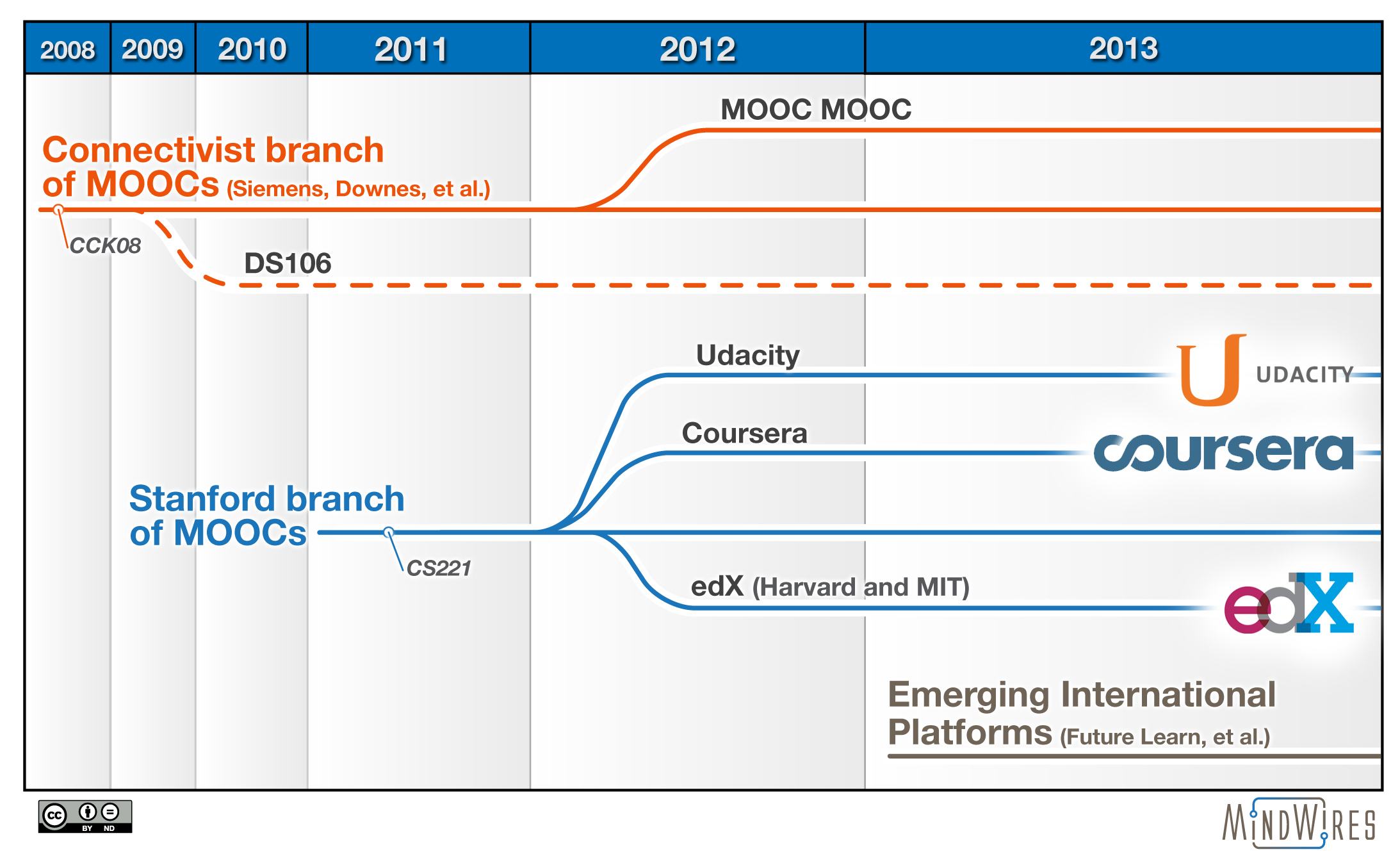
    With all of the great discussions spawned by the “greatest MOOC conference in the history of MOOCs” (MRI13), it seems a good time to share a segment of a keynote presentation I gave last year on MOOC history. This presentation was at the American Association of the Colleges of Nursing (AACN) conference in April 2013. For context, I had just shared how online education was no longer an issue kept in the corner, away from mainstream higher ed, but was now affecting the traditional campus discussions.

    There is a relevant graphic that was shown during this segment of the talk, showing the MOOC timeline (updated version shown below).

    MOOCpreHistory20131202

  • Changing the Narrative

    As Phil mentioned, he and I were both lucky to attend the MOOC Research Initiative conference, which was a real tour de force. Jim Groom observed that even the famously curmudgeonly Stephen Downes appeared to be enjoying himself, and I would make a similar observation about the famously curmudgeonly Jonathan Rees. If both of those guys can be simultaneously (relatively) pleased at a MOOC conference, then something is going either spectacularly right or horribly wrong. I believe it was the former in this case.

    We are at one of those rare moments when there’s enough confusion that real conversation happens and possibilities open up. The sense I got is that everybody is really grappling with the questions of where we can take the concept of a “MOOC” and what MOOCishness might be good for. That is fun and hope-inducing. Phil and I spent a lot of the time interviewing folks for a future e-Literate TV series (coming to a computing device near you in March or April of 2014), so we were lucky to hear a lot of perspectives. There is some very good exploration happening now. George Siemens and his fellow conference organizers (as well as the Bill and Melinda Gates Foundation, which sponsored the event and the research) did a real service by bringing people together to talk about these issues at this pregnant moment.

    One thing happened toward the end of the conference that has me puzzled, though. Jim mentioned it in his blog post:

    At the same time[,] Bon Stewart’s admonitions for some kind of organized response to start filling the temporary void of direction with alternative narrative still rings in my ears—and it is very much the lesson I took away from Audrey Watters keynote at OpenEd.

    There was a lot of conversation, really throughout the conference but coming to a head at the end, that the term of MOOC is somehow damaged goods and that…something…should be done about it. Usually the word “narrative” was brought up. But this talk of “alternative narratives” or, as Bonnie put it, “changing the narrative”, confuses me. As far as I’m concerned, the connectivist/open ed crowd has been spectacularly, stunningly successful at “changing the narrative,” and I’m not at all clear what it would look like to somehow do it differently. I don’t understand what they mean here. Unfortunately I had to rush out the door to try to catch a plane shortly after the panel discussion and didn’t have an opportunity to follow up with some of the attendees. So I’m going to try to express my confusion in this blog post and hope that somebody can help me figure out what I’m missing.

    Warning: This post is long and lit crit wonkish.

    (more…)