e-Literate

Present is Prologue

Tag: Google

  • Is Microsoft or Google your next LMS? The view from BETT

    Is Microsoft or Google your next LMS? The view from BETT

    The following is a guest post from Jason Cole, a longtime colleague and freelance consultant who recently moved back to London. Previously, Jason was Vice Chancellor for IT at the Peralta Community College District, and before that was CEO and Board Chair at Remote-Learner. [ed]

    I recently spent a day at BETT (formerly known as the British Educational Training and Technology show), the UK’s largest educational technology show. The show tends to skew towards the primary and further education market (k-12 and community college in the US), but there is also significant higher education presence. If you are looking for a US equivalent, its more akin to ISTE than EDUCAUSE.

    For those who haven’t been to BETT, it can be a bit overwhelming. There are over 34,000 attendees and 900 exhibitors from 138 countries. The massive show floor hosts everyone from national trade organizations from Denmark, Spain, UAE and Egypt to little ed tech startups that will probably evaporate in a few years.

    Everything is in one giant exhibition hall, with auditoriums scattered amongst the vendor booths. You can hear the noise of the conference space everywhere, even in the main event auditorium.

    For all of the activity, what was noticeable was the absence of the major LMS vendors besides Instructure Canvas. The company sponsored talks and roundtable lunches, but it didn’t have a traditional marketing booth. Their presence and sponsorship, however, meant they were the only LMS vendor anyone was talking about. D2L, Moodle, the UK Moodle partners, and Blackboard had no discernible presence. WebAnywhere is now focused on the SchoolJotter product and corporate Totara market. Synergy had small table in the back with one small Moodle Partner badge. Why – is BETT just a bad bet for lead generation and branding for the LMS providers? The large schools presence may mean less traffic for the higher ed (HE) focused LMS providers. But there are HE attendees, and Moodle had a strong schools presence. Some might argue the limitations of GDPR make lead generation difficult in European shows, but the presence of 900 exhibitors seems to imply there is some return on investment.

    On the other side of the spectrum, Google and Microsoft had large crowds in their large multi-plot booths. Each company had case study talks by users, how-to’s for teachers, and partner ecosystem mini-booths. Most of the hands-on presentations by these two tech giants were near capacity when I checked in throughout the day, as were most of the case study discussions.

    Every presentation in the Microsoft booth had real-time captioning displayed directly above the slides, and every presentation had real-time translation into multiple languages. Microsoft is obviously confident in both services, and from what I could see these services were remarkably accurate.

    It may have been the (AI-recommended) Microsoft Kool-aid ((Somehow an AI tied to a screen with a camera judged my reactions to three pictures, and estimated my age and gender and then labelled me an “Empowerer”. It’s recommendation was a rather refreshing apple cucumber drink with Spirulina distributed for free by two attendants. I have no idea why empowerers need cucumber, nor was there any falsifiable alternatives to getting a different flavour. Would the Innovator beverage make me more creative? Ah, the joys of inscrutable machine logic!)), but it appears Google and Microsoft are edging their way into the LMS space. Their presence at a K-12 focused show suggests they are finding traction at the younger grades. But as their education offerings grow in sophistication, and their ecosystem advantages start to accelerate, I believe a more concerted push in the higher ed space is inevitable.

    When Microsoft makes their push, the learning system won’t look like an LMS, but it will look like Teams. Teams is Microsoft’s central communication application for business, rolling in Skype and other business lines. There is an education version for teachers. Students with courses in Teams access their materials, communicate with the instructor and each other, and collaborate using Office and other tools online.
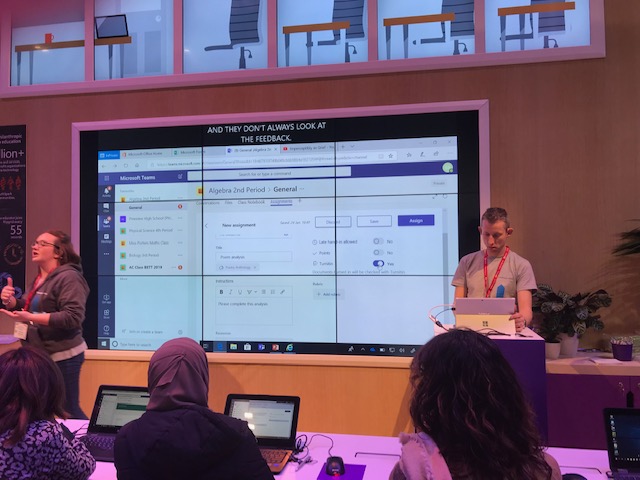
    View of Microsoft Teams demo

    The early indicator of Microsoft’s intent is their recently released Assignments for Teams for Education. Assignments gives teachers an easy to use tool to create either quizzes (using Forms) or submissions (using the Office suite). The student work can be graded using either a straight score or a rubric. Students see the results in their Teams, and teachers can download the grades for all the Assignments to Excel. It’s an interesting feature that signals a definite intent from Microsoft to meet the needs of teachers in the education version.

    Teams is not ready to replace or compete with the LMS yet, but it isn’t terribly far away. The Teams interface for classrooms needs some reorganization, it needs a centralized grade book that isn’t reliant on export to Excel, and it needs a slightly better authoring experience to combine the features together in learning modules. Teams and Sharepoint would also need a clear content strategy enable integration with publisher tools and content. But none of these challenges are impossible, and some Microsoft partners already have pieces of the solution.

    The ecosystem around Teams and Office will give Microsoft an increasingly interesting story. Microsoft is rapidly integrating service platforms for email, calendar, business logic, business intelligence, AI, device management, and cloud services into the Teams platform. There is enormous potential for educational organizations to leverage these capabilities to deliver a unified student experience. The “learning management” features move into the background, while students interact with a single application and message flow.

    While the potential is there, there are a few hurdles on the way. Moving into the learning and teaching side of the HE market requires a different channel strategy than the current focus on the productivity and infrastructure side of the house. Microsoft relies on a combination of direct account management and partner sales in a complex selling process. The Microsoft partners who would need to engage in the sales process and own customer relationship tend not to have academic sales experience, nor do they have the brand recognition of Canvas, Moodle, D2L and Blackboard among faculty. Given the sales costs and margins, a higher education focused Microsoft partner would have difficulty achieving scale. I would watch for more bottoms up adoption, pressure from students coming to HE from Google and Microsoft schools, and adoption outside of the traditional HE context as early indicators of a market shift.

    Other observations:

    • By sheer number of vendors, apparently every school in the EU is going to have a robotics lab and a maker space in the next few years. Lots of Arduino, 3D printers, and so… many… robots.
    • A few VR and AR vendors were making a splash (and inducing large scale motion sickness) with headsets and learning simulations.
    • Newton Rooms, modular, pre-packaged hands on science learning rooms, designed in Norway are one of my new favourite things.
  • Notes on EDUCAUSE 2018

    Notes on EDUCAUSE 2018

    I recently finished three weeks of travel to ed tech conferences – Online Learning in Toronto, WCET in Portland, and EDUCAUSE in Denver. Given the size of EDUCAUSE and its history of being the place to see the greatest number of vendors in one location, that conference is a good trigger to cover general ed tech market news.

    Official photo of EDUCAUSE exhibit hall from promotional tweet
    Source: https://twitter.com/educause/status/1034810456584740864

    EDUCAUSE By the Numbers

    John O’Brien, president and CEO of EDUCAUSE, described in his welcoming speech and in an interview how this was the largest conference yet for the organization, with more than 8,000 registered attendees including more than 3,000 first-timers. I asked O’Brien about the changing and more crowded environment for ed tech conferences – with WCET, ASU/GSV, Online Learning, various vendor conferences, SXSWedu, and others – and he indicated that more is better. In other words, EDUCAUSE does not see a need to change due to competition, as there is room for multiple conferences with different emphases.

    The direction that EDUCAUSE is going can be seen in O’Brien’s recent article “Strategic IT: What Got Us Here Won’t Get Us There”. In this view, technology is integrated, so the organization and conference must bring in decision-making from outside the IT organization.

    To fully realize the value of information technology as the strategic asset it is, we must embrace strategic IT. What got us here, a remarkable utility mindset, will no longer suffice. Instead, higher education leaders must consider the role and placement of information technology in the strategic fabric of their institutions.

    Based on interviews with O’Brien as well as multiple sponsoring vendors on the exhibit hall, these are the key numbers:

    • Total attendance of 8,018
    • Of these almost 5,900 opted to share registration info, implying that 2,100 opted out of sharing info (and I assume that the vast majority of the 2,100 are from higher ed schools)
    • Just over 3,000 were first-time attendees
    • Almost 2,700 were from vendors, both as sponsors / exhibitors and paying attendees to walk around; another 200 or so were from foundations, media, associations, and other organizations
    • Therefore 5,000 – 5,100 attendees were from institutions of higher ed, with more than 300 of those attendees from outside the US

    In 2017:

    • Total attendance of 8,000
    • More than 1,600 first-time attendees
    • More than 6,900 opted to share registration info

    There is somewhat of a disconnect, however, in that the exhibit hall certainly didn’t feel crowded or busy, at least compared to previous years. Most vendors I talked to described traffic at booths somewhat healthy but not at a peak for this conference. I also do not know why the registration list from last year had more 1,000 more than this year. I have asked EDUCAUSE for commentary or clarification on the attendance numbers; while their PR firm did respond to my email, I have not received any updates on the numbers other than saying “it cannot be assumed that the opt-outs were from higher education schools”.

    One other disconnect was noted by Josh Kim at Inside Higher Ed in his post about the EDUCAUSE Top Ten IT Issues list released at the conference.

    Curious About the Lack of Overlap with the ELI 2019 Key Issues in Teaching and Learning List:

    Perhaps the existence of the ELI Key Issues list exempts the EDUCAUSE mothership from putting teaching and learning related issues on its list. I still read the lack of teaching and learning issues as curious. How could it be that academic transformation is everywhere in the ELI community, and nowhere to be found in the IT list? Maybe the EDUCAUSE list should have one entry that says “see the ELI list.”

    I see the same issue where the EDUCAUSE “mothership” in many ways does not directly speak to teaching and learning issues, which is confusing given the direction the organization is taking. When I asked John O’Brien about this situation, he indicated that they have been increasing their emphasis on T&L issues at the leadership level. The answer is not that EDUCAUSE wants to point all T&L issues to ELI, but the integration is a work in progress, I suppose.

    Big Tech Companies

    Moving beyond the numbers, what struck me the most was the increasing presence of Big Tech at the conference. Amazon, Microsoft, Google, IBM were all there in force, with an increased focus on education as a vertical market. Only Apple was missing.

    The question, especially for Google, is how much they plan to fully jump into higher education as opposed to dabbling in the market with a ‘let’s see how this tech gets used’ approach of the past. I get conflicting messages in this regard, at least for Google. For example, I asked a sales lead in the booth about Google Classroom and whether they plan to push this into the higher ed LMS market. He answer was clear that Classroom belongs in the K-12 market, but in higher ed they have no need to try and displace Canvas, Blackboard, D2L, Moodle, et al. For higher ed, they plan to use Course Kit, their set of tools integration G Suite with the campus LMS, to incrementally get more exposure. When I talked to one well-known university CIO, however, he said that Google is responding to his push to fully jump in and even expand Classroom usage as an LMS alternative. Don’t treat this as a full description of the issues but rather one example of mixed messages.

    Microsoft and Amazon, however, are really expanding their higher ed solutions and market presence.

    In years past, EDUCAUSE exhibit hall was dominated by the ERP companies plus Blackboard and the publishers. In the ERP space, Oracle, Workday, Ellucian, and Jenzabar had large booths and aggressive marketing presence. Yes, I mention Jenzabar in that group, at least in terms of conference booth and marketing presence. Expect more on that story in the coming months.

    Moodle Presence

    For the first time, Moodle HQ had their own booth at the conference rather than solely relying on Moodle Partners for messaging. In fact there was a mini-Moodle alley at the left side of the hall, with eThink, Moodle HQ, and Moonami all together. This marketing move is significant after last year’s funding round of $6 million for Moodle HQ and this year’s news of Blackboard / Moodlerooms leaving the Moodle Partner program. I don’t know how far this new marketing spend will go in influencing LMS decision-making at colleges and universities, but it is significant that the world’s largest LMS is now spending money to raise awareness of what Moodle currently offers and what it can be.

    Additional Notes

    • If you ever wondered how many 20-somethings you could possibly fit in one large conference booth, I hope you visited Splunk to see the answer.
    • Cybersecurity – both in terms of protection / audit services as well as content for training and certificates – was another area with increased emphasis this year.
    • In a strange way, video is becoming a crowded market (again). Lecture capture, streaming, synchronous collaboration tools, etc. Where did this new market investment come from?
    • At the booth with the punching bag game, I should have invited 35-year-old Phil to be competitive with the eThink and Moodle guys. At least, I’ll pretend that this was the issue.

    Update 11/21: Clarified response status from EDUCAUSE at their request.

  • Google Classroom Addresses Major Barrier To Deeper Higher Ed Adoption

    A year ago I wrote about Google Classroom, speculating whether it would affect the institutional LMS market in higher education. My initial conclusion:

    I am not one to look at Google’s moves as the end of the LMS or a complete shift in the market (at least in the short term), but I do think Classroom is significant and worth watching. I suspect this will have a bigger impact on individual faculty adoption in higher ed or as a secondary LMS than it will on official institutional adoption, at least for the next 2 – 3 years.

    And my explanation [emphasis added]:

    But these features are targeted at innovators and early adopter instructors who are willing to fill in the gaps themselves.

    1. The course creation, including setting up of rosters, is easy for an instructor to do manually, but it is manual. There has been no discussion that I can find showing that the system can automatically create a course, including roster, and update over the add / drop period.

    (more…)

  • Miami, Harvard and MIT: Disability discrimination lawsuits focused on schools as content providers

    In the discussions at Google+ based on last week’s post about the Miami University of Ohio disability discrimination lawsuit ((Insert joke here about G+ and its hundreds of active users.)), George Station made two important points that deserve more visibility.

    It’s been a-coming for several years now. Cal State has some pretty strong rules in place for compliance with ADA and state-level disability laws. Still, [Universal Design for Learning] UDL is a little-known acronym on any campus you care to visit, and staff support is probably one person in an office, except for Miami of Ohio as of this week, I guess…

    Add the recent edX settlement with the US Department of Justice, and the whole direction of edtech changes…

    Put another way, it should come as no surprise that the US Department of Justice is ramping up its enforcement of disability discrimination regulations in the education world. Captioning service provider CaptionSync has an excellent summary of the field, written before the DOJ intervention at Miami. (more…)

  • Ed Tech World on Notice: Miami U disability discrimination lawsuit could have major effect

    This week the US Department of Justice, citing Title II of ADA, decided to intervene in a private lawsuit filed against Miami University of Ohio regarding disability discrimination based on ed tech usage. Call this a major escalation and just ask the for-profit industry how big an effect DOJ intervention can be. From the complaint:

    Miami University uses technologies in its curricular and co-curricular programs, services, and activities that are inaccessible to qualified individuals with disabilities, including current and former students who have vision, hearing, or learning disabilities. Miami University has failed to make these technologies accessible to such individuals and has otherwise failed to ensure that individuals with disabilities can interact with Miami University’s websites and access course assignments, textbooks, and other curricular and co-curricular materials on an equal basis with non-disabled students. These failures have deprived current and former students and others with disabilities a full and equal opportunity to participate in and benefit from all of Miami University’s educational opportunities.

    The complaint then calls out the nature of assistive technologies that should be available, including screen readers, Braille display, audio descriptions, captioning, and keyboard navigation. The complaint specifies that Miami U uses many technologies and content that is incompatible with these assistive technologies. (more…)

  • Early Review of Google Classroom

    Meg Tufano is co-Founder of SynaptIQ+ (think tank for social era knowledge) and leader of McDermott MultiMedia Group (an education consulting group focused on Google Apps EDU). We have been checking out Google Classroom – with her as the teacher and me as the student. I include some of Meg’s bio here as it is worth noting her extensive experience designing and teaching online courses for more than a decade.

    Meg posted a Google Slides review of her initial experiences using Google Classroom from a teacher’s perspective, which I am sharing below with minimal commentary. The review includes annotated slides showing the various features and Meg’s comments.

    I have not done as much work to show the student view, but I will note the following:

    • The student view does not include the link to the Chrome Store that Meg finds to be too confusing.
    • The biggest challenge I’ve had so far is managing my multiple Google accounts (you have to be logged into the Google Apps for Edu as your primary Google account to enter Classroom, which is not that intuitive to students).
    • I wonder if Google will continue to use Google tools so prominently in Classroom (primary GDrive, YouTube, GDocs) or if the full release will make it easier to embed non-Google tools.
    • I have previously written “Why Google Classroom won’t affect institutional LMS market … yet”, and after initial testing, nothing has changed my opinion.
    • I have one other post linking to video-based reviews of Google Classroom here.
  • Why Google Classroom won’t affect institutional LMS market … yet

    Yesterday I shared a post about the new Google Classroom details that are coming out via YouTube videos, and as part of that post I made the following statement [emphasis added]:

    I am not one to look at Google’s moves as the end of the LMS or a complete shift in the market (at least in the short term), but I do think Classroom is significant and worth watching. I suspect this will have a bigger impact on individual faculty adoption in higher ed or as a secondary LMS than it will on official institutional adoption, at least for the next 2 – 3 years.

    The early analysis is based on this video that shows some of the key features:

    (more…)