
e-Literate

Present is Prologue

Tag: Indiana University

  • Unizin membership fee is separate from Canvas license fee

    With Unizin going public yesterday, I’ve been looking over our three posts at e-Literate to see if there are any corrections or clarifications needed.

    Based on yesterday’s press release, official web site release and media event, I have not found any corrections needed, but I do think there is a clarification needed on whether Unizin membership includes Canvas usage or not (it does not).

    Common Infrastructure

    During the media call, the Unizin team (representatives from the four founding schools plus Internet2 and Instructure) pushed the common infrastructure angle. Rather than being viewed as a buying club where schools can buy from a common set of pre-negotiated services, Unizin can more accurately be viewed as planned integration and operation of a common service to allow white-label outsourcing of the learning infrastructure. The idea is that a school can use Unizin’s infrastructure for LMS, content repository and analytics engine rather than hosting or maintaining their own, but the service will not be branded as Unizin for the faculty and student end users. From the Unizin FAQ page:

    There is another sense in which Unizin is different from MOOC efforts. Unizin is about providing common infrastructure to support the missions of its university members. It is not a public-facing brand. It will not offer content, courses, or degrees in its own name. Unizin’s membership model is built on the premise that universities need to strengthen their influence in the use of data and content for the long run. They will accomplish this goal by working together and taking greater control over content, while also opening content up for selective sharing.

    In this morning’s IHE article, the Unizin founders described the need for a common infrastructure:

    The digital learning consortium, announced Wednesday morning, aims to simplify how universities share learning analytics, content and software platforms. But in order to do so, Unizin needs its members to use the same infrastructure. A common learning management system is the first part of that package.

    “You don’t really have common infrastructure if you’re saying everything is heterogeneous,” said Brad Wheeler, the Unizin co-founder who serves as vice president for IT and chief information officer at Indiana University. “A lot of these different learning tools — Sakai, Blackboard, Canvas — they all do a bunch of really good stuff. But five universities picking five different ones — what’s the end value in that if they want to do something together?”

    Brad Wheeler went on to describe the results that will occur from sharing infrastructure:

    “This is a hard decision,” Wheeler said about picking Canvas. “I think the key point is enabling Unizin to do what it’s meant to do…. The path for Unizin is creating a dependence on Unizin — a university-owned entity — but creating potential for greater interdependence among our institutions.”

    Instead of differentiating themselves based on what software tools they individually pick, Wheeler said, Unizin’s member institutions will stand out based on what they do with the common platform — in other words, the degrees they offer, the research they produce and the students they serve.

    Clarification on Canvas Licensing

    (more…)

  • It’s Official: Unizin Is Real


    A giant deity from the confines of space and time, Unizin has orbited the Earth like a comet, appearing once every twelve years of Christmas Eve. One man by the name of Dr. Kori wanted to study Unizin after seeing the monster himself when he was a boy. Even though he was called a con artist trying to capture Unizin he never gave up his search. On Christmas Eve day, he was working on his self made radar that would find Unizin when Elly came and was shocked by the device. After Dr. Kori repaired her the two made a trap to capture Unizin. That night, the dimensional kaiju made himself known as both DASH and Dr. Kori captures it in a mystical trap, but time around him began to disappear. Kaito turned into Ultraman Max and made a barrier to slow down the process. Not wanting the graceful giant to be hurt Dr. Kori let it go, restoring everything to normal. Unizin gave the doctor the branch of a tree he had not seen in some time, whether it was intended to be given to him or a reward for releasing him was unknown, but he was grateful nonetheless.

    The Ultraman Wiki

    No, not that Unizin. This Unizin. The secret university consortium is no longer secret. Phil and I wrote a few posts about the consortium before the group went public:

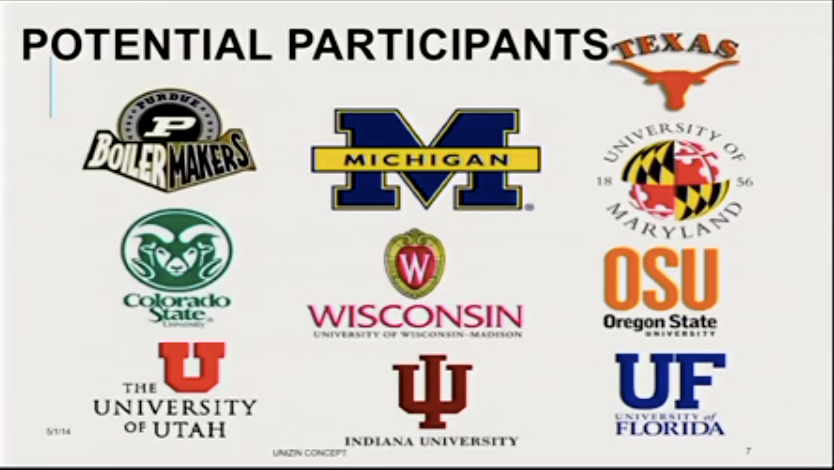
    So far, four of the ten universities we reported were considering joining have officially and publicly joined: Indiana University, University of Michigan, Colorado State University, and University of Florida.

    Here’s a roundup of the news coverage:

    Probably most important to read, in addition to IHE’s coverage and ours, is the “Why Unizin?” blog post on the Unizin website.

    There was a press call this afternoon, so I expect we will be seeing more articles over the next few days. Of course, Phil and I will be providing some additional analysis as well. Stay tuned.

  • Unizin: What are the primary risks?

    In Michael’s most recent post on Unizin, the new “learning ecosystem” initiative driven by Indiana University, he asked the question of who would be threatened by the proposed consortium (with the answer of edX). This question assumes of course that Unizin actually succeeds in large part, but what are the primary risks for the initiative to succeed in the first place? Based on the public information we have available to date (primarily in the two posts linked above), I see two near-term risks and one long-term risk that rise above the others.

    Near-Term Risk: Getting Schools to Sign Up

    The obvious question is whether there are enough schools willing to commit $1 million and adopt the proposed platforms to get the consortium off the ground. Based on the Colorado State University recording, it appears that the goal is to get 9 – 10 schools to commit $9 – $10 million in the initial phase. Beyond Indiana University, the most likely school to commit is the University of Michigan. Their leadership (dean of libraries, CIO) are fully behind the initiative, and from press reports they are seeking final approval. I cannot find any evidence that any other schools have reached this point, however.

    Slide from CSU Presentation
    Slide from CSU Presentation

    There are active debates in the Committee on Institutional Cooperation (CIC), primarily between provosts and CIOs, about Unizin and whether this approach works for member institutions. The provosts in fact already put out a position paper generally endorsing the same concept. (more…)

  • Why Unizin is a Threat to edX

    In the week since we published our Unizin exposé, there has been nary a peep from the group to us, or apparently to the traditional news outlets either. When we ran the piece, we emailed Indiana University CIO Brad Wheeler to request comment or corrections. We have not heard back from him yet. Brad, if you’re reading this, our door is always open. Talk to us.

    Luckily for us, we don’t need to rely on new pronouncements from Brad to give us more insight into what’s going on. It turns out that he’s been speaking in public about this idea for years. He just hasn’t called it Unizin. And from what I can tell, it should give edX cause to worry.

    (more…)

  • Unizin: Indiana University’s Secret New “Learning Ecosystem” Coalition

    Indiana University has been the driving force behind the creation of a new organization to develop a “learning ecosystem”. At least ten schools are being quietly asked to contribute $1 million each over a three-year period to join the consortium. The details of what that $1 million buys are unclear at this point. The centerpiece for the short-term appears to be a contract with Instructure for use of the Canvas LMS. But there are also hints of ambitious plans regarding learning object repositories and learning analytics.

    What is remarkable is the level of secrecy surrounding the project. Several sources from involved schools have indicated that very few people have been informed regarding their institutions’ prospective involvement. When school discussions do take place, care is being taken to keep them quiet. For example, a video recording of a presentation to faculty about Unizin at Colorado State University has since been removed from public access after it received some attention on Twitter (although e-Literate downloaded a copy of the video before it was removed from public access).

    Nevertheless, details of the project are beginning to leak out. In this post, I will share the facts that we have been able to confirm. Phil and I will both follow on with some analysis and inferences early next week. And of course, we will continue to bring you updates as news breaks.

    (more…)