So, Instructure CEO Dan Goldsmith is “stepping down.” Going to “spend more time with his family.” “Hiking the Appalachian Trail.” Choose your euphemism. He has been forced out. Don’t shed too many tears for him; he made about $12 million during his roughly 14-month tenure as CEO. That’s enough to pay maybe 25 decent software engineers for 5 years in the Salt Lake City area.
The truth is that nobody would have paid much attention to how much Goldsmith was getting paid had he been doing a good job. But in the education market, people tend to pay attention to who is getting a big payout if they worry that their vendor is not putting the students first. I hope that is a lesson that Thoma Bravo is taking note of. (More on that in a bit.)
That said, the Goldsmith era is now water under the bridge. The more important question is what happens at Instructure going forward and how it impacts the students and educators who depend on the company.
Short-term
The acquisition of Instructure by Thoma Bravo is not dead. If anything, it is considerably more likely now, for a variety of reasons, including but not limited to a higher bid by the private equity company. As usual, Phil has a terrific breakdown of the financial drama. The short version is that there is likely to be a bit more drama that will take a bit more time, but the acquisition looks close to a done deal at this point.
In the meantime, there is no CEO. Instead, the company is being run by a team of its senior executives, some of whom are the veterans that I’ve been complaining have been stifled. Within hours of the announcements of Dan’s departure, I began seeing private signs of aggressively renewed outreach from this team. The bunker mentality is gone. We’ll see how well this team coordinates that outreach, but the horse is out of the barn on this one. I think it will be hard for the next CEO to go back to a classic corporate command-and-control customer interaction style. That is one good outcome from the interregnum (though it is possible to go too far in the other direction if they don’t all pull together).
The bigger question for customers, assuming that the deal does go through, is what happens afterward.
Medium-term
My position has always been neutral-positive on Instructure being acquired by a private equity company in general and neutral on being acquired by Thoma Bravo in particular. Instructure needs some time to move past its current growth plateau. There is a reasonable argument to be made that they could focus on doing that with fewer distractions that could harm their core work for customers if they were under private ownership rather than under the quarter-by-quarter performance pressures of the public stock market. Instructure’s acquisition could be good or bad for education, depending on two major factors.
The first factor is Thoma Bravo’s plan. I am quite confident that they already have one. And as Phil wrote in the aforementioned post, it is likely an ambitious one:
One other note – with these aggressive moves, I have to believe that Thoma Bravo has much bigger plans than simply buying a few more Portfoliums while divesting Bridge. Bravo is sitting on a pile of cash ($12+ billion in their latest round), and there are likely bigger plans that depend upon this Instructure acquisition.
The danger is that the typical private equity merger and acquisition playbooks have a decidedly mixed record in EdTech. At best. Education is a weird market. Combinations that look good based on the spreadsheets are often terrible ideas IRL. I can think of one or two possible big combinations that might work—Coursera comes to mind—but by and large, the impulse to combine two EdTech giants more frequently results in the destruction of value than in the creation of it.
Private equity folks are rarely stupid. On the contrary, the ones that I’ve met have generally been incredibly smart. They simply lack education market domain knowledge. They apply their disciplinary skills in an area where those skills don’t translate straightforwardly. That can work out if they have a partner in the form of an excellent CEO who does understand education (or can learn it quickly) and is a strong advocate for customers. Dan Goldsmith wasn’t that person, which meant that private equity ownership under him was virtually guaranteed to be disastrous. Assuming the Thoma Bravo acquisition does go through, then the CEO that Thoma Bravo brings in to replace him will be critical.
They almost certainly have somebody already lined up. Private equity companies tend to keep stables of CEOs that they rotate from company to company. That is probably just fine in the short term. While I have a lot of respect for Instructure’s management team, managing a company of that size through a committee will only work for so long. So bringing in a caretaker CEO quickly is a good idea. But that person may or may not be a good long-term solution. I would argue, for example, that somebody who comes from running an enterprise software company, like Goldsmith did, is not likely to be a good long-term fit. The market dynamics are very different, which is one reason why Goldsmith was completely blindsided and seemed slow to learn.
There are major opportunities in EdTech. The education sector is entering a period of massive and uncharacteristically rapid evolution. That represents opportunities for a company that can identify new, unmet needs, engage in innovative, user-informed product development, and keep good relations with a particularly demanding customer base. Leadership matters in this kind of situation.
I see two possible candidate profiles. The first is somebody from EdTech. There is now a generation of executives who have grown up in the space, seen all the many mistakes that have been made, know the customers, and have an eye for the market shifts as they happen. The ideal candidate in this mold is one who is old enough to be seasoned but young enough or unorthodox enough not to be stuck in the first-generation mindset from the established product categories like LMS or textbook publishers (which is where they will likely have earned their stripes). The second possibility is somebody more like Josh Coates, by which I mean a strong product-oriented CEO from the consumer software space who knows how to listen to—and speak to—customers. This person would have more of a learning curve, but since Instructure has a seasoned management team, it could work. But it would take more time before such a person could provide good guidance on acquisitions.
Those awkward teenage years
In the summer of 2018, I wrote that Instructure was entering its awkward teenage years. We just survived eighth grade. After a year of monosyllabic responses and long periods in the bedroom with the door closed, the pale young thing has emerged into the sunshine.
But now comes high school. There will be new friends and new temptations. There will be strange ideas of what it means to be cool and how to get to the top of the ladder. Instructure didn’t become popular by being the cool kid that everyone had to be with. They became popular by being the kid that was fun to be with. That was good at making friends. That listened to you, cared about your problems, and laughed at your jokes.
It’s that kind of popularity that makes the company valuable and that will enable the right leadership team to build value going forward. Whatever clever plans Thoma Bravo may have, they need a CEO who can provide them with ground truth, push back when necessary based on an education-informed perspective, and keep faith with the customers.
Having reluctantly weighed in on Instructure’s proposed acquisition by Thoma Bravo, I would like to turn back toward positive rather than negative possible futures by describing a different potential vector for the company. Despite the criticisms of my previous post, I do not believe that Instructure is in a deep hole, inevitably heading deeper, with no way out in the foreseeable future. If there are two takeaways from that post, they are these: First, it is easy for an EdTech company to have a sudden and dramatic reversal of fortunes and of customer perceptions, especially in the downward direction. Instructure is at an inflection point where the risk of such a turn is particularly high. (I warned about this over a year ago, after Instructurecon 2018.) Second, the seemingly obvious or proximal causes of a company’s success can be misleading. When we misunderstand causality in this way, it heightens the risk. Instructure has not been a well-understood company in general, and my concern is that the current board of directors and executive management may not have a good understanding of the causes of the company’s historic success. So that post wasn’t about what will happen. It was about what could happen.
In this post, I want to explore the company’s actual current competitive strengths as the basis for the kind of growth in value generation that both customers and shareholders would like to see. In the process, I’m going to have to spend a little more time analyzing their missteps. But beating up on Instructure’s management is not my goal. Rather, I want to offer up a case study for how value can be created in EdTech in the 2020s. In the process, I am going to spend some time on the promise and perils of data-driven affordances.
Reminder: D2L, one of Instructure’s major competitors, recently became the first foundational sponsor of e-Literate’s Empirical Educator Project (EEP). Given that big decisions are in the process of being made about Instructure’s future right now, I am obliged to call special attention to the appearance of a conflict of interest.
Instructure’s remaining competitive strengths
As I highlighted in my previous post, Instructure entered the market with competitive strengths that were difficult and time-consuming for their competitors to duplicate. One was that Canvas was built from the ground up to be cloud-native. From their customers’ perspective, that’s a critical ingredient to the product’s reliability. From their competitors’ perspective, it is a very hard technical task to retrofit a cloud architecture onto a mature product that was designed to run on individual customers’ own servers. Another competitive advantage was that Canvas was built from the beginning to delight end-users, whereas older platforms were at least partly built to delight the IT managers who had made purchasing decisions in the early years of LMS sales, and who often had different concerns than the end users. This too is very hard to retrofit onto an older application. Arguably, Blackboard’s biggest mistake with Ultra has been to set customer expectations too high regarding the pace of progress. The rearchitecture and redesign they have undertaken are genuinely, seriously hard.
But given time and motivation, these challenges can be overcome. And sure enough, Instructure’s competitors have been steadily narrowing these gaps over the years. The race is now competitive in these areas where Instructure had the field to itself for a long time. Likewise, their competitors have improved their customer service and focus on improving the end-users’ interactions with the companies.
So what’s left?
First, while Instructure’s brand has taken a couple of hits lately, it’s still strong enough, and customer memory of their positive experiences with the company is long enough, that lost ground can be regained. There are some customers who have had bad experiences, or growing concerns. The CEO has said potentially alarming things in public and failed to correct his mistakes. Nevertheless, I get the sense that the customer base is still rooting for the company to find its footing again.
Second, there’s the culture. Most of the front-line people and important mid-level to senior managers who grew up in Instructure’s culture of excellence are still there. They still have the same knowledge, skills, experience, and convictions. And they have a collective muscle memory of how to work together in ways that were successful for customers in the past. Until we start seeing either talent flight or layoffs that cut deeply into the wrong parts of the company, then the heart of the original company is still beating.
As for the core platform, while it’s no longer dramatically differentiated, it’s still solid. All things considered, nobody enjoys migrating to a new LMS. Instructure is still on a glide path to at least maintain its market share in the US and grow abroad. They would have to actively screw that up for the situation to change. And while that is easier than it may seem, it would take a while.
Finally, while the market has caught on to the value of Canvas being designed as a cloud-based application with a focus on end-users, there is one other novel decision the company made early on that is still underappreciated. Canvas was designed to be a platform, not an application. To grasp the difference, think about the difference between a Blackberry (if you are old enough to remember those) and an iPhone. The Blackberry was a good phone that had a great keyboard. So, in a world where texting and email were becoming at least as important as voice communications, adding text communication features to a phone was a good idea. Yes, there were a few “apps,” for Blackberry. But there weren’t many, and most of them were bad. The iPhone, in contrast, was built for apps. Instead of making the primary interface a great physical keyboard, Apple made it a pane of glass. The interface was anything that could be created for a touch screen. Including interfaces and applications that Apple hadn’t even dreamed of. The iPhone is a platform. It is infrastructure that is designed for other people to write applications that run on it and through it.
Instructure made a series of principled decisions not to develop certain capabilities in Canvas. Instead, they built both the technical infrastructure in Canvas and the relationships with integration partners to have a very strong ecosystem of EdTech companies that have deep relationships with the company and deep integrations with the platform. Rather than building a great keyboard and email app, they built a metaphorical pane of glass and app store. They created a technology platform and ecosystem that attracted other people to extend Canvas with new capabilities.
This too was a pioneering strategy. Before Instructure, the model for LMS partner relationships had been set by Blackboard in the Chasen/Small era. They recognized that the vast majority of digital education products would have to integrate with the LMS. So they decided to monetize that by charging every integration partner a (significant) fee. In those early days, there was some business justification for that strategy. After all, Blackboard had invested in developing integration APIs—Blackboard Building Blocks—and, since they were by far the largest player in the market, integration with their platform offered substantial business opportunities in the form of access to Blackboard’s customer base. This became a significant revenue source for Blackboard that its competitors envied and, to varying degrees, tried to emulate.
But just as Instructure was lucky to come along right when the nature of the LMS customer was shifting, and right when cloud-based development had matured enough to make building a cloud-based LMS feasible, they were also lucky to come to market right when the IMS LTI interoperability standard was starting to take off and EdTech venture funding was really taking off. The LTI technical integration standard made charging a toll harder to justify, while the proliferation of EdTech startups transformed the locus of value for an LMS from a Swiss army knife into the hub of an ecosystem. Or, as my friend Kelvin Thompson from UCF has memorably characterized it, the potato part of Mr. Potato Head. On the one hand, there is no Mr. Potato Head without the potato. On the other, the potato itself is not where the personality (and personalization) come from. Instructure was less focused on charging partners and more interested in enticing them into adding character to Canvas in new and imaginative ways.
Dalek Mr. Potato HeadHomer Simpson Mr. Potato Head
Their platform differentiator is subtle in the LMS world, but one that is critical to their current situation.
In fact, it is essential to the first of two paths Instructure has for developing a product portfolio that I’m going to describe in the remainder of this post.
Acquisitions
There is now a whole galaxy of small EdTech companies that have developed new products or services that touch the LMS in one way or another. Instructure arguably is in the best position of any of the players in the market to identify good companies with products that already integrate well with Canvas and snatch them up. It’s not an exceptionally strong or durable advantage, but it’s one that they could be utilizing aggressively right now.
Former Instructure CEO Josh Coates had a philosophy about acquisitions. Specifically, he was against them most of the time. I heard him give a talk about it once. His strategy was thoughtful and well-reasoned. And it would have been justified had the company succeeded in organically developing a portfolio of compelling offerings. But that didn’t happen. So, at least for the short term, the company is going to need to be more acquisitive in order to become financially healthy. But for that strategy to work, Instructure will need to rely on the knowledge of its employees who have worked on the platform aspects of Instructure’s business to identify truly good companies. What I mean by “truly good companies” is ones that have earned customer loyalty by solving some important problem well. Instructure needs to find compelling products, which is not easy in EdTech. The company leaders will also need to clearly and consistently articulate the reasons why they are proud to have acquired those products and how the acquisitions will better serve their Canvas customers.
Instructure has made one high-profile acquisition under CEO Dan Goldsmith: Portfolium. Here’s the relevant bit from Instructure’s press release announcing the acquisition:
Portfolium was created to help every person realize their full potential by connecting their learning with opportunity. The company helps institutions inspire, assess, and showcase student achievements via its powerful ePortfolio network, student-centered assessment, job matching capabilities, and academic and co-curricular pathways.
“Working with Portfolium advances our mission since it enables us to help people move from the classroom to the workplace,” said Dan Goldsmith, CEO of Instructure. “Portfolium has been a great partner of ours. With their team, and by adding their student success capabilities built on the leading learner network, we will, together, provide more value to both current and new customers.”
Honestly, I don’t know what that means. Portfolium is an ePortfolio. That blurb mostly describes what an ePortfolio does, but adding some pleasant adjectives. Shorter version:
Instructure is acquiring Portfolium, which is an ePortfolio company. Portfolium does things that ePortfolios do. We like it and think you will too.
Honest press release
The only bit in there that isn’t completely generic is the sentence fragment about job matching. But they don’t do anything with it.
In fairness, most people who haven’t written a press release don’t appreciate how hard it is to write a meaningful one. I’m a pretty good writer, but I will readily admit to having struggled with that particular genre at times. That’s exactly why smart companies don’t rely on the press release to carry all the weight. They go out and repeat and elaborate on the message. Relentlessly.
I haven’t heard any such message about Portfolium.
Again, in fairness, I have not been following the LMS market as closely as I used to. But the thing is, if Instructure were really doing this right, it shouldn’t have been possible for me to miss this. I should have read it in the articles in outlets like EdSurge, Inside Higher Ed, and The Chronicle. In preparing to write this post, I did a search to see if I missed anything in the coverage by these or any other outlets.
Nope.
No quote from the CEO beyond what was in the press release. In fact, no quote that I could find from anyone that wasn’t already in the press release. There was an interview with the Portfolium founder in the San Diego Tribune. But it was clearly a local business story, in a local outlet—Portfolium was San Diego-based—and not anything aimed at Instructure’s customers. There’s nothing. Nada. Zip.
When I ask Instructure customers about the deal, they tell me they haven’t heard anything either. And when I have run into Instructure employees at conferences—specifically, ones who are in a position to know about Portfolium—none of them have brought it up with me. In the old days, they would have. These are the same humans. There has been no invasion of the body snatchers. So it appears that the corporate communication strategy has changed. Where it used to be the case that you could get any random Instructure employee driving a golf cart at Instructurecon ((Golf carts driven by employees at Instructurecon is an actual thing. Or at least, it used to be.)) to talk about just about anything, it is now difficult to get even senior Instructure managers to talk about…well…just about anything.
So there is at least one and possibly two serious but very fixable problems here. First, there is definitely a communication problem. Specifically, it would be good to have meaningful communication directly from the people within the company who understand why acquisitions are being made. Instructure employees have been some of the best brand ambassadors in the sector. Circumstantial evidence strongly suggests that they are no longer empowered to speak for the company. By muzzling them, Instructure is voluntarily throwing one of its remaining competitive strengths in the garbage can. And the only senior manager who has been allowed to speak on the record about the Goldsmith era’s first important, high-profile acquisition—to anybody, apparently—is the CEO. The one who has the most to prove about actually knowing the sector and caring about it. And his only statement that I can find amounts to a spoonful of bland pap in a press release.
I don’t know much about sports, but I know what an unforced error is.
While it would be easy to lay much of this at the feet of the marketing department, there has been a pattern of communication in the Goldsmith era that started immediately after he became CEO and has been consistent despite some churn in marketing department senior personnel. In fact, that churn may be an indicator in itself. The leader sets the tone.
The second possible problem is harder to assess precisely because of the effects of the first one. I can’t tell if Portfolium is a good acquisition or not. A lot depends on what problems Instructure’s managers think it solves for customers and how they intend to make it more useful. Which they’re not really talking about. I can’t tell if this acquisition was a paint-by-numbers decision or if there is a real effort to increase value for the customers in a mindful, meaningful way. Instructure has people who know which partners are good potential acquisitions and why. They know their partners and customers really well. I can name a handful of them off the top of my head. In general, they are not being heard externally, which is unfortunate. If they are also not being heard internally—and again, I can’t tell one way or another—that would be a lot worse.
I am confident that Instructure has the right ingredients and the right chefs to cook up an effective acquisition strategy. But the proof of the pudding is in the eating. If Instructure doesn’t both prioritize the acquisition of companies that will serve their customers well and communicate the reasoning and intentions behind the acquisitions, that could easily mean the difference between customers who are hungry for more and ones who are left with a bad taste in their mouths.
Insights
The other area for growth is in providing educators and students with better insights that support student success. It is impossible to overstate both how important and how fraught a topic this is.
On the one hand, colleges and universities fail huge swathes of students all too often. There are students who want to go to college, get admitted to college, but haven’t had anybody to teach them how to succeed in college. Students who never make it to the first day of class. Or who get partway to a degree and drop out, due to lack of skills and support or tough personal circumstances. Students who need to come back to school and reskill while they are holding down full-time jobs and raising families.
Many colleges and universities are not very good at serving some or all of these groups and routinely fail them. This used to be “only” a moral failing. Now it is an existential one, because the most obvious path to long-term sustainability for an increasing number of colleges and universities is to serve more students in their area more effectively for 20 or 40 years rather than for two or four. Institutions of higher education need to learn to perform better. And they need to learn it urgently. To do that, they need new insights. To get new insights, they need better information—that is, better data—and better ways of analyzing it.
On the other hand, we live in an era when people have good reason to be concerned about the misuse of data in a seemingly ever-increasing variety of deeply troubling ways. Educators are responsible for their students. Many of them take this responsibility very seriously indeed. And particularly when it comes to the experimental use of data—even for the best of purposes—that responsibility is hard-wired into institutional processes in very particular ways.
In academia, educational research falls into a larger bucket of “human subjects research.” That category also includes research on topics like how to perform open-heart surgery, how to deal with intractable clinical depression, and how people can be manipulated or fooled by social media. Think about the possible unintended consequences of poorly designed experiments in any of those three areas. We have canonical examples from bygone eras. The Milgram experiment. The Stanford Prison Experiment. Today, any academic research conducted in the United States that involves human subjects must submit its experimental design and protocols for experimental subjects’ informed consent to a rigorous peer review and approval process before the experiment can be undertaken. Educational research must be submitted to the same approval process by the same oversight board that would approve life-and-death surgery or psychological experiments.
But unlike in medicine, an EdTech company that wants to conduct research using student data for product development purposes is required to do…nothing at all. They don’t even have to inform the students that they are being experimented on.
In fact, EdTech companies conduct experiments on a weekly basis that would require a lengthy approval process in some universities. ((Different universities interpret the rules around such approvals differently, in part because a university that has a world-class medical school will likely understand their responsibilities differently than one with no medical school at all but a significant psychology research program, for example.)) Suppose, for example, that product developers want to test which design of a button is more likely to raise user awareness of a feature. They conduct what is known in the industry as an “A/B” test. They show some users one design, other users the other design, and track which design gets the most clicks. This is an absolutely routine software development practice. It is a foundational strategy that developers use to learn how to make their software more useful and usable.
But let’s also suppose that the feature the button activates has a significant impact on improving student outcomes. Using the feature helps to improve learning. The developers, with the best of intentions, are trying to figure out which version of the button will get more students to use the feature that will help them. But in this experiment, the button that turns out to be worse may negatively impact the learning outcomes of students using that version of the software.
This is exactly the kind of contingency that might trigger a requirement for an experimental design review process inside a university.
Imagine that you’re an academic who feels responsible for your students and who lives in that kind of a culture surrounding anything that remotely looks like it could be human experimentation. Imagine that you read the following statement by the CEO of a company whose EdTech product you, personally, require your students to use extensively every single day:
We’ve been working on the scaffolding for [DIG] for well over a year now. I mentioned in our remarks that we already have product validation towards out there in the market. We have instructors and students consuming output from some of the initial experiments with DIG. And we anticipate later this year obviously to make more announcements around specific products and offerings and how we bring them into the market. DIG ultimately is a platform first and foremost based upon machine learning and artificial intelligence. I believe that any multi tenant SaaS company born in the cloud has the opportunity once they hit a certain market share. And in fact, it may even be incumbent upon those organizations to partner with the industry and evolve that industry with new insights and predictive modeling using AI and ML. That’s what DIG is at its heart.
We already have analytical capabilities in our Canvas platform. I want to be really clear and delineate the difference between an analytics and reporting capability, and a machine learning and AI platform. [snip]
We have the most comprehensive database on the educational experience in the globe. So given that information that we have, no one else has those data assets at their fingertips to be able to develop those algorithms and predictive models.
Instructure CEO Dan Goldsmith
Heads would explode. Heads did explode. Heads are still exploding.
Even so, as I said in my previous post, that was a very fixable problem. Dan was still new. He easily could have played the “new guy” card. A mea culpa, a couple of comments to reporters, and a brief but earnest listening tour likely would have blunted the worst of it. The company could have reset and been in a position to have productive conversations with customers about this thorny set of challenges that they need to face together. Instead, Goldsmith said nothing, and the problem festered.
In July, Instructure VP of Higher Education Jared Stein wrote a blog post on DIG trying to settle things down and dispell some of the concerns. I trust Jared and, more importantly, Instructure customers trust Jared. He did a decent job in that post, as far as it went. But one blog post by a senior employee, three months later, is not going to undo the damage of such a bad faux pas by the CEO. A CEO trumps a VP. Therefore, a CEO’s misstatement can only be credibly corrected by the CEO. Furthermore, Pandora’s Box had been opened. Because Instructure didn’t jump on the lid the moment they saw it crack open, all the deeply difficult questions about uses of student data in EdTech have come flooding out. The company didn’t lose everybody’s trust, but they lost the trust of enough vocal customers that now they have a persistent problem.
This too is fixable, but it must be fixed. Some damage has been done to Instructure’s reputation. Enough that a more concerted and sustained effort must now be made which includes actions and not just gestures. But the imbroglio has not yet permanently damaged the company. People have long memories of their experiences with Instructure and personal relationships with employees who still work there.
Update: Jeff Young just published a piece out about the data concerns in EdSurge. It includes quotes from Instructure’s chief spokesperson Cory Edwards, who I don’t know well but have found so far to be a good actor, and Melissa Loble, a long-time Instructure vet and current SVP for Customer Success, who is exactly the kind of person we should be hearing from directly more often. There’s even a quote from a Thoma Bravo representative. All were responding directly to the data use uproar. So this is progress. But still nothing from CEO Dan Goldsmith. Why EdSurge was able to get Instructure’s prospective PE owner on record but not its CEO, about a problem that was set off by a comment made by that CEO…it’s just mystifying.
Education needs insight-providing, data-driven tools to help educators better serve a wider range of students who could succeed if only we were offering them the right kind of help. Furthermore, educational institutions need productive partnerships with the private sector to get these solutions out to as many students as possible as quickly as is possible and responsible. But this partnership can only take place in a high-trust environment. Instructure has had the necessary level of trust from their clients to do this kind of work. They have damaged that trust in this particular area. But not beyond repair. There is still a sound foundation, and any cracks still can be repointed.
This brings me to Instructure’s most compelling product. It is not Canvas. Canvas has only been Instructure’s second-most compelling product.
Brand, brand, brand
Most people interpret “brand” as shorthand for a banal series of tactics employed by marketing departments. Academics, in particular, are inclined to load the word with distasteful connotations of shallow window dressing at best and obnoxious disingenuousness at worst.
Nothing could be further from the truth. “Brand” is another word for reputation. It is who people think you are. It’s how much they trust that you are who you say you are. How much they trust you, period. Brand isn’t a series of tactics. It is the outward manifestation of the character of an organization or individual, as understood by people who have come to know them based on their actions over an extended period of time. Far from being a small set of eye-rolling marketing gimmicks executed by a small set of individuals, an organization’s brand is the gestalt impression that people get from every single interaction they have with every single member of that organization and every single product, website, or other touchpoint. That gestalt is “monetizable” to the extent that people trust the organization to understand their needs and have their interests at heart. They will give you their money if and when they believe they can trust you with it.
Instructure’s brand has, until now, been its primary and best product. It is still one of the best in the sector, even if it is getting a little ragged around the edges. Because the brand is still good, the company can still build the relationships it needs to make good acquisitions, evangelize those acquisitions to its customers, and work with its customers on even the most sensitive (and important) product research and development efforts.
That is what I hope for Instructure and why I have expended so much energy writing these last two blog posts. I want to live in a world where EdTech vendors are successful because their customers and partners believe in them. Instructure has been that kind of company. And it still could be.
But back to the proof of the pudding. In this 21st-Century economy, as the saying now goes, if you’re not at the table, you’re on the menu. Instructure can recover, succeed, and thrive to the degree that the company’s leadership can reignite their customers’ faith that they have a seat at the table. Every decision they make, including financial transactions, should be judged by how it helps or hinders them from doing so.
Yesterday, I wrote about my experiences at the recent IMS Learning Impact Leadership Institute. Today, I’m going to write about a sentence that I heard uttered several times while at that summit. One that I’ve been expecting to hear for nearly a year now.
“Instructure is the new Blackboard.”
It’s not the first time I have heard that sentence, but it has reached critical mass. I have known it was coming since last Instructurecon. I wrote a blog post specifically to prepare for this entirely predictable moment. It has finally arrived.
And now it is time to explain why nobody should ever say “X is the new Blackboard” about any company ever again.
Predicting the inevitable
I have often characterized Instructure’s first decade of customer relations as “gravity-defying.” Once or twice, I have had people challenge me on the blog about that characterization. “Why are you rooting for them to fail?” they would ask. But I wasn’t. I was merely observing that gravity exists, and nobody can defy the laws of physics forever. What goes up eventually comes down. And in ed tech, any fall is a fall from grace. As a rule, educators are distrustful of ed tech companies, are really distrustful of large ones, and are bitterly resentful of companies that disappoint them. At some point, Instructure would have to slip from abnormally good and revert to mean. And when that happened, there would be blowback.
It was clear that moment had arrived at Instructurecon 2018 because Instructure was no longer able to pull off the impossible. Josh Coates keynotes should have been impossible. Josh is a smart, interesting, thoughtful guy. He is not a good keynote speaker. He rambles. He careens. He talks about what he cares about, and what he thinks you should care about, but doesn’t give a lot of thought to what you think you need to hear from him. And yet, somehow, his Instructurecon keynotes came off as charming and fascinating. Nobody cared that he said not one damned thing about anything that every other LMS company CEO would have been shredded by their customers for not covering. He was like some funhouse mirror version of Mr. Rogers.
Until 2018, when his keynote was a disaster. It wasn’t just that the quirky charm failed to work this time. Josh offended multiple groups in the audience. What goes up must eventually come down.
Then there was Josh’s fireside chat with Dan Goldsmith, then the newly announced President. It was obvious to Phil and me that Dan was being introduced to the customers because he would be CEO within a year. Gravity-defying Instructure would have somehow magically helped the audience understand that they were being introduced to the line of succession while being reassured that things were steady-as-she-goes. But that would have been a near-impossible feat to pull off, and the Instructure of 2018 walked on the earth like you and me. So the audience reaction was, basically, “Uh, he seems nice, but why do I need to hear about how he was an Uber driver for a while?”
There were also smaller signs, and other facts from which one could draw inferences. There was the small but noticeable reduction in spending on the conference. There was the increasing pressure from the stock market for Instructure to grow their sales of Bridge to corporations. The dominos had already started falling, and the pattern was set for the next ones to fall in a certain order:
Josh would leave soon. Other executives and senior managers would likely leave as well. Some would go because they had had a good run and were ready to move on. Others would go because Dan would want to put his own team in place.
Instructure was built around Josh, who is an idiosyncratic leader. It was also built to sell to higher education. In order to retool it so that it is something that can run well under Dan’s leadership style and sell into higher education, K12, and the corporate market, many things would have to change internally. People would move around. Some people would leave. Others would arrive. Processes would change.
All of this would be distracting to people who are trying to do their jobs. Things inevitably would fall through the cracks. Some of those things would be important to some customers. Those customers would notice.
All of this uncertainty would inevitably create some trepidation among the employees, even if the new management handles the situation beautifully. The fact is that when people are no longer sure what their job is or how they can be successful at it, which is inevitable in this kind of environment of change, they tend to keep their heads down until they figure it out. They may not challenge decisions that they think are on the wrong track.
Meanwhile, some of the new senior management, crucially including the CEO, were new to education and wouldn’t know where the landmines are. And there are many, many landmines. It wouldn’t matter how smart the new people are. It wouldn’t matter how decent and kind they are. Since they wouldn’t know where the landmines are, and their people would be likely too nervous or distracted to warn them, then sooner or later they would step on one.
What’s even more interesting and compelling is that we can take that information, correlate it across all sorts of universities, curricula, etc, and we can start making recommendations and suggestions to the student or instructor in how they can be more successful. Watch this video, read this passage, do problems 17-34 in this textbook, spend an extra two hours on this or that. When we drive student success, we impact things like retention, we impact the productivity of the teachers, and it’s a huge opportunity. That’s just one small example.
Our DIG initiative, it is first and foremost a platform for ML and AI, and we will deliver and monetize it by offering different functional domains of predictive algorithms and insights. Maybe things like student success, retention, coaching and advising, career pathing, as well as a number of the other metrics that will help improve the value of an institution or connectivity across institutions. [snip]
We’ve gone through enough cycles thus far to have demonstrable results around improving outcomes with students and improving student success. [snip] I hope to have something at least in beta by the end of this year.
That quote is pulled from Phil’s contemporaneous post on the statement, where he then goes on to reference the “robot tutor in the sky.” But Dan probably wouldn’t have gotten that reference, because he wasn’t in the industry at the time that former Knewton CEO Jose Ferreira made it. As a result, his own statement, which was predictably explosive to Phil and me, probably seemed somewhere between anodyne and exciting to him.
So. You have an ed tech company that has spectacularly over-performed for a decade. Their performance slips, not to horror show levels, but to levels where some customers are noticeably unhappy. The company leadership makes a tone deaf statement or two about unreleased products that we really don’t know that much about.
And that is all it takes to become a fallen angel in higher education ed tech. There is likely no way that employees at Instructure who have only ever worked at that one ed tech company could have known that to be true in advance of having experienced it. There is likely no way that executives coming in from outside of ed tech could have known that to be true without having experienced it either. Because it doesn’t make sense. But it is true. Instructure’s brand was destined to crash hard precisely because it was so good. That’s how it works in ed tech. Cynics are disappointed optimists, and we have a lot of those.
But why, specifically, “the new Blackboard?” It’s not the first time I’ve heard that phrase used about a company. And really, it’s unfair to both Instructure and Blackboard. In fact, when I wrote in my last post about how some companies that used to be barriers to interoperability work now are among its most important champions, I was specifically thinking of Blackboard. The complaints I’ve had about them in recent years have been related to (1) trying to spin their financial challenges and (2) struggling to execute well during an extraordinarily tough transition. In other words, totally normal company stuff. Today’s Blackboard may not be perfect, but it is basically a decent company. In the moral sense.
This sector has a lingering revulsion for a version of a company that ceased to exist in 2012–at the latest—and yet continues to loom as a shadow over the entire vendor space, creating a sense of ever-present subconscious dread. It’s like having a lifelong fear of clowns from something that happened at a circus when you were three years old but that you can no longer remember.
It is time to remember.
The personal as parable
As I described in a recent post, my public debates with Blackboard over their patent assertion are something of an origin story for e-Literate. There is a lot about the story that I’m going to tell now—some of it for the first time on the blog—that became personal because certain parties at Blackboard chose to make it personal. Throughout that period, and through my writing since, I have tried to keep e-Literate professional and focused only on details that are worth sharing insofar as they advance the public good. I have not always succeeded in that aspiration, but it is important to me to try.
Today I choose to share some actions that were taken against me because I think it is important to understand how truly bad actors behave. These are not the kinds of actions that either Instructure or today’s Blackboard would take. If the sector is going to improve, then we need to get better at distinguishing between bad behavior, which can have a variety of causes and can be corrected through engagement, and truly bad actors, with whom there can be no negotiating. In my experience, truly bad actors are rare.
So I’m going to share some personal experiences later in this blog, but I’m going to try to keep this as minimally personal as I can. When possible, I’m going to avoid naming names, even though some of you will know who I’m talking about. I will share some details but not others. What I ask you to think about as you read my portion of the story is not what happened to me or who did what but how what happened then is qualitatively different from what is happening now.
The old Blackboard
The period of Blackboard’s history that I am talking about is specifically from roughly 1999 to roughly 2012 (or 2009, depending on how you mark the end of the era). During this period, the company carefully developed a carefully crafted and highly successful business strategy. First, they were pioneers in the software rental business. You didn’t own Blackboard software, even if you ran it on your own servers. You paid an annual license fee. I can’t say that Blackboard invented this strategy—I’m not sure who did; it might have been Oracle—but Blackboard certainly drove it deep into the education sector.
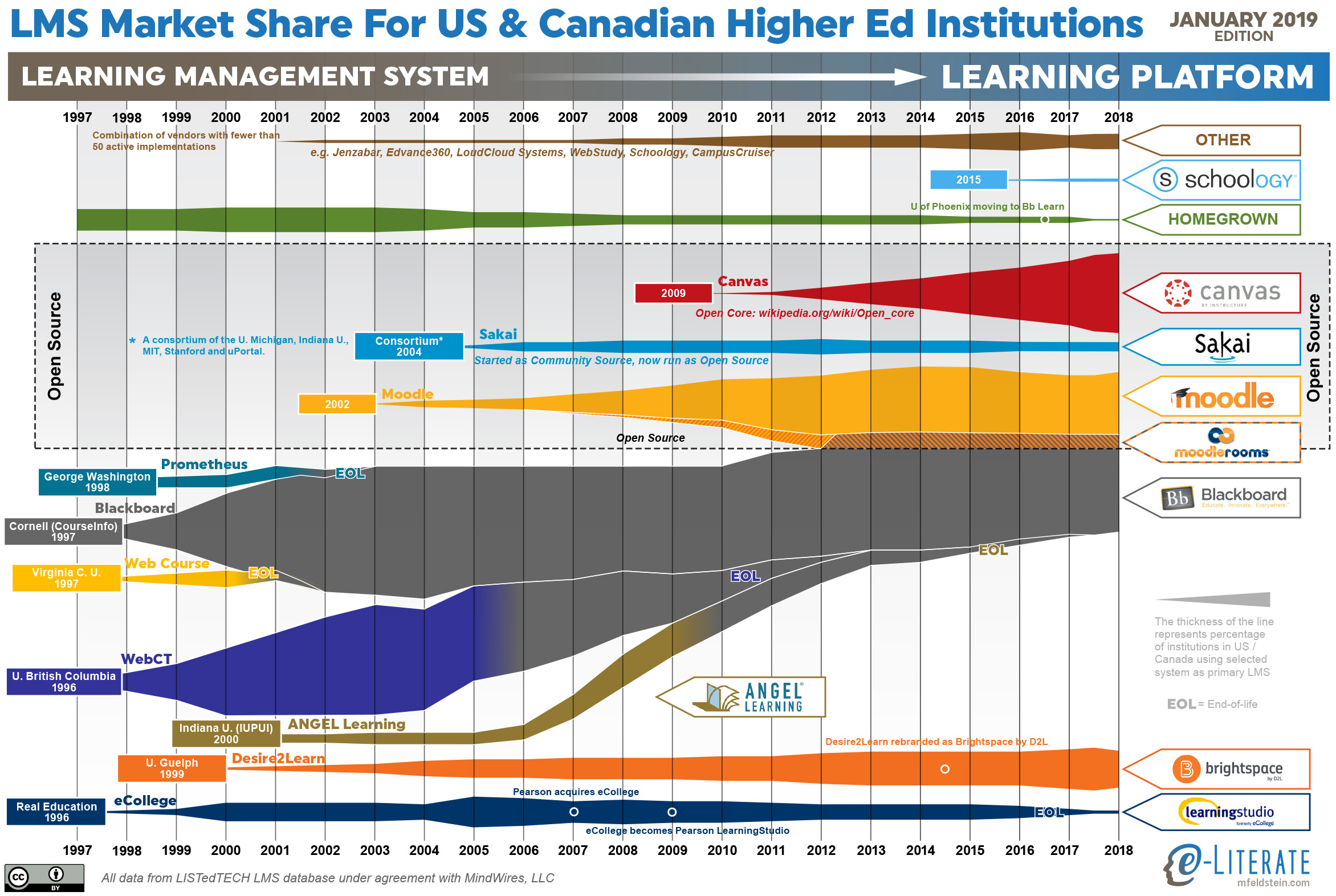
This could be a handsomely profitable business model, particularly if they could hold market share and maintain pricing power. Which brings us to the second leg of their strategy. Blackboard sought to dominate ed tech product categories by buying up every vendor in the category as soon as it reached significant market share. Here’s how that looked in the LMS product category:
In 2000, they acquired MadDuck Technologies, which made Web Course in a Box
In 2002, it was George Washington University’s Prometheus
In 2006, WebCT (which had spun out of University of British Columbia but had been independent for a while)
In 2009, ANGEL Learning from IUPUI
In 2012, after reportedly failing to buy Moodle Pty, the company bought Moodlerooms and NetSpot, the biggest Moodle partners in the US and Australia respectively
The reason that Phil’s famous LMS market share graphic is called the “squid graph” is because Blackboard formed the body by continuously gobbling up competitors as they formed.
In every case except Moodle, Blackboard would kill off the acquired platform after acquisition. They weren’t really looking to acquire technology. To the contrary; they didn’t want the expense of maintaining multiple platforms and showed almost no interest any of the technical innovation until after the ANGEL acquisition, when Ray Henderson started driving some of the product strategy for them. Rather, Blackboard was interested in acquiring customers. They knew that some of those customers would leave—in fact, some of those customers had already left Blackboard previously to the platform that was now being acquired—but that was OK. Because by keeping competition low and competitors under a certain size, Blackboard was really controlling pricing power. LMS license fees were, not coincidentally, significantly more expensive during this period than they are today.
There was one company—Desire2Learn—that represented an increasing threat to Blackboard but would not sell. So Blackboard tried a different tactic, which we’ll come to a little later in this narrative.
Blackboard tried a similar trick of domination through acquisition, somewhat less successfully, in the web conference space by simultaneously buying Wimba and Elluminate, which were two of the largest education-specific web conferencing platforms at the time. If there hadn’t been an explosion of cheap and excellent generic web conferencing solutions soon afterward, it might have worked.
Blackboard did not really consider itself a software development company during this period and was not afraid to say so explicitly to customers. I was told this by a Blackboard representative, and I know of one ePortfolio company that was told the same thing. They started up specifically because Blackboard’s response to them when they asked as university customers if Blackboard would an build ePortfolio was, “We don’t really develop software, but if you know of any good ePortfolio companies, we might consider acquiring one.”
Blackboard did have an internal product development strategy of sorts, albeit an anemic one. Companies understand that it’s easier (and cheaper) to sell a second product to an existing customer than a first product to a new customer. So they often develop a portfolio of products and services to “cross-sell” to those existing clients. In and of itself, there’s absolutely nothing wrong with that. And like many companies, Blackboard had a formula for how many products they needed to cross-sell in order to hit their financial goals. Again, this is pretty standard stuff. The objectionable part was the way in which that formula drove the product road map.
The quintessential example of this was Blackboard Community. Keep in mind that the LMS originated when universities started taking generic groupware (like Lotus Notes, for example) and adding education specific features like a grade book and a homework drop box. Blackboard’s idea was to strip those education-specific features back out of the product and license it separately to use for clubs, committees, and so on. I’m sure it wasn’t quite that simple from a development perspective, but it wasn’t very far off. Take the product you’ve already sold to the customer, strip out some features, integrate the stripped down version with the original version—badly—and sell it to the customer a second time.
Blackboard also had epically bad customer service. Far worse than any of the LMS vendors today. To be clear, there were individuals at Blackboard who worked their butts off to serve their customers. There are always good people at sufficiently large companies. There were people in Blackboard—on their development teams, in customer service, and in other parts of the company—who tried desperately hard to serve their customers well. But the company’s processes were not optimized for customer service, and it did not invest in customer service. One can only conclude that customer service was not a priority of executive management, whatever the line employees may have felt about it.
The patent suit
As I mentioned earlier, Desire2Learn was becoming a thorn in Blackboard’s side. But Blackboard’s management team was developing a legal strategy that they thought would complement their acquisition strategy, especially in cases where pesky entrepreneurs would not sell. They started filing for patents. Now, software patents are an unfortunate reality in our world. I don’t like them, but since they exist, I understand why some companies feel the need to have them. That said, Blackboard’s intentions were neither for defensive purposes nor for demonstrating durable value to investors. They intended to assert their patents against other companies.
In industries like pharmaceuticals or electronics, where innovation takes considerable investment up front but yields significant, long-term profits afterward, the economics can support patent assertion. There is enough money flowing in the system that there is at least a plausible argument that paying the inventor a licensing fee incentivizes investment in innovation. But education is not that sort of market, and the LMS product category in particular has thin margins. If new LMS vendors had to pay patent royalties, there likely wouldn’t have been new LMS vendors.
Blackboard received a patent for LMS functionality, the precise definition of which I will get to momentarily. They immediately asserted that patent against Desire2Learn. They probably expected the company to fold and agree to either pay the royalty or sell. Companies usually don’t fight patents. If Desire2Learn had folded, that would have given Blackboard’s patent added legal weight. And Blackboard had other patents it had filed. There was every indication that they were attempting to create what is called a “patent thicket,” effectively making it impossible to bring a new product to market without running into one or another of their patents. If they had succeeded, they would have owned the LMS market forever.
They would have killed the LMS market.
And what was Blackboard’s first patent? What was their supposed innovation?
A system where a user could log into one course as an instructor and another as a student.
That’s it.
Really.
When I learned enough about how to read a patent to figure that out, I couldn’t believe it. And this is where Blackboard started fighting with me. But it was all non-denial denials. There is a moment in the legal process of a patent fight where the court determines the scope of the patent. Before that, legally speaking, the patent is undefined. So when Blackboard pushed back against my posts, all they were really saying was that the court hadn’t spoken yet.
When the two companies faced each other in court and argued for their definition of the scope of the patent, what did Blackboard argue was the scope of their patent?
A system where a user could log into one course as an instructor and another as a student.
Blackboard didn’t like me writing stuff like that. They—where “they” means specific executives who I choose not to mention by name, rather than some hive mind of every human working at the company—did not like it when I called them out on it in advance. And they really did not like it when I pointed out afterward that they had been misleading at best in their previous statements about what they believed the scope of the patent to be.
What concerned me was that their repeatedly calling attention to my writing by arguing with me in public was irrational. I was relatively unknown until they started responding to me. This kind of regular unforced error was out of character. It was telling me…something. What was it telling me? The most logical explanation was that I had gotten under their skin. I had cause to suspect that they were the kind of people who did not have a high tolerance for being challenged. That could be dangerous.
As long as I was working at SUNY, I was protected. They may have been irrationally focused on me, but they weren’t stupid. They were not about to attack a university employee. However, once I became an Oracle employee, I was concerned that things would get ugly.
I was right.
What ugly looks like
When I was offered the job at Oracle, I had a conversation with my prospective manager about the Blackboard situation. I told him that I thought the patent assertion was a threat to the health of the sector, that I did not intend to stop writing about it, and that it was possible that Blackboard would come after me once I was no longer working for a university. He replied that he respected my right to continue writing as long as I made clear on the blog that my opinions were my own—which I did, scrupulously—but that if the politics reached above a certain level in the organization, then his ability to protect me would have its limits. We agreed that it would be unfortunate if that were to happen, we each understood and respected the other’s position, and we agreed to give it a go. Nothing ventured and all that.
It didn’t take long. I was at a Blackboard reception at EDUCAUSE when one of the executives approached me and started a conversation about my posts. “You know, I wouldn’t complain to Oracle about it. I would never do that. I respect your independence. But this isn’t good for the relationship between our two companies.”
That’s a nice shiny new job you got there, kid. It would be shame if anything were to, you know. Happen to it.
I kept writing.
Not many months after that, the same executive, in the presence of my manager, sat down next to my colleague and started complaining to her about me. Repeatedly. Incessantly. To the point where my manager had to physically interpose himself between the executive and my colleague in order to protect her from what he perceived to be harassment. At which point, the executive started complaining to my manager about me.
It had the opposite of the intended effect. My manager was very protective of his people.
I kept writing.
Not all of the writing was negative, by the way. For example, when Blackboard’s Chief Legal Counsel showed up at a Sakai conference to debate the Software Freedom Law Center’s Eben Moglen on the merits of the patent, I argued both that Blackboard’s representative had been unfairly treated and that it was important to continue to try to work with the company constructively on the larger patent problem if at all possible.
Nevertheless, Blackboard continued what I can only describe as a widening and escalating campaign to convince my employer to either silence me or remove me. They were specifically told that I was unwelcome at Blackboard hosted events. The message was clear: Feldstein is harming Oracle’s relationship with Blackboard. And if that weren’t clear enough, I started being approached by random Oracle employees. The conversation would go like this:
Do you know [Blackboard employee name redacted]?
Yeah, I know him. Why?
Well I don’t, but he just came up to me at BbWorld and started complaining to me about how you’re harming Oracle’s relationship with Blackboard.
That same Blackboard employee accosted me at an IMS meeting, literally yelling at me, telling me that he had almost convinced his bosses to adopt the new version of the LIS standard we were developing—the one that was going to save universities time and money by getting rid of the need to manually monitor the integration between the registrar software and the LMS—but they killed it when they read my latest blog post.
A Blackboard executive all but confirmed this in a later meeting. He looked me in the eye, with my manager present, and asked, “Why should we adopt Oracle’s standard?”
“Oracle’s standard.”
I kept writing.
Next, the Blackboard executive decided to go up a few levels in the food chain. He told my manager’s manager’s manager that he was having Blackboard customers coming into his office in response to my blog posts and asking why Oracle hates Blackboard. This intervention too had the opposite of the intended effect. My manager’s manager’s manager did not believe for one second that people were confusing my personal blog posts with Oracle’s official position on Blackboard.
After all of that, and some more that I’m not going to write about here, Blackboard lost the patent suit. They took a $3.3 million write-down for it. But that’s nothing compared to the actual loss, which the company is still paying today. If people are still using the sentence “X is the new Blackboard,” do you think there is any way that Blackboard itself is not still paying for the damage done by management that left the company seven years ago? Many people in this sector still hate that company with a fiery passion, and some of them don’t even know why anymore.
Now, ask yourself this: Does what I just described bear any relation to the behavior of any company that you know of in ed tech today? Instructure? Blackboard? Anyone? I can think of a few that I would characterize as on the spectrum of bad actors. All of them are in immature product categories, where there is less transparency, more hype, and therefore more room for con artists. Jose Ferreira from Knewton was a bad actor in that he harmed our ability to have a productive discussion about the utility of adaptive learning or machine learning through his unsubstantiated hype (and the fundraising he did off it). But he didn’t do anything I’m aware of that rose to the level of anything like what I’ve described here. The robot tutor hype scam, and the new variation where vendors start claiming that all their competitors are robot tutor scam artists, are the main dangers at the moment. Anything AI-related still has some danger in it, as does the OPM space. But the bad actors I can think of are mostly little league compared to the Hall of Fame bad actors at old Blackboard.
Instructure is the new Instructure
Organizations change. Instructure changes. Blackboard changes. Your university changes. Your department changes. Change happens. Change is hard. Mistakes happen during the stress of transition. And what comes out the other side is not always predictable. But it often can be influenced.
When I wrote my post in the wake of Instructurecon 2018, I knew that it might not make a ton of sense in the moment to either customers or employees of the company. So a lot of it was written in a way that would hopefully be memorable…I don’t know…maybe eleven months later, when the story had played out enough that we could have a real conversation about it.
Here’s the important bit:
Instructure’s unbelievably long age of innocence may finally be coming to an end. That doesn’t mean that it is going to fail or to become the next ed tech company that everybody hates. It does mean that it is beginning to go through some changes, that some of those changes will be awkward and hard, and that the company will eventually grow up to become somewhat different than it has been. Not necessarily better or worse. But necessarily different.
So maybe you don’t like some of the things that they’ve been doing (or not doing) lately. Now what? You could try engaging with them. OK, maybe you tried that and didn’t get the results you wanted. Remember that extended metaphor about the awkward teenage years in my original post? I used to teach eighth graders, and I’ve raised kids of my own. One talk usually doesn’t do it during the challenging periods. Not because they don’t care about you, but because it’s just really hard being a teenager. You’re overloaded. Everything is changing at once, and you’re just trying to get through the day. If a teenager responds badly in the moment, it doesn’t mean that they’re a bad person, or even that they’re not listening. It usually means that they’re dealing with more than just you.
A company isn’t a teenager; it’s a group of adults who you pay to do things for you. Nevertheless, it is also a group of humans who can experience change, individually and collectively, and who can have all the reactions that humans do to change and stress and all that stuff.
These organizational transitions don’t finish up over night. Dan’s been CEO for less than a year now. Next month will be his first Instructurecon as CEO. He’s still in the steep part of his learning curve. Will he be a good CEO? I don’t know. I barely know the guy. You probably barely know the guy too. His employees are starting to get to know the guy by now. They’re figuring it out.
Maybe you feel like you can’t engage with Instructure because other people in your university “own” that relationship, and you’re relatively powerless.
Well, that’s a different sort of problem, isn’t it? I’ve written before about how bad LMS vendor behavior and bad LMS product development are actively driven by bad university LMS procurement processes. These internal conversations are hard ones to have, and sometimes the people who see the problems are not in a position to force the conversation. But ultimately, the vendors have to respond to whatever sorts of interactions the universities invite them to have (or don’t). It’s worth taking some time to understand why the vendors are thinking and acting the way they are so that you can find some productive ways into the conversation.
And by the way, those vendors do read what you write. Heck, we live in an era where we pick the President of the United States on Twitter and Facebook. You think these companies don’t read your posts? They damned well do. They may be constrained in how they respond, but they do pay attention. How do you think I do what I do? I’m just a dude with a blog. How did I get myself into all the trouble you just read about? By being a dude with a blog. Turns out that using your voice can be a powerful thing, particularly if think carefully about who you want to hear you and how you want them to react. Yes, I do beat on vendors in public sometimes. But I always do it with a specific intention to make something happen. It may not be obvious in the moment, but it is always there. You can talk to these vendors and be heard, particularly if you have that intentionality and if they think that you are also listening.
If you want your vendors to be better, it’s not that different from trying to get your kids to be better, or any humans with whom you want to have a genuine relationship to be better. That was really the point of my original blog post. Talk to them, listen to them, engage with them. It doesn’t mean you have to let them walk all over you, but it does mean you shouldn’t assume you understand what they’re thinking or that they are force of nature that cannot be influenced. If you’re reading e-Literate, then you’re probably an educator of some sort. Be an educator. Use that.
Instructure is changing. I don’t know what they’re changing into yet. You don’t know either. I would bet money that Instructure doesn’t know yet. And this isn’t really just about Instructure. They are the case study of the moment. The point is, vendors make their money by responding to the conditions created by the university ecosystem. That’s you and your colleagues. If you want better vendors, then create the conditions under which they can succeed by behaving in the ways in which you would prefer them to behave. That’s hard work, and it may involve some family therapy inside your home institution. But the alternative is living in perpetual fear of clowns. And that, my friends, is no way to live.
It’s common knowledge that Instructure has shifted its focus to place more emphasis on its growth in corporate learning markets than in the educational markets that have fueled the company growth to date. We covered the initial news about their introduction of the corporate learning LMS, Bridge, four years ago.
While Instructure has excelled on maintaining product focus and simplicity of user experience, this move outside of education raises the question about whether they can maintain company focus. The corporate market is very different than the education market – different product needs, fragmented vendor market, different buying patterns. Many companies have tried to cross over between education and corporate learning, but most have failed. Blackboard, D2L and Moodle have made a footprint in the corporate space using one product for both markets. Instructure’s approach is different.
As noted, the other Big Four LMS vendors are also targeting corporate learning (or professional ed, or workplace, pick your name). D2L and Blackboard are using the same platforms in both markets (Brightspace for D2L, Learn and Open LMS for Blackboard), while Moodle released Workplace, a set of plugins on top of core Moodle. Instructure, however, has different products for educational and corporate markets.
That is old news. What is more interesting is to understand Instructure’s emerging strategy given the new executive team. Thanks to the nature of Instructure being a publicly-traded company, we are getting more insight that should set expectations for educational customers. As CEO Dan Goldsmith said during an investor conference a week ago:
We really changed the company, as I came in nine months ago and then took over as CEO January 1st of this year. We’re initiating the second chapter in the journey of Instructure.
I should first note that the audience for these calls is the investment community, so naturally Instructure executives focused more on financial performance and projections that they would in academic meetings. But there is a lot to learn here.
In some ways, the changes to operations of Instructure are welcome and are already helping them manage corporate finances. In other ways, however, that second chapter reads a lot like Blackboard. Moving beyond the LMS, willing to bet on corporate acquisition, expecting big focus on data and analytics, and continuing challenges in completing products.
Operational Improvements
One of the ongoing criticisms of Instructure, particularly by their competitors, is that they continue to lose money and are buying growth. While these observations are accurate, as long as Instructure keeps growing, they have never been at risk of running out of money or having their losses significantly impact their operations. Under the new leadership, Instructure has been much more aggressive in managing expenses, with a big milestone described on the conference call by CFO Steve Kaminsky [emphasis added].
Turning to the expense side. With our focus on operational excellence during the second half of 2018, we’ve changed the mindset of our leadership team and the entire organization about how we approach the business and fund investment. We focused on disciplined investments for balancing profitable growth has been put in place and is reflected in the outlook we provided today. On the cash side, we have a strong cash position to support our important strategic objectives for both Canvas and Bridge. And looking forward to 2019, we anticipate being approximately free cash flow neutral for the full year.
Beyond simple finances, we have seen some operational changes for international operations as well. The global regions (EMEA, Latin America, APAC) all have more autonomy now, including control over country-specific marketing and product management. The non-US operations have moved beyond being regional sales and support offices into more aggressive engines of growth. In Europe and other regions, the management team has more autonomy is deciding which countries are worth investment for expanding markets, and when. From the Feb 25th investor presentation:
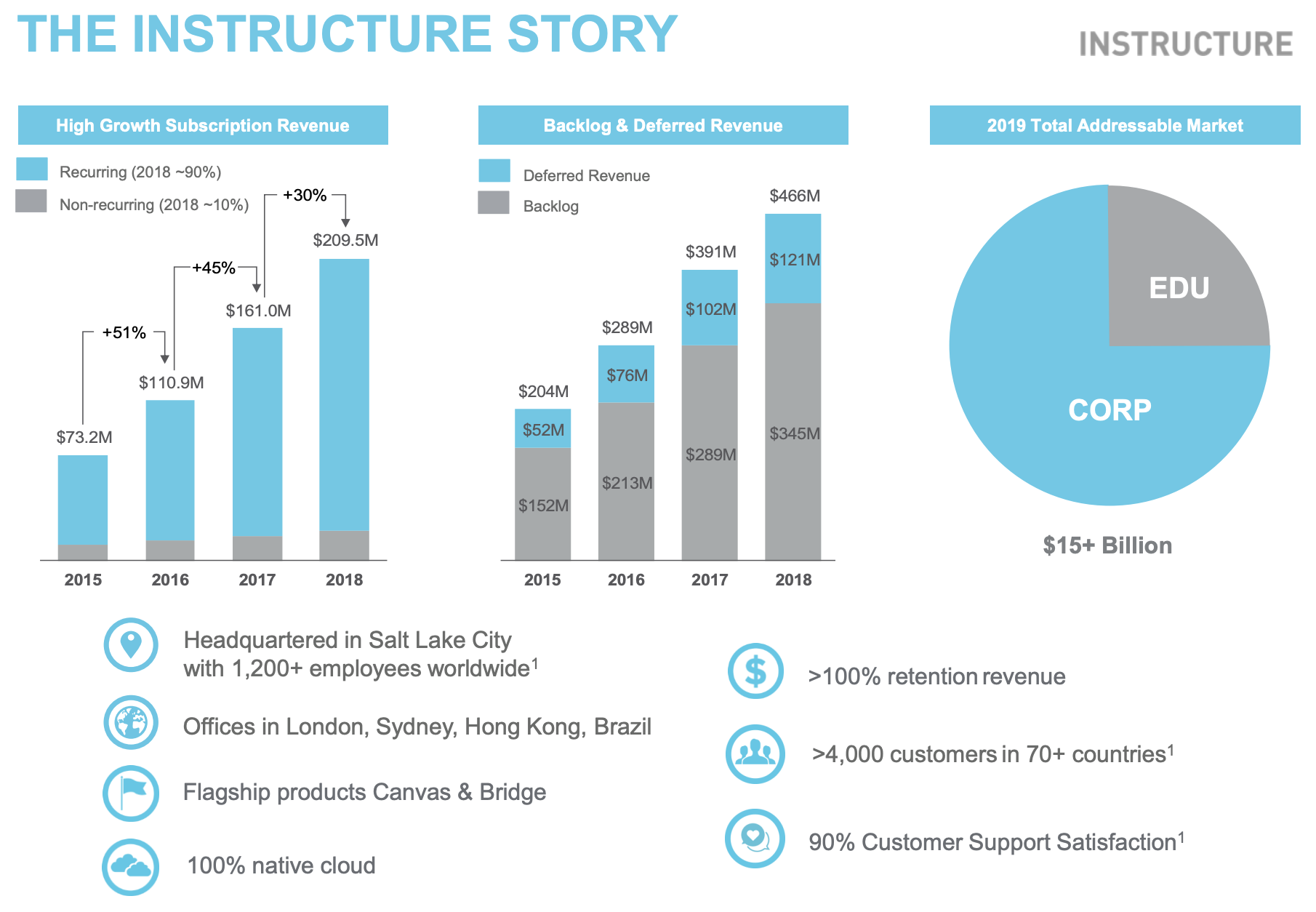
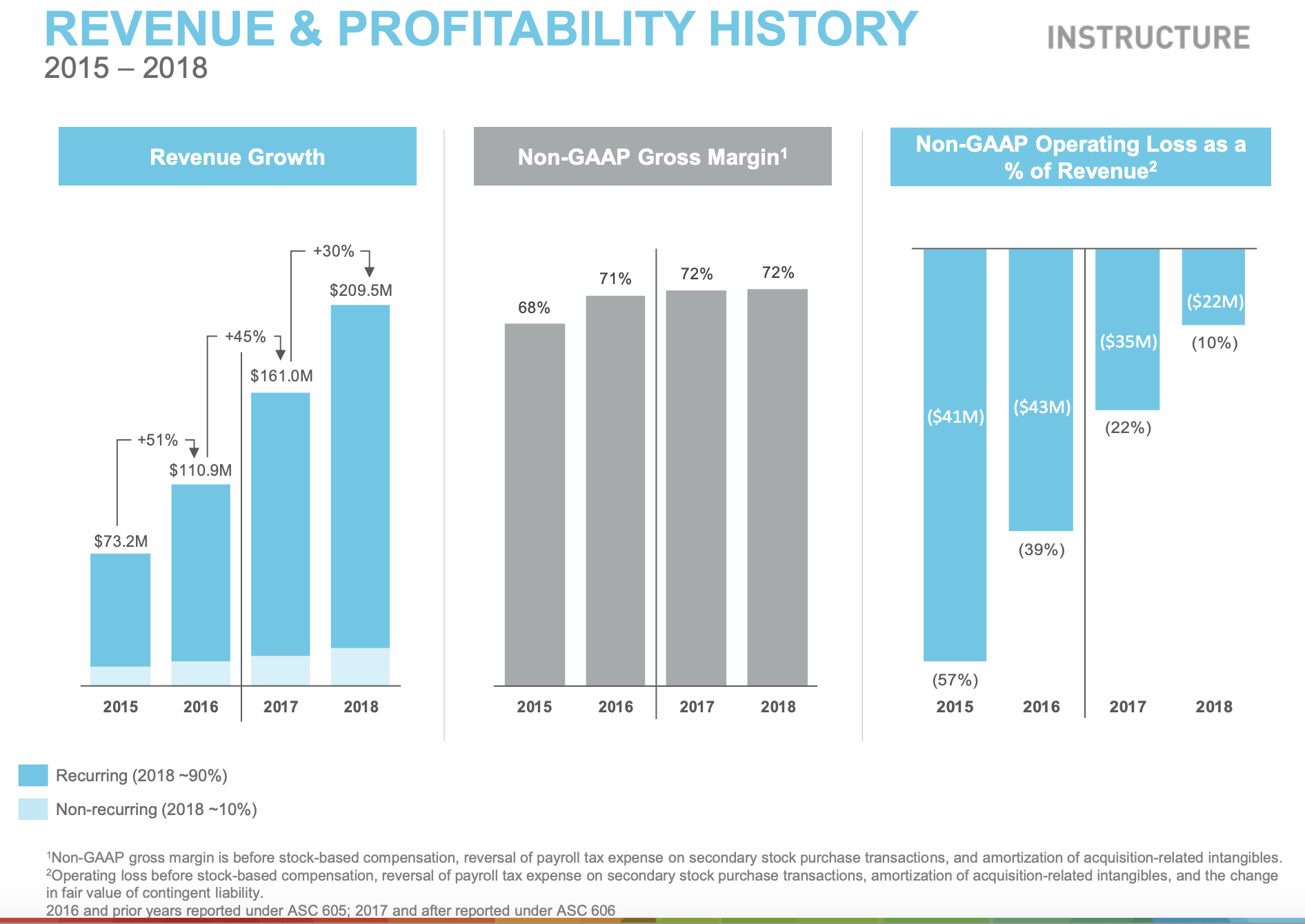
With the improving operations, Instructure has reduced their operating losses from 57% of revenue to 10% of revenue in the past three years.
Moving Beyond the LMS
On the same day as Instructure’s earnings call and release of FY2018 financial results, the company announced the acquisition of Portfolium for $43 million, a small startup focusing on “ePortfolio network, student-centered assessment, job matching capabilities, and academic and co-curricular pathways”. We interviewed Instructure staff the same day as the earnings call and noted a different message. In our initial call, the Portfolium acquisition was positioned primarily as a way to improve how Instructure can handle structured assessments in the education market – think CBE, mastery learning, with ePortfolios not as the goal but as the necessary infrastructure. During the earnings call, however, the positioning was more about bridging educational and corporate markets and expanding total addressable market (TAM).
Today, we’ve taken a great stride towards enabling that transition with our expected acquisition of Portfolium, a successful long time Canvas partner. Portfolium vision is to help each person realize their full potential by connecting learning with opportunity, through e-portfolios, program and course level assessments, career pathways and by matching students to job opportunities. Portfolium will join Instructure with a wealth of shared customers, such as Virginia Tech, Santa Clara University and Swinburne University in Australia. This acquisition is a great match in vision and culture and represents our first major step into the Student Success market. And while Portfolium’s current offerings provide an excellent solution, more importantly, they establish the first Bridge between academia and the corporate world that aligns precisely with Instructure’s vision.
Instructure now views itself as a company with a suite of products, and they are much more open to using corporate M&A to build this portfolio.
Emphasis on Data & Analytics
The second initiative announced on the earnings call was DIG, a strategic move with data and analytics.
I am also pleased to share with you an early insight into our second growth initiative focused on analytics, data science and artificial intelligence. The code name for this initiative is DIG. And this technology platform combined with the most comprehensive SaaS database on the educational experience uniquely positions us to deliver meaningful value to our customers. And from a growth perspective, DIG has the potential to double our TAM in education.
Instructure started ramping up their data and analytics efforts (again) about a year ago, although the focus was described at the time as being about internal analytics – that is, making Canvas a better and more valuable LMS product. From what I have heard the product validation for DIG are consistent with this message – dashboards, surfacing useful data within a workflow, etc. But that was not how DIG is being sold during the conference call [emphasis added].
We’ve been working on the scaffolding for [DIG] for well over a year now. I mentioned in our remarks that we already have product validation towards out there in the market. We have instructors and students consuming output from some of the initial experiments with DIG. And we anticipate later this year obviously to make more announcements around specific products and offerings and how we bring them into the market. DIG ultimately is a platform first and foremost based upon machine learning and artificial intelligence. I believe that any multi tenant SaaS company born in the cloud has the opportunity once they hit a certain market share. And in fact, it may even be incumbent upon those organizations to partner with the industry and evolve that industry with new insights and predictive modeling using AI and ML. That’s what DIG is at its heart.
This is brand new behavior for Instructure as a company. Previously the company was reticent to talk much about non-released products, but now they are talking not just about a new initiative, they are touting buzzwordy machine learning and artificial intelligence and predictive modeling well before any of those capabilities exist or are in customer hands. Goldsmith further clarified the DIG plans during the investor conference discussion [starting at 9:00, emphasis added].
We already have analytical capabilities in our Canvas platform. I want to be really clear and delineate the difference between an analytics and reporting capability, and a machine learning and AI platform. [snip]
We have the most comprehensive database on the educational experience in the globe. So given that information that we have, no one else has those data assets at their fingertips to be able to develop those algorithms and predictive models.
Goldsmith then described an example of predicting a student’s expected performance in a class and how that prediction reliability goes up over time. Then we get the vision.
What’s even more interesting and compelling is that we can take that information, correlate it across all sorts of universities, curricula, etc, and we can start making recommendations and suggestions to the student or instructor in how they can be more successful. Watch this video, read this passage, do problems 17-34 in this textbook, spend an extra two hours on this or that. When we drive student success, we impact things like retention, we impact the productivity of the teachers, and it’s a huge opportunity. That’s just one small example.
Our DIG initiative, it is first and foremost a platform for ML and AI, and we will deliver and monetize it by offering different functional domains of predictive algorithms and insights. Maybe things like student success, retention, coaching and advising, career pathing, as well as a number of the other metrics that will help improve the value of an institution or connectivity across institutions. [snip]
We’ve gone through enough cycles thus far to have demonstrable results around improving outcomes with students and improving student success. [snip] I hope to have something at least in beta by the end of this year.
Wow. Robot tutor in the sky – meet the new kid on the block.
The most generous interpretation I have is that they are being sloppy in their terminology and casually throwing out machine learning and AI to eager investors, while the reality could be more mundane but useful sharing of useful data to help instructors or administrators.
If I had to guess, however, I would suggest that Instructure has its sights set on additional corporate acquisitions over the next year or two to try and back up these expectations. I hope they realize they are not the first company to believe that AI on top of their best-in-world data will deliver success for all.
The message is also clear that Portfolium and DIG are intended to increase TAM. This means separate product categories with separate pricing in addition to Canvas. Either that or offering Canvas at different pricing levels to include add-on product bundles.
Challenges in Completing Products
We noted the modernization efforts behind Quizzes.Next, the next generation quizzing and test engine for Canvas, as well as the big schedule miss. In short, Quizzes.Next was announced at InstructureCon 2016 as being available within a few months. 12 months later at InstructureCon 2017 it entered limited beta, and at InstructureCon 2018 it entered general availability. But the story is not over. Quizzes.Next is still not at feature parity with the original quiz engine, as noted by Indiana University.
Instructure has released a new quizzing tool for Canvas called Quizzes.Next. Quizzes.Next offers several new features and question types, but is missing many features from the current Quizzes tool on which many instructors depend. Both tools will continue to be available until Quizzes.Next has achieved feature parity with Canvas Quizzes. The original Canvas Quizzes tool will eventually be retired, but Instructure has not yet announced the timeline.
If you read the Canvas Community page comparing features, it is clear that feature parity is not imminent. The transparency is impressive, however, and from what we are hearing customers are still giving Instructure some leeway because of trust. But Quizzes.Next and its delivery is a continuing problem, not least of which is the reduction in R&D spending growth for Canvas, described by CFO Steve Kaminsky on the call.
Regarding the R&D investment, we don’t really break that out. But what we can tell you qualitatively is while we are doing some incremental investments on the Canvas side and DIG is a good example of that, the lion share of the growth in R&D is going into Bridge.
What to Expect
Instructure is at a crossroads. While they continue to grow, especially in education markets, and while they report improving financial performance, Instructure is entering uncharted territory (for them) in this second chapter. It is remarkable that they have not lost a major educational LMS customer in the 8+ years since Canvas was first selected by the Utah Education Network, but there are some warning signs that should not be ignored and some risky expectations being set.
In last week’s post on Blackboard, I shared the roughly linear progression of migration of the Learn LMS to a software-as-a-service (SaaS) model – a move that we believe is more important than is the Learn Ultra user experience. If you take into account percentages of total Learn deployments, you see that Blackboard has roughly 25% of Learn clients on SaaS after starting in late Fall 2016, increasing by approximately 10% per year. ((Each point is taken from Blackboard public release of information either directly to us at e-Literate or in press releases.))
Blackboard is not the only LMS company migrating to the cloud, however, and D2L ((Disclosure: D2L and Blackboard and Instructure are all subscribers to our LMS Market Analysis service.)) has taken a more aggressive bet on SaaS for their Brightspace LMS platform (also based on AWS), as described in Summer 2018.
While we heard grumblings from multiple clients during the transition – especially through early 2017 – D2L clearly made some hard choices and and is aggressively moving to the cloud, not just as an option, but as their primary delivery model. According to David Koehn, VP of Product Management at D2L:
All new Brightspace implementations are on AWS cloud;
Virtually all current Brightspace implementations use Continuous Delivery; and
Approximately 50% of current customers are already on the AWS version of cloud deployment; and
By the end of 2018, a large majority of customers will be on cloud deployment.
Last Fall I spent time at D2L’s Kitchener, Ontario headquarters getting an update on the company’s progress on a number of initiatives. D2L executives described that all but roughly a dozen Brightspace clients are now on SaaS deployment, and by the end of 2019 they should be fully a SaaS platform company.
Why is percentage of total deployments important? Two reasons are that the move to 100% SaaS deployment enables the movement to a single version of code, dramatically simplifying regression testing and enabling more rapid development of new designs, while also taking advantage of modern technology stacks. As described in the Summer 2018 post:
David Koehn also pointed out that the real driver for the AWS cloud move by D2L is to enable a redesign of the user experience [branded Daylight] and to provide improved scalability and reliability. In other words, the cloud deployment is a means to the Daylight end.
The downside, of course, is that pure SaaS deployments largely leads to a reduction in customization capabilities. Companies like D2L and Blackboard that are moving from an enterprise model to a cloud model are betting that they can build in appropriate configuration options (rather than customized code) and leverage third-party integrations to overcome this challenge. But to get the full advantage of SaaS, a company needs to do the entire move.
I further spent some time in London and had the opportunity to talk with D2L’s London-based leadership team that covers EMEA and Latin America regions. D2L leaders in London presented a transparent and honest appraisal of the company’s current market position in Europe and Latin America, and where they see the biggest opportunities. For starters, D2L acknowledged that Instructure’s system-wide wins for the Canvas LMS in the Nordic countries had largely blocked opportunities for expansion in that region. Other areas, however, have been much more promising. They are doing well particularly in the Benelux countries (Belgium, Netherlands and Luxembourg) with Ghent University in Belgium being an example of a recent, large (45,000 student) implementation. There have been important wins in the UK and Ireland, and activity in Spain seems to be picking up some momentum. Germany continues to be a challenging place to get a foothold partially due to university funding that favors in-house staff maintaining open source systems.
In Latin America, D2L was open about cutting back investment in the region in 2017, particularly in Brazil, largely due to economic uncertainties and limited growth opportunities. They now see activity picking up in the region and have been investing to take advantage of the market potential.
In both Europe and Latin America, the provision of professional services beyond the LMS platform, as well as willingness to add requested features, appears to be a differentiator for D2L, especially in comparison to Instructure. D2L has shown a much greater willingness to roll up their sleeves and collaborate on instructional design, course building, and online pedagogy using internal staff, almost in an Online Program Enablement model. It surprised me during my Fall HQ visit to see just how well-established is the content creation team that helps schools redesign courses and even design front-end web sites for online programs. We have heard similar messages from D2L customers and even from a consulting firm that works directly with Canvas and Brightspace customers.
To a degree, none of this post is different from our Summer 2018 coverage other than updating on progress, so why has D2L not made more of a market share increase in the past year? I suspect there are three reasons. One is that D2L has done a better job updating their product line and introducing new services than they have done in fixing issues with current customers, particularly around data and analytics. During my Fall HQ meetings, when the D2L team was describing their new data and analytics approach called the Brightspace Data Platform, I pointed out that while this appears to be an improved approach, it does not acknowledge that D2L has been touting its data and analytics capabilities for years. There are leftover frustrations from customers based on previous attempts that did not match client expectations.
The second reason is Instructure. While D2L is in a solid second place for new implementations worldwide (schools migrating from one LMS to another), they have also lost a number of clients in North America – almost all to the Canvas LMS. In our recent LMS Market Analysis report, we showed a transition graphic with higher ed LMS migrations from 2017 – 2018.
The third reason is that it is very difficult to be a third competitor in terms of customer mindshare. The academic LMS market has tended to have a narrative of a major competitor and an upstart. Blackboard and WebCT in the early and mid 2000s, Blackboard and Moodle in the late 2000s, and Blackboard and Canvas through much of the 2010s. It is difficult for a company like D2L to break through this narrative and be top of mind for institutions from day one of an evaluation.
While D2L has challenges in market position and introduction of a new data and analytics approach, they are completing the transition to a SaaS platform company and focusing on flexibility and services.
This is the eleventh year I have shared the LMS market share graphic, commonly known as the squid graphic, for US and Canadian higher education. This past year we at e-Literate shifted our LMS Market Analysis reports from Spring / Fall to Mid-Year / End-of-Year to better allow analysis of entire years. With the release of our end-of-2018 report last week to subscribers, it’s time for us to look at updates on the institutional LMS market for North America (US and Canada) higher education. Note that our coverage for the market analysis includes Europe, Latin America, Oceania (Australia, New Zealand, and surrounding island countries) as well as emerging coverage of the Middle East.
We present the following data “by institutions”, with market share as a percentage of the total number of institutions using each LMS as a primary system, and “by enrollments”, where we scale the institutions by its total enrollment. The latter better captures the business of the LMS market, since most licensing deals are based the number of students.
But first, let’s look at an updated LMS market share graphic, commonly known as the squid graphic, for US and Canadian higher education. The original idea remains – to give a picture of the LMS market in one page, highlighting the story of the market over time. The key to the graphic is that the width of each band represents the percentage of institutions using a particular LMS as its primary system.
This year there are two inter-related trends that deserve a broader explanation -the LMS market slowed down with less activity overall, and Canvas and Blackboard continue to be neck-and-neck in the top spot of this market.
We recently described the overall market activity slowdown in that there are fewer LMS formal evaluations taking place since mid 2018, with initial data pointing to a 20 – 25% drop from a year earlier. This slowdown seems to be a type of plateau rather than a continuing trend, and we are watching to see if it is temporary or not.
Last summer we shared the symbolic passing of the torch where Canvas surpassed Blackboard in US market share, which was the first time Blackboard was not the top system since the market emerged two decades ago. What is interesting is that half a year later, the two systems are still neck-and-neck. In the US Canvas is still slightly ahead, and in North America (adding in Canada), Blackboard remains in the top spot by 0.4% (26.8% to 26.4%). Why is Canvas not continuing to extend its lead? Looking at the underlying data, there seems to be three reasons to consider:
The overall market slowdown means that there are fewer deals for Canvas to win lately.
Blackboard continues its University of Phoenix implementation, which still includes dozens of campuses despite its enrollment drop.
The shutdown in December of the for-profit Education Corporation of America (Virginia College and Brightwood College systems) meant that Canvas lost several dozen campuses.
The latter two points should fully play out in the next three months, possibly making this a one-time change in trends, but it is important to call this situation out.
Some other notes:
The market continues to consolidate around the Big Four – Blackboard, Canvas, D2L Brightspace, and Moodle.
The Homegrown option for LMS usage is going away, at least in a statistical sense. Only a handful of schools even consider this option.
D2L shares the challenge of having picked up several large for-profit systems that are closing campuses and therefore hurting market share. In D2L’s case, the biggest one is the former EDMC schools – the Art Institutes, Argosy University, and South University – that were sold out of bankruptcy to a non-profit entity and have closed dozens of campuses over the past year. These losses offset many of D2L’s wins in 2018.
Moodle had a few new wins in North America.
Sticking with North America, we can also show LMS market share scaled by the enrollment of each institution, giving a different measure worth considering.
We’ll share more information on other global regions in the coming months.
Assuming [new Instructure President Dan Goldsmith’s] trial period goes well, I think it likely that he will be promoted to the top job within 9 months. The reason I pick this time frame is anything too close to InstructureCon 2019 poses the danger of being a distraction during the most important event of the year for the company.
Today at 4:00 PM ET, the company announced,
Instructure, Inc.(NYSE: INST), a leading software-as-a-service (SaaS) technology company in education, learning, and employee development, today announced that the Board of Directors has appointed Instructure President, Dan Goldsmith, as Chief Executive Officer, effective January 1, 2019. On that date, Josh Coates will transition from his role as CEO to Executive Chairman of the Board. Goldsmith has also been appointed to the Board.
So the transition actually happened a little less than three months after Mr. Goldsmith’s Big Top début. Instructure is not wasting any time.
In my original post, I wrote about Dan’s coming on board as part of a larger set of changes that the company is going through. I referred to the company as entering “those awkward teenage years” because it is in the beginning of a transition to becoming something else:
Instructure’s unbelievably long age of innocence may finally be coming to an end. That doesn’t mean that it is going to fail or to become the next EdTech company that everybody hates. It does mean that it is beginning to go through some changes, that some of those changes will be awkward and hard, and that the company will eventually grow up to become somewhat different than it has been. Not necessarily better or worse. But necessarily different.
We tend to write a lot about the short to medium term changes—the “adolescence” in this case—because one of our primary audiences is the group of folks at colleges and universities who may see changes in the behavior of a vendor that they depend on and need to understand the drivers behind those changes in order to make good decisions for their institutions. And those changes, in turn, are at least partially driven by finance and markets and other business stuff. As I write this post, we are less than an hour away from Instructure’s quarterly earnings call. Many of the people listening to that call are concerned, not because the company is in financial free fall, but because it might not grow as quickly in the next couple of years—or even in the next couple of months—as it has in the past.
The pathology of investor short-term thinking is, unfortunately, part of what university folks need to understand in order to understand the behavior of these companies. That said, while we’re going to continue writing about the short and medium term, Phil and I are going to take a step back from the serpent-eating-its-tail obsession with quarterly performance and write some pieces about the long-term prospects for the LMS, both as a product category and as business. Neither of those aspects are a static as they appear to be. In fact, while some of the behaviors of the various providers are motivated by those short-term demands of the markets, others have to do with tectonic shifts that aren’t yet obvious but may be far more consequential in the long run. The LMS continues to have a future, and it’s a surprisingly interesting one in some ways. We’ll have more to say about it in the coming weeks.