e-Literate

Present is Prologue

Tag: Instructure

  • North American Higher Ed LMS Market Share by Enrollments: A consolidating market

    North American Higher Ed LMS Market Share by Enrollments: A consolidating market

    We have published market share data measured by total institutional enrollment instead of institutional count in several posts at e-Literate over the years, within the twice-annual reports of our LMS Market Analysis service, and for several of our premium subscribers of the same service. In July of this year we reported that Canvas had overtaken Blackboard as the market leader in US higher education in terms of institutional adoptions as well as scaled by enrollment. These last two posts got a fair amount of media and vendor attention.

    What we have realized, however, is that we have not made this information on market share by enrollment easy to access in one place. LMS company revenue tends to be based on the total enrollment of adopting institutions, thus this enrollment-based measure provides a more direct connection to company finances. Given the increased importance of LMS provider business models and revenue to the future trends of the market, we are sharing the information more broadly.

    In this view below we share North American (US and Canada combined) total enrollment for LMSs that are primary – that is, available for the entire institution. Total enrollment in this case means the institutional student count, but it does not imply that all students at that institution actually have courses using the LMS (see comment below from John Fritz). It is important to note that during an LMS transition there is often a period of time (6 – 18 months) where two systems overlap, with both available to the school. Therefore the total market share enrollments will be somewhat higher than actual total enrollments, as a subset of LMS-transitioning institutions will be counted twice.

    You can download a spreadsheet version here.

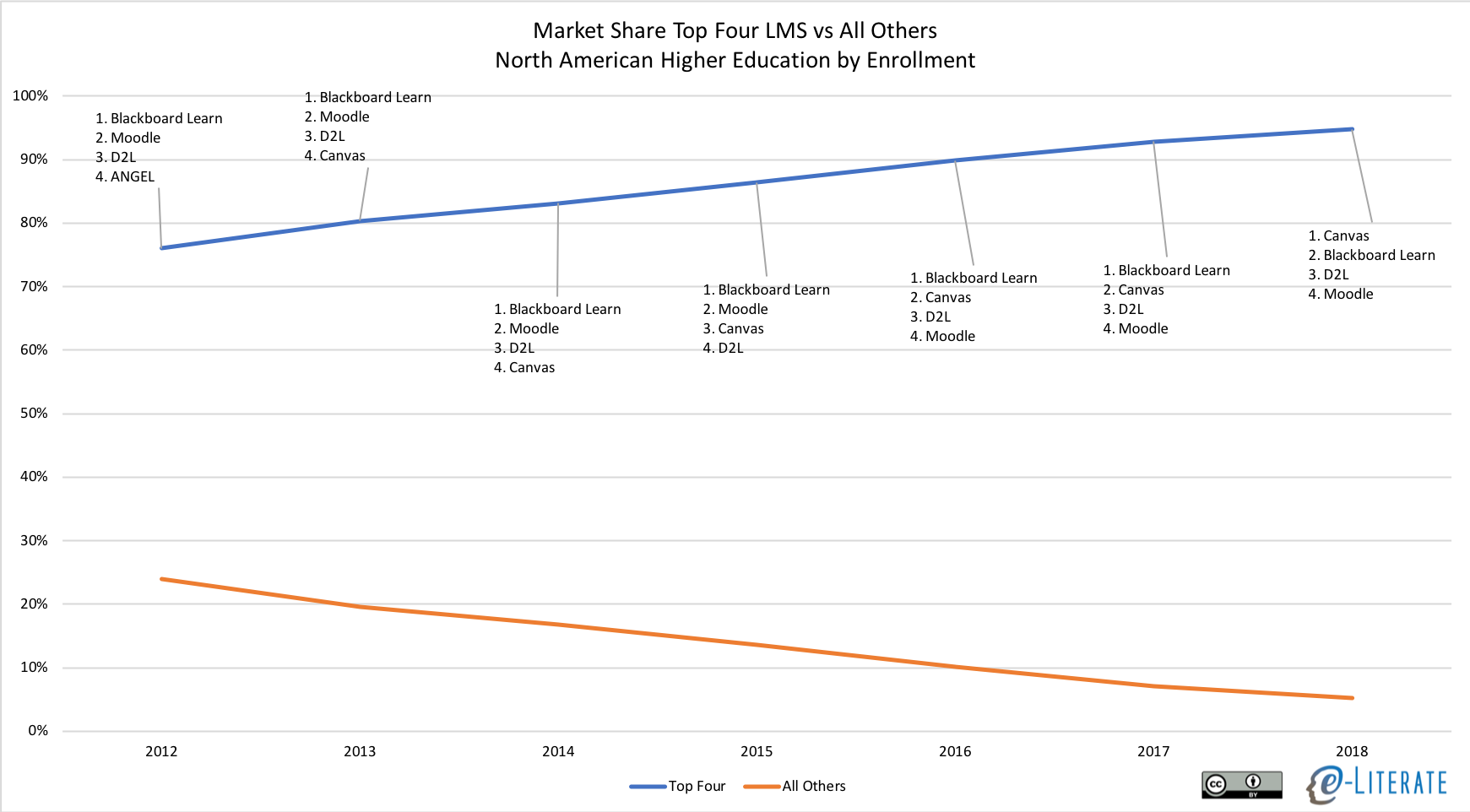
    LMS Market Share by Enrollment NA HE

    Some notes on the data worth considering:

    • Canvas has not just surpassed Blackboard Learn in this updated view, 35% to 33% – it has also expanded its lead as the most-adopted LMS in North American higher ed markets (while Moodle has clear lead worldwide in total installed base).
    • D2L Brightspace has been in third place for NA HE markets since 2016 when viewing by enrollments.
    • Moodle is fourth and has been dropping in recent years.
    • The top view of total enrollments adds in the effect of changing enrollments – both at a national level and an institutional level.
    • In the past five years, the LMS Market for North American higher ed has become increasingly dominated by “the Big Four” (Instructure Canvas, Blackboard Learn, D2L Brightspace, Moodle) for institution-wide adoptions; the aggregate market share of year’s top four systems moving from 80% to 95% in past five years.

    This last point deserves more analysis. There are other systems gaining new institutional clients (think Schoology here, or think CBE-specific platforms like Motivis), but they are mostly picking up either small schools or being adopted for specific programs and not for the entire institution.

    Consolidation of NA HE LMS Market

    Expect more coverage as we enter ed tech fall conference season.

    Update 8/3: Added sentence in third paragraph to clarify usage of total enrollment terminology.

  • What’s Important about the Blackboard Market Share News

    My last post on Canvas’ US market share surpassing Blackboard’s predictably got a fair bit of attention, including some follow-up press elsewhere on the internet. There were a few comments to the press made by Blackboard executives and industry experts that merit some further examination.

    But let me start by being crystal clear about one point: In and of itself, the fact that (by our count) Canvas now has two more primary systems than Blackboard Learn in the US market, is purely symbolic. It has historic significance for those of us who have been long-time watchers (or sufferers) in the LMS market. But if Blackboard’s number were ten higher or ten lower, it wouldn’t change the big picture.

    The more important question is this: If the crossing of the lines is purely symbolic, then what is it symbolic of? What actually matters about this story to colleges and universities, and why?

    Let’s see if we can separate the signal from the noise by working our way through a couple of well-sourced articles and the commentary that they contain.

    First, there’s Lindsay McKenzie’s piece in Inside Higher Ed. She chased down a number of customer reactions. Some of these were the usual pile-on of “we hate these guys and we love those guys.” ((See the comments on my original post; LMS personal commentary tends to be just a few steps removed from primal scream therapy. I’m not judging; just observing.)) But she also got an interesting pricing anecdote, which is helpful given how opaque LMS pricing tends to be:

    Now that Canvas is the “hot product,” Instructure has been trying to aggressively increase its fees, said [Emporia State University’s Rob] Gibson. A 5 percent increase per year for such services is not unusual, but Instructure has been asking for more. Gibson said his institution has had to push back against further increases.

    Blackboard, on the other hand, was “desperate to keep us,” said Gibson. They offered a 50 percent discount to stop Emporia from making the switch. “I think they could see the writing on the wall,” he said.

    Customers take note: Blackboard’s change in fortunes may affect the behavior of all the LMS vendors.

    The article also has a quote from Lou Pugliese who, in addition to being a current senior innovation fellow at ASU and CEO from Blackboard’s early days, was CEO of Moodlerooms when Blackboard acquired it. In other words, he knows something about the LMS market. He raised an interesting question:

    Pugliese said that the statement that Canvas is “now the primary LMS in more U.S. colleges and universities than Blackboard Learn” is misleading. “The real measurement metric should be akin to website traffic. Statistical data on number of unique users, not total ‘installations,’” he said.

    For a long time, Blackboard has been at the top of the LMS food chain not only in raw market share but in terms of having a high percentage of the largest customers. In fact, at one point the company killed off Learn Basic precisely because the company calculated that small colleges were not profitable enough to justify continuing to sell the cheaper, no-frills version of Learn.

    So, if we look at number of students served in the US market rather than the number of universities served, is the market share picture substantially different?

    USA Enrollement.png

    Nope. ((But the picture of Brightspace’s market share relative to Moodle’s does.))

    Second lesson: Blackboard’s customer loss is no longer contained to smaller colleges. Both the IHE piece and the Bloomberg piece that I will be commenting on next mention that Cornell, which is the birthplace of Blackboard, has announced that they will be moving to Canvas. This is another example of a milestone with more symbolic than literal significance. Blackboard’s loss of Cornell may sting from an emotional perspective, but it’s probably not material to the company’s balance sheet in and of itself. On the other hand, the loss of schools like Cornell is material. As is the loss of schools like Pugliese’s current professional home, ASU.

    Lastly from the IHE piece, there’s a substantial quote from Blackboard’s Chief Learning and Innovation Officer Phill Miller:

    Phill Miller, chief learning and innovation officer at Blackboard, said that the data shared by Feldstein were “not consistent with our own,” which show that “Blackboard remains the dominant ed-tech company around the globe.” He added that Blackboard Learn is not the only service that the company offers — “we have thousands of Blackboard Collaborate, Moodle and Blackboard Ally clients,” he said.

    Miller said that over the past year and a half, Blackboard has “taken a hard look as a company at what we need to do to better serve our clients.”

    In response to customer feedback, Blackboard has been working to improve existing products and develop new ones. Though Miller notes that development of Ultra “took longer than we anticipated,” he says institutions are reacting positively to the changes.

    “We’re in a much different and better place than we were a year ago,” said Miller. “We’re seeing that RFPs are slowing down, our renewal rate is strong and we’ve won in a number of competitive situations recently.”

    There’s a lot to unpack here. Let me preface my comments by saying that I’ve known Phill for well over a decade and have a high opinion of his integrity. I feel the need to say this because his comment about our data not being consistent with Blackboard’s own comes across in the context of the article as a dodge that I don’t believe Phill would make in regular conversation. Our numbers likely do differ modestly from Blackboard’s. Counting installations is more complex and requires more methodological decisions than you might think, such as the date when you officially register a switchover. But I don’t believe our numbers are different by much, and I don’t believe anyone can credibly deny that Canvas has achieved rough parity with Blackboard Learn in US market share.

    The comment about Blackboard having “taken a hard look…at what we need to do to better serve our clients” is the right thing for any executive at a company with declining market share to say, and I believe it is also true in this case. Blackboard has had a long reputation hangover from former CEO Michael Chasen, who was notorious for his disregard of customer satisfaction. For what it’s worth, Blackboard is not that company anymore. Emphasis added here because people still have strong feelings about the company’s behavior from that era and don’t always realize that there has been a complete turnover in company management since then. (Twice.)

    Case in point: To his credit, Miller owned up to the delays in Ultra. This isn’t new, but it is ongoing, so Blackboard needs to continue to be up front about the problem until customers are satisfied that it has been fully resolved. The company may be struggling to bring Ultra up to a level that customers consider “feature-complete,” but they have made a consistent and visible effort to take responsibility for their results.

    Miller’s point that Blackboard sells more than just Learn is a valid and important one, but has to be weighed in the context of the company’s short- and medium-term financial challenges. The real issue of concern is the potential behavior of their debt and equity owners. I’ll come back to the point about Blackboard’s total product portfolio in that conxt.

    Miller’s last comment, about seeing RFPs slowing down and a strong customer renewal rate, is the most consequential. Given that the market has been chasing Instructure on reliable SaaS, usability, and high-quality customer service, there has been (and continues to be) an outstanding question of how long Blackboard’s customer base will remain patient as it tries to catch up on these fronts. To be honest we at e-Literate are somewhat skeptical of Blackboard’s ability to forecast. Jay Bhatt, the company’s previous CEO, did enormous damage to the company’s sales force, which is an essential component of any company’s sensory apparatus. If customers are getting nervous and thinking about bolting, the sales reps should pick that up early. But it’s not clear that Blackboard’s early warning system is working properly at the moment. When the e-Literate team is at BbWorld next week, we’ll be looking for clues about customer sentiment.

    The second “Blackboard alert” article worth reading is the one by Katherine Doherty and Eliza Ronalds-Hannon at Bloomberg News. This one wasn’t a reaction to our piece but rather coincidental timing triggered by the same underlying concerns. I spoke with Doherty, whose beat includes companies with distressed debt.

    The debt is the real existential issue. Without it, Blackboard would just be a company that continues to struggle with its flagship product but which would have enough runway to turn itself around over time, one way or another. In the Bloomberg article, Blackboard CEO Bill Ballhaus repeats Miller’s reminder that the company sells other products and services. And as we have pointed out repeatedly here on e-Literate, the international markets are an increasingly large percentage of Blackboard’s financial picture. The fundamentals of the company may not be great, but they’re not dire either. Given time, good leadership, and low debt, a company in this position should be able to right itself.

    But because Blackboard has high debt, their situation potentially a lot more volatile. One major reason why the market share milestone matters is that it’s an apt metaphor for Blackboard’s financial waterline. At their current debt levels, the company can’t afford for their market share to continue to drop.

    Contract losses have sent Blackboard’s revenue and earnings sliding, according to people with knowledge of the matter, making it harder to carry more than $1.3 billion of rated debt. With some of Blackboard’s bonds selling at deeply distressed levels, Ballhaus is crafting a comeback, and possible options include the sale of its payment processing division, said the people, who asked not to be identified because the discussions are private.

    Even in this situation, the results for Blackboard Learn customers won’t necessarily be bad, or even noticeable—depending on how the finances are resolved. If Blackboard sells off Transact, gets a good price for it, pays down some debt, and otherwise sticks with the current management’s plan, that could buy them some time and some ability to survive further erosion of market share around Learn. If the company’s owner, Providence Equity, decides to take more drastic steps, then the potential impact on customers is unpredictable. And Providence’s calculations regarding how much drastic action is required must be at least partly driven by their assessment of how close Blackboard is to bottoming out in LMS market share loss.

    So what are the take-aways for LMS customers?

    • It is no longer the case the Blackboard is the big dog and Instructure is the underdog. And, as is suggested in the customer quote above about pricing, that may have consequences for the behaviors of all the vendors.
    • Blackboard is in a financially precarious situation in the short term. They have a number of options for getting themselves out of this situation, some of which are more impactful on customers than others. This is worth watching closely.
    • In the medium term, the fate of the company depends on them staunching the bleeding of market share, not because the loss of Learn customers is in danger of driving them out of business in and of itself, but because they need to buy time with their equity owners so that they can execute a turn-around strategy that will keep the company (relatively) intact. Ally may be a runaway hit in the market, but if its revenues aren’t growing faster than Learn revenues are shrinking, that will not go over well with equity investors.
    • The current situation is real trial by fire for Blackboard’s executive leadership, including some new players. Phill Miller in particular may have been in senior management for quite a while, but with the departure of Katie Blot, he is now very much in the hot seat now. And he’s not the only one. In the same company blog post that announced Phill’s promotion, Ballhaus announced a new Chief Portfolio Officer, Chief Strategy Officer, and Teaching and Learning product line lead. This is a particularly challenging moment to be an executive at that company.
    • All of this puts a lot of pressure on Blackboard to get customers migrated over to SaaS and convince the market that Ultra is ready for prime time now.
    • Blackboard may be in a tight spot, but don’t conflate that with behavior of the previous management in the bad old days. Schadenfreude may feel good, but it doesn’t help when you’re making strategic decisions. Evaluate Blackboard based on what they do today, not on what they did 10 years ago.

    Watch this space.

  • Canvas Surpasses Blackboard Learn in US Market Share

    As of July 6th, our data partner LISTedTECH informs us that Canvas is now the primary LMS in more US colleges and universities than Blackboard Learn. By a margin of two; Canvas has 1,218 installations, while Blackboard Learn has 1,216. Statistically speaking, the two companies are tied for US market share:

    % USA

    Still, this is a stunning development for a company that seemed to have established an unbreakable market dominance a decade ago. When Blackboard, the number-one US platform in early 2005, announced that it would be acquiring its closest competitor (WebCT) in early 2006, the combined company owned approximately 70% of the US and Canadian market. Their next largest competitors were far, far behind. A few platforms, most of which no longer exist, were vying with “homegrown” to become the Dr. Pepper of the LMS market at the time that the Coke acquired the Pepsi.

    qKArWlGQ

    Blackboard’s acquisition of WebCT hit the market like a thunderbolt. At the time, I wrote,

    Yes, yes, we’ve all heard the news by now. BlackCT Wednesday has hit. Will it be remembered as The Day the Music Died? I don’t think so. Unfortunately, it could be remembered as The Day the Music Was So Badly Wounded That It Became Barely Listenable for a Really Long Time.

    You know. Kinda like the ’80’s. Except with software.

    Blackboard was already viscerally disliked, both as a product and as a company, by a large segment of the market in those days. Customers responded to the merger by talking with their feet. Moodle, Sakai, and Desire2Learn—A.K.A. Brightspace—all surged in 2006 and 2007 as customers began fleeing the Blackboard behemoth.

    Blackboard responded by suing D2L ((D2L was called Desire2Learn at the time and shortened its name later.)) for patent infringement in 2006, acquiring ANGEL Learning in 2009, and acquiring Moodlerooms—the largest US Moodle support company—in 2012. It seemed like the US LMS market was done. Any time a competitor grew large enough to become a threat, Blackboard would acquire them and force migrate their customers to Learn. If they couldn’t acquire the company, then they would attempt to sue them into submission.

    Nobody would have predicted that a project started by two graduate students Brigham Young University and assisted by their professor, who happened to be a bored former executive from a pioneering cloud storage company, would become the product that could break through Blackboard’s dominance. Yet that is exactly what happened. The Canvas LMS was concieved, and Instructure formed, in 2008. The combination of a reliable, cloud-based offering, updated user interface, reputation for outstanding customer service, and brash, in-your-face branding, the company surpassed all of the more established contenders to take the crown (at least in the US).

    Not just symbolic

    Anybody who has paid attention to this market at all knows that Blackboard’s market share has been dropping while Instructure’s has been rising. But this symbolic end of an era marks more than just those two market share lines crossing. Bigger changes are afoot.

    Humans have a tendency to assume that what is true now and has been true for a while will continue to be true in the future. The LMS market was more vulnerable to change than we thought it was in 2006, and it is more vulnerable to change than many realize today. Blackboard in particular is in a precarious position. Their long-delayed Ultra user experience refresh has been dragging out for so long now that customers who have been hanging on waiting for it are in danger of losing patience. It’s not clear whether, as of the upcoming BbWorld conference this month, Ultra will finally be feature-competitive with either the original Blackboard Learn interface or the competition. And even if it is, it’s unclear whether that will be enough to prevent another mass exodus of Blackboard customers, nevermind attract new ones.

    Meanwhile, their private equity ownership has the company in financial peril. Even with a shrinking customer base, Blackboard has been a relatively well-run and financially healthy company—if you don’t count the pile of debt that their private equity owner has saddled them with. But they have big interest payments to make. When Providence Equity bought Blackboard, they paid for it by taking out something analagous to a massive mortgage on Blackboard itself, with the plan that Blackboard would pay off that debt with the profit that it generates. This is a classic private equity investment strategy, but sometimes it backfires. Blackboard would be doing OK financially, despite its shrinking market share, were it not for those massive mortgage payments. The LMS market is seasonal, which means that Blackboard sells more in some months than in others. During the better months, the company can still comfortably make its debt payments. During the slower months, debt ratings company Moody’s warns that Blackboard’s margin for error on being able to make those debt payments is worryingly thin.

    But it’s worse than that. Sticking with the mortgage analogy, some of Blackboard’s debt has what you can think of as very aggressive foreclosure terms, in the form of “lien covenants.” If the company’s cushion for making its debt payments drop below a certain level—even if it doesn’t actually miss a payment—then the bondholders can demand that Blackboard pay off the principle. If this were to happen, it would likely force the Blackboard into bankruptcy. (Keep in mind that bankruptcy doesn’t necessarily mean that the company disappears. But it’s not good.)

    So because of its financing, Blackboard’s continuing loss of market share is at the tipping point of changing from a serious problem to an existential threat.

    Lo, how the mighty have fallen.

    What might happen next

    Chances are good that we will see some fairly dramatic changes at Blackboard soon. Even if Ultra catches up with the competition this summer, and even if that is enough to prevent a major customer exodus, and even if all of that is enough for the company to avoid triggering the bankruptcy-inducing lien covenants, the company will have to take some steps to improve its financial soundness. The easiest place for them to start would be to sell off of some parts of the business so that they can pay down some of their debt. (Blackboard’s Transact commerce and security line of business is the most obvious candidate.) But that may only be the beginning. The next possible move would be for Providence Equity, the company that owns Blackboard, to sell them off—either as a whole or in pieces. Depending on how all of this plays out, it could be good, neutral, or bad for current customers. All we can say with confidence right now is that there will probably be some significant changes fairly soon.

    The other companies are not static either. Instructure lost much of its executive management team, and we are now hearing rumors of a second wave of departures in the Asia/Pacific region. Between these changes and Wall Street’s pressure on the company to show more growth in the corporate training side of their business, it remains to be seen how much past performance will be predictive of future behavior. Meanwhile, D2L has quietly been improving their core product.

    People tend to only focus on the top two competitors in any product category: Coke and Pepsi, Hertz and Avis, Uber and Lyft, and so on. And, as I noted at the top of the post, they also tend to underestimate potential for change. If Blackboard’s situation changes dramatically enough to shake up these default assumptions among customers, then that could open up all kinds of possibilities. Maybe Brightspace will rise, or Moodle will be resurgent. Maybe Instructure will continue to gobble up market share until it owns the market the way Blackboard did back in the day. Maybe a couple of kids in some university somewhere will come up with the next big thing. Maybe Blackboard will pull a rabit out of a hat. It’s hard to know right now. The market is approaching a tipping point, which means that a some basic assumptions about the LMS market that people could take for granted during the era of Blackboard’s dominance are not safe to assume anymore.

    We just released our Spring 2018 report for our LMS market analysis subscription service, which provides more context for these potential changes (including a more international view of the markets than I’ve provided in this post). As we enter LMS conference season, we will be providing increased coverage of the market, both here on the blog and in the monthly newsletter in the subscription service.

    Buckle up, folks.

  • Interview with CEO of Instructure on changes to executive team

    Interview with CEO of Instructure on changes to executive team

    Instructure is now a decade old as a company and faces a crucial test this year with recent changes to their executive management team and the need to scale both Canvas (academic LMS) and Bridge (corporate learning LMS). The long-time head of sales, Marc Maloy, and head of marketing, Misty Frost, left Instructure in the fall. The company eventually hired a new head of marketing, Bjorn Eriksson from the world of corporate HR, in January. After a months-long search, Instructure did not directly replace Marc with a new head of sales, but instead they hired a new president, Dan Goldsmith, who also has sales leaders reporting directly to him. With this move, Mitch Macfarlane, the long-time chief operating officer and former head of client services, will be leaving the company this summer. ((Disclosure: Instructure and D2L are subscribers to our LMS market analysis service and were sponsors at our recent Empirical Educator Project summit.))

    We’ve written about previous executive changes for Instructure – when their two founders left the company and when their CTO departed after just one year – but in each case the company managed the transitions and came out stronger in the end. As we have shared in our LMS Market Analysis service and on e-Literate, the Canvas track record is remarkable in terms of not losing customers and gaining new customers from most other LMS providers.

    But the executive changes over the past year come at a time when Instructure faces new challenges in product development and implementation support. At InstructureCon 2016, the company announced their next-generation quizzing platform, Quizzes.Next, stating that it would be “made available to you over the course of the next several months”. Last summer at InstructureCon 2017, Quizzes.Next entered a limited beta program, but the new set of tools is still not fully in production. To our knowledge, this might be the biggest product schedule miss in the company’s history, and it will be quite interesting to see what happens with this summer’s InstructureCon.

    In addition, we have had several people contact us privately, even before the most recent management change, telling us about a new level of frustration in implementation projects and product upgrades. None of the tales were extreme, but they were unusual for Canvas clients and in general spoke to distractions from staff and lack of clear answers and updates.

    The press release announcing the hiring of Dan Goldsmith included this description:

    With more than 20 years of experience in software and services, Goldsmith’s career is marked by directing high-performing global teams and achieving outstanding penetration and growth in challenging markets. Goldsmith spent the last eight years as a senior executive at Veeva Systems, a cloud-based software company, where he started and ran Veeva’s international business, led the company’s strategy in new markets and products, and most recently was responsible for Veeva’s global engagement and growth in strategic accounts.

    “It is an exciting time for Instructure. We are well positioned for success as we focus on the continued growth of Canvas, expansion of Bridge, and international execution,” said Josh Coates, CEO of Instructure. “Dan’s energy, creativity and proven track record in driving go-to-market strategies and rapidly scaling businesses make him a tremendous addition to Instructure at the perfect time to lead us through our next phase of growth.”

    Goldsmith was one of the first 50 employees at Veeva. He helped lead the company through a successful IPO and a growth path to a $10 billion market cap. Prior to Veeva, he worked in various executive positions at top companies, including Accenture, PwC and IBM. During his years in management consulting, Goldsmith led initiatives in global markets and developed new offerings. Goldsmith will have an immediate impact on Instructure’s strategy. His initial focus will be on market growth, with the sales leaders reporting directly to him.

    This was the setup for an interview that we had with Josh Coates, the CEO of Instructure, last week. Given our focus at e-Literate on education markets, we in particular wanted to ask about how the company is balancing the needs of Canvas and Bridge.

    Coates came prepared for the interview, and up front he made the point that the “vast majority of company resources” are allocated to the academic markets and that this is their foundational business. After we pointed out that the majority of discussions on quarterly earnings calls focus on Bridge, Coates noted that Wall Street is overly focused on corporate learning markets and unfortunately takes Canvas’ academic market performance for granted. He does not do so, but some of the investor community seems to.

    The primary selling points bringing Goldsmith to Instructure are that he helped Veeva grow into a $10 billion company, having joined as one of first ~40 employees, and that he specifically helped them grow international markets. According to Coates, Goldsmith spent his first three years opening up the Europe, Middle East, and Africa (EMEA) markets, and that yes, his international experience is a big reason for Instructure recruiting him.

    We have noted at e-Literate that Canvas really began international expansion just 3-4 years ago. According to our current data, Canvas leads in higher ed adoptions in Europe and Australia / New Zealand, but interestingly, D2L is beating Canvas in Latin America higher ed adoptions despite Instructure having a bigger investment in its regional office in São Paulo. At some point Canvas’ market share growth rate in North America will have to flatten out and international markets will naturally increase in importance for company finances. While market wins in Europe and Australia / New Zealand are impressive, Instructure will need more aggressive growth in other markets, and clearly Goldsmith is being tapped as a catalyst to increase sales overseas.

    We pointed out that Goldsmith had no education background and appears to be more closely aligned to corporate learning markets than higher ed or K-12 markets. Coates responded that Goldsmith has done quite well for himself at Veeva but is also passionate about education, as evidenced by his experience as the chair of the Montgomery School board of trustees. Coates acknowledged that this is not deep academic sector experience and that the company will need to give Goldsmith a big education on higher ed and K-12 markets. If we had a dollar for every time we heard of a rich dude who is passionate about education, well, we’d be rich dudes who are passionate about education. It is good to hear, however, the acknowledgement that the new executive brings rich software company scaling and international market growth experience but not domain knowledge of the academic markets for Canvas.

    We asked for an update on Quizzes.Next – when it will be generally available (GA) and whether the schedule challenges are related to the executive changes. Josh Coates assured me that no executives are working on the code, but Jared Stein, VP of higher ed product strategy, answered more directly.

    Quizzes.Next’s GA release is scheduled for Summer 2018. This is later than planned because we underestimated the complexity of building assessments entirely as a micro-service at the level of quality we set for ourselves and our users.

    The executive management team over the years has played a big role in establishing the company culture that is a large part of Instructure’s success. Now that the three M’s (Marc, Misty and Mitch) are out, the question is not whether the culture will change, but how. Coates’ acknowledges this reality and trusts that Instructure’s internal rudder is strong enough to keep the company on course.

    There are two company risks that stand out in trying to balance Canvas and Bridge. First is that complacency sets in not just with some in the investment community but with Instructure itself, and they begin to take their strong position in the academic market for granted. Second, and related, is that resources and talent end up flowing disproportionately to the corporate learning market given its increasing importance. These are risks to watch and not observations of actions, however, and Coates was emphatic that the academic market will always be the foundation of Instructure’s business. The corporate learning market is significantly larger than the academic market, however, and Coates estimated that in ten years or so, corporate will likely drive a larger portion of Instructure’s revenue.

    It should be noted that growth in corporate does not have to come at the expense of the academic market. It actually has the potential to strengthen product offerings in higher ed and K-12 as Instructure gains deeper insights into teaching and learning more broadly. There is also the potential for convergence, or at least cross-pollination, in these markets as the profile and needs of learners evolve.

    We’ll keep a close eye on academic LMS market trends in the coming months for signs of new developments. For the near term, at least, Instructure’s success is predicated on the continued success of Canvas in higher education and K-12 despite the quarterly investor calls skewing toward the corporate learning markets and new management hires with experience outside of the education sector.

  • Portentous Changes in Instructure’s Executive Management

    Portentous Changes in Instructure’s Executive Management

    Instructure just announced the hiring of a new president. Dan Goldsmith is a software executive with experience in SaaS, international markets, and business-to-business sales, but not with education. He “will have broad responsibilities overseeing sales, marketing, product, customer experience, engineering and business development.” At the same time, COO Mitch Macfarlane is leaving. So this is a major reorganization. Taken together with the earlier departures of the company’s long-time sales and marketing executives, there has been a near complete turnover and reorganization of their top-level management.

    To some extent, this is to be expected. People do start to cash out after an IPO. But the turnover and reorganization at Instructure seems quite significant—at a company that has stood out in the industry for having a tight, highly functional management team.

    We’ll have more to say about these changes in the coming weeks. For now, I’ll predict that 2018 and 2019 will continue to be eventful in the higher education LMS space.

  • Comparing the First Ten Years of Blackboard and Instructure in LMS Market

    Comparing the First Ten Years of Blackboard and Instructure in LMS Market

    Last year Blackboard celebrated their 20th anniversary as a company, and this year Instructure celebrated their 10th. Yes, the company with Canvas, the “new” LMS solution, is a decade old. To gain historical perspective, it is interesting to compare each company’s first ten years in business in terms of primary financials – revenue and income – and performance in their core North American Higher Education market.

    We can only go so far in comparing the companies on this basis, however, due to different circumstances.

    • Most importantly, Blackboard helped create the LMS market and therefore had significant portion of its expansion in a greenfield situation, picking up clients who had not previously used an institution-wide LMS. Canvas entered the market well after saturation, with greater than 90% of institutions already having a standard LMS.
    • Blackboard developed its product line pre-cloud, with on-premise hosting being the primary deployment model. Canvas was cloud-native, developed on top of AWS infrastructure.
    • Blackboard’s growth was heavily based on corporate acquisition of competitors – Prometheus, WebCourse, WebCT in the first decade – while Instructure’s growth has been almost exclusively organic.
    • Both companies sold in more than just the North American Higher Ed (NAHE) LMS market, even if that was the core. Blackboard acquired two companies in 2000 and launched a card-reader transaction business, and they played somewhat in the K-12 and corporate learning space. Instructure developed Bridge for corporate learning, Arc for video platform, and it has a heavy presence in the K-12 LMS market.

    Interestingly, both companies went public in Year 7 (Blackboard in 2004, Instructure in 2015).

    With that in mind, let’s compare revenue, operating income – both derived from public SEC filings and adjusted to 2018 dollars – and market share in their core NAHE market. The financial data comes from public filings, and data for 2018 for Instructure are estimates based on their outlook presented in the most recent quarterly earnings release. Market share data is based on our LMS Market Analysis service and associated financial analysis for premium subscribers.

    Blackboard and Instructure revenue and income in 2018 dollars, and north american higher ed market share in percentage and numbers

    Some notes:

    • Blackboard raised ~$185 million in venture financing pre-IPO while Instructure raised ~$95 million (both in 2018 dollars). Part of this difference can be attributed to the much higher costs associated with pre-cloud enterprise software deployment models.
    • Blackboard’s revenue was higher than Instructure’s at similar points, and their operating income was mostly positive after Year 6. Instructure has maintained a significant loss each year from operations. One way to explain this difference is that Blackboard’s used funds for corporate acquisitions, thus fueling growth, while Instructure invested funds into sales & marketing and organic growth. This is not the whole story, but it is a big difference between the two companies.
    • In market share represented as a percentage, Blackboard’s growth was much faster, but this was in a period where the market was developing and not all schools had a standard LMS. When viewing this market share in raw numbers, we see that Instructure’s growth would have exceeded Blackboard’s were it not for the Year 9 WebCT acquisition.
    • Blackboard was already showing organic market declines (in NAHE market share %) and slowdowns in raw numbers outside of the immediate WebCT acquisition of customers. Instructure’s organic growth shows no signs yet of slowing down, is less lumpy and more predictable.


  • Preliminary Data on K-12 LMS Market

    Preliminary Data on K-12 LMS Market

    Over the past several months, we have worked with our partners at LISTedTECH as they ramp up their efforts to collect data on LMS usage in the K-12 market in the United States. This is a massive effort as the market includes more than 130,000 individual public and private schools, and more than 13,600 school districts, according to recent NCES documentation. We are aware of several private data sources with estimates on the K-12 LMS market, but there are no public sources.

    Part of the challenge is that the K-12 market is messier than higher education’s and its roughly 7,200 institutions. One reason is that the general IT infrastructure in K-12 is less mature than in higher ed, and for smaller schools there are a lot of ad hoc implementations running on a local server not even in a data center. Another reason is the availability of free options such as Google Classroom, or freemium options such as that offered by Schoology and Canvas for individual faculty.

    As we build up the data and improve our methods, we believe we are starting to see some interesting trends in the data worth sharing.

    Our initial sample looks at 6,875 public schools from across the country in the NCES-designated primary, middle, high and other (special ed, vocational or alternative) categories. These results were analyzed over several data collection methods along with manual evaluation of that data. That said, we expect to see movement in the numbers as we collect and verify additional data, including LMS usage at private schools.

    As in our analysis of the higher ed market, we are focusing on school-wide implementations of LMS platforms. At many K-12 schools, in the absence of a school-wide implementation, individual teachers opt to use an LMS for their particular classroom, often for free. We do not consider this case a school-wide adoption and therefore do not include those use cases in our data. This methodology does not fully analyze total usage of a platform like Schoology that has a freemium model, including a free option for individual teachers and an enterprise solution which is a school-wide adoption based on a fee per student model. A platform like Google Classroom likewise has usage by individual teachers as well as school-wide implementations.

    Before we share the preliminary data, some caveats are in order to hopefully avoid anyone misrepresenting this information:

    • This is preliminary data that will likely change as we learn more. While we believe there are some broad trends already emerging, there will be refinements as we increase our coverage over time. We expect the changes to be in small adjustments to specific numbers but not in big changes to market shape.
    • This view is based on number of schools that have implemented an LMS, which is a different metric than district-wide implementations (where many or most of the purchasing decisions occur) or implementations scaled by student enrollments. We will add these views in the future.
    • This view is based on installed base (which represents total estimated deployments), which is different than new implementations in a given time period (which would measure market momentum). Again, we will add these views over time, just as we have done for the higher ed LMS market.
    • Due in particular to the free options available in K-12, there will be schools that have more than one LMS available at the institutional level. Google Classroom in particular is often available as an option at a school even when there is another LMS.
    • As is our practice at e-Literate, we’ll describe the caveats and present the data as is. As we learn more, if the relative percentages change significantly, we will share updates.
    • For more information on our data methods, see this post.

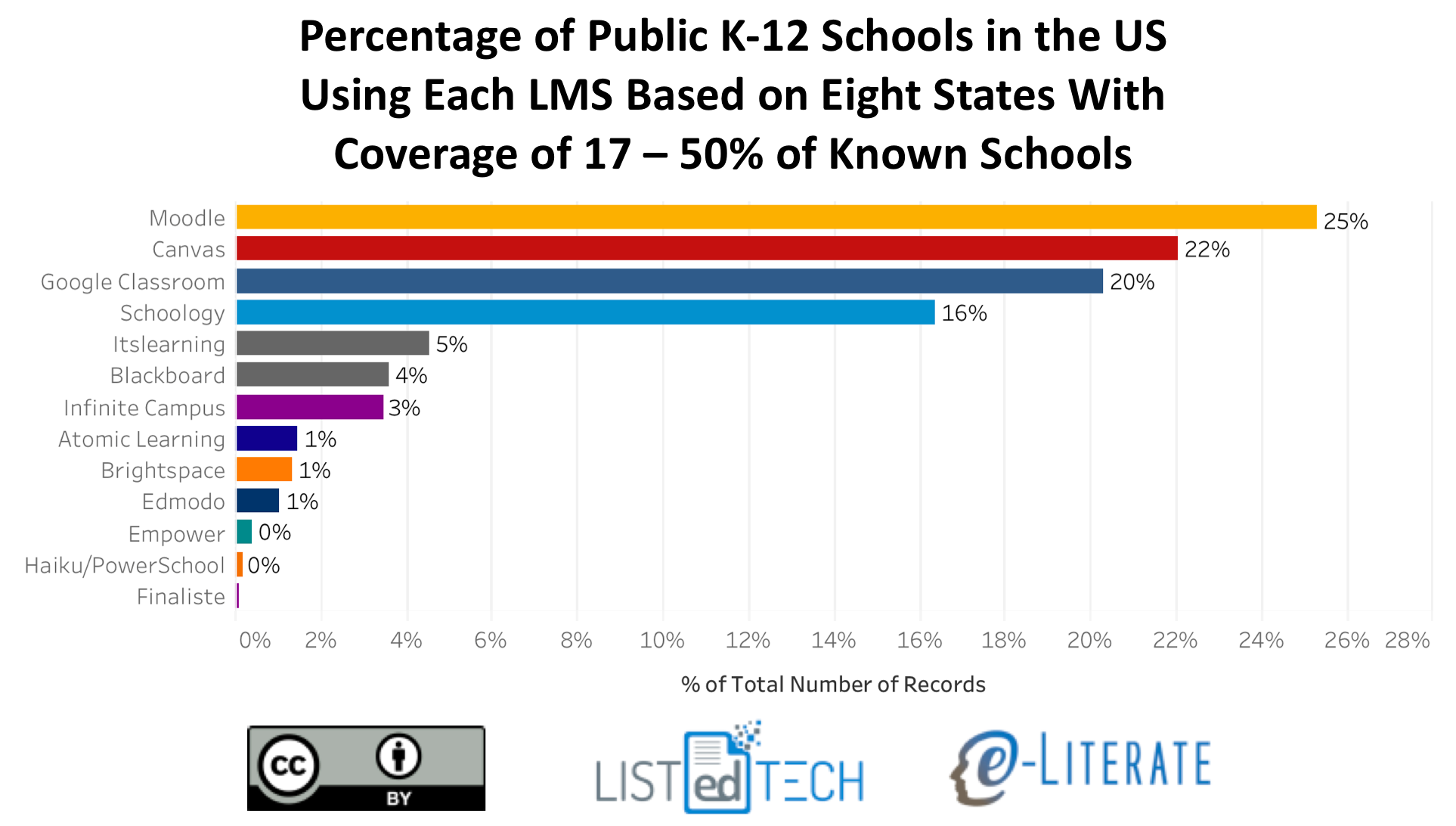
    The first graph presents a view of K-12 school-wide LMS implementations in the United States for the 8 states (and DC) where we have at least 17% coverage of known schools (Alaska, Delaware, District of Columbia, Florida, Massachusetts, Minnesota, Texas, Wisconsin).

    LMS Market Share for K-12 in US, 8 States

    To get a sense of how representative this initial market share is, we made the same calculations across all 6,875 schools from 50 states and DC that in our data thus far. The data for each LMS matched within ~2% for each LMS (e.g. Canvas went from 22% to 24%, Moodle went from 25% to 24%) between the two views.

    As in the higher education market, there appears to be four top contenders in K-12 – Moodle, Canvas, Google Classroom, and Schoology – with all others having 5% or less of market share. Moodle and Canvas are both present in the Big Four for both higher education and K-12, but in K-12 Google Classroom and Schoology are the other big players. We believe that this is the first data set showing just how widely Google Classroom has been adopted. ((Disclosure: Instructure, Schoology, Blackboard, and D2L are subscribers to our LMS Market Analysis service; Instructure and Blackboard also are sponsors for an upcoming event we are organizing.))

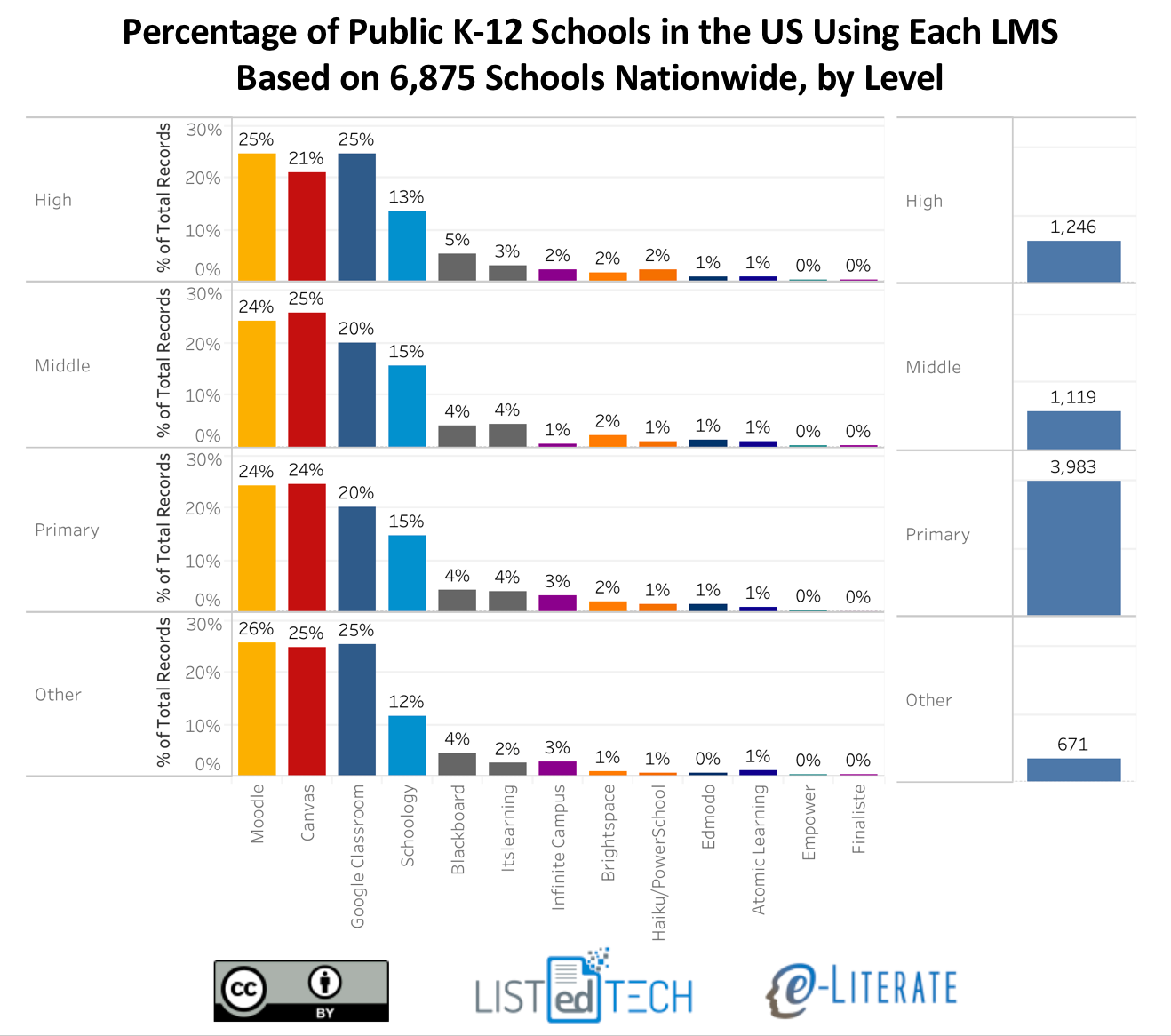
    The general distribution is somewhat consistent across school levels – primary, middle, high school, and others – with some interesting smaller variations. The following view also gives a sense of our relative data coverage by level. In this case we are using all our data across the 6,875 schools. Note that totals are higher than this number due to multiple systems being available at some schools.

    LMS Market Share for US K-12, By Level

    We hope this new data provides a broader view of the academic LMS market. We’d love to hear your feedback and questions.