
e-Literate

Present is Prologue

Tag: Instructure

  • What does Devlin Daley’s departure mean for Instructure?

    Despite all the media hype on MOOCs over the past two years, perhaps the most important recent market entry for ed tech has been Canvas, the LMS from Instructure. Instructure was founded in 2008 by Brian Whitmer and Devlin Daley. At the time Brian and Devlin were graduate students at BYU who had just taken a class taught by Josh Coates, where their assignment was to come up with a product and business model to address a specific challenge. Brian and Devlin chose the LMS market based on the poor designs and older architectures dominating the market. This design led to the founding of Instructure, with Josh eventually providing seed funding and becoming CEO by 2010.

    Michael covered the burst of news in January 2011 that served as the launch of Canvas.

    Instructure has just announced that they will be releasing an open source version of their Canvas LMS product. Between this announcement, the winning of the Utah Education Network contract (109,000 college students and 40,000 K12 students), and the oh-so-ever-brief lawsuit by Desire2Learn about that win, Instructure has been making quite a splash lately.

    Since that time Instructure has grown to 7M+ users, 500 customers and 240 employees while raising $50M in total VC funding. With that much early success, it was a surprise to see Devlin Daley leave the company as of last week with his Douglas Adams reference. (more…)
  • Some big personnel changes in LMS market

    In just the past week we have had three fairly significant people depart higher ed LMS companies. This really is turning out to be a bumpy ride as the market changes.

    • Ray Henderson announced last night that he is leaving his operational role at Blackboard (President, Academic Platforms and CTO) and is moving into a role with the Board of Directors. More info from Jay Bhatt’s post here and Ray Henderson’s post here. Michael is working on an e-Literate post with more information soon. Bill Flook covered in an article here.
    • Devlin Daley, one of the two founders of Instructure, the company behind the Canvas LMS, is leaving the company as of today. I talked to Instructure rep today who indicated that Devlin is looking to get back in to startup ed tech mode, whereas Instructure is becoming a larger company. I’ll write more of an analysis on this move soon. For now I’ll just say that it is extremely rare for a tech founder to leave a company that might go public within a year or two.
    • Al Essa, the Director of Analytics Research and Strategy for Desire2Learn, has left the company to join McGraw-Hill based on his LinkedIn profile. This is curious timing, given Desire2Learn’s major focus on analytics and the Student Success System this year.

    More to come.

  • LMS Market Update: May and June News

    There have been a number of LMS and Learning Platform announcements over the past month or two that will help shape the market over the next year or more. One trend I’ve described is the transition from an LMS market to a Learning Platform market, which includes a broader scope of products. Below are some of the notable announcements. I expect that Michael and I will write separate posts in more detail on several of these updates.

    • LMS CEO panel discussion at Learning Impact
    • Instructure, maker of Canvas LMS, raises $30M
    • Desire2Learn announces Student Success System as predictive analytics with new release
    • Sakai OAE recovers from loss of partners, rebrands as Apereo OAE
    • Coursera shifts strategy in partnering with schools, now overlaps with LMS market
    • edX finishes releasing platform code as open source
    • LMS conference season approaching

    LMS CEO panel discussion at Learning Impact

    In mid May, Inside Higher Ed’s Scott Jaschik hosted a panel discussion of the LMS CEOs at the Learning Impact conference. Blackboard’s new CEO, Jay Bhatt, was welcomed into the higher education community with the, ahem, liveliest panel discussion in recent memory. Given the all-star panel (John Baker, CEO, Desire2Learn; Jay Bhatt, CEO, Blackboard; Josh Coates, CEO Instructure; Martin Dougiamas, Moodle Founder and Lead Developer, Moodle; Manoj Kutty, CEO, LoudCloud Systems; Matt Leavy, CEO, Pearson eCollege), I’ve been surprised to see very little discussion after the event.

    But then I remembered:

    The First Rule of the LMS Panel is you do not talk about the LMS Panel

    (more…)

  • Open as in Transparent: Instructure Conducts 2nd Public Security Audit on Canvas LMS

    I wrote a series of posts last fall about security testing for higher ed LMS products. In my initial post I called for more transparency.

    We need more transparency in the LMS market, and clients should have access to objective measurements of the security of a solution. To paraphrase Michael Feldstein’s suggestions from a 2009 post:

    • There is no guarantee that any LMS is more secure just because they say they are more secure
    • Customers should ask for, and LMS vendors should supply, detailed information on how the vendor or open source community has handled security issues in practice
    • LMS providers should make public a summary of vulnerabilities, including resolution time

    I would add to this call for transparency that LMS vendors and open source communities should share information from their third-party security audits and tests. All of the vendors that I talked to have some form of third-party penetration testing and security audits; however, how does this help the customer unless this information is transparent and available. Of course this transparency should not include details that would advertise vulnerabilities to hackers, but there should be some manner to be open and transparent on what the audits are saying.

    Subsequently I was asked by Instructure to serve as an embedded reporter as they undertook a public security audit. In a post from January 2012, Josh Coates called for other LMS vendors to follow suit.

    Despite the lack of response, Instructure declared their intent to test again in fall 2012.

    We will kick off our second annual open security audit in Q4. We invite any and all education companies to participate. We think education should be open, safe, and secure — and that corporations should be held accountable for their claims.

    Second Annual Audit for Canvas LMS

    True to their word, Instructure conducted another audit this year, again using Securus Global, described in this blog post and documented in this Securus report. I did not act as an embedded report this time around, but I would like to highlight some of the findings from the report.

    (more…)

  • Canvas Network – Are the LMS and MOOC Markets Colliding?

    Six weeks ago I posted a new graphic on the LMS market which included MOOCs in the same view as traditional LMS solutions.

    In the comments to the post there was an interesting note from Josh Coates (Instructure CEO) in response to whether MOOCs should be so closely aligned with the LMS market:

    i agree with you [fellow commenter Bob Puffer] that MOOCs aren’t the same thing as an LMS and should be accounted for differently.

    With the recent news of the Coursera / Antioch partnership as well as Instructure’s release of the Canvas Network, I believe we are starting to see the LMS market overlap with the MOOC market, although I do not see them completely merging. After offering to fix Josh’s broken shift key, I’d like to explore the prospects for the Canvas Network to compete in the MOOC marketplace.

    (more…)

  • Everybody Wants to MOOC the World

    You may have seen this week’s announcement from Instructure of their new Canvas Network to support MOOCs and other open courses. Blackboard has already been dipping its toe in this water, having had Curtiss Bonk run a MOOC on CourseSites. I also find it significant that Blackboard (somewhat awkwardly) made an attempt to remind the market of this fact on the same day as Instructure’s announcement. I predict that “MOOC” will reach the same level of hype at this year’s EDUCAUSE conference that “open” did last year.

    But hype aside, it’s worth asking what it means for the traditional LMS players to be marketing themselves as platforms for MOOCs and other open courses.

    (more…)

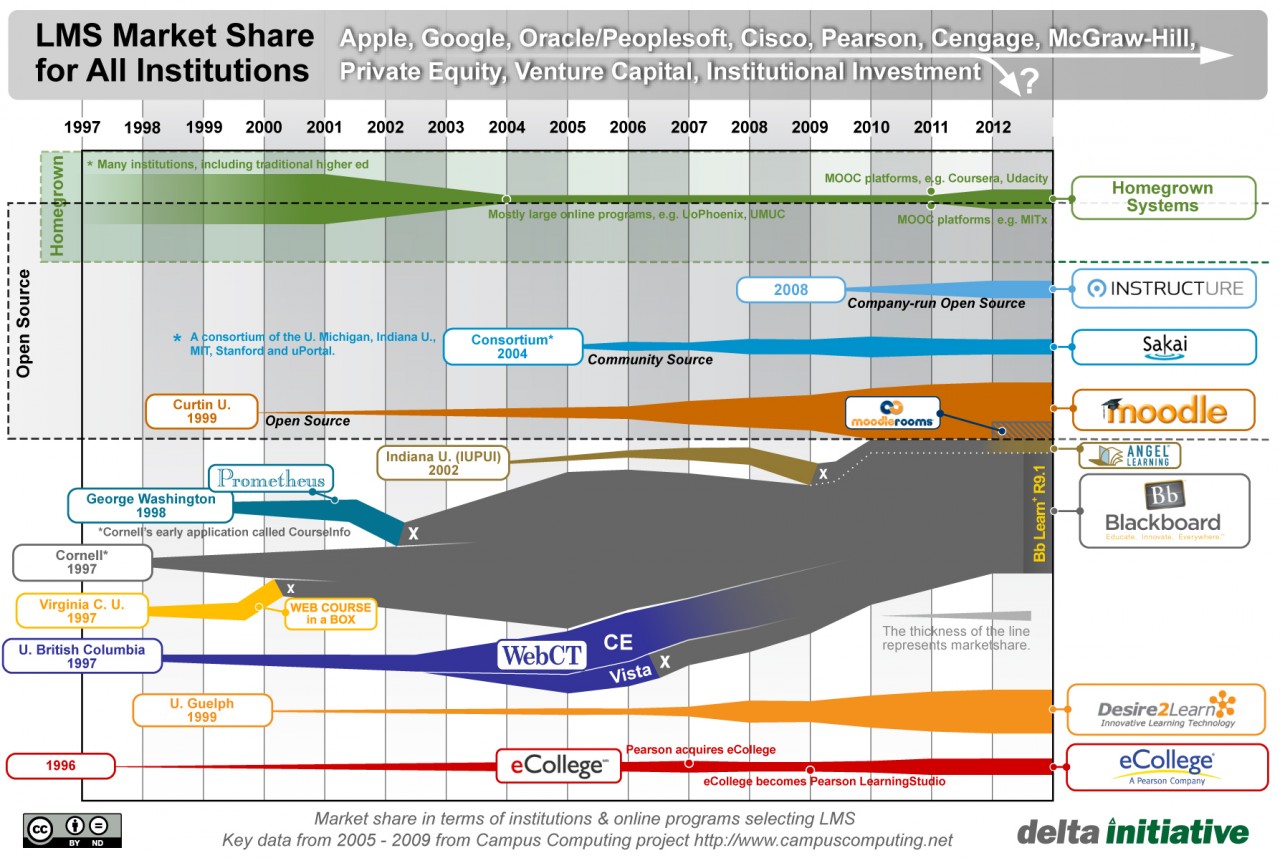
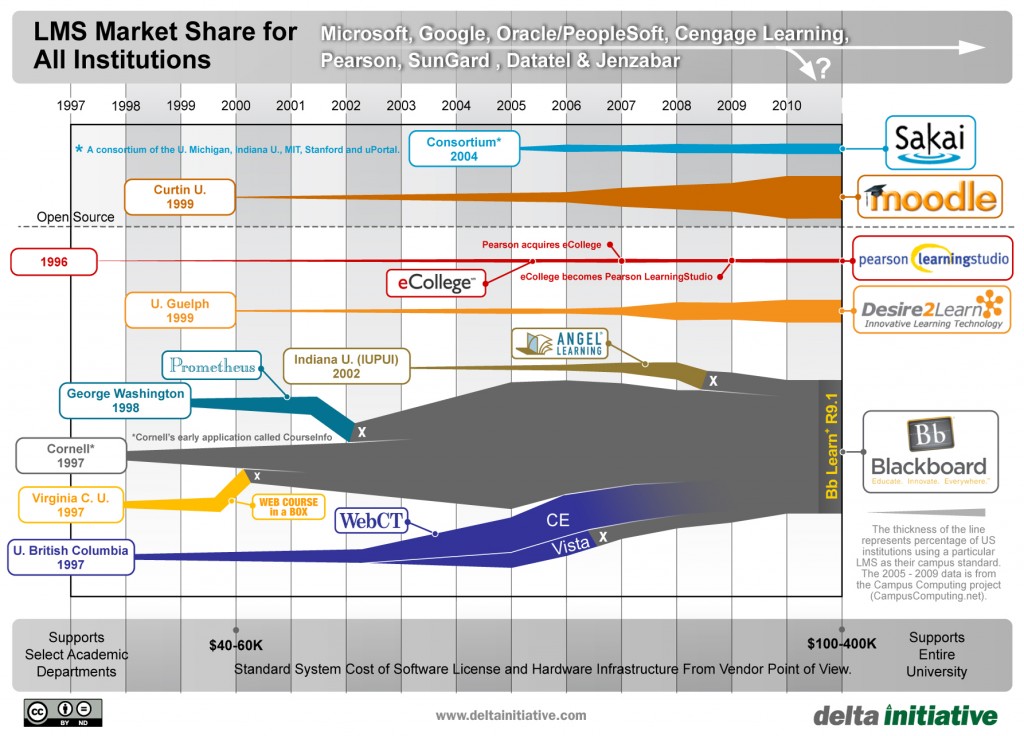
  • State of the Higher Education LMS Market: A Graphical View

    The transformation of the higher education LMS market continues, and I expect more changes over the next 2 – 3 years. However, it seems time to capture the state of the market based on changes over the past year or two.

    I shared the most recent graphic summarizing the market in mid 2011. As with all previous versions, the 2005 – 2009 data points are based on the Campus Computing Project, and therefore is based on US adoption from non-profit institutions. This set of longitudinal data provides an anchor for the summary.

    The most significant changes over the past two years include the following.

    (more…)