
e-Literate

Present is Prologue

Tag: Jim-Farmer

  • Blackboard's Market Share Erosion

    Barry Dahl is asking the question, “Is Blackboard losing clients?” and has created a wiki for people to enter information on whether they are migrating to Blackboard, migrating from it, or re-evaluating their installation. In general, it would be great to see more visibility of information of this kind. I’d love to see a wiki or database where schools can enter the LMS(s) they are using and their state of evaluation for the future, regardless of brands they adopt or consider. But at a coarse-grained level, we already know the answer to Barry’s question. In November of 2007, bolstered by the excellent financial forensic work of Jim Farmer, I wrote a post entitled “Blackboard Is Losing Customers, But What Does It Mean?” Then in March, 2008 I reported on a survey by the American Association of Community College’s Instructional Technology Council (ITC) showing a loss of Blackboard’s market share within the American community college cohort.

    The main takeaways from these data points are as follows:

    • Blackboard is losing market share.
    • Most or all of this loss is happening at the low end of the market.
    • The two main drivers for loss on the low end are (1) Blackboard raising their average price to $50K/customer, and (2) Blackboard announcing the imminent death of WebCT CE, which is forcing low-end campuses to re-evaluate their vendor situation.
    • Despite the market share loss, Blackboard is growing both revenues and profits.
    • The reason Blackboard is growing both of these is that they are able to cross-sell and up-sell more product to their higher end customers (and even some of their mid-sized customers) while acquiring new high-end customers. 
    • So far, it appears that Blackboard is continuing to do very well on the higher end of the market, probably because they are perceived as a “safe bet” by the average risk-averse university.
    Blackboard CFO Michael Beach explicitly acknowledged much of this in the company’s last quarterly earnings call. Responding to a question about Blackboard’s shrinking number of international customers over the quarter, Beach responded,

    Yeah, I think clearly we never want to lose clients, but I think the trend, which generally what we’ve kind of experience broader across Blackboard, which was we had attrition of low priced customers at the same time we were adding higher priced customers. So, the overall dynamic the overall impact on contract value is positive but from a unit back that we, we didn’t had enough to cover the losses.

    So the answer to Barry’s question is yes, Blackboard is losing clients, but that doesn’t mean that they are losing net business.
  • LETSI: HR-XML Consortium Seeks Cross-Domain Interoperability

    This is a guest post by Jim Farmer.

    “Learning, education, and HR standards communities have very little to show in terms of cross-domain standards interoperability and convergence despite significant investments over a period of more than a decade.” Chuck Allen, Executive Director of the HR-XML Consortium, made this assessment of standards that cross the boundaries of standards-setting bodies in a “White Paper” submitted to the LETSI SCORM 2.0 Workshop held October 15-17, 2008 in Pensacola, Florida. As learning systems exchange data with various administrative, ERP and human resources systems, standards are needed to avoid expensive continuous redundant software maintenance.

    Although Allen didn’t cite historical opportunities, during development of the HR-XML resume specification, the Consortium requested assistance from higher education in recording competencies and the description of academic work such as publications. Higher education did not respond.

    (more…)

  • Distributed Learning is Here: Ask Any College Student

    This is a guest post by Jim Farmer for a special issue on distributed learning environments for On the Horizon. Jim is Coordinator, Scholarly Systems Group at Georgetown University and editor at the eReSS project, University of Hull.

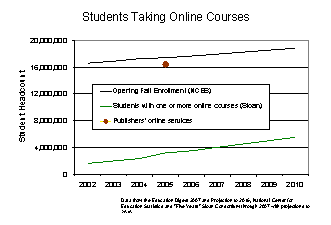
    This fall more than 17 million students will be using publisher-provided online services. More than 5 million students will be enrolled in distance learning courses. More than 15 million will be using the Internet. 6.7 million will use Wikipedia. More than 11 million students will use the public library propelled by the increased use of libraries by today’s youth—often to use online materials.

    image0021.gifAlmost 15 million students work full or part-time; 8.3 million use computers at work. An estimated 4.4 million student employees will receive online training from their employers.

    These estimates do not include the several learning and library systems that may be available on the campus. Nor the online tutorial services and learning resources marketed directly to students.

    Today’s college students are already in an environment of distributed learning and increasingly they, not their professors, are making decisions about which resources and services they use.

    This rich distributed learning environment benefits graduate students who are motivated, demonstrated their ability to learn, and have faculty advisors guiding their learning. The current distributed learning environment may not be best for beginning undergraduate students who are less well prepared, have instructors with large class sizes, and who have less financial resources to purchase access to learning services.

    (more…)

  • SpikeSource Supporting Moodle on the Microsoft Stack

    Jim Farmer has an interesting guest post over at Seb’s blog about SpikeSource supporting Moodle on Windows/IIS. Both the creation of supported softwares stack for higher education and the mixture of proprietary and open source software in at least some of those stacks strike me as natural steps. I expect that we’ll see more of this kind of thing.

  • An Eye-Witness Account of the Trial

    With all the coverage of the Blackboard v. Desire2Learn case, most of us (including me) have very little insight into the actual trial process. And with emotions running high about the case, it’s easy for people to jump to extreme conclusions about the process and everyone involved in it. That’s why I’ve asked Jim Farmer to write a first-hand account of the portion of the trial that he attended. In addition to being a knowledgeable observer of the legal system as a former expert witness in the U.S. Tax Court on behalf of the California State University in Los Angelese and in District Court in Denver on financial aid software, Jim is also a gentleman’s gentleman. I knew that he would give an account that is fair-minded and charitable to all parties involved. And that’s what he did.

    In the interest of full disclosure, Jim asks me to remind you all that Georgetown University, where he coordinates the Scholarly Systems Group, is a long-term satisfied Blackboard Learning Systems user. The views expressed in this blog post are solely his own.

    – Michael

    (more…)

  • Common Cartridge: e-Learning Made Easy

    This is a guest blog post by Jim Farmer, Coordinator, Scholarly Systems Group at Georgetown University and editor at the eReSS project, University of Hull.

    On September 4, 2007, a summer morning in Adelphi, Maryland, the workgroup, breakfast in hand, slowly assembled into in a large conference room at the University of Maryland, University College (UMUC). The tables were assembled in a U-shape with twelve places on each of the three sides. A digital projector on a stand in the center became the symbolic altar of digital technology. A large screen at the open side of the U illuminated knowledge with multicolored four-line outlines, charts, graphs, “screen captures” and illustrations.

    Heads down behind black or sliver laptop screens, eleven representatives of publishers, software suppliers, higher education organizations, and colleges and universities sat scattered among the conference tables. As part of the IMS Global Learning Consortium Common Cartridge Test Fest, they had been considering how this technology could be used to transfer digital content from publishers and authors to learning management systems for use by faculty and students.

    (more…)

  • Making College Textbooks More Affordable: Part II

    This is a guest post blog by Jim Farmer, Coordinator, Scholarly Systems Group at Georgetown University and editor at the eReSS project, University of Hull.

    On Friday, June 1st, the Advisory Committee on Student Financial Assistance released their report “Turn the Page: Making College Textbooks More Affordable.” Responding to a Congressional concern about high and rapidly increasing cost of “textbooks,” The Committee was asked “to conduct a one-year study of the cost of college textbooks and to make recommendations on increasing the affordability of textbooks.”

    The report relied heavily on two commissioned papers. Dr. James V. Koch authored “An Economic Analysis of Textbook Pricing and Textbooks Markets” distributed in September 2006. He made some suggestions how the “markets” for textbooks could be improved to provide lower prices. (He did not use the term “textbooks and other learning materials” later used in the Advisory Committee’s report).

    (more…)