
This is a guest blog post by Jim Farmer, Coordinator, Scholarly Systems Group at Georgetown University and editor at the eReSS project, University of Hull.
On September 4, 2007, a summer morning in Adelphi, Maryland, the workgroup, breakfast in hand, slowly assembled into in a large conference room at the University of Maryland, University College (UMUC). The tables were assembled in a U-shape with twelve places on each of the three sides. A digital projector on a stand in the center became the symbolic altar of digital technology. A large screen at the open side of the U illuminated knowledge with multicolored four-line outlines, charts, graphs, “screen captures” and illustrations.
Heads down behind black or sliver laptop screens, eleven representatives of publishers, software suppliers, higher education organizations, and colleges and universities sat scattered among the conference tables. As part of the IMS Global Learning Consortium Common Cartridge Test Fest, they had been considering how this technology could be used to transfer digital content from publishers and authors to learning management systems for use by faculty and students.
IMS Global lead Kevin Riley sat at the outside center table of the U facing the screen. He leaned back, his two thumbs between his bright red braces-he is British-and his French blue shirt. “It is four o’clock, perhaps we can demonstrate the Test Cartridges scheduled for nine thirty this morning. Kellan, do you want to begin?”
Test cartridges contain digital content used to verify the digital files were placed into a learning management system course according to the IMS Common Cartridge specification and made ready for immediate use by students and their instructor. Using materials provided by Pearson Education, five cartridges had been developed to test the capability to exchange these materials. The test consisted of demonstrating the use of these materials within the learning management system as intended by the publisher.
 Kellan Wampler looked like a mop-haired student with a slight smile setting in the back of a classroom. All day his eyes intently followed the conversations. Last year Kellan graduated from Rose-Hulman Institute of Technology majoring in mathematics. “I took a few computer science courses and liked to program. I went to work for ANGEL Learning as a programmer. But I hope to go to graduate school someday in mathematics.” Only later we learned he finished in the Top 500 in the national William Lowell Putnam Mathematical Competition award from the Mathematical Association of America.
Kellan left his seat near the screen, uncoiled the cord from the digital projector and connected it to his laptop computer in front of his seat, sat down, and began to tap the keyboard. The screen displayed a page from the ANGEL Learning System. The images flashed by as Kellan begin clicking through the import, installation, and test.
“Can you start over and tell us exactly how a professor would use the Common Cartridge?”
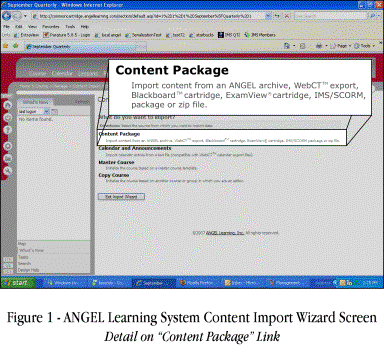 The initial screen flashed again. “You download the cartridge over the Internet as any other file. Then you import the content using the Content Import Wizard.” (Figure 1)
“Where would you get the cartridge from?” Michael Neuman asked. Neuman, a former English professor and Department Chair, is with the Scholarly Systems Group at Georgetown University. Soft spoken-an academic Columbo-master of the short, unexpected, slowly-revealed and sometimes humbling question. Alan Aikens from Pearson Education replied: “When the instructor selects a textbook for the course, the instructor is authorized to download the course materials and install them on the campus learning management system. Neuman continued: “Can any student use the materials? “The materials are available to all of students in the course.” Students who purchased used textbooks or who used a copy in the library would have equal access to the digital materials. “The use of the digital materials is included in the price of the textbook.” But none of the price of used textbook go to the publisher to pay for developing the supplementary digital materials some of the students in the class will be using.
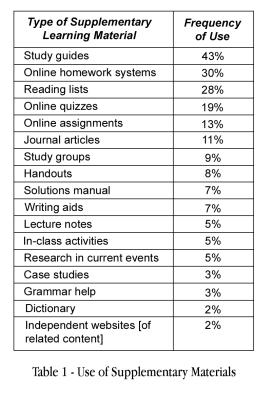
The term textbook is understood differently depending on when you went to college. For most college graduates, including members of Congress, education lobbyists and analysts clamoring about the price of textbooks, the textbook is a paper object purchased at the campus bookstore and most important, in their conversation, nothing more. Current and recent students assume a textbook has “supplementary materials,” including online learning services available from the publisher, which they are expected to use. These materials, increasingly available as digital files, are listed in Table 1 by Type and Frequency of Use. Many of these are still provided as printed documents, but increasingly as digital files that can be distributed in a Common Cartridge. According to a recent survey, 86% of the faculty use supplementary materials if they are available. Not every course has all types of the materials nor does every textbook yet have a full set of supplementary material. Generally all of the available digital materials are used by the instructor.
 These materials are authored by teams of knowledge specialists, writers, multimedia specialists, learning technologists, and web content developers and sometimes computer programmers. Although the development costs can vary widely, costs of US$1 million is considered reasonable for a U.S. course of 45 classroom hours or the equivalent. Based on information extrapolated from publisher websites, the publishers now have 1,000 courses under development-an industry investment of about US$1 billion-yes, billion with a “b.” This is about the same investment made by the Open University in the U.K., in cooperation with the British Broadcasting Corporation, to develop its first baccalaureate program in the 1990s.
Some course materials from the Open University are now being made available to colleges and universities, at no cost, under the OpenLearn project with funding from the William and Flora Hewlett Foundation. The first Common Cartridges of these materials have been developed and are now being tested.
 Cartridge is not a new idea. Blackboard and WebCT-purchased last year by Blackboard-had the capability of “importing” a publisher’s cartridge. The format of the cartridge differed from one software supplier to another, different products of the suppliers, or even different versions of the same product. In discussions about the uPortal and Sakai projects several years ago, McGraw Hill reported supporting 24 different formats. In later discussions at Stanford University with the Board of the Sakai Project-an open source learning management system development, other publishers confirmed a similar number. The number of possible combinations of cartridges and learning systems often required assistance from campus technical support and the publisher’s technical support staff to successfully identify, import, and install the correct cartridge. An effort costing the publisher and the campus and creating a frustrated instructor.The Common Cartridge is an attempt to specify a single format that would be adopted by all publishers and learning system software suppliers. The single “Common” Cartridge should reduce the costs of producing and supporting multiple formats and, for the college or university, the effort to import and install these digital materials.
A 2006 survey of faculty revealed 90% of the faculty recommend or require a textbook and 86% use some of the supplementary materials if they are available-up 11% since 2004. The Common Cartridge, requiring less faculty effort, may sharply increase the use of publisher’s eLearning materials in classes and student performance. The use of these materials “supplements” rather than replaces lectures. Even richer materials can also be used in distance learning classes where students and their instructor may never meet.
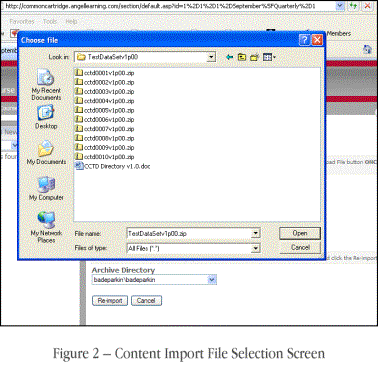
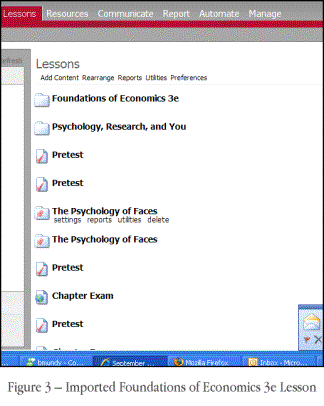 Kellan continued. “When you have the file on your desktop, then you import it into the learning management system by selecting the file (Figure 2). When we import it into the ANGEL Learning System the folder is named Foundations of Economics 3e (Figure 3).” Based on instructions contained in a manifest file, the files of digital content are placed appropriately in the learning system database.
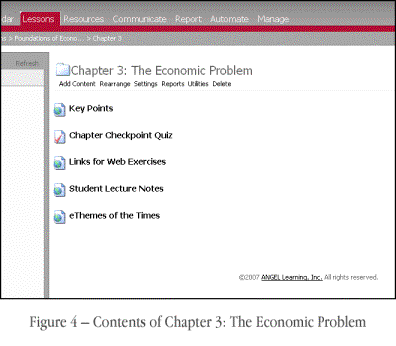
The contents of the imported “Chapter 3: The Economic Problem” can be listed (Figure 4): Key Points, Chapter Checkpoint Quiz, Links to the publisher’s online Website for Web Exercises, Student Lecture Notes, and eThemes of the Times. Kellan said the chapter was an HTML webpage now available to any student participating in the course. Web Exercises is more than text. Like U.S. Today’s “McPaper” and today’s textbooks, the webpages have many multi-colored charts, graphs, photographs, and other illustrations and connections to audio and video displayed on the webpage.
 Neuman again: “Can you change the content of the Chapter?” “Yes. See the “CommonCartridge Admin – Editor” button on the screen? This means you have edit authorization. You can use the HTML editor to add, delete, or change any of the content.” “Are you licensed to do that?” Alan commented “usually you are.” The publishers try to obtain rights from authors and sources of copyrighted materials. “Can other classes see these materials?” “Depends upon the license.” Publishers are trusting faculty to use materials under the terms of the license agreement.
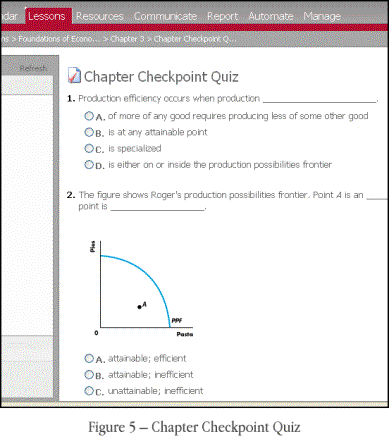
Kellan continued: “Assessments are imported as quizzes-both the questions and answers (Figure 5).” The quizzes then can be scheduled. Neuman again asked if they could be changed.”Yes, like the web pages, you can change the questions and answers and add and delete questions.”
Common Cartridge can also set up a discussion group for the class in the learning system if discussions are a course activity.
The Common Cartridge can also include other digital files called “resources.”
“How are resources different from the webpages and quizzes?” “These may be papers the students may find useful.” Because faculty authors increasingly write under Creative Commons licenses, students can print copies and retain the digital documents for their own use later. “In some cases the publisher cannot include the paper, but will include an Internet link or URL. For example, the link may be to a paper in JSTOR. If the campus has a JSTOR license-and most do-then the student would be able to read and print the paper from a single click.” “How does JSTOR know the student is authorized access to the paper?” “We are hoping the use of Shibboleth authentication and authorization will solve that issue.” Shibboleth is a protocol that need not reveal the identity of the student or faculty user, but rather asserts the user is, for example, “a student or faculty member at Georgetown University” and, by institutional license agreement would be authorized access. This technology has been demonstrated and is now being implemented throughout the United Kingdom.
 In addition to the text of Martin Luther King Jr’s “I Have a Dream” speech in 1992, an audio or a video recording of his speech can be made available so the student can hear the words as they were spoken. Over coffee Sakai Executive Director Michael Kurcoska described a use of video in drama classes, “…different videos of the same Shakespeare scene to see interpretations in different productions”
And, of course, the ubiquitous PowerPoint presentations required for recently installed “smart classrooms.” Again presentations in a digital form the professor can adapt for use in the class, often adding material relevant to the class at that time. And made available to students so they can concentrate on the instructor’s classroom presentation instead of copying slides during the lecture.
Examples reveal the richness of materials being made available to today’s iPod iTouch iPhone wielding students.
In addition to resources presented by the learning system, a student may be directed to a website of the publisher. The links in this example were labeled Web Exercises. Here more complex materials may be presented. One of the most effective learning sites has been Pearson Education’s MathXL-based MyMathLab used to teach algebra. In 2006 MyMathLab was presented as an example of instructional effectiveness to U.S. Department of Education Secretary Spellings’ Commission on the Future of Higher Education. Those using MyMathLab increased course completion rates from 10 to 30%. IMS Global is now considering how the student’s performance on a publisher’s website, such as MyMathLab, can be reported back to the campus learning system and subsequently to the student information system.
Alan also said references to other websites may be made for materials because of restrictions on distribution made by the author.
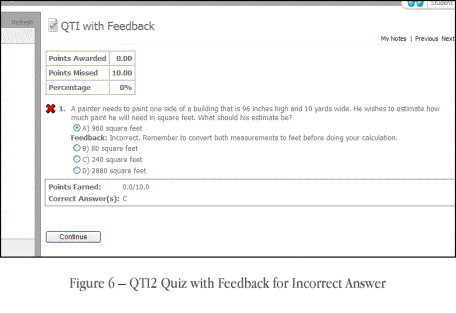
Kellan clicked back to the ANGEL Learning System. “At noon you asked about questions with feedback. Let me show how this is done using QTI 2.1. ” The screen (Figure 6) showed a question with all of the answers and text associated with each answer.
 According to the IMS Consortium, “The IMS Question & Test Interoperability (QTI) specification describes a data model for the representation of question and test data and their corresponding results reports. Therefore, the specification enables the exchange of this item, test and results data between authoring tools, item banks, test constructional tools, learning systems and assessment delivery systems.” There are two version of the specification QTI 1.2 and recently released 2.1.
As faculty move beyond “assessments of learning” adding “assessments for learning,” the student receives immediate response to an answer to a question. Instead of a simple “right” or “wrong,” the response to a wrong answer can be a full explanation of why this is the wrong answer. This instant “feedback” to the student provides an immediate and relevant learning experience. Typically the scores of individual students are not recorded as a student grade. Faculty can review the progress of students collectively in order to guide instruction.
Kevin used this discussion as an opportunity to describe the criteria used by the Common Cartridge work group “Common Cartridge is based on interoperability specifications that are already implemented by many [software suppliers], publishers, and authors. We generally wanted at least 80% [of the software suppliers] to have implemented the specification.” This means more than 90% of the students would have access to compliant software. “We used QTI 1.2 because it was widely adopted and implemented. We used only six of the question formats since more than 80% of the quizzes used those formats.” The strategy is to provide the most used capabilities to faculty within the most widely implemented technical capabilities-a strategy for encouraging Everett Rogers’ “early and late majorities”-68% of users-in addition to “innovators” and “early adopters”-16% of users.
Kellan said the more recently developed ANGEL Learning System uses QTI 2.1 natively. Common Cartridge quizzes are reformatted from QTI 1.2 to 2.1 during import. From the faculty perspective, the key difference is the ability to provide “questions with feedback.” And, for students, improved learning.
As additional eLearning capabilities become available, faculty are changing methods of instruction to incorporate these capabilities in their instruction. Kevin said he expects new capabilities will be included in a version 1.1 of the Common Cartridge specification. IMS is trying to encourage software suppliers, authors and publishers, and instructors to adopt new learning capabilities at about the same rate. A very difficult task of coordinating efforts of the large and furiously independent higher education community.
Throughout the development of the Common Cartridge specification the IMS workgroup focused on the benefits for faculty and student and making authors and publishers more productive. If using the Common Cartridge is as easy as Kellan demonstrated, we can look forward to an upsurge of learning technology. Fortunately at the same time technology-savvy students are entering higher education expecting to find these technologies in use.
Comments
5 responses to “Common Cartridge: e-Learning Made Easy”
Very interesting! I am looking forward for the full Common Cartridge specification. However, I still can´t see how this technology cooperate with a SCORM compliant LMS and the whole ecosystem of subsystems. But, maybe this is just my lack of proper understanding.
Thanks Michael and Jim for sharing…
Moises
[…] [email protected] (Michael Feldstein) wrote a fantastic post today on “Common Cartridge: e-Learning Made Easy”Here’s ONLY a quick extractHeads down behind black or sliver laptop screens, eleven representatives of publishers, software suppliers, higher education organizations, and colleges and universities sat scattered among the conference tables. … […]
[…] Common Cartridge:电子学习变容易了 关于IMS Common Cartridge标准的总结性文章,并没有真正告诉我们 Common Cartridge标准到底是什么,但是对它的好处大肆宣传。“你在网上可以象下载任何其他文件一样下载cartridge。然后用内容导入向导导入内容。”Jim Farmer, e-Literate October 9, 2007 [原文链接] [Tags: none] [参与评论] […]
[…] https://eliterate.us/common-cartridge-e-learning-made-easy/ […]
Having the proper amount involving water is essential, in the event roses really are watered insufficiently they may die of course, if there’re well watered very much their very own beginning are certain to get ” light ” plus not able to drink up nutrients and vitamins. Deeply tearing is paramount towards good carnations while cursory sprinkling will certainly promote fungus growing, but still their very own foliage needs to be retained dried up to be able to keep health issues.