
e-Literate

Present is Prologue

Tag: Jonathan Rees

  • Recommended Reading: With or Without EdTech

    Recommended Reading: With or Without EdTech

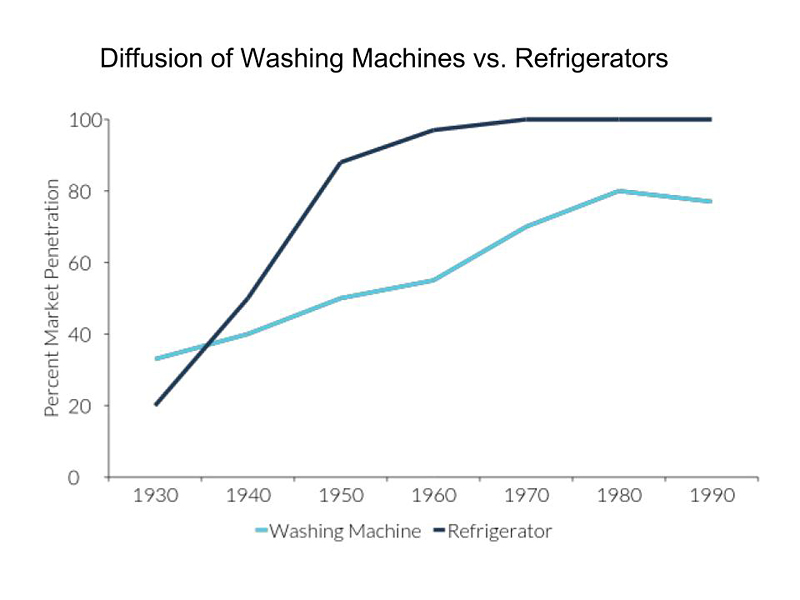
    A few weeks ago, I recommended an EdSurge piece by the Clayton Christensen Institute’s Julia Freeland Fisher. It featured this graph of refrigerator vs. washing machine diffusion:
    machines-1491937394

    I saw this same image featured last week in a main stage talk at the IMS conference, so it is making the rounds.

    Audrey Watters pointed me to this blog post responding to Freeland Fisher by CSU Pueblo history professor Jonathan Rees. Jonathan has made several appearances here on e-Literate. I would describe him as an open-minded and engaged ed tech skeptic. He teaches using tech but is suspicious of narratives such as Christensen’s “disruptive innovatation” that tend to displace educators in favor of tech. He also happens to be a scholar of the history of refrigeration.

    Ruh roh.

    Jonathan takes apart the graph using a number of tools of scholarship:

    • He notes the lack of sourcing for Freeland Fisher’s data. (This is a problem that’s common in ed tech blogging and reporting—as opposed to scholarship. The less formal style of writing and different audience invites a certain sloppiness in sourcing at times. We’ve occasionally been guilty of this sin on e-Literate.)
    • He surveys alternative scholarship, finding a difference in diffusion rates for the washing machine than the figure Freeland Fisher cites.
    • He looks at differences in the analyses to explain differences in the data. “Perhaps this [difference] can be explained by the difference between owning a washing machine and ‘accessing’ a washing machine in the basement of your apartment building or taking your dirty laundry down the street to a laundromat.”
    • He looks at differences in context to explain differences in the data: “French or English people in 1957 still had easy access to fresh meat and produce at large markets.  Many still choose to live that way today because fresh perishable food tastes better. Americans, on the other hand, tend to preference convenience over taste. That’s why the refrigerator industry was one of only three in the whole United States to grow during the Great Depression.”

    These are all solid analysis techniques that are common in scholarship across many disciplines. But we rarely see them applied directly to claims of “efficacy” in ed tech, particularly in mainstream outlets where academics who are not education scholars can read them and evaluate the arguments.

    Whether Rees is correct in his takedown of Freeland Fisher is almost beside the point to me. His casual demonstration of scholarly analysis is a stark reminder that we are missing something critical in our academic conversations about ed tech.

    Read it here.

  • Personalized Learning and the Teacher

    A few weeks ago, Jonathan Rees wrote a post calling out that, no matter what potential of so-called “personalized learning” for improving student outcomes, there is a potential—and a temptation—for it to be abused as a method of lowering (labor) costs in a way that also lowers educational quality and effectiveness. This is a serious and realistic concern, particularly as long as personalized learning is framed as a product rather than a set of teaching strategies.

    Phil and I have addressed this concern head-on in our latest piece on EdSurge. I suppose a battle over the meaning of the term was inevitable; why should this one be any different from all the others? There is an enormous disconnect between the way the term is used in product marketing and ed tech circles and the way it is actually applied in the real world in cases places it actually works. I have seen a number of cases in which personalized learning, as an educational strategy, produces good results for students. But every single one of those cases has had one or more good educators leading the charge, thinking hard about how to better serve the students. At its best, personalized learning is an effort to identify those classroom and institutional practices that are depersonalizing, and use technology as an aid to teaching strategies and support processes that can replace those practices with something more humane. Perhaps we should call it “undepersonalized learning.”

    As such, true personalized learning should be labor-friendly in important ways. It should put a premium on skilled educators and make a strong case for increased investment in professional development and teaching-friendly tenure and promotion practices. That doesn’t mean it will always be job-preserving. The focus should be on students and agnostic with respect to student/teacher ratios. It is possible to achieve a more humane and personal education at scale. Sometimes. With a lot of thought and iteration. But I have seen no evidence to suggest that personalized learning technologies improve outcomes significantly without good teachers at the helm, and plenty of evidence suggesting that they don’t.

  • Better Ed Tech Conversations

    This is another follow-up to the comments thread on my recent LMS rant. As usual, Kate Bowles has insightful and empathetic comments:

    …From my experience inside two RFPs, I think faculty can often seem like pretty raucous bus passengers (especially at vendor demo time) but in reality the bus is driven by whoever’s managing the RFP, to a managed timetable, and it’s pretty tightly regulated. These constraints are really poorly understood and lead to exactly the predictable and conservative outcomes you observe. Nothing about the process favours rethinking what we do.

    Take your focus on the gradebook, which I think is spot on: the key is how simply I can pull grades in, and from where. The LMS we use is the one with the truly awful, awful gradebook. Awful user experience, awful design issues, huge faculty development curve even to use it to a level of basic competence.

    The result across the institution is hostility to making online submission of assignments the default setting, as overworked faculty look at this gradebook and think: nope.

    So beyond the choosing practice, we have the implementation process. And nothing about this changes the mind of actual user colleagues. So then the institutional business owner group notices underuse of particular features—oh hey, like online submission of assignments—and they say to themselves: well, we need a policy to make them do it. Awfulness is now compounding.

    But then a thing happens. Over the next few years, faculty surreptitiously develop a workable relationship with their new LMS, including its mandated must-use features. They learn how to do stuff, how to tweak and stretch and actually enjoy a bit. And that’s why when checklist time comes around again, they plead to have their favourite corner left alone. They only just figured it out, truly.

    If institutions really want to do good things online, they need to fund their investigative and staff development processes properly and continuously, so that when faculty finally meet vendors, all can have a serious conversation together about purpose, before looking at fit.

    This comment stimulated a fair bit of conversation, some of which continued on the comments thread of Jonathan Rees’ reply to my post.

    The bottom line is that there is a vicious cycle. Faculty, who are already stretched to the limit (and beyond) with their workloads, are brought into a technology selection process that tends to be very tactical and time-constrained. Their response, understandably, tends to be to ask for things that will require less time from them (like an easier grade book, for example). When administrators see that they are not getting deep and broad adoption, they tend to mandate technology use. Which makes the problem worse rather than better because now faculty are forced to use features that take up more of their time without providing value, leaving them with less time to investigate alternatives that might actually add value. Round and round it goes. Nobody stops and asks, “Hey, do we really need this thing? What is it that we do need, and what is the most sensible way of meeting our needs?”

    The only way out of this is cultural change. Faculty and administrators alike have work together toward establishing some first principles around which problems the technology is supposed to help them solve and what a good solution would look like. This entails investing time and university money in faculty professional development, so that they can learn what their options are and what they can ask for. It entails rewarding faculty for their participation in the scholarship of teaching. And it entails faculty seeing educational technology selection and policy as something that is directly connected to their core concerns as both educational professionals and workers.

    Sucky technology won’t fix itself, and vendors won’t offer better solutions if customers can’t define “better” for them. Nor will open source projects fare better. Educational technology only improves to the extent that educators develop a working consensus regarding what they want. The technology is a second-order effect of the community. And by “community,” I mean the group that collectively has input on technology adoption decisions. I mean the campus community.

  • Changing the Narrative

    As Phil mentioned, he and I were both lucky to attend the MOOC Research Initiative conference, which was a real tour de force. Jim Groom observed that even the famously curmudgeonly Stephen Downes appeared to be enjoying himself, and I would make a similar observation about the famously curmudgeonly Jonathan Rees. If both of those guys can be simultaneously (relatively) pleased at a MOOC conference, then something is going either spectacularly right or horribly wrong. I believe it was the former in this case.

    We are at one of those rare moments when there’s enough confusion that real conversation happens and possibilities open up. The sense I got is that everybody is really grappling with the questions of where we can take the concept of a “MOOC” and what MOOCishness might be good for. That is fun and hope-inducing. Phil and I spent a lot of the time interviewing folks for a future e-Literate TV series (coming to a computing device near you in March or April of 2014), so we were lucky to hear a lot of perspectives. There is some very good exploration happening now. George Siemens and his fellow conference organizers (as well as the Bill and Melinda Gates Foundation, which sponsored the event and the research) did a real service by bringing people together to talk about these issues at this pregnant moment.

    One thing happened toward the end of the conference that has me puzzled, though. Jim mentioned it in his blog post:

    At the same time[,] Bon Stewart’s admonitions for some kind of organized response to start filling the temporary void of direction with alternative narrative still rings in my ears—and it is very much the lesson I took away from Audrey Watters keynote at OpenEd.

    There was a lot of conversation, really throughout the conference but coming to a head at the end, that the term of MOOC is somehow damaged goods and that…something…should be done about it. Usually the word “narrative” was brought up. But this talk of “alternative narratives” or, as Bonnie put it, “changing the narrative”, confuses me. As far as I’m concerned, the connectivist/open ed crowd has been spectacularly, stunningly successful at “changing the narrative,” and I’m not at all clear what it would look like to somehow do it differently. I don’t understand what they mean here. Unfortunately I had to rush out the door to try to catch a plane shortly after the panel discussion and didn’t have an opportunity to follow up with some of the attendees. So I’m going to try to express my confusion in this blog post and hope that somebody can help me figure out what I’m missing.

    Warning: This post is long and lit crit wonkish.

    (more…)

  • SJSU and Udacity: The Obvious Problems and Value of Report

    SJSU has announced via an official blog post that they are studying the results of the SJSU Plus program using Udacity.

    First, news coverage and much commentary have been based on very preliminary and unanalyzed data from a spring 2013 pilot of three SJSU Plus courses with Udacity. We are currently awaiting a more comprehensive National Science Foundation data analysis and report that will be available in August (spring semester courses ended and final grades were submitted only seven weeks ago). We look forward to discussing these results next month.

    I mentioned in my post last night that I believe this is a good move.

    How often do we get the chance to review the results of traditional college courses and see institutions publicly study the learning outcomes in order to improve the course effectiveness? This open review is one innovation from the SJSU Plus program that should be extended to other courses.

    There are plenty of people who do not share my optimism of the reporting process, partially due to the expectation that we already know most of the lessons learned and there should be no real surprise. Indeed, if you read the news coverage of SJSU pausing the Udacity program, there are several findings that are already fairly obvious.

    Findings to Date

    The following summary is based on several articles and blogs directly based on first-hand experience.

    Finding 1) The program was rushed, and the courses were still being developed while students started the courses:

    IHE: But, because of the haste, faculty were building the courses on the fly. Not only was this a “recipe for insanity,” Junn said, but faculty did not have a lot of time to watch how students were doing in the courses because the faculty were busy trying to finish them. It took about 400 hours to build a course, though the courses are designed to be reused.

    (more…)

  • SJSU and Udacity: Poor Planning and Support, but Valuable Reviewing of Results

    A couple of weeks ago I was interviewed for an article in the NY Times about recent pushback against MOOCs.

    Jonathan Rees, a history professor at Colorado State University at Pueblo, who has written critically about MOOCs, said their spread is likely to lead to a three-tiered world, with a few high-status “super professors” for whom the courses provide both status and royalties; a larger pool of tenured professors who continue to teach their regular in-person classes until they retire; and “a huge army of adjuncts and teaching assistants,” whose jobs will be vulnerable to online competition.

    “The problem with this MOOC-as-labor-issue argument is that it has no place for students and learning,” said Phil Hill, an education technology consultant. “Our starting point ought to be what students need and whether this is an effective form of learning.”

    Perhaps to the dismay of Jonathan’s Aunt Nancy, my comments were positioned as refuting his comments. In the context of the NY Times article, that positioning was accurate; however, in Jonathan’s follow-up blog post, he misinterprets my meaning.

    MOOCification is about power too. If people with access to power want to convince recalcitrant professors to accept MOOCs, arguing that they must be because this must be is a terrible idea. Yet this is precisely what the two quotes following mine in that New York Times article from last week try to do. [snip]

    Whenever Phil makes that infuriating argument, I usually respond with some variation of “profs gotta eat.” Not surprisingly that argument works really well on other profs, but not so well on Phil. However, I want to point out to Phil’s clients that they can’t just wish the class divide away. Since profs gotta eat, they’re going to worry about eating whether you tell them they’re allowed to or not. Moreover, plenty of us believe that by looking out for our interests we are looking out for students and learning. Therefore, making this kind of argument simply serves as a way to shut down all discussion of the subject, which will only breed resentment. [emphasis added]

    While I enjoy reading Jonathan’s blog and appreciate his real concern with student learning and the profession of teaching, he is incorrect in his assertion that I want to “convince recalcitrant professors to accept MOOCs” or that I don’t believe that “by looking out for [professors] interests we are looking out for students and learning”. I am not making “this kind of argument”.

    Focus on Students and Learning First

    What I meant to say is, ironically, what I said: “Our starting point ought to be what students need and whether [MOOC] is an effective form of learning”. The lens of MOOC-as-labor-issue tends to create an us-versus-them, you’re either pro-MOOC or anti-MOOC, mentality that leads to, well, nowhere except arguments. The lens of MOOC-as-teaching-method to be explored should lead us to critically look at learning outcomes and exploration of how to apply or refine the teaching method.

    Michael made this same point in a more elegant fashion in his commentary on the SJSU Philosophy Department rejection of edX:

    Rather than thinking of MOOCs as products to be bought or rejected, they could have approached them as experiments in teaching methods that can be validated, refuted, or refined through the collective efforts of a scholarly community.

    SJSU Plus and Udacity

    And this is where the story comes to San Jose State University and the recent announcement that they were “pausing” the Udacity MOOC-for-credit pilot program (SJSU Plus), as described at Inside Higher Education:

    (more…)