
e-Literate

Present is Prologue

Tag: LMS

  • New data available for higher education LMS market

    Despite much talk about the demise of the LMS market, the end is nowhere in sight. Unlike many of the newer learning platform concepts (e.g. MOOCs, free platforms, unbundled learning platforms), the LMS market has an established business model and real revenues. Just today came news of an investment analysis report predicting that total LMS market (higher ed, corporate training, K-12) would triple in revenue by 2018, moving from $2.6B to $7.8B. The LMS ain’t sexy, but it’s still important.
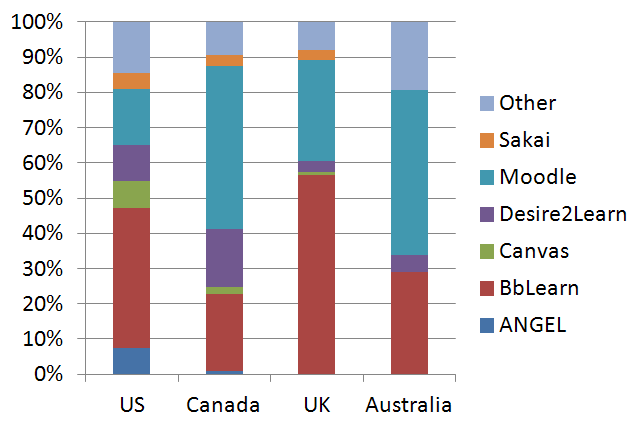
    global_LMS_stacked_by_typeThis is why I have found it surprising how long it is taking to move from survey-based and anecdotal market information to harder data directly measured by the actual LMS implementations. Until recently, that is, when there are at least two very useful sites available.


    Edutechnica

    George Kroner, a former engineer at Blackboard who now works for University of Maryland University College (UMUC), has developed what may be the most thorough measurement of LMS adoption in higher education at Edutechnica (OK, he’s better at coding and analysis than site naming). This side project (not affiliated with UMUC) started two months ago based on George’s ambition to unite various learning communities with better data. He said that he was inspired by the Campus Computing Project (CCP) and that Edutechnica should be seen as complementary to the CCP.

    (more…)

  • Layoffs and reorganization at Blackboard

    Bill Flook, who covers the DC technology scene for Business Journals, just interviewed Blackboard CEO Jay Bhatt about last week’s layoff. The full article can be found here. From a quick read, it looks like Blackboard is executing on two key priorities:

    • Trimming the fat caused by years of acquisitions and redundant operations; and
    • Completing the acquisitions by centralizing core functions, particularly under new management.

    From the article:

    Blackboard Inc. carried out a round of layoffs last week as part of a broader reorganization by CEO Jay Bhatt, the latest in a string of actions aimed at revitalizing the 16-year-old ed-tech behemoth.

    Bhatt, in an interview Tuesday evening, confirmed the job cuts, which he described as “a very small action we took to take some costs out of the business, primarily on things that don’t allow us to get where we need to go.” He declined to specify the number of layoffs.

    As for the priority of trimming the fat, it is now fairly clear that Blackboard is not set to divest any major product lines, but rather will follow a path of centralization. The new management team is a key part of the reorganization plans.

    (more…)

  • MOOC Discussion Forums: barrier to engagement?

    Robert McGuire wrote an article for Campus Technology, Building a Sense of Community in MOOCs, that touches on an important topic – is the centralized discussion forum a barrier to student engagement?

    But more students can also mean more isolation within the crowd. “Online classes can be really lonely places for students if they don’t feel like there’s a community,” notes Maria Andersen, director of learning and research at Instructure, which runs Canvas Network, an open repository where participating schools can deliver their own MOOCs.

    Ironically, the biggest obstacle preventing MOOC students from forming relationships is the feature most relied on to encourage them. Discussion forums are the number one complaint by readers and contributors of MOOC News and Reviews, an online publication devoted to critiquing individual MOOC courses and the evolving MOOC landscape. Most MOOC discussion forums have dozens of indistinguishable threads and offer no way to link between related topics or to other discussions outside the platform. Often, they can’t easily be sorted by topic, keyword, or author. As a result, conversations have little chance of picking up steam, and community is more often stifled than encouraged.

    There are several studies that appear to show that MOOC discussion forums have few students participating and that the forums are dominated by a small number of students.

    (more…)

  • What does Devlin Daley’s departure mean for Instructure?

    Despite all the media hype on MOOCs over the past two years, perhaps the most important recent market entry for ed tech has been Canvas, the LMS from Instructure. Instructure was founded in 2008 by Brian Whitmer and Devlin Daley. At the time Brian and Devlin were graduate students at BYU who had just taken a class taught by Josh Coates, where their assignment was to come up with a product and business model to address a specific challenge. Brian and Devlin chose the LMS market based on the poor designs and older architectures dominating the market. This design led to the founding of Instructure, with Josh eventually providing seed funding and becoming CEO by 2010.

    Michael covered the burst of news in January 2011 that served as the launch of Canvas.

    Instructure has just announced that they will be releasing an open source version of their Canvas LMS product. Between this announcement, the winning of the Utah Education Network contract (109,000 college students and 40,000 K12 students), and the oh-so-ever-brief lawsuit by Desire2Learn about that win, Instructure has been making quite a splash lately.

    Since that time Instructure has grown to 7M+ users, 500 customers and 240 employees while raising $50M in total VC funding. With that much early success, it was a surprise to see Devlin Daley leave the company as of last week with his Douglas Adams reference. (more…)

  • Some big personnel changes in LMS market

    In just the past week we have had three fairly significant people depart higher ed LMS companies. This really is turning out to be a bumpy ride as the market changes.

    • Ray Henderson announced last night that he is leaving his operational role at Blackboard (President, Academic Platforms and CTO) and is moving into a role with the Board of Directors. More info from Jay Bhatt’s post here and Ray Henderson’s post here. Michael is working on an e-Literate post with more information soon. Bill Flook covered in an article here.
    • Devlin Daley, one of the two founders of Instructure, the company behind the Canvas LMS, is leaving the company as of today. I talked to Instructure rep today who indicated that Devlin is looking to get back in to startup ed tech mode, whereas Instructure is becoming a larger company. I’ll write more of an analysis on this move soon. For now I’ll just say that it is extremely rare for a tech founder to leave a company that might go public within a year or two.
    • Al Essa, the Director of Analytics Research and Strategy for Desire2Learn, has left the company to join McGraw-Hill based on his LinkedIn profile. This is curious timing, given Desire2Learn’s major focus on analytics and the Student Success System this year.

    More to come.

  • Moodle has quietly become the dominant LMS for online service providers

    One subject that we have not covered much at e-Literate lately is the market position of Moodle. Given the significant LMS market changes over the past two years, it might be worth considering how institutions are adopting and using Moodle. In the US at least, there has been a significant change – whereas in previous years Moodle growth came primarily from institutions moving away from Blackboard, today much of the growth appears to have shifted to online service providers.

    Traditional US Market

    From 2006 – 2011 Moodle grew quickly in the US, both in terms of the number of users (students, faculty) and in terms of the number of schools adopting Moodle. This growth appears to have slowed considerably since 2011, although the data can be difficult to interpret since the system is open source – anyone can download for free and run Moodle, without even notifying Moodle headquarters or often the institution.

    While the data is inconclusive, my assumption is that traditional Moodle growth – institutions adopting the LMS as the campus standard, typically moving away from Blackboard or WebCT – has significantly slowed from its peak growth in 2009 – 2011. I’ll write a separate post on this subject in the future.

    New Growth Model

    While the traditional growth may have slowed, there is a market segment in the US where Moodle is quietly dominating – as the preferred learning platform (or LMS) for online service providers.

    (more…)

  • This is not your father’s Blackboard

    Thanks for inviting me to this conference in Las Vegas, but I couldn’t help notice there is no After Party. Could you point me to the BbWorld conference instead? . . . What’s that? . . . Really?? Because I just came out of a product roadmap presentation where people were clapping, and not just for improved customer service but actual product usability and features that people want. . . . OK, OK, maybe you’re right . . . But the ex-WebCT folks were actually clapping the loudest. . . . WTH?

    Blackboard’s user conference this year was unlike any previous BbWorld I’ve attended. After the WebCT acquisition in 2006, the user conferences tended to be love-hate events (love the show and good times, hate the acquisition of competitors and tin ear). After the 2009 acquisition of ANGEL and subsequent changes in the management team, the user conferences moderated to ambivalence. Many of the product announcements were exciting in the abstract, but it was not clear that product roadmaps and new features were directly addressing client concerns.

    BbWorld 2013 was the first time that I’ve seen customers have such a positive response to Blackboard presentations. At least from a short-term roadmap perspective, the product changes presented this year seemed to hit the sweet spot of what current customers have been requesting. There was a sense of appreciation and relief from customers that Blackboard was listening and reacting to them. And that is no small feat.

    (more…)