
e-Literate

Present is Prologue

Tag: LMS

  • Open as in Transparent: Instructure Conducts 2nd Public Security Audit on Canvas LMS

    I wrote a series of posts last fall about security testing for higher ed LMS products. In my initial post I called for more transparency.

    We need more transparency in the LMS market, and clients should have access to objective measurements of the security of a solution. To paraphrase Michael Feldstein’s suggestions from a 2009 post:

    • There is no guarantee that any LMS is more secure just because they say they are more secure
    • Customers should ask for, and LMS vendors should supply, detailed information on how the vendor or open source community has handled security issues in practice
    • LMS providers should make public a summary of vulnerabilities, including resolution time

    I would add to this call for transparency that LMS vendors and open source communities should share information from their third-party security audits and tests. All of the vendors that I talked to have some form of third-party penetration testing and security audits; however, how does this help the customer unless this information is transparent and available. Of course this transparency should not include details that would advertise vulnerabilities to hackers, but there should be some manner to be open and transparent on what the audits are saying.

    Subsequently I was asked by Instructure to serve as an embedded reporter as they undertook a public security audit. In a post from January 2012, Josh Coates called for other LMS vendors to follow suit.

    Despite the lack of response, Instructure declared their intent to test again in fall 2012.

    We will kick off our second annual open security audit in Q4. We invite any and all education companies to participate. We think education should be open, safe, and secure — and that corporations should be held accountable for their claims.

    Second Annual Audit for Canvas LMS

    True to their word, Instructure conducted another audit this year, again using Securus Global, described in this blog post and documented in this Securus report. I did not act as an embedded report this time around, but I would like to highlight some of the findings from the report.
    (more…)

  • Canvas Network – Are the LMS and MOOC Markets Colliding?

    Six weeks ago I posted a new graphic on the LMS market which included MOOCs in the same view as traditional LMS solutions.

    In the comments to the post there was an interesting note from Josh Coates (Instructure CEO) in response to whether MOOCs should be so closely aligned with the LMS market:

    i agree with you [fellow commenter Bob Puffer] that MOOCs aren’t the same thing as an LMS and should be accounted for differently.

    With the recent news of the Coursera / Antioch partnership as well as Instructure’s release of the Canvas Network, I believe we are starting to see the LMS market overlap with the MOOC market, although I do not see them completely merging. After offering to fix Josh’s broken shift key, I’d like to explore the prospects for the Canvas Network to compete in the MOOC marketplace.

    (more…)

  • CEO Transition at Blackboard is Latest Move in Corporate Turnaround

    On Monday of this past week Michael Chasen announced that he is leaving Blackboard, the company he co-founded in 1997 and has led as CEO since 2001. Blackboard simultaneously announced the appointment of Jay Bhatt, a software industry executive as the immediate replacement.

    As Rip Empson has noted in TechCrunch, this is the end of an era. I agree with Josh Kim and Ray Henderson in calling out Michael Chasen’s role as an industry pioneer, and I would argue that Chasen was the leading force in creating the enterprise-level, mission-critical educational technology market. Henderson also points out that Chasen played a leading role in developing a sustainable revenue model that enabled much of the transformation seen over the past decade.

    Empson described in his article that this are two sides of this latest story from Blackboard.

     This week, in a letter addressed to “The Education Community,” Michael Chasen stepped down as the CEO of edtech software giant, Blackboard. In a way, it’s the end of an era. Whether or not it was an “era to remember” remains to be seen.

    Why is this significant? Because of what Blackboard has come to represent — both for good and for ill. On the one hand, the company became one of the biggest success stories in the education space, bringing mainstream consumer and investor attention (and scale) to an industry that previously had little. But that’s only one part of Blackboard’s story.

    What should we expect from the future Blackboard? I believe the best way to understand future changes at Blackboard is to view the CEO transition as the latest move in a corporate turnaround – and an unsurprising move .

    (more…)

  • Please Fill Out the Campus Computing Survey

    This is an incredible time of change in the United States higher education LMS market. Here are just some of the relevant developments that are driving big movements:

    • WebCT is in its last year of Blackboard support, forcing many campuses to migrate either to Blackboard or to something else.
    • Instructure is on an absolute tear, growing at an unprecedented rate.
    • Blackboard acquired Moodlerooms, the best known Moodle support vendor in this market.
    • Desire2Learn got a major infusion of cash, presumably based on their own market success.
    • Recent turmoil in the Sakai OAE project is causing the Sakai community to go through a period of reflection and retrenchment.
    • New LMS entrants are coming into the market right and left, including but not limited to MOOC platforms like Coursera.

    We all have our observations and intuitions about what all of this adds up to in terms of the big picture. But if you really want to know what is going on, there is only one place to go to get reliable, solid, proven data: the Campus Computing Project. I know that campus folk get inundated with surveys on top of the increasingly onerous workloads. But if you want a clear picture of what is going on in the LMS market today, then I urge you to fill out the Campus Computing survey or, if you are not the person responsible for doing so, then let the person on your campus who is responsible know just how important you think the survey is. The survey closes on October 24th and goes public at EDUCAUSE on November 7th.

    Please take this seriously.

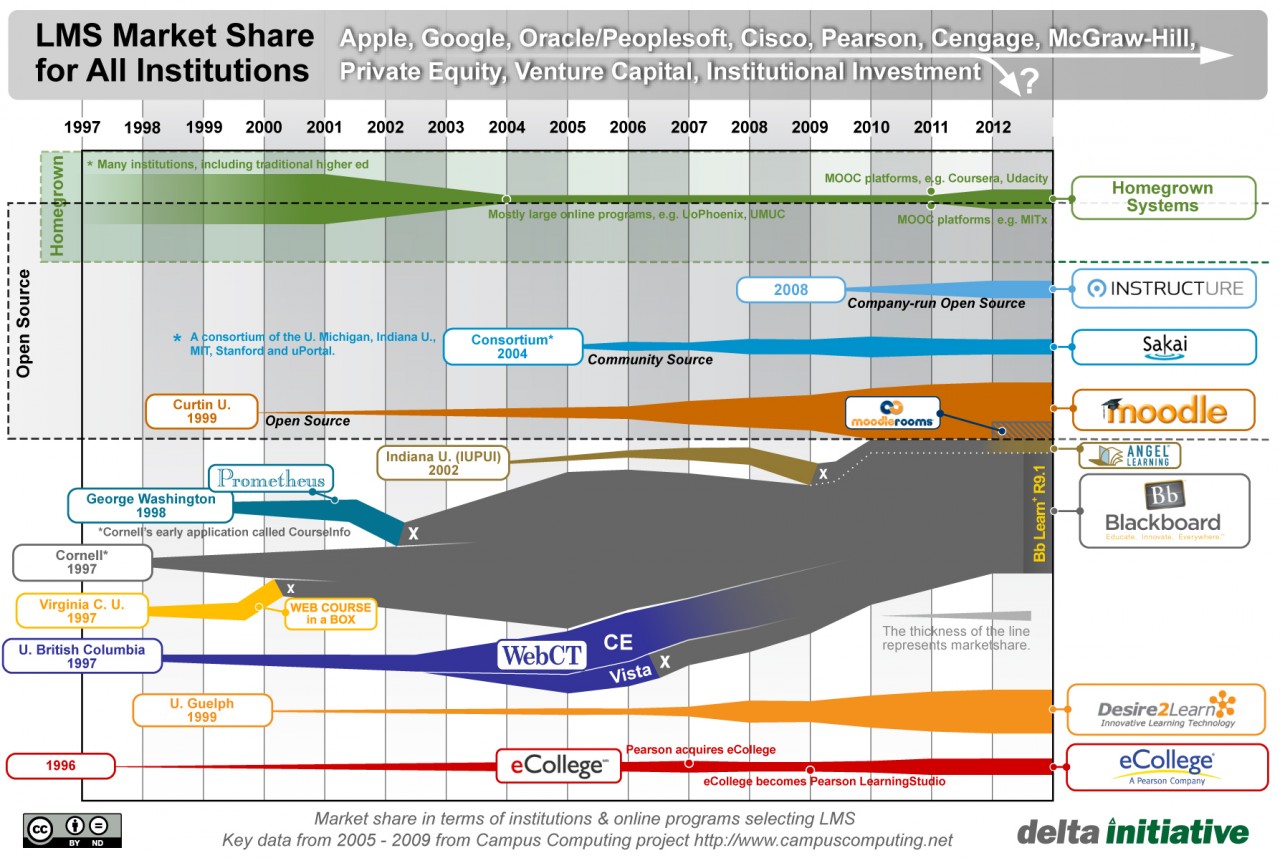
  • State of the Higher Education LMS Market: A Graphical View

    The transformation of the higher education LMS market continues, and I expect more changes over the next 2 – 3 years. However, it seems time to capture the state of the market based on changes over the past year or two.

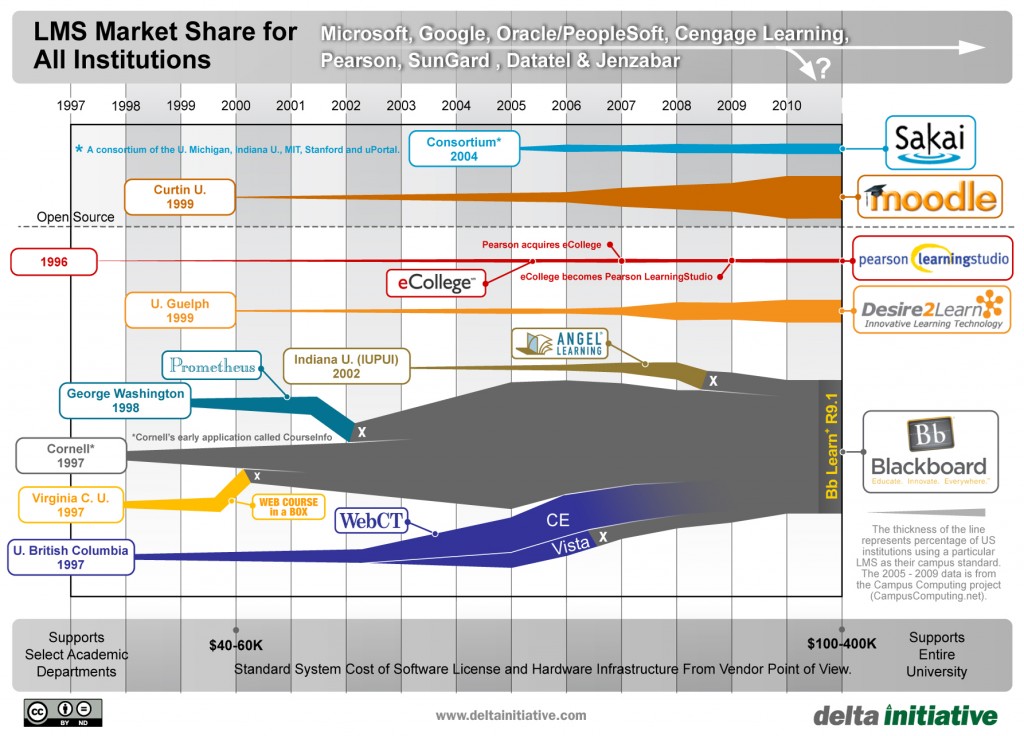
    I shared the most recent graphic summarizing the market in mid 2011. As with all previous versions, the 2005 – 2009 data points are based on the Campus Computing Project, and therefore is based on US adoption from non-profit institutions. This set of longitudinal data provides an anchor for the summary.

    The most significant changes over the past two years include the following.

    (more…)

  • Now UC Berkeley and Charles Sturt University Leave Sakai OAE

    Just three months ago, the University of Michigan and Indiana University made a joint decision to “pause investment” in the Sakai OAE project. The latest news is that the University of California Berkeley and Charles Sturt University (in Australia) have also decided to leave the Sakai OAE project. The only schools remaining as part of the Sakai OAE Steering Group are New York University, Cambridge University, and Georgia Tech.

    Ken Romeo from Stanford has an excellent post summarizing the Berkeley and Sturt announcement and resulting community discussions, based on his first-person experience in the early version of OAE. It is worth reading his entire post, but I’ll quote a few key sections.

    (more…)

  • Google Introduces Course Builder, an Open Source Project Targeted at MOOCs (but the Real Competitor Might Be Amazon)

    Google quietly made an educational technology announcement yesterday about the release of Course Builder, an “open source project” targeted at massive open online courses (MOOCs). This platform follows on the heels of Google’s own MOOC this summer. We should find out more information over the coming months, but here are my initial observations after reading the Research Blog on Google’s site:

    In July, Research at Google ran a large open online course, Power Searching with Google, taught by search expert, Dan Russell. The course was successful, with 155,000 registered students. Through this experiment, we learned that Google technologies can help bring education to a global audience. So we packaged up the technology we used to build Power Searching and are providing it as an open source project called Course Builder. We want to make this technology available so that others can experiment with online learning.

    We really shouldn’t be surprised at Google’s interest in the MOOC movement, since Peter Norvig, their Director of Research making the announcement, was one of the two professors at Stanford, alongside Sebastian Thrun, to develop and teach the influential Artificial Intelligence course (CS221). This course started the Stanford branch of MOOCs (also known as xMOOCs). Coursera and Udacity spun out as venture-funded startup companies based on the internal Stanford MOOC courses.

    (more…)