
e-Literate

Present is Prologue

Tag: Massive open online course

  • Unizin: Indiana University’s Secret New “Learning Ecosystem” Coalition

    Indiana University has been the driving force behind the creation of a new organization to develop a “learning ecosystem”. At least ten schools are being quietly asked to contribute $1 million each over a three-year period to join the consortium. The details of what that $1 million buys are unclear at this point. The centerpiece for the short-term appears to be a contract with Instructure for use of the Canvas LMS. But there are also hints of ambitious plans regarding learning object repositories and learning analytics.

    What is remarkable is the level of secrecy surrounding the project. Several sources from involved schools have indicated that very few people have been informed regarding their institutions’ prospective involvement. When school discussions do take place, care is being taken to keep them quiet. For example, a video recording of a presentation to faculty about Unizin at Colorado State University has since been removed from public access after it received some attention on Twitter (although e-Literate downloaded a copy of the video before it was removed from public access).

    Nevertheless, details of the project are beginning to leak out. In this post, I will share the facts that we have been able to confirm. Phil and I will both follow on with some analysis and inferences early next week. And of course, we will continue to bring you updates as news breaks.
    (more…)

  • New e-Literate TV Series on MOOCs

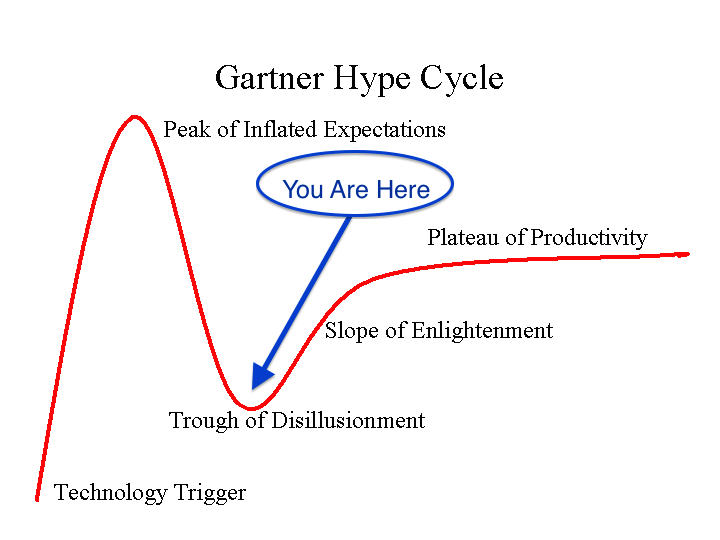
    hypecycle

    If 2013 was the year that MOOC mania peaked in the Gartner hype cycle, then surely 2014 is the year in which they have entered the trough of disillusionment. And just as it was important last year to push back on the inflated expectations, it will be equally important this year to make sure we don’t throw out the baby with the bath water.

    With that in mind, I’m pleased to announce our new e-Literate TV series, “Massive and Open: What Are We Learning?” Filmed at the 2013 MOOC Research Initiative (MRI) conference, it delves into the current state of knowledge of the field. The interview with Stanford’s Amy Collier from our pilot series should really be considered Episode Zero for the series, as it explores the value of the first generation of MOOCs (particularly xMOOCs). To that, we have added three episodes from the new series:

    1. MOOC Research Initiative Grant Projects: After a brief introduction with MRI lead researcher George Siemens, Phil and I talk to a number of the grantees about the research they are undertaking. The range of research questions is eye-opening.
    2. MOOC Point/Counterpoint: We intercut interviews between MOOC enthusiast Keith Devlin and MOOC skeptic Jonathan Rees. The result is a rich and nuanced dialog between these two smart guys.
    3. Crowdsourced Answers to Popular MOOC Questions: We got MRI conference attendees to give their answers to frequently asked MOOC questions. The answers are varied and give a good sense of just how much our thinking about MOOCs is still all over the place.

    Enjoy!

  • A response to New Yorker article on ‘A MOOC Mystery’

    The New Yorker published an article yesterday titled “A MOOC Mystery: Where Do Online Students Go?” which tried to explain low MOOC completion rates by comparing the situation to the General Educational Development (GED) exam. Right off the bat, the article conflates MOOCs with “online students”. MOOCs are but one form of online education, and a very recent one at that. Worse, however, is that the entire basis for the article is quite flawed – GED results do not give much insight into MOOC students patters, and it turns out there is not much of a mystery in the first place.

    The hook in this article seems to be the coincidence of two numbers [emphasis added]:

    (more…)

  • Massive, Open, and Course Design

    Martin Weller has a great blog post up about course design responses to MOOC completion rates. He starts by arguing that, while completion rates are not everything in MOOCs, they are not nothing either. A lot depends on whether you think completion is an important metric to meet the course goals because, for example, the course is designed to help remedial students pass into a non-remedial track, or whether having students explore the content in a non-comprehensive way accomplishes your course goal. (Martin brings up an analogy by Stephen Downes that nobody complains about the low newspaper completion rates, which I have never heard before and which I love.)

    This is good stuff, but it starts us down the path toward a more radical re-examination of how we think about course design. Because while Martin is focusing primarily on course goals and how those should determine metrics, he’s beginning to raise the question of how individual learner goals should influence course design. And once you start asking that question, it changes everything.

    (more…)

  • MOOC history as presented at AACN13 conference

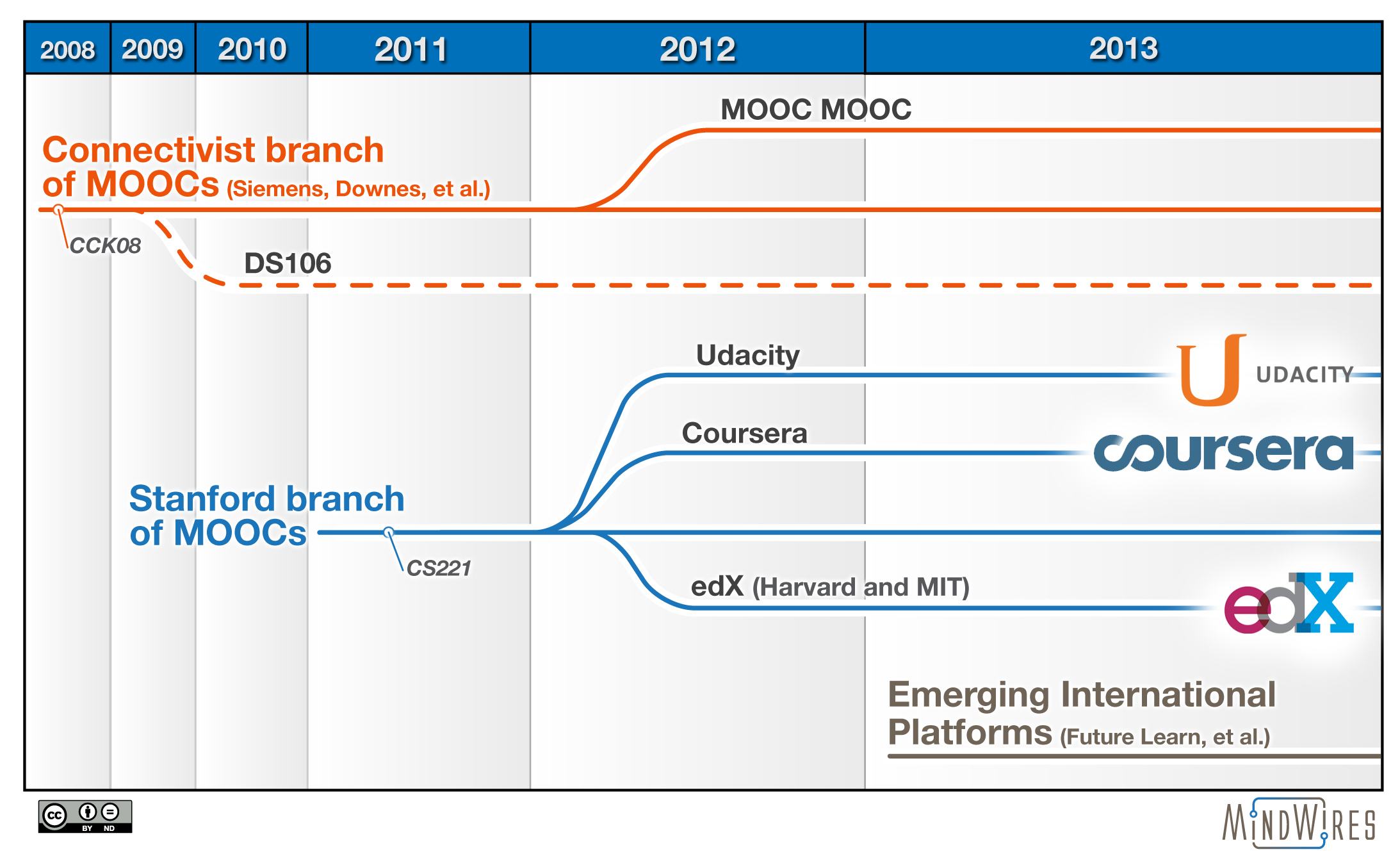
    With all of the great discussions spawned by the “greatest MOOC conference in the history of MOOCs” (MRI13), it seems a good time to share a segment of a keynote presentation I gave last year on MOOC history. This presentation was at the American Association of the Colleges of Nursing (AACN) conference in April 2013. For context, I had just shared how online education was no longer an issue kept in the corner, away from mainstream higher ed, but was now affecting the traditional campus discussions.

    There is a relevant graphic that was shown during this segment of the talk, showing the MOOC timeline (updated version shown below).

    MOOCpreHistory20131202

  • Right to Access Report Links and Upcoming Event

    As we announced the other day, Phil and I have written a report sponsored by the 20 Million Minds Foundation responding to California SB 520, a.k.a. the “MOOC bill,” and making some recommendations for the governor and legislature to consider as they attempt to tackle the bottleneck course problem in the current budget discussions. You can see more about the report on 20 Million Minds website here. Ry Rivard of Insider Higher Education has a good write-up of the paper here.

    Phil and I will doing a CrowdHall event Tuesday through Friday of next week. CrowdHall basically lets anyone ask questions (asynchronously) and then have participants vote up the best questions for responses by the “speakers.” I have no idea how well it will work, but I’m interested in trying it. We will be serializing the paper here on e-Literate during those days, posting a new section and some commentary each day to try to stimulate discussion. The event starts at 9 AM PST and ends at 2 PM PST each day (although how much those times mean during an asynchronous event is not clear to me).

  • We’re from the Valley and We’re Here to Help

    The other week I had the pleasure of attending the annual GSV Advisors Education Innovation Summit in Scottsdale. For those who aren’t aware, the main purpose of the event is to help ed tech startups and investors find each other. After last year’s summit, I wrote a post called “What Are Ed Tech Entrepreneurs Good For?“, the main lessons of which could equally apply to this year:

    • The main stage speakers generally tilted to the right, ideologically (although there was a visible effort to achieve more balance this year). But by and large, that didn’t matter, since the important work of the conference was generally driven by what ed tech startups were available for funding.
    • Many of the ed tech entrepreneurs have good intentions but varying degrees of knowledge about the theory and pragmatics of education.
    • The degree to which ed tech entrepreneurs need that knowledge varies widely depending on the specifics of what problems they are trying to solve with their offerings.
    • The success or failure of these startups are often heavily influenced by the market conditions, which means that we should be thinking about things like improving institutional purchasing practices if we want more from our vendorsThe main difference this year was that the conference was roughly twice the size of last year’s.

    I’ll have more to say about the dynamism and/or frothiness of the ed tech startup market in a future post. For now, I want to focus on that continuing disconnect between what happens on the main stage of the conference and what happens in the rest of it, because I think there is a lost opportunity. (more…)