e-Literate

Present is Prologue

Tag: MOOC

  • Some validation of MOOC student patterns graphic

    File this under “you read it first on e-Literate”.

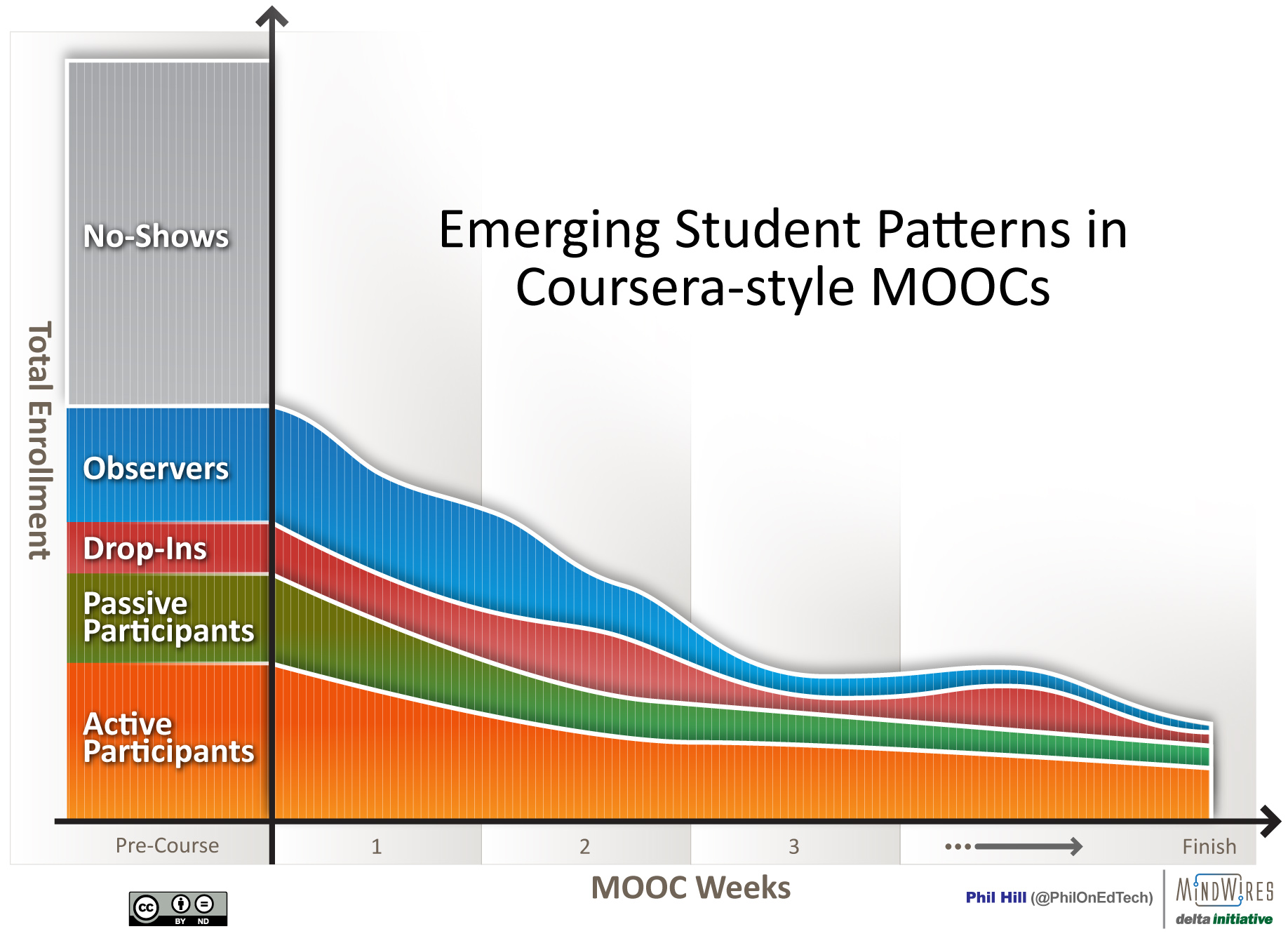
    In previous posts from spring 2013 I provided a graphical view on MOOC student patterns based on observed retention over time as well as differing student types. This graphic was based on anecdotal observations of multiple MOOCs, mostly through Coursera.

    studentPatternsInMoocs3-2


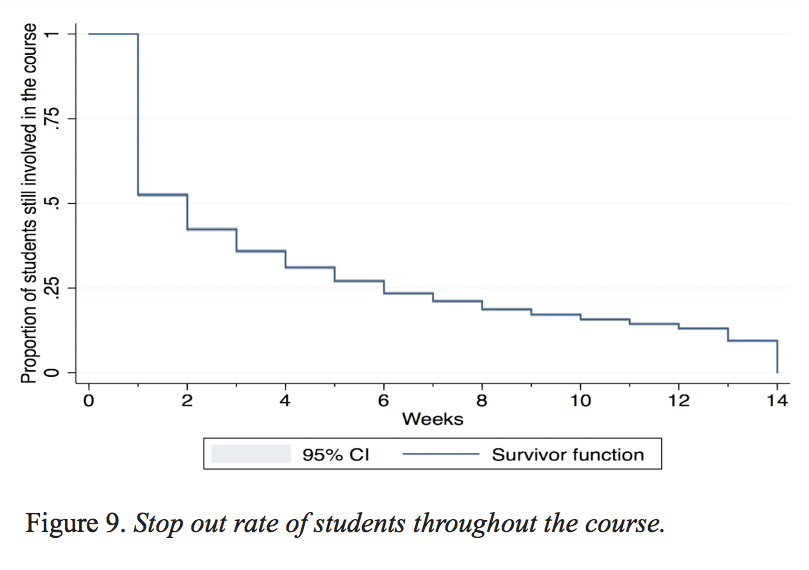
    Based on a recent study of the edX Circuits and Electronics MOOC, there is this interesting chart of student patterns based on actual data analysis of the 155k students from the spring 2012 offering of this course. The full report is worth reading, by the way, with some real student pattern insights.

    edX Retention


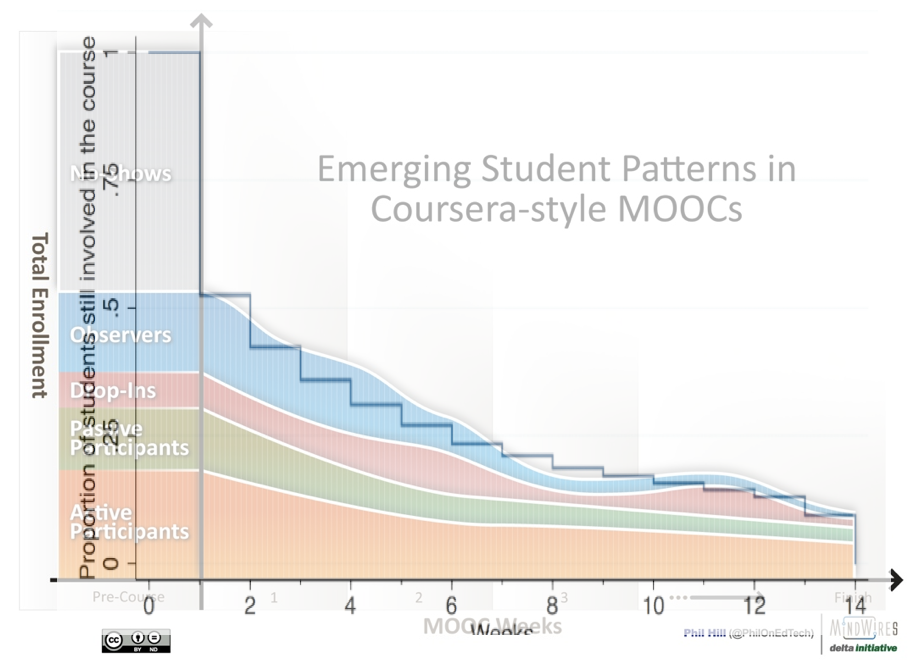
    I took this chart and overlaid it on the MOOC student patterns graphic, scaling for 0% / 100% of enrollment vertically and start / stop of course horizontally.

    Combined MOOC patterns


    It’s good to see this validation of the overall retention pattern based on real data analysis to augment the original graphic’s model.

  • SJSU Plus Udacity Pilots: Lack of transparency in describing data

    Alternate Headline: “Our Long National Nightmare is Over – SJSU and Udacity solve problem of college graduates being able to pass remedial math”

    The more I read on SJSU’s announcement on the pilot program, the more troubled I am with the lack of clear description of student population change (I wrote briefly about the change in student populations yesterday). In a nutshell, the spring 2013 pilot was completely different in the major demographic variables than the summer 2013 pilot. That’s good, right, showing that SJSU and Udacity are learning their lessons? It would be good if SJSU clearly described the student differences and avoided any implications that the numbers could be compared. Further, it would be good to avoid misleading comparisons to face-to-face courses at SJSU.

    But that is not what is going on. SJSU, in particular, is going out of its way to compare spring, summer pilots alongside SJSU on-campus courses in its media blitz. And the strategy is working, based on the articles that came directly from SJSU / Udacity interviews and information releases.

    (more…)

  • SJSU Plus / Udacity Update: Different student populations

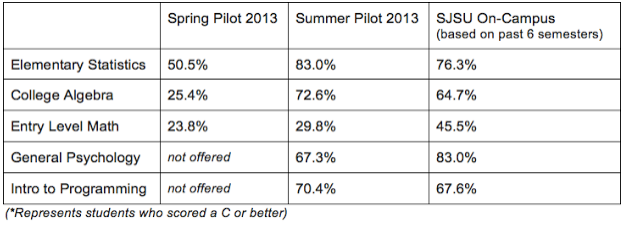
    San Jose State University (SJSU) and Udacity have announced the results of their summer pilot, and the headlines cover the big improvements (text from IHE article, table from Udacity blog).

    Thrun recently hinted that the summer pilot’s results would be more positive, and that Udacity was getting close to finding the “magic formula” to deliver high-quality, low-cost education.

    The lone holdout among the SJSU Plus courses is entry-level math, which saw the smallest increase in students who received a passing grade, from 23.8 to 29.8 percent. That places the pass rate almost 40 percentage points below the closest SJSU Plus course, and about 15 percentage points below the pass rate of the on-campus course.
    Thrun Blog

    I am not trying to throw cold water here, but it is very important to look at the student populations. To his credit, Sebastian Thrun describes the big differences in his blog post.

    This summer, we ran the second instance of our pilot. While in the Spring, we actively sought out underserved high schools from low-income areas in California, this time we simply opened up enrollment to anyone. As predicted, with 2,091 students who enrolled, we mainly reached students who would not ordinarily attend college. Only 11% of the summer students who took the for-credit courses from SJSU were matriculated students in one of the California State Universities. 71% of our students came from out of state or foreign countries. And while the total number of high school students went up, their proportion in the total student body went down. [snip]

    One key difference between Spring and Summer was that we opened our Summer session to everyone. This led to a substantial difference in student body. Among the student body, 53% reported that they already hold a post-secondary degree (5% Associate, 28% Bachelor’s, 16% Master’s, and 4% Doctorate). Only 12% of the students had a high school graduate diploma or equivalent, and 15% were active high school students. This is very different from the Spring Pilot, in which approximately 50% of the student body were active high school students, and the other 50% were matriculated SJSU students. [emphasis added]

    One of the key success factors of online education is to target student populations who can succeed in this environment. If you target groups (remedial students, underserved students, high school students), then there must be tremendous student support.

    Pay attention to the student populations – this might be the real story. If you ignore the difference in student populations, you might draw the wrong conclusions.

  • You know what would help MOOC articles? Getting the facts and goals right before analyzing

    Keith Devlin has an article at Huffington Post today titled “MOOC Mania Meets the Sober Reality of Education”. The premise is that the halting of the San Jose State University (SJSU) / Udacity pilot project and of SB 520 show that naive assumptions on the power of MOOCs to disrupt higher education are insufficient in reality – education is too complex. While the overall article has some good points, the very foundation of the article is flawed.

    I have written about both issues – SJSU program and SB 520 – and agree that there were flaws in both. Michael and I co-wrote a position paper for 20 Million Minds Foundation making recommendations to change and improve California legislation, and we have been critical of overly-simplistic views of higher education disruption. But authors should at least characterize the goals of each program accurately before drawing conclusions. The HuffingtonPost article has three glaring problems that undercut its entire message.

    Problem 1: Getting the explicit goals wrong

    Devlin begins:

    Politicians who saw MOOCs as a means to cut the cost of higher education are having to think again after two high-profile initiatives in California recently came to a crashing halt.

    Did politicians see “MOOCs as a means to cut the cost of higher education” in both of these programs? Let’s look at the stated goals for the SJSU program:

    This marks the first time that a broad and diverse range of students, not just matriculated students, will have access to online college classes for credit from an accredited university at a very affordable price of $150 per course, about the same as a course at the California Community Colleges.

    The pilot’s target population includes underserved groups such as high school students who will earn college credit, waitlisted students at California Community Colleges who would otherwise face out-of-state or private options, and members of the armed forces and veterans. [emphasis original]

    (more…)

  • MOOC Mania: Stanford AI Course Creates Media Sensation Two Years Ago

    It was two years ago, give or take a week, that the MOOC mania started. Think about the effects on higher education of this seminal event and how short a time it has been. In the past two years online education and ed tech have moved into the front pages, being discussed in the front pages of leading newspapers, popular media magazines, and in president’s cabinets and board meetings for most institutions. Previously, online education was discussed in small circles and specific contexts, but not as a dominant theme whenever higher education was the topic.

    Below is a brief (and incomplete) timeline of the national media articles as MOOC mania started in August 2011. I have not included ed tech blogs in this list, but it is worth noting that George Siemens wrote about the new MOOC on August 4 – exactly two years ago.

    And the rest, for better or worse, is history. Let me know if I’ve missed any key articles in this time frame, and I’ll update.

  • New Post at WCET: Update on California Online Initiatives

    I have a new post up at WCET with updates on the California Online Initiatives driven by state government, including today’s news that SB520 is on hold.

    The big news today is that the controversial bill seeking to allow for-credit partially-outsourced online education in California has been put on hold until at least 2014. [snip]

    On the surface, it appears that higher education insiders might have defeated state government efforts to take a leading role in online initiatives. SB520 is on hold and possibly dead, and most conditions on the additional funding have been removed.

    If you look under the surface, however, the outcome is not as clear. It turns out that the systems are in fact changing their priorities and investing in online to help matriculated students complete degrees at a lower cost, which was the original goal of state government leaders.

    There’s more information there, including news on the University of California’s and California State University’s two new online initiatives.

  • ELI Podcast: Emerging Issues Around MOOCs

    Michael and I were interviewed by Veronica Diaz for the EDUCAUSE Learning Institute (ELI) podcast series. The theme was looking not at where MOOCs are today, but at where MOOCs might go in the future. The interview is about 13 minutes in length and covers questions such as:

    • Coursera just raised $43m of funding – what potential do investors see in MOOCs?
    • Based on recent Forbes article – do you see MOOCs as replacing parts of traditional higher ed?
    • Will growing numbers of online students reduce hesitation of employers to hire online students? How does this affect institutions being proxies for quality?
    • What applications are there for MOOCs beyond academic programs? (with interesting answer from Michael based on DS106)

    You can access the podcast on iTunes under the EDUCAUSE channel (just search ‘educause’ and go to episode 18), through the EDUCAUSE site, or by the link below.