e-Literate

Present is Prologue

Tag: MOOC

  • Coursera blocked in Iran due to human grading and discussion forums?

    Update: I just received confirmation from a Coursera spokesperson that the description of facts about Coursera’s block of student access in this and my previous blog post is accurate. They cannot comment on the rest of the professor’s statement nor on Udacity and edX.

    Yesterday I wrote about Coursera having to block access to its courses from students in Iran, Syria, Cuba and Sudan. Kris Olds covered this subject in more detail this morning as did Carl Straumsheim at Inside Higher Ed. The nub of the issue is that the US government (the State Department I believe) has declared MOOCs as educational services rather than information or informational materials, and thus the courses are subject to US embargoes of the four countries in question.

    According to IHE, Udacity “has not received official word about enrolling students in countries subject to economic sanctions”, and EdX has a license to operate in Iran, Syria and Cuba. So the issue is mostly with Coursera, although not by their decision.

    If a recent post from a Coursera instructor is accurate, we may now know what triggered the classification of MOOCs as a a service subject to sanctions. I was notified by a trusted reader that Ebrahim Afsah from the University of Copenhagen (yes, the same one from the story about abusive discussion forum posts) send a message this afternoon to all students in his MOOC “Constitutional Struggles in the Muslim World” (registration required). He quotes a message from Coursera to MOOC instructors that includes the new information [emphasis added].
    (more…)

  • Coursera and Udacity, but not edX, blocked in Syria and Iran

    One of the most-cited aspects of Massive Open Online Courses (MOOCs) is their openness – anyone can access the courses with just Internet access and and email address. But this openness might not be valid in all countries based on recent actions.

    The media site Wamda, which focuses on supporting entrepreneurs in the Middle East and North Africa (MENA) region, has a story out today describing how Coursera and Udacity MOOCs have apparently been blocked in Syria and Iran [see update below on Syria].

    Just over six months ago, online education platform Coursera thanked a Syrian doctor for a poignant blog post that spoke directly to its mission to change the world by educating the masses. [snip]

    Yet today, Dr. Angrimi no longer has that lifeline, as Coursera appears to have blocked Syrian IPs since Friday.

    “Our system indicates that you are attempting to access the Coursera site from an IP address associated with a country currently subject to U.S. economic and trade sanctions. In order for Coursera to comply with U.S. export controls, we cannot allow you access to the site.”

    (more…)

  • Educational videos now outrank cat videos – my ticket onto NPR

    From NPR this morning:

    With 1 billion unique visitors per month, YouTube offers a glimpse of the online world’s tastes and interests. And this year, one notable trend — for better or worse — is that people are spending more time watching videos about video games. [snip]

    In case this has you thinking, “Oh great, another way that YouTube has given us to waste time (as if cat videos weren’t enough),” here’s the good news: The number of people watching educational videos on YouTube has surpassed cats.

    And with that premise, I found my ticket onto NPR (segment starting at 2:54).

  • SJSU and Udacity End Game: 3 courses to be offered for-credit on Canvas LMS

    After a great deal of publicity from their spring and summer pilots, San Jose State University has just announced that they will offer three of the courses again in Spring 2014 – but with a twist. On the surface, the announcement sounds like a continuation of the pilot.

    This spring, San Jose State will offer three online courses that were developed with Udacity to SJSU and California State University students.

    San Jose State students are registering now for Elementary Statistics, Introduction to Programming and General Psychology. In addition, the programming and statistics courses will be open to all CSU students through the CSU’s CourseMatch program.

    But after digging deeper, it really appears that this is an effort to separate without admitting failure or making either side look bad. There are some significant changes here:

    • Udacity is no longer being paid for the courses;
    • All the course content is free and open to SJSU and CSU faculty;
    • The for-credit course content will be on Udacity platform but faculty interactions and assessments will be run on SJSU’s official LMS (Canvas); and
    • SJSU will provide the teaching assistants.

    (more…)

  • MOOC history as presented at AACN13 conference

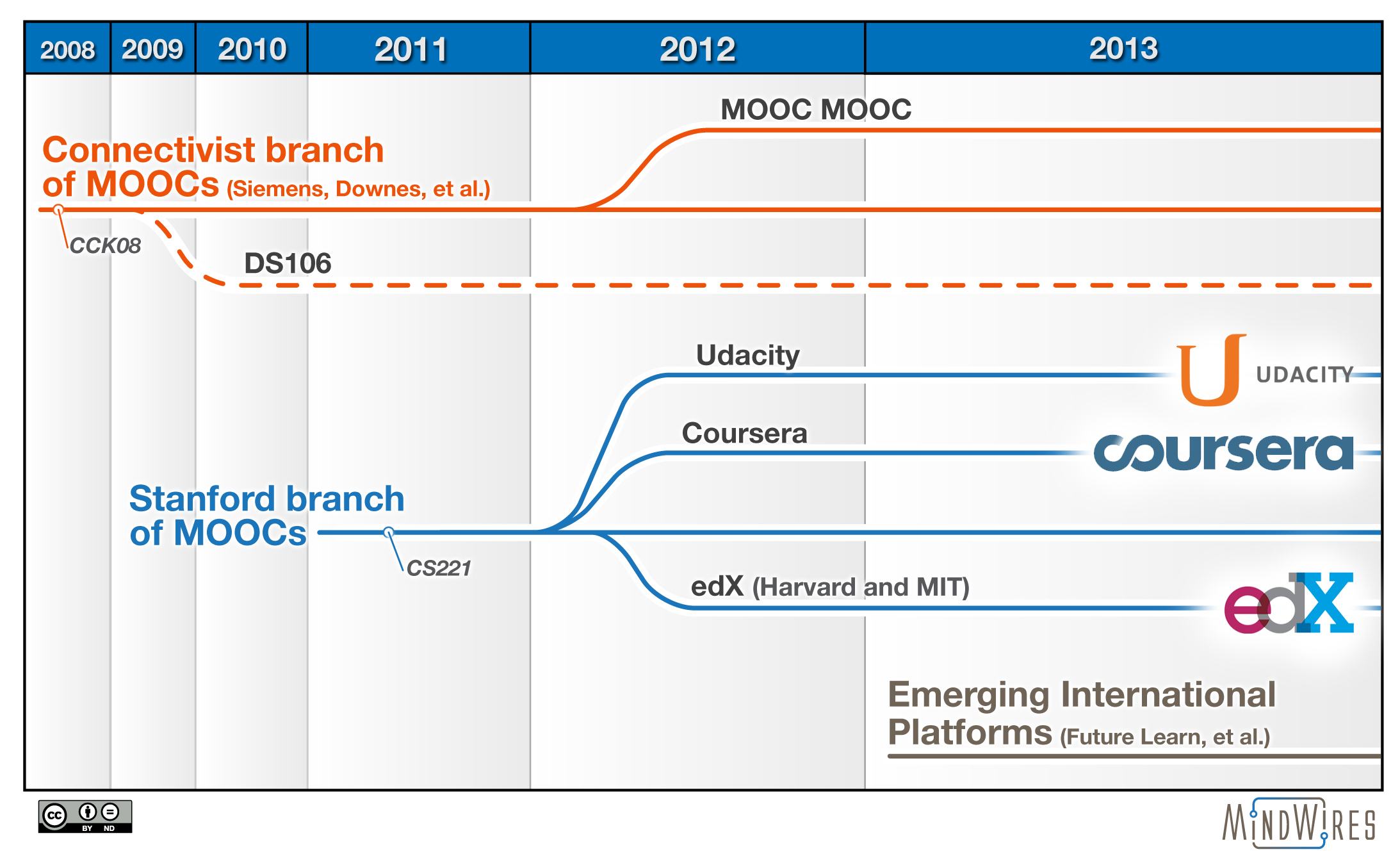
    With all of the great discussions spawned by the “greatest MOOC conference in the history of MOOCs” (MRI13), it seems a good time to share a segment of a keynote presentation I gave last year on MOOC history. This presentation was at the American Association of the Colleges of Nursing (AACN) conference in April 2013. For context, I had just shared how online education was no longer an issue kept in the corner, away from mainstream higher ed, but was now affecting the traditional campus discussions.

    There is a relevant graphic that was shown during this segment of the talk, showing the MOOC timeline (updated version shown below).

    MOOCpreHistory20131202

  • State of the Anglosphere’s Higher Education LMS Market: 2013 Edition

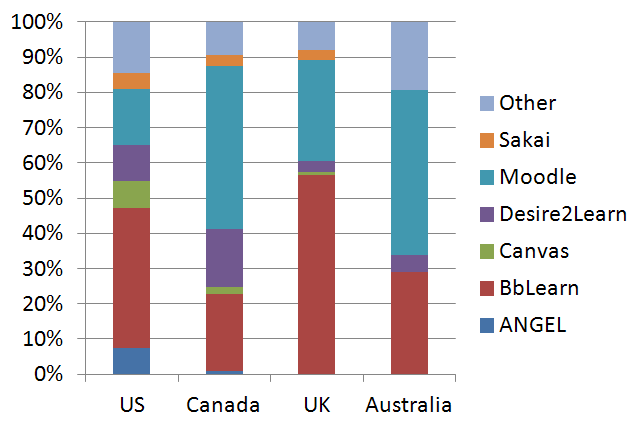
    I shared the most recent graphic summarizing the LMS market in September 2012, and thanks to new data sources it’s time for an update. As with all previous versions, the 2005 – 2009 data points are based on the Campus Computing Project, and therefore is based on US adoption from non-profit institutions. This set of longitudinal data provides an anchor for the summary.

    What I’ve been attempting to do lately is to expand the market definition beyond the US. Last year I used some heuristics:

    LMS_MarketShare_20121018-Home

    (more…)

  • New data available for higher education LMS market

    Despite much talk about the demise of the LMS market, the end is nowhere in sight. Unlike many of the newer learning platform concepts (e.g. MOOCs, free platforms, unbundled learning platforms), the LMS market has an established business model and real revenues. Just today came news of an investment analysis report predicting that total LMS market (higher ed, corporate training, K-12) would triple in revenue by 2018, moving from $2.6B to $7.8B. The LMS ain’t sexy, but it’s still important.

    global_LMS_stacked_by_typeThis is why I have found it surprising how long it is taking to move from survey-based and anecdotal market information to harder data directly measured by the actual LMS implementations. Until recently, that is, when there are at least two very useful sites available.


    Edutechnica

    George Kroner, a former engineer at Blackboard who now works for University of Maryland University College (UMUC), has developed what may be the most thorough measurement of LMS adoption in higher education at Edutechnica (OK, he’s better at coding and analysis than site naming). This side project (not affiliated with UMUC) started two months ago based on George’s ambition to unite various learning communities with better data. He said that he was inspired by the Campus Computing Project (CCP) and that Edutechnica should be seen as complementary to the CCP.

    (more…)