
e-Literate

Present is Prologue

Tag: MOOC

  • Educational Technology and the Sources of Innovation

    Based on Jon Udell’s excellent post, I spent the weekend getting reacquainted with work of Eric von Hippel, the researcher who pioneered the study of user-driven innovation.

    What’s interesting about von Hippel is that his research hits on the common themes of the open education movement, but does so in a slightly different key.

    Briefly, there are a number of intersecting debates about MOOCs. There is what Reich frames as the Dewey/Thorndike debate about what learning is. There is the centralized/de-centralized debate about what the web does best. There is the debate about about whether MOOCs are disruptive or innovative or neither, and the discussion over how much ability to remix teachers need to make classroom learning work well (answer, probably, is quite a bit).

    But people on both sides of the debates are often driven by a larger question that we are not naming directly enough: “What are the sources of innovation?”

    User Innovation

    This is the question that von Hippel has been investigating for over thirty years now. And if we see innovation not as something that has happened, but as something we want to continue to happen, this may be the most important question of all.
    (more…)

  • Combining MOOC Student Patterns Graphic with Stanford Analysis

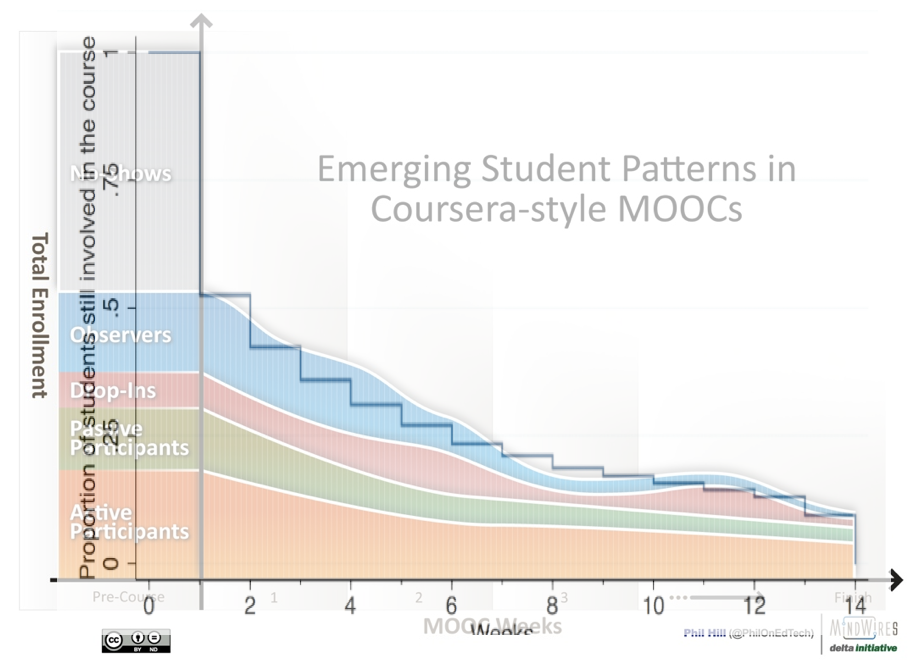
    In part 1, part 2, and part 3 of this series of posts on MOOC student patterns, I shared a description of five student patterns emerging from open-enrollment MOOCs (excluding those with an associated student fee) based on anecdotal data.  In part 4 I compared the overall course completion pattern against an MIT study of the first edX MOOC, leading to some validation of the general shape of when participants drop out.

    Combined MOOC patterns

    The model and typology has gained traction recently, being referenced in both the Government of Ontario’s  environmental scan and literature review [pp 32-33, 40] as well as the British government’s The Maturing of the MOOC literature review [pp 26-28]. So that means it’s time to update and keep people on their toes.

    (more…)

  • Two MOOC curriculum announcements in one week

    In two apparently unrelated announcements, both MIT and Wharton announced they were moving beyond just courses and putting significant parts of their curriculum into MOOC platforms, both with identity verification. MIT is putting several undergraduate sequences online through MITx (their implementation of  edX), while Wharton business school is putting a “foundation series” of first-year courses online through Coursera.

    First the MIT news from Inside Higher Ed (see the Chronicle for additional coverage):

    The Massachusetts Institute of Technology will this fall package some of its online courses into more cohesive sequences, just as edX prepares to roll out certificates of completion using identity verification. Seen together, the two announcements may provide a glimpse at what the future holds for the massive open online course provider.

    The “XSeries” sequences add a new layer of structure to MITx, the institution’s section of the edX platform. The first of seven courses in the Foundations of Computer Science XSeries will be offered this fall, with one or more new courses being rolled out each semester until the fall of 2015. The Supply Chain Management XSeries, consisting of three courses, will begin in the fall of 2014. The two sequences will target undergraduates and working professionals, respectively. [snip]

    (more…)

  • MOOC Discussion Forums: barrier to engagement?

    Robert McGuire wrote an article for Campus Technology, Building a Sense of Community in MOOCs, that touches on an important topic – is the centralized discussion forum a barrier to student engagement?

    But more students can also mean more isolation within the crowd. “Online classes can be really lonely places for students if they don’t feel like there’s a community,” notes Maria Andersen, director of learning and research at Instructure, which runs Canvas Network, an open repository where participating schools can deliver their own MOOCs.

    Ironically, the biggest obstacle preventing MOOC students from forming relationships is the feature most relied on to encourage them. Discussion forums are the number one complaint by readers and contributors of MOOC News and Reviews, an online publication devoted to critiquing individual MOOC courses and the evolving MOOC landscape. Most MOOC discussion forums have dozens of indistinguishable threads and offer no way to link between related topics or to other discussions outside the platform. Often, they can’t easily be sorted by topic, keyword, or author. As a result, conversations have little chance of picking up steam, and community is more often stifled than encouraged.

    There are several studies that appear to show that MOOC discussion forums have few students participating and that the forums are dominated by a small number of students.

    (more…)

  • What Blackboard, Desire2Learn, and Udacity Should Learn from SJSU

    As Phil noted in his analysisof the SJSU report, one of the main messages of the report seems to be that some of what we already know about performance and critical success factors for more traditional online courses also seem to apply to xMOOCs. But how good is the ed tech industry at taking advantage of what we already know?

    Not very good, as far as I can tell.

    (more…)

  • SJSU research report confirms MOOCs are online courses

    By reading the SJSU research report (download actual report here), one item that really hits me is that however different the scaling model is for MOOCs, they are still online courses and have similar success factors. I am not trying to minimize the value of the report by the title of this post, because there is real value in letting objective data lead you to conclusions, even if hunches and assumptions would have led to similar results.

    First, however, it would be useful to understand the data and key terms – AOLE is Augmented Online Learning Environment, which represents the additional support structures and for-credit status for MOOCs.

    Out of a total of 274 students enrolled in AOLE courses, 249 students remained in the sample after data cleaning, which included removal of students enrolled in multiple courses and of those with no course activity. In addition, 36 students were removed who withdrew from the course or received a final grade of Incomplete. This left 213 students for the deeper analysis. This data set will be referenced throughout this report as a “research data file”.

    So this data does not include no-shows, withdraws or incompletes, making it more akin to analyzing a traditional college course after the add / drop period.

    (more…)

  • SJSU releases NSF-funded research report on Udacity pilot

    Back in late July we found out that San Jose State University was pausing their SJSU Plus pilot program using Udacity for-credit MOOCs due to low passing rates. While there was fairly extensive media coverage of the story broken by Inside Higher Ed, there was the promise of a National Science Foundation (NSF) funded research report based on the spring 2013 courses. I described why the research report was important, despite indications that the lessons learned aligned with well-known practices for online education.

    With this many known issues, which have also been documented in several excellent blog posts, why is it valuable for SJSU to use the external NSF-funded report?

    In my opinion, there will still be value in A) releasing the full data set and analysis, and B) getting others to understand key points.

    Many specialists might understand why the program failed, but many others do not. Campus leaders and policy makers need to learn many of the lessons that are already known in ed tech / higher ed community, and SJSU Plus will help in this area. Plus, I wouldn’t discount some unexpected findings (e.g. need for self-pacing in math courses as mentioned in student surveys). [snip]

    It is important for some of the new participants (and I would add foundations, state governments, university presidents, etc) to fully understand what worked and what didn’t work in this application of online education. The official report from SJSU will provide a valuable service to help with this learning process.

    There is also value in this very public case establishing a precedent of pausing pilots that don’t work, evaluating results early in the process, adjusting the course and support design based on findings, and focusing on student learning outcomes as the primary measure of success.

    After several delays, SJSU has now released the full NSF-funded research report on Elaine Collins’ official web page (she was the principal investigator). The full report can be downloaded here.

    (more…)