e-Literate

Present is Prologue

Tag: MOOCs

  • MOOC Die-Off Coda

    In response to my last post, my friend Matthew Rascoff tweeted,

    https://twitter.com/mzrascoff/status/1180303464951250944

    Matthew makes some valid points, both here and further down in that thread. So I thought it would be worthwhile to take a moment to clarify a couple of the finer points of my post.

    First, I absolutely agree that there is a long-running narrative of “MOOCs are dead” that is not productive. My intention wasn’t to reiterate that narrative but rather to say that, given the very evolution of what is “coming next” that Matthew is interested in, the term “MOOC” itself has become meaningless. Design and usage of “MOOCs” have fragmented in really substantial ways as people have learned and tried new things. To call Georgia Tech’s Affordable Degrees at Scale, ASU’s Global Freshman Academy, and the new Coursera on Campus initiative all “MOOCs” or “MOOC-based” is to paper over the critical differences among them that are exactly the experimental factors that we should be attending to. Of these three programs, only Global Freshman Academy was something close to what I would call a MOOC in the original sense.

    The point isn’t to get into an academic debate (in the pejorative sense) over a term definition but rather to understand that there are very different kinds of experiments being run. The success or failure of one of these tells us very little about the prospects of the other two. When we call everything a MOOC, we obscure the differences among the experimental conditions and the possible reasons for the different results that are coming in from them. There are lots of interesting experiments happening on MOOC platforms right now. I’m not sure how to tell what works and what doesn’t because we’re not using precise language to disambiguate among the experiments. Die-offs are part of evolution, and we’re trying to understand the process of natural selection.

    Second and somewhat separately, I have a bugaboo about the term “disruption” being casually thrown about by ed tech companies. Disruptive innovation is a theory of change. We have lots of data about how the LMS market in particular changes—or doesn’t. At one point, Moodle was supposed to be a disruptive innovator. At another point, OpenClass was supposed to be the disruptive innovator. Both competed against non-consumption with a cheaper, simpler solution. Both got soundly beaten in developed markets by Instructure Canvas and, later, by other commercially hosted cloud-based solutions. There is no particular reason to believe that disruptive innovation works as a theory of change in the LMS market.

    Further, if you’re going to claim to be ready to “disrupt” a product category, then you damned well better have good understanding of the needs of the customers in that product category. It’s a matter of respect. There is a long history of vendors failing to show proper care in this regard, which in turn has created trauma and fostered dysfunction on the part of universities going through a procurement process. Those universities tend to develop a cynicism which, at its worst, manifests as a corrosive political nihilism in their approach to picking a product.

    Vendors have a responsibility to the sector to be humble. I don’t have any problem at all with Coursera’s ambitions for their Coursera at School offering, at least as far as I understand them. I do have a problem with the way that their executive characterized those ambitions in the EdSurge article. I think the language of disruption is both counter-productive for Coursera and harmful to the kind of conversations we want to foster in general about evaluating innovative offerings. As I said in my original post, it is long past time for companies serving the education market to strike that word from their public vocabularies.

    In general, I am spending less time picking at vendor language in this new incarnation of e-Literate, as I try to focus on incentivizing good behavior rather than punishing bad behavior. That especially applies to vendors using unfortunate but relatively inconsequential language. What Coursera is doing is generally much more important that what they are saying about what they are doing. That said, there are times when patterns of language use are genuinely harmful and need to be called out, not to punish a bad actor but to put a halt to counter-productive behavior that retards progress in the sector. This is one of those times.

  • Disruption Disrupted: The Great MOOC Die-Off

    Coursera has announced, with some fanfare, their Coursera for Campus initiative, which Jeff Young at EdSurge has characterized as an attempted entrance into the courseware market but which Coursera Vice President of Enterprise Leah Belsky described as aimed at the LMS market.

    From the EdSurge piece:

    Coursera for Campus is designed specifically with colleges in mind, says Leah Belsky, Coursera’s vice president of enterprise. That means the service includes new features tailored for use in an academic environment, including plagiarism detection to spot cheaters and integration with existing student gradebooks in the learning management systems (LMS) that colleges use.

    Meanwhile, Coursera is opening up its technology platform to any college to use for free to deliver course materials on their own campuses. That means that colleges could use the Coursera software as an alternative to their learning-management system. Belsky argues that Coursera’s system is better designed for delivering online courses and interactive lessons than most LMSes. 

    “We’re talking about a potential major disruption to the LMS market,” she says. “We don’t have all the features of an LMS but what we do have is all the tools to create cutting-edge interactive learning experiences.”

    This is bad framing from a PR perspective, but more importantly, it just plain misses the real potential value proposition and chases a plainly imaginary one instead.

    First, I hear a constant stream of complaints about both major MOOC providers having platforms that are not even fully adequate for their original purpose (though the situation does seem to be improving, particularly in terms of data analytics). At least one very high-profile customer, who I won’t name here, uses the MOOC platforms basically as a store front while putting their actual courses in an LMS. This comes at a time when some Blackboard customers still balk at switching from the classic to the Ultra experience because of feature gaps on level of granularity of test question feedback. MOOC platforms are interesting and have some innovative features, but they are neither mature for their original purpose nor tuned for the broad range of usage that a campus LMS must serve. Second, disruption talk is particularly tone deaf from anyone in a product category that was very recently known for hyping that they would be disrupting the university itself. And finally, disruptive innovation is an unfalsifiable theory that has thus far shown itself to have no predictive power in higher education. It’s a provocative idea that may have some generative intellectual value, but really, it’s well past time for every company that has aspirations in education to drop the word “disrupt” from their public vocabularies. Coursera for Schools may well have a decent value proposition, but this isn’t it.

    Jeff’s framing is closer to the truth: This is primarily a courseware play. There’s a little bit of gray area because courseware platforms and LMS platforms are slowly drifting toward each other in terms of design, but if they ever do converge, it won’t be in the next couple of years. No, this is about repurposing content. And the real story here is that the content needs to be repurposed because we have an overpopulation of MOOCs that are in the midst of a die-off. I’m not saying that MOOC companies are dying off. As far as I can tell, Coursera seems to be healthy. (I have less visibility into EdX’s financial status.) What I mean is that previous generation of the Stanford/MIT/Harvard-style xMOOCs, having failed to achieve either their mission or their sustainability goals, are now being repurposed into other things. Because we don’t have better names for those things, we still call them “MOOCs.” But they don’t meet the definition of Massively Open Online Courses. Even the Stanford/Harvard/MIT definition.

    Meanwhile, there are zombie MOOCs on these platforms that are in the process of getting killed off. Not too long ago, one campus stakeholder told me that their MOOCs basically serve the same purpose as their YouTube marketing videos, except that the YouTube videos get much better viewership and cost a lot less. I don’t expect the MOOC to die entirely, but two years from now, there will be a lot fewer of them than there are now. We just may not recognize that change if we insist on continuing to call any online enrollable thing with more than 30 students a “MOOC.”

    The known failure

    What’s weird is that everybody has known that the xMOOC was a failed experiment within 12 months of it reaching peak hype, and the widely known evidence has only mounted since then. In a January 2019 article in Science that was tellingly titled “The MOOC Pivot,” authors Justin Reich and José A. Ruipérez-Valiente write in the summary,

    When massive open online courses (MOOCs) first captured global attention in 2012, advocates imagined a disruptive transformation in postsecondary education. Video lectures from the world’s best professors could be broadcast to the farthest reaches of the networked world, and students could demonstrate proficiency using innovative computer-graded assessments, even in places with limited access to traditional education. But after promising a reordering of higher education, we see the field instead coalescing around a different, much older business model: helping universities outsource their online master’s degrees for professionals (1). To better understand the reasons for this shift, we highlight three patterns emerging from data on MOOCs provided by Harvard University and Massachusetts Institute of Technology (MIT) via the edX platform: The vast majority of MOOC learners never return after their first year, the growth in MOOC participation has been concentrated almost entirely in the world’s most affluent countries, and the bane of MOOCs—low completion rates (2)—has not improved over 6 years. [Emphasis added.]

    The entire (paywalled) article is worth reading, but honestly, is any of the above a shock to you? xMOOCs, as originally designed, are not replacements for face-to-face classes. They do not lead to reliable course or credential completion. They do not do a good job of serving underserved populations. And they do not create sustainability models by giving a way expensively produced courses and making up for the cost on volume. They have value for some folks. I’m glad they exist in the world. But as an alternative system of education, they are a failure.

    We see this proven out again and again, in multiple variations. Most recently, ASU has largely shut down their Global Freshman Academy, a large undergraduate MOOC experiment designed to give students credit for their first year of college and attract them to matriculate to ASU for a degree. From the IHE article:

    Of 373,000 people who enrolled, only 8,090 completed a course with a grade of C or better, just over 2 percent of all students enrolled. Around 1,750 students (0.47 percent) paid to receive college credit for completing a course, and fewer than 150 students (0.028 percent) went on to pursue a full degree at ASU.

    Was Global Freshman Academy an experiment worth running? Absolutely. In fact, I fervently hope that ASU will be more forthcoming than they have been so far with the lessons they have learned from the experience. Did students in those courses gain value? While that article doesn’t provide significant data on this question, I strongly suspect that many did. Were MOOCs an effective vehicle for saving freshmen roughly 25% of the cost of a college tuition while still getting them on to sophomore year? Clearly not.

    So what has worked as a MOOC-like alternative to the traditional degree? What’s the closest we’ve come to fulfilling the original vision? The most high-profile success has been Georgia Tech’s affordable graduate degrees at scale. Note: I have not seen them refer to these courses as “MOOCs.” They talk about “affordable degrees at scale.” Yes, these are big classes. And yes, Georgia Tech does use MOOC platforms as part of their delivery ecosystem. But their experiment was never about “massively open.” It was about “affordable at scale.” They wanted to see how inexpensively they could offer a degree while keeping some of the same structures and conventional quality checks that their face-to-face programs have. And for Udacity, Georgia Tech’s first MOOC partner, the degree program represented a pivot. (The first of several.) They essentially acted as a kind of Online Program Enabler, which is a weird category that crosses boundaries of platform, content, and services.

    When I look at Coursera’s latest announcement, I see an offering very roughly akin to the one that Udacity originally made for Georgia Tech, but with a heavier emphasis on prepackaged content—likely because Coursera already has a lot of content on the platform that may be quite good but is apparently not going to be disrupting universities, or conventional degrees, any time soon. If Coursera were to become (in part) a two-sided market for universities to buy and sell interactive curricular materials from each other, that’s not necessarily a horrible future for either the company or its customers. But it is suggestive of the collapse in the hype we’ve seen in both the MOOC and the OPM markets.

    OPMs, courseware providers, and “MOOCs”

    I want to return to the portion of that quote from the Science article about MOOC providers turning into OPM companies, which I highlighted but didn’t address. Again, that’s obviously true. All this talk about “micro masters” and “degree pathways” essentially amounts to a claim that many working professionals would like to pursue their post-graduate education in small, career-oriented (but still accredited and tuition-burdened) chunks. Likewise, MOOC providers like to talk about how MOOCs provide an inexpensive sales funnel to get degree students.

    While I haven’t seen direct hard data to support either claim, I’m more inclined to believe the former than the latter. A “micro-masters” program is essentially a large certificate program that can count toward a larger degree. Certificate programs have been around forever, and they sell. On the other hand, I’ve seen no public evidence that the MOOC, a course genre which has trouble getting students to the end of the first course, is going to be successful at getting students to matriculate to a program in significant numbers. The ASU Global Freshman Academy isn’t a direct comparison, since it is undergraduate, but the numbers are still pretty discouraging.

    Reich and Ruipérez-Valiente have their own opinion about the competitive advantage of MOOC providers in the OPM space, and it is revealing:

    The primary competitive advantage of MOOCs relative to established school-as-a- service providers involves cutting labor costs through automation. Many “traditional” online programs include small class sizes, synchronous sessions with instructors, and human-graded assignments. Many degrees offered by universities with the technology and support of Coursera and edX will be one- half or one-quarter as expensive as typical U.S. professional online credentials, with the bulk of savings coming from a combination of larger class sizes, fewer or no synchronous sessions, reduced contact with instructors, and more autograded assignments (12).

    This is precisely the value proposition that the digital homework solution—courseware’s older sibling—brought to the face-to-face lecture hall in survey-level courses. Digital assessment is what enabled those courses to swell to 500 or more students. The authors continue,

    Because MOOC platforms support programs that look more like “traditional” online higher education, the literature on online learning can provide guidance. By most indications, students typically do worse in online courses than in on-campus courses, and the challenges of online learning are particularly acute for the most vulnerable populations of first generation college students, students from low-income families, and underrepresented minorities (13). If low-cost, MOOC-based degrees end up recruiting the kinds of students who have historically been poorly served by online degree programs, student support programs will be vital. Some recent research has explored online and text-message–based interventions for supporting these students, but most research suggests that human connections through advisers, tutors, and peer groups provide the most important student supports (14). These human supports will push against lower tuition costs. MOOC- based degree providers may find that highly effective online learning for diverse populations costs about the same to provide as highly effective residential learning (12).

    When you start playing with this balancing act in order to arrive at…ahem…an affordable degree at scale and quality, you likely end up with something that looks very much like the Georgia Tech solution. It’s not a free degree or a $1,000 degree. It might be a $7,000 degree or a $14,000 degree. And that’s at the graduate level. It’s not clear that we know how to do this at the undergraduate level yet.

    But the more interesting implication vis-a-vis MOOC providers is that their value proposition starts looking more like that of modern courseware support with some services bundled in.

    As MOOC providers compete with conventional OPMs, there are entirely separate questions of financing the program development (via revenue share or some similar mechanism) and marketing. The MOOC providers have the advantage of their portals for marketing; students may go to Coursera or EdX to look for a credential program (as opposed to a full graduate degree program) before they’d go to their local university. I’ve not seen that proven, but at least it’s plausible. And the financing is what it is. Either you want a revenue share or you don’t.

    But as a genre of course, the population of xMOOCs is dying off. We don’t see it because we’re also calling the thing that is replacing them—which isn’t open—a “MOOC.” The collection of actual xMOOCs that are still functioning as full and (more or less) open courses is slowly shrinking to fit the size and shape of the professional non-degree credential market. Forking off from that is something that looks like a MOOC but is actually prepackaged courseware, to be licensed like a textbook and taught by individual instructors at different universities, with or without a face-to-face component. Then there’s this third thing—the affordable degree at scale—that is using MOOC and courseware affordances, which are increasingly the same affordances, to teach more students with similar learning outcomes at a lower cost. So far, only in professionally oriented graduate degree programs. And finally, there are zombie MOOCs that have no strong reason to exist and are being killed off by the platform providers for whom they are loss generators (sometimes to the dismay of the universities who invested considerable time and money in creating them).

    OK, maybe I was wrong. The word “disruption” is still relevant in at least one sense.

  • Revisiting 2012 Post on Barriers That MOOCs Would Face

    Revisiting 2012 Post on Barriers That MOOCs Would Face

    Inside Higher Ed published an article today, titled “Free MOOCs Face The Music”, about edX quietly adding support fees for many of their courses. Dhawal Shah and I both commented that we were not surprised by the move.

    Writing about the introduction of the fee, Dhawal Shah, founder and CEO of Class Central, a review site for online courses, said the announcement was the latest in a phenomenon he termed “the shrinking of free.” Regardless of MOOC provider — be it edX, Coursera, Udacity or FutureLearn — “all have cut back on what was originally free in MOOCs.”

    Phil Hill, co-founder of Mindwires Consulting and an author of the e-Literate blog, agreed that the edX announcement was not surprising. Early MOOC providers like edX thought they would be able to “get really big for free,” said Hill. “Magic didn’t happen, and now they’re facing reality.”

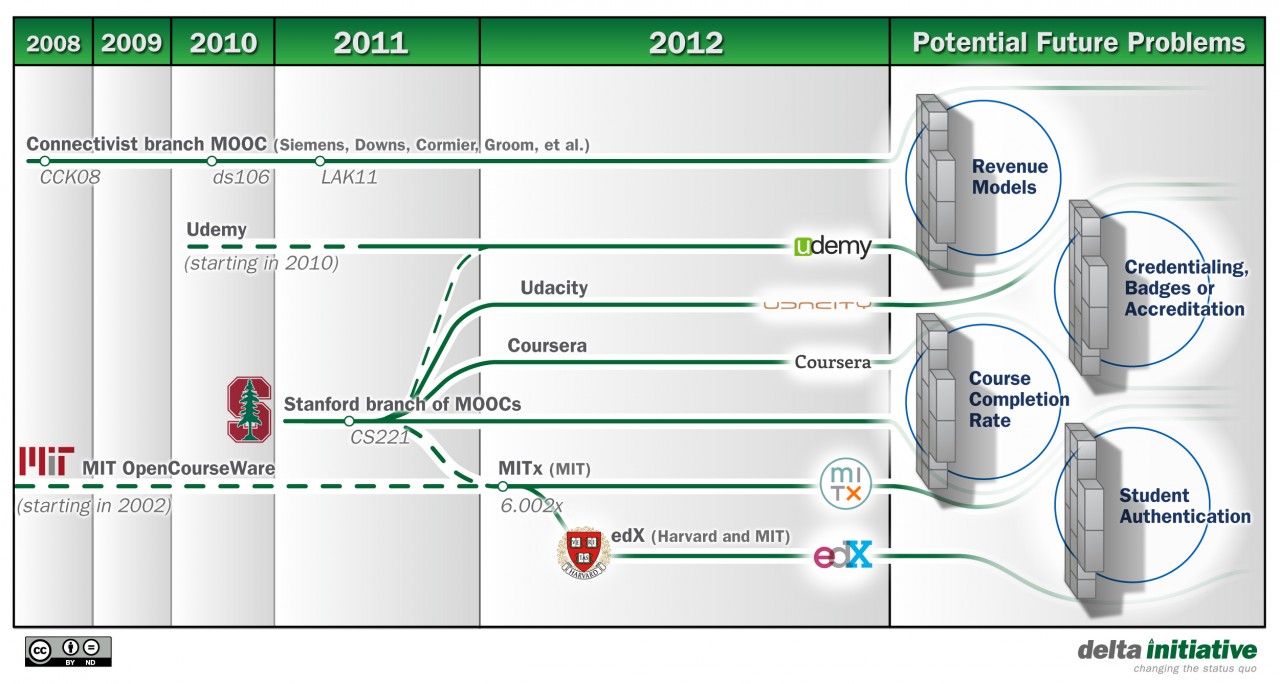
    There’s more information in the article worth reading, but I would like to revisit a post here at e-Literate from 2012 to help explain the point I made. In “Four Barriers That MOOCs Must Overcome To Build a Sustainable Model”, I noted:

    The current generation of courses has proven the feasibility of massive online enrollments, but the Kolowich article reveals that the result is based on a form of adult continuing education. The majority of students in the Udacity and Coursera courses analyzed were professionals in the software industry – hardly the target audience for those seeking a change in how we educate postsecondary students. The current MOOCs provide a nice proof-of-concept, but hardly solve significant educational problems.

    So what are the barriers that must be overcome for the MOOC concept (in future generations) to become self-sustaining? To me the most obvious barriers are:

    • Developing revenue models to make the concept self-sustaining;
    • Delivering valuable signifiers of completion such as credentials, badges or acceptance into accredited programs;
    • Providing an experience and perceived value that enables higher course completion rates (most today have less than 10% of registered students actually completing the course); and
    • Authenticating students in a manner to satisfy accrediting institutions or hiring companies that the student identify is actually known.

    Given this short timeline and the nature of investment-backed educational experiments, I think the real focus should be on whether and how MOOCs or successor models build on current scalability and openness while overcoming these four barriers.

    What have we seen since 2012?

    • Revenue Models: Coursera, FutureLearn, and edX moving towards an OPM business model, and Udacity focusing on corporate education;
    • Credentialing: All MOOCs offering some sort of verified certificates, and in the OPM cases offering actual degrees through their partner institutions;
    • Course Completion: MOOCs realizing that the two issues above lead to higher completion rates; and
    • Authentication: Verified certificates and OPM models requiring student authentication through webcams and approaches similar to online proctoring companies, and even partnering with proctoring companies.

    At this stage  pretty much everyone recognizes a blatant ‘I told you so’ post written while Michael is on vacation and unable to talk me out of it, so I’ll move along and cut off further commentary.

  • OPM Market May Be Growing, But It’s Not Without Chaos

    OPM Market May Be Growing, But It’s Not Without Chaos

    There has been growing interest in the Online Program Management (OPM) market, as more schools try to develop a strategy and revenue model for online programs (particularly for master’s level), and as 2U continues its rapid rise in the stock market (with a nearly $4.8 billion market cap). Typically the description of this market is that the total annual revenue is somewhere between $1.5 – $2.5 billion and that it is growing. The implications are that we have a land grab as companies get rich off the new programs.

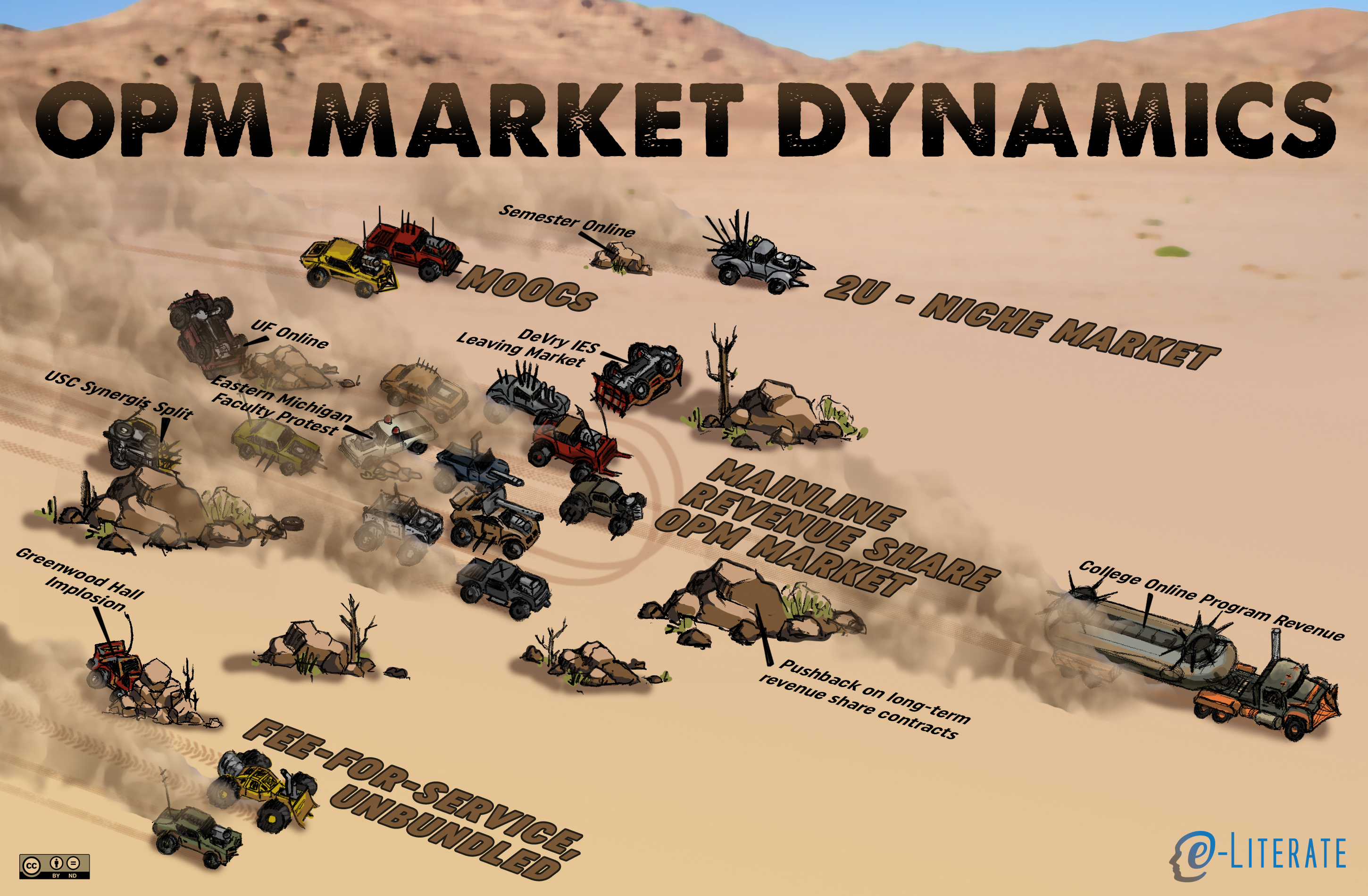
    The reality, however, is more complicated. The OPM market may be growing, but it is chaotic and messy. Consider the following problems within the market:

    • This is not an easy market, as many programs take millions of dollars of investment by the OPM provider before an account becomes profitable, often 3 – 5 years down the road.
    • 2U’s Semester Online initiative, targeted at the undergrad market as a consortium, shut down in 2014 due to the departure of several founding member institutions and due to low enrollment.
    • Later that same year Cal State Online shut down in all but name, along with its usage of Pearson as its OPM partner.
    • In 2015 Synergis Education pulled out of its work with USC’s Master of Integrated Design, Business and Technology program, to be eventually replaced by 2U.
    • In 2016 the University of Florida Online (UF Online) canceled its contract with Pearson and pivoted to a new approach not using an OPM partner.
    • After raising $230 million from Bertelsmann in 2015, HotChalk has failed to bring in any new clients of the scale of Concordia University, and in 2016 the company paid a $1 million settlement (though not admitted any fault) based on a federal investigation and lawsuit.
    • Sometime in 2016/17, the nonprofit OPM Educators Serving Educators from Excelsior College shut down.
    • In 2017 after a management shake-up, DeVry Education Group (now Adtalem) pulled out of the OPM market and got rid of its Integrated Education Solutions group.
    • In late 2017 the Eastern Michigan University’s chapter of the American Association of University Professors filed a complaint against EMU’s contract with Academic Partnerships, although an arbitrator sided with the school earlier this year.
    • Also in late 2017 Greenwood Hall – a call center-based fee-for-service OPM provider – collapsed in dramatic fashion, with AnswerNet eventually buying the remaining assets.
    • There has been growing pushback on the mainline revenue-sharing model, where full-service OPM providers make 50% or even more of tuition dollars from online programs. This has led to the rise of unbundled, fee-for-service category of OPM providers.

    The picture one gets is of a chaotic market that is not for the faint of heart, and one that will likely see further consolidations and category changes. 2U, for its part, has been successful partially due to a niche strategy where they go after elite master’s programs and mostly avoid direct competition or engagement with the rest of the market. And recently we have started to see the MOOC providers become OPM providers – where the primary revenue for Coursera and FutureLearn are based on revenue sharing with online programs, albeit with lower sharing rates and with very different marketing approaches. In other words, there seems to be several efforts to enter into the same OPM race, but if possible to avoid being in the mainline rev-share OPM market. The Toecutter would feel right at home.

    The Mad Max view of OPM market dynamics

    Not even represented here is the movement of former for-profit institutions (e.g. Grand Canyon University, the parent company of Kaplan University) becoming OPM providers.

    This means that our landscape view of the market is temporal in nature – expect more shake ups and category changes as the OPM market continues to grow in new ways.

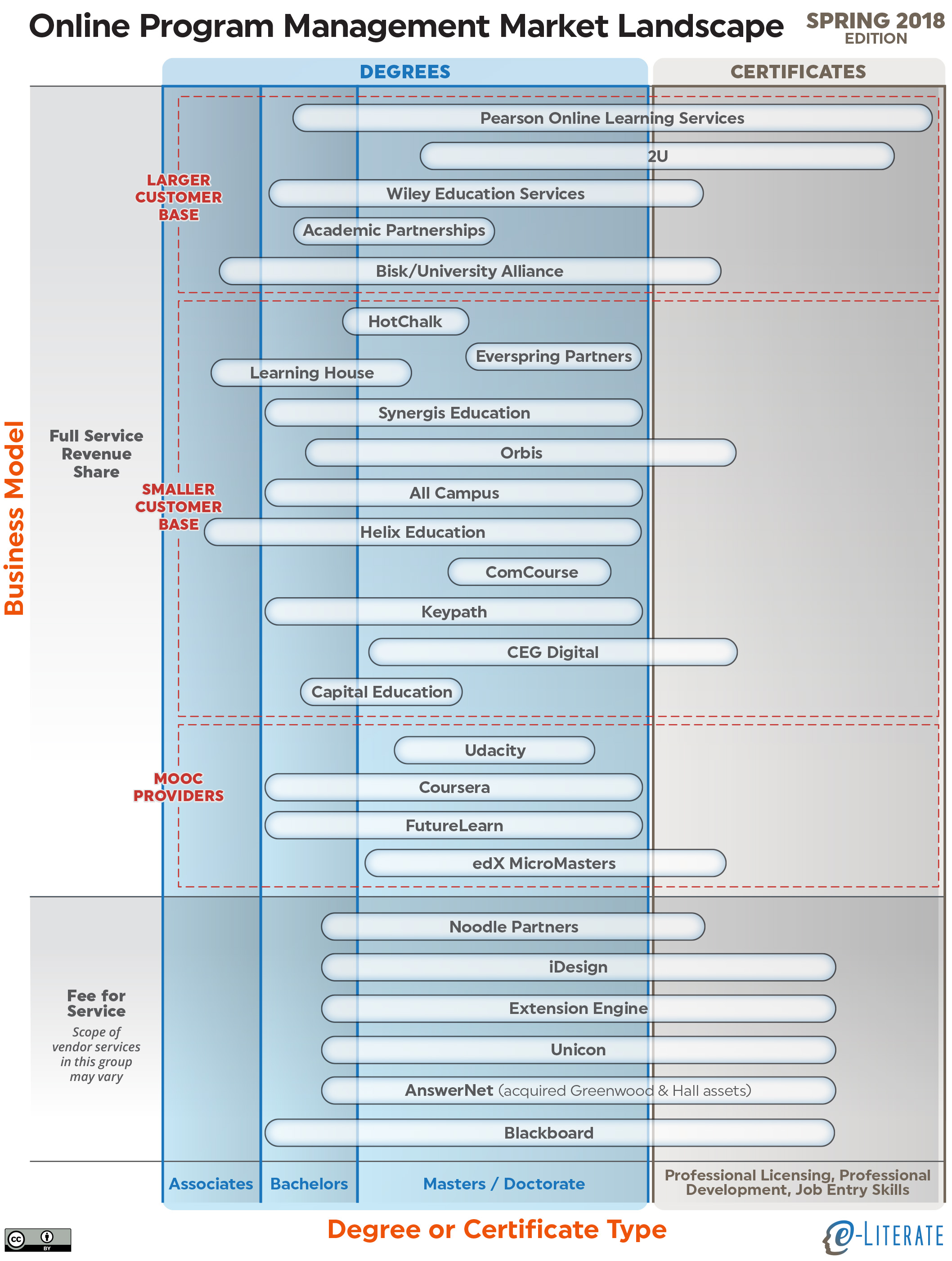
    Market landscape of OPM vendors

  • Online Program Management: Spring 2018 view of the market landscape

    Online Program Management: Spring 2018 view of the market landscape

    Nearly two years ago I wrote two blog posts giving a high-level view of the Online Program Management (OPM) market landscape. This is a growing but messy market, and the market changes since mid 2016 call for an updated view.

    OPM providers are for-profit organizations that help non-profit schools develop online programs, most often for Master’s level programs. These companies provide various services for which traditional institutions historically have not had the experience or organizational capability to fully support, at least for fully-online programs and often for non-traditional student populations. Some examples of the services include marketing & recruitment, enrollment management, curriculum development, online course design, student retention support, technology infrastructure, and student & faculty call center support.

    The OPM market has historically been known for a full-service, revenue-sharing model, based on the premise that most traditional institutions are not only operationally unprepared to offer online programs at scale but also are not set up to invest in online programs up front. There are extensive costs, particularly in marketing and recruitment as well as curriculum and course design, that cause most scalable online programs (that is, those designed with the intent and infrastructure to allow more than just a few dozen students) to require investment over the first several years, before tuition revenue catches up. Rather than requiring the institution to spend sizable up-front money without a guarantee of repayment, revenue-sharing OPM vendors provide this financing themselves – which is in itself an expensive proposition. It often takes three to five years for an OPM company to become profitable for any online program, which is why they often require 10-year or even longer contracts.

    As the online education market has matured, however, there has been a growing pushback against revenue-sharing as the only model available. Thus there is an emerging unbundled fee-for-service OPM model, in which the companies offer the same services, or some subset, for the market price of those services. The institution pays for the services used, mostly independent of the amount of tuition revenue coming into the online program. This category leads to the program, or institution, to take the up-front financial risk but not have to sign contracts sending ~40 – 60% of the tuition revenue to the vendor. Fewer strings attached but more responsibilities and risks for the school.

    With the recent success of Southern New Hampshire University and longer-term models from Penn State World Campus (as well as others), there are also questions about whether non-profit schools can create scalable programs without an OPM partner at all. This category, for obvious reasons, is not presented in our market landscape but is a real option.

    In our view, there is not an either-or proposition in the market. We see strong arguments for both bundled revenue-sharing models and for unbundled fee-for-service models, and I personally do not believe that the market is moving away from revenue sharing as much as there is pressure for additional models. There are a growing number of choices available to schools, but there is also a crowded marketplace that is becoming more difficult to understand.

    With that setup in mind, on to the market landscape graphic.

    As before, please note that this view is intended to give a visual overview of the market landscape and is not comprehensive in terms of vendors represented. This is especially important to understand for the Fee for Service category, where there is no clear definition yet of what is an unbundled OPM provider and what is a product or service provider who happens to serve online programs. Treat this category as illustrative and not exhaustive.

    Market landscape of OPM vendors

    There are three primary changes to note in the graphic’s design since 2016:

    • We have combined different categories of Certificates into one column on the right side of the graphic, since it was difficult to to differentiate between OPM target markets.
    • We have added a sub-category of MOOC Providers under Full Service Revenue Share category to capture the recent changes in that market.
    • We have combined the Fee for Service and General Contractor into one category labeled Fee for Service, again due to difficulty differentiating service offerings.

    We should also note that there will likely be another sub-category of Full Service Revenue Share to capture the ongoing pivots by former for-profit institutions. Graham Holdings sold Kaplan University to Purdue University and remains a single-client OPM provider for that new brand Purdue University Global. Grand Canyon University is converting to a non-profit institution with the remaining for-profit company turning into a (single-client?) OPM provider. Bridgepoint Education plans to turn Ashford University and University of the Rockies into a combined non-profit institution, leaving the remaining for-profit company as an OPM. We are not ready to add this sub-category, and it is not clear yet if these providers plan to go beyond servicing the non-profit conversions.

    There are several changes to the vendors listed:

    • Pearson no longer refers to the Embanet brand that they acquired and now goes by Pearson ((Disclosure: Pearson, 2U, iDesign, Unicon, and Blackboard are sponsors for our Empirical Educator Project. See this post for more details.)) Online Learning Services.
    • 2U, after the May 2017 acquisition of GetSmarter, now serves certificate programs and not just masters degree programs.
    • Wiley no longer refers to the Deltak brand that they acquired and now goes by Wiley Education Services.
    • DeVry Integrated Education Solutions no longer appears to be active in the market, based on outdated web site (key executive listed has been gone for seven months) and no marketing or competitive presence. We have removed their listing.
    • Cambridge Education Group’s CEG Digital unit has emerged as an OPM provider serving UK-based institutions.
    • We (re)added Udacity based on the success of the Georgia Tech Masters in Online Computer Science program, which has helped spawn the new sub-category of MOOC Providers in the market, even though Udacity appears to have no interest in pursuing other higher education degree offerings.
    • We added Coursera as an OPM Provider, as this market now appears to be their core market moving forward.
    • We added FutureLearn based on their continuing expansion as a MOOC-based OPM provider.
    • We added edX with their MicroMasters initiative.
    • We added ExtensionEngine as a Fee for Service provider based on their work with Notre Dame and related program creation.
    • We changed Greenwood Hall to AnswerNet. After a spectacular implosion from Greenwood Hall a few months ago, AnswerNet acquired the remaining assets. It is not yet fully clear if AnswerNet will not provide more than Call Center services, so we’ll keep an eye on this one.
    • Excelsior College’s Educators Serving Educators (ESE) initiative, launched in 2012 to provide a non-profit OPM offering, is no longer active.

    We’ll keep updating our landscape diagram over time and look for other methods to help make sense of this market.

  • ASU, edX and The Black Knight: MOOCs are not dead yet

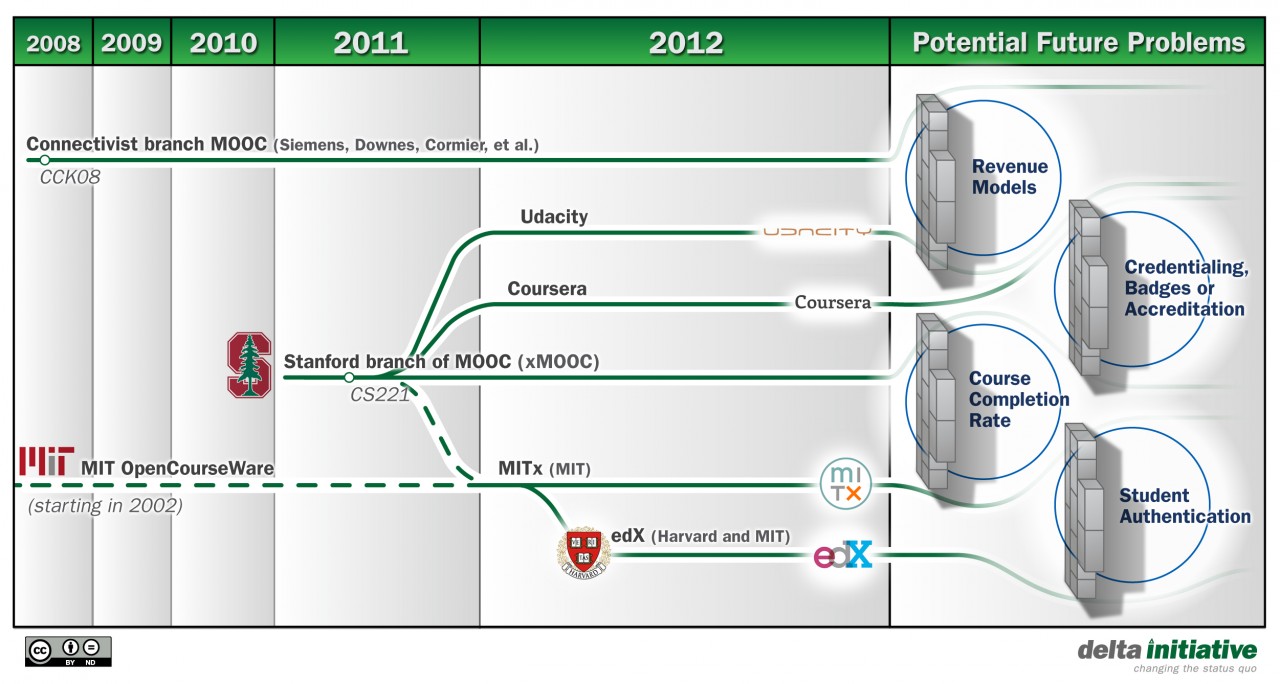
    In 2012 I wrote a post during the emergence of MOOC mania, pointing out some barriers that must be overcome for the new model to survive.

    So what are the barriers that must be overcome for the MOOC concept (in future generations) to become self-sustaining? To me the most obvious barriers are:

    • Developing revenue models to make the concept self-sustaining;
    • Delivering valuable signifiers of completion such as credentials, badges or acceptance into accredited programs;
    • Providing an experience and perceived value that enables higher course completion rates (most today have less than 10% of registered students actually completing the course); and
    • Authenticating students in a manner to satisfy accrediting institutions or hiring companies that the student identify is actually known.

    Fig 3 EvolutionCombine20120927

    Since that time, of course, the MOOC hype has faded away, partially based on the above barriers not being overcome.

    Today, Arizona State University (ASU) and edX announced a new program, Global Freshman Academy, that takes direct aim at all four barriers and could be the most significant MOOC program yet. From the New York Times story: (more…)