e-Literate

Present is Prologue

Tag: MRI13

  • Learner-Centered Analytics: Example from UW La Crosse MOOC research

    Last week I wrote a post What Harvard and MIT could learn from the University of Phoenix about analytics. As a recap, my argument was:

    Beyond data aggregated over the entire course, the Harvard and MIT edX data provides no insight into learner patterns of behavior over time. Did the discussion forum posts increase or decrease over time, did video access change over time, etc? We don’t know. There is some insight we could obtain by looking at the last transaction event and number of chapters accessed, but the insight would be limited. But learner patterns of behavior can provide real insights, and it is here where the University of Phoenix (UoP) could teach Harvard and MIT some lessons on analytics.

    Beyond the University of Phoenix, there other examples of learner-centered analytics exploring usage patterns over time. While I was at a summit at the University of Wisconsin at La Crosse last week, Bob Hoar showed me some early results of their “UW-System College Readiness Math MOOC” research that is part of the MOOC Research Initiative. I interviewed Bob Hoar and Natalie Solverson as part of e-Literate TV, where they described their research project:

    The results to date focus on capturing and visualizing the student patterns, and progress can be tracked at this project site (go to the site to see interactive graphics). (more…)
  • e-Literate TV and Community-Negotiated Focus

    The goal of e-Literate TV (ETV) is to help school communities develop a working consensus around how they can use learning technologies to achieve important educational goals. For example, we’d like to be able to help schools that are motivated to improve student retention to identify appropriate ways that technology can help them do that. To do that, we have to do more than just provide relevant information. We have to provide it in a structure that encourages a productive culture of conversation and consensus building about these sorts of issues. It’s education as change management.

    In order to make ETV useful in that way, we’re developing (inventing? rediscovering?) a number of design principles. The first one, which I’ve written about before, is differentiated engagement. The ways in which deans, advising faculty, non-advising faculty, technology support staff, and other stakeholders need to be involved in a conversation about, for example, adopting a retention early warning system are different, as are the needs and interests of different individuals who have these roles. With the layered, hyper- and transmedia approach that we are able to take with our episodes, we can invite people to participate in the ways and to the degrees that are appropriate for them. We can help them find their zones of proximal curiosity, encouraging them to explore the issues a little further than they might have on their own while also recognizing that each individual is going to have limitations on how much they need or want to know.

    A second design principle we’re exploring is what we can call “community-negotiated focus.” Every school community is going to have its own collective zone of interest within a given topic. For example, Berkshire Community College may only be interested in MOOCs in cases where they are being used in an attempt to support remedial students or underserved populations, while Colorado State University Pueblo may be interested in how MOOCs are being used to flip classrooms and related labor issues. Once again, one size does not fit all. Phil’s recent post about our commitment to release the ETV videos under a Creative Commons license is intimately related to our goal of enabling ETV to be a resource that particular academic communities can customize to serve their particular needs.

    (more…)

  • e-Literate TV Interviews from MRI13 Now Available

    In December 2013 Michael I attended the MOOC Research Initiative Conference (aka #MRI13 or “The greatest MOOC conference in the history of MOOCs”). Thanks to a grant funded by the Gates Foundation through Athabasca University, we are creating three episodes of an upcoming e-Literate TV series based on the conference. We expect to release these episodes in March.

    MRI

    As part of developing material for the episodes, we interviewed a number of research grantees and ed tech luminaries. We had some great guests who spoke about what we have learned from MOOCs, what the potential applications are, what the downsides are, and where open education could and should go in the future. It was a unique opportunity to get so many well-informed people in one place on a common topic.

    Today we releasing these videos through the e-Literate TV YouTube channel. These videos all carry a Creative Commons license to facilitate sharing and repurposing of the material.

    (more…)

  • MOOC history as presented at AACN13 conference

    With all of the great discussions spawned by the “greatest MOOC conference in the history of MOOCs” (MRI13), it seems a good time to share a segment of a keynote presentation I gave last year on MOOC history. This presentation was at the American Association of the Colleges of Nursing (AACN) conference in April 2013. For context, I had just shared how online education was no longer an issue kept in the corner, away from mainstream higher ed, but was now affecting the traditional campus discussions.

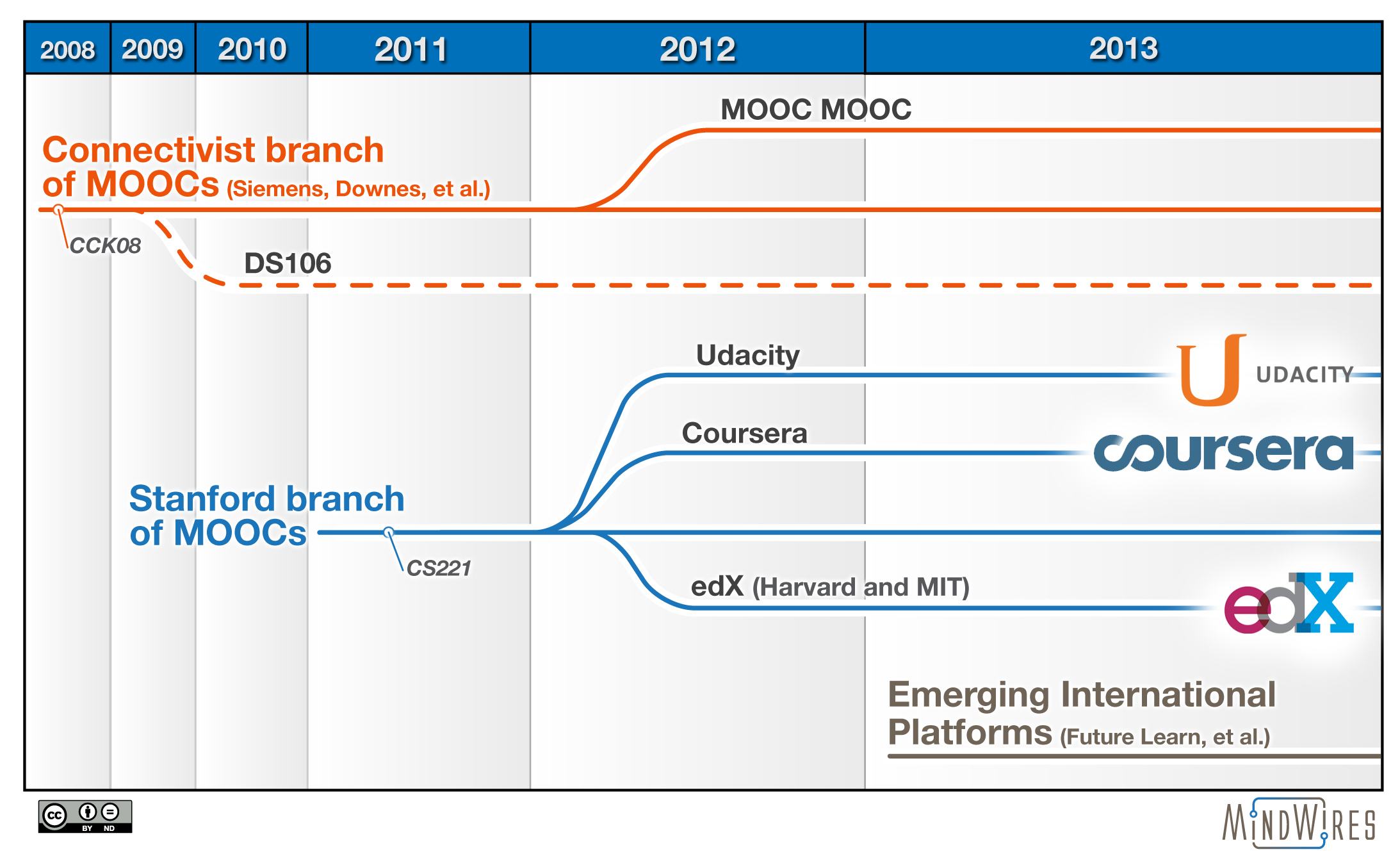
    There is a relevant graphic that was shown during this segment of the talk, showing the MOOC timeline (updated version shown below).

    MOOCpreHistory20131202

  • Changing the Narrative

    As Phil mentioned, he and I were both lucky to attend the MOOC Research Initiative conference, which was a real tour de force. Jim Groom observed that even the famously curmudgeonly Stephen Downes appeared to be enjoying himself, and I would make a similar observation about the famously curmudgeonly Jonathan Rees. If both of those guys can be simultaneously (relatively) pleased at a MOOC conference, then something is going either spectacularly right or horribly wrong. I believe it was the former in this case.

    We are at one of those rare moments when there’s enough confusion that real conversation happens and possibilities open up. The sense I got is that everybody is really grappling with the questions of where we can take the concept of a “MOOC” and what MOOCishness might be good for. That is fun and hope-inducing. Phil and I spent a lot of the time interviewing folks for a future e-Literate TV series (coming to a computing device near you in March or April of 2014), so we were lucky to hear a lot of perspectives. There is some very good exploration happening now. George Siemens and his fellow conference organizers (as well as the Bill and Melinda Gates Foundation, which sponsored the event and the research) did a real service by bringing people together to talk about these issues at this pregnant moment.

    One thing happened toward the end of the conference that has me puzzled, though. Jim mentioned it in his blog post:

    At the same time[,] Bon Stewart’s admonitions for some kind of organized response to start filling the temporary void of direction with alternative narrative still rings in my ears—and it is very much the lesson I took away from Audrey Watters keynote at OpenEd.

    There was a lot of conversation, really throughout the conference but coming to a head at the end, that the term of MOOC is somehow damaged goods and that…something…should be done about it. Usually the word “narrative” was brought up. But this talk of “alternative narratives” or, as Bonnie put it, “changing the narrative”, confuses me. As far as I’m concerned, the connectivist/open ed crowd has been spectacularly, stunningly successful at “changing the narrative,” and I’m not at all clear what it would look like to somehow do it differently. I don’t understand what they mean here. Unfortunately I had to rush out the door to try to catch a plane shortly after the panel discussion and didn’t have an opportunity to follow up with some of the attendees. So I’m going to try to express my confusion in this blog post and hope that somebody can help me figure out what I’m missing.

    Warning: This post is long and lit crit wonkish.

    (more…)

  • About those U Penn MOOC results reported at MRI13

    Michael and I have been at the MOOC Research Initiative conference in Arlington, TX (#mri13) for the past three days. Actually, thanks to the ice storm it turns out MRI is the Hotel California of conferences.

    13th_Floor_-_Hotel_California

    credit: Bailey Carter assignment for Laura Gibbs’ class

    While I’m waiting to find out which fine Texas hotel dinner I might enjoy tonight, I thought it would be worthwhile to share more information from the University of Pennsylvania research that seems to be the focus of media reports on the conference (see Chronicle, Inside Higher Ed, and eCampusNews, for example). Penn has tracked approximately one million students through their 17 first-generation MOOCs on Coursera, which provided the foundation for this research.

    Per IHE:

    “Emerging data … show that massive open online courses (MOOCs) have relatively few active users, that user ‘engagement’ falls off dramatically especially after the first 1-2 weeks of a course, and that few users persist to the course end,” a summary of the study reads.

    For anyone who has paid even the slightest bit of attention to the MOOC space over the past year, those conclusions hardly qualify as revelations. Yet some presenters said they felt the first day of the conference served as an opportunity to confirm some of those commonly held beliefs about MOOCs.

    While it is accurate that these basic observations have been made in the past, there was some additional information from U Penn worth considering. The following slide images are courtesy of Laura Perna, a member of the research team.

    (more…)