
e-Literate

Present is Prologue

Tag: OER

  • Babson Report on OER in US Higher Education

    The Babson Survey Research Group just released their report on OER usage in US higher education, “Growing the Curriculum: Open Education Resources in U.S. Higher Education”. The report is based on three different surveys among faculty and academic leaders, and it is heavy on attitudinal information – are you aware of OER, do you plan to use OER, what are the reasons to choose OER, what are the barriers to adoption, etc.

    Some of the key findings from the executive summary:

    • Most academic leaders are at least somewhat aware of open education resources (OER) and slightly over half list themselves as ‘Aware’ or ‘Very aware.’
    • Only one-half of all chief academic officers report that any of the courses at their institution currently use OER materials.
    • In 2011, most surveyed academic leaders report that open education resources will have value for their campus; 57 percent agree that they have value and less than five percent disagree.
    • Nearly two-thirds of all chief academic officers agree that open education resources have the potential to reduce costs for their institution.
    • There is wide agreement among academic leaders that open education resources will save time in the development of new courses.
    • Over one-half of academic leaders agree or strongly agree that open education resources would be more useful if there was a single clearinghouse.
    • Among faculty, cost (88% reporting as important or very important) and ease of use (86%) are most important for selecting online resources.
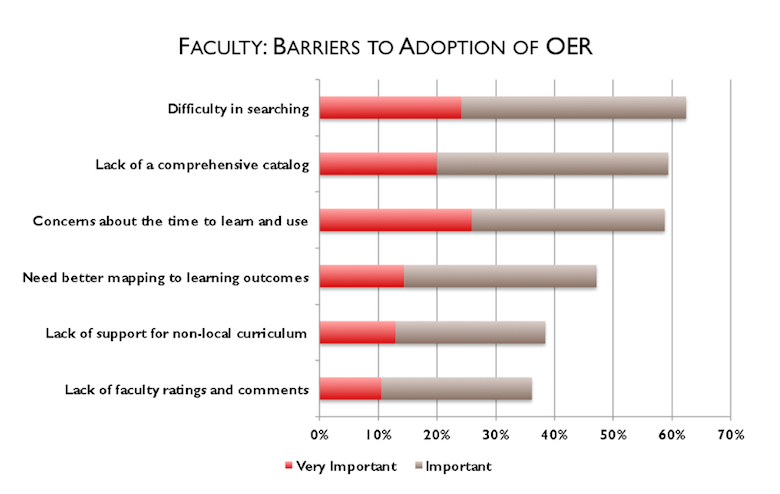
    • The time and effort to find and evaluate are consistently listed as the most important barriers by faculty to the adoption of open education resources.
    • Older faculty have a greater level of concern with all potential barriers to open education resource adoption than do younger faculty.
  • Project Blue Sky: Big Boost to OER From . . . Pearson?

    In June 2012, Campus Technology interviewed some higher education leaders in the use of open educational resources (OER) to discuss the major challenges to more prevalent adoption of free and open resources. The top two challenges mentioned in the article were:

    • discovering material efficiently due to the vast quantity of resources; and
    • getting faculty to move beyond the “textbook is the course” mindset.

    In a move that could have a significant impact on higher education, Pearson announced just before EDUCAUSE the creation of Project Blue Sky, which directly addresses both of these challenges.

    From the article:

    There are too many resources to choose from. OER may be a new concept for some professors, but that doesn’t mean there aren’t enough resources to go around. In fact, Geoff Cain, director of distance education for Eureka, CA-based College of the Redwoods, said the number of resources is so vast that it can literally paralyze instructors.

    “Helping faculty find appropriate resources is a major issue,” said Cain, whose institution is a member of the Community College Consortium for Open Educational Resources.[snip]

    Cain said impressing upon the educators the fact that they already “adapt” coursework and textbooks to meet student needs is a good way to help break them out of the “textbook is the course” mindset. “Teachers skip chapters, incorporate current events, and drill down on specific student needs all the time,” said Cain. “OERs are really just an extension of that.”

    While anecdotal, the findings of this article (at least on discoverability) are backed up by an upcoming report from the Babson Survey Research Group that lists the barriers to adoption of OER from a faculty study.

    (more…)

  • Textbook Publishers and OERs

    Not too long ago, The Chronicle ran an piece called “Publishers Criticize Federal Investment in Open Educational Resources.” The meat of the article was some quotes of textbook company executives on a panel at an SIIA conference speaking out against a provision in a United States Department of Labor grants program that requires course materials being produced for grant-supported courses to be released under a Creative Commons Attribution license. Here’s a taste of their comments:

    “I think it’s very dangerous for them to be in the product business,” said Bill Hughes, vice president of business development and innovation at Pearson Education.

    “There’s no free lunch,” said James Kourmadas, vice president of strategic marketing at McGraw-Hill Higher Education.

    “I fear when big bucks from government is put into certain places, it actually stops pushing people to innovate,” said Kevin Wiggen, chief technology officer of Blackboard Xythos….

    “I think what the industry says is that we don’t see the point in the government collecting up taxpayer money and trying to rebuild an industry from scratch,” said Mr. Kourmadas of McGraw-Hill.

    To my esteemed fellow textbook industry professionals, I reply,

    Dudes. Seriously? (more…)

  • New LMS Entrant: NIXTY

    You may have already heard a bit about NIXTY, since they have managed to make a significant media splash in the last few weeks. There have been a number of interesting analyses, both pro and con. I’d like to highlight a few aspects that haven’t gotten much coverage.

    For starters, here’s a screencast that NIXTY CEO Glen Moriarty was kind enough to make for me:

    (more…)

  • Open Forum Brain Dump

    I’m sitting in my hotel room near LAX early in the morning and I have a little time between the legs of my trip to reflect on the amazing experience I just had at The OPEN Forum. I must say, Thanos Partners did a superb job of organizing a fun, fascinating, and frictionless conference. (And the food. OMG.) I expect to write a number of posts reflecting on different facets that were covered during the forum, but this first one will mainly be a brain dump to capture a bunch of raw observations before they have a chance to fly out of my head.

    (more…)