e-Literate

Present is Prologue

Tag: OER

  • The Course Hero/Lumen Deal

    The Course Hero/Lumen Deal

    EdSurge’s Daniel Mollencamp has published a piece called “What a Homework Help Site’s Move to Host Open Educational Resources Could Mean” about Lumen Learning’s deal with Course Hero to transfer hosting of those OER textbooks from Lumen’s site to Course Hero’s. The article contains a fair bit of speculation quotes from folks who I believe miss the mark on some basic facts and implications. I confess that I will engage in some informed speculation here in the sense that I have not engaged with on-the-ground reporting to confirm what I believe I know. Nevertheless, I believe I know some facts that contradict some of the speculation in the piece and put the transaction in a somewhat different light.

    For most of this piece, I’m going to stick with what I believe to be the facts. I will take a little time in the last section to provide my own point of view. That said, there are strong feelings in pockets of the educational community about both of these companies. I will be treading lightly. If you want to read vehement critiques of these companies, their business models, and their values, you can find them elsewhere on the web.

    The basic facts as I understand them

    Here’s what I believe to be true:

    • Lumen has had two branded lines of OER-based products:
      • Waymaker is their flagship product line. They invest in editorial work and research to improve the content and software development to improve the underlying platform on which it is hosted.
      • Candela are OER products that were contributed by the community but not actively maintained and improved by Lumen. They were hosted on a less capable platform. And, to my knowledge, they were free.
    • Lumen transferred Candela products, but not Waymaker products, to Course Hero.
    • Lumen received quite a bit of traffic to those free OER content. I seem to recall Kim telling me the number was in the millions of visits. That’s great for education but is also an expense for a small company. While I know some will dismiss the cost of hosting web pages on the internet, the cost of hosting content with that much traffic and keeping it accessible can add up over time.
    • The business value of Candela courses to Lumen was far from clear. It’s not like students using the content for free were likely to become paying customers or convert their faculty to adopting Waymaker products. Again, hosting the content is a good thing to do. But every company has a limit of how much they can afford to invest in public-good work. I don’t know how much Candela costs to host and maintain relative to Lumen’s total revenues. I speculate that it was non-trivial.
    • On the other hand, Course Hero’s primary clientele is students. Every user of Candela is a potential subscriber to Course Hero’s paid services. And Course Hero is a vastly bigger company. So the relative cost of hosting the content was smaller to them than to Lumen and the potential business benefit was larger.
    • As I alluded to in my introduction, both companies have vocal detractors.
      • In Lumen’s case, their primary critics tend to be within a subsection of the OER community and relate to which business models in relation to OER are considered “legitimate” or support the values of the OER community.
      • In the case of Course Hero, the controversy is more widespread. They are criticized as being a “cheat site.” Some universities are blocking access to Course Hero from school networks and I hear periodic rumors of plans for legal action against the company, although I am not aware of any actual litigation.
    • [Update] I have heard multiple complaints that Candela students were redirected from Lumen’s site to Course Hero’s site with no notification to instructors or universities, including paying customers. (See the correction below for more detail on “paying customers.”)
    • I do not believe the content was editable on either site. I’m certain it’s not currently editable on Course Hero’s site and I’m fairly confident that it was not editable in Candela on Lumen’s site.

    Corrections: A source informed me that I was mistaken on two fronts. First, Lumen did charge a low price for the version of Candela that integrated with LMSs. I do not believe it was a money maker for Lumen, and I’m confident that the free, non-integrated version got significant traffic. While this doesn’t change the overall business implications, I got the facts wrong. Unfortunately, this also means that some of those affected by the switch were paying customers.

    Second, Candela did support editing.

    Implications

    First, the business logic for both companies is clear. Hosting OER content for free is a public service that has non-zero cost, particularly if it is successful at attracting significant volume. Hosting a catalog of free online textbooks simply costs less and buys more for a company like Course Hero than it does for a company like Lumen. I make not value judgment here, one way or the other. These are simple economics.

    By I suspect—and this is pure speculation on my part—that Course Hero did pay Lumen, at least to cover the costs of supporting the content transfer. I don’t know the details of any potential transaction but I don’t see any ethical red flags with it, at least as a stand-alone issue. I’d have to see some sign of some other, ethically problematic quid pro quo which is not evident in the reporting.

    Second, these details (assuming their accuracy) tend to cut against some of the commentary in the article. For example, while I respect Bryan Alexander, I don’t think the facts support the speculation that “Lumen handing over the content to Course Hero seems like it could plausibly be them agreeing with those who think there’s no good business case for OER.”

    Likewise, Steel Wagstaff from Pressbooks, in my opinion, missed the mark on a couple of points. The first was when he suggested that “Although the content has an open license, it’s conceivable that it will be harder for technical reasons to edit and make copies of the content on Course Hero’s platform, depending on what Course Hero is doing to host the content.” My understanding is that it is neither easier nor harder. Neither platform supports native editing. To change the content, one would have to copy and paste the content in a platform that does support editing such as Google Docs or Pressbooks.

    Correction: Steel was correct. Candela, unlike Waymaker, did allow for editing. (I’m not sure if it was available in the free version of the product; see the correction above.)

    Wagstaff is also paraphrased in the article as saying, “If your main interest in OER is to adopt a book for free, then the hosting change isn’t such a big deal, except perhaps that people “feel scuzzy” about Course Hero being the ones hosting the content[.]”

    This is where things get messy. And sometimes nasty.

    Course Hero’s reputation and some circumscribed commentary

    “Scuzzy” vastly understates the breadth and depth of feeling currently swirling around Course Hero. And that concern is likely the reason this transfer of free content between two companies generated enough noise to get the attention of EdSurge.

    Before I get into further commentary, I want to state my priors here. I know the leadership of both companies. In Lumen’s case, I’ve known CEO Kim Thanos and her co-founder, David Wiley, for many years. I consider them to be friends. I trust their values even when I don’t agree with particular decisions. I know Course Hero CEO Andrew Grauer and his leadership team less well. But I have had a number of interactions with them, spent some time vetting them, and came away feeling good about the humans in charge. My best read on them, given the caveat that I don’t know them terribly well, is that they want to be constructive partners in supporting education. I have worked with both companies in the past (though not recently) and have no qualms or regrets about having done so. With that in mind, here’s my take on the story:

    Currently, Course Hero is widely and often vehemently viewed as a bad actor that helps students cheat within a significant slice of university educators and administrators. It’s not particularly easy to get your website blocked by a major public university and yet I personally know of a handful that have blocked Course Hero. EdSurge likewise states that “some campus networks have actually blocked Course Hero’s core service domains”.

    This state of affairs, combined with the companies’ mutual decision to roll out the change quietly, had two serious implications. First, universities that have encouraged students to use free OER hosted by Lumen suddenly started hearing from their students that they cannot access these resources. Second, students could not access those resources because the content has been quietly moved to a web site that important university stakeholders decided was harmful enough that they blocked it from university networks. They believe that Course Hero undermines their policies and contributes to students’ failure to learn. To add insult to injury, I heard from folks at several of these universities that they first heard about the switch from panicked students who couldn’t access their course materials after the term had started rather than from Lumen or Course Hero beforehand. These leaders feel blindsided.

    Both companies appear to have been taken by surprise at the level of backlash. In fact, Course Hero’s Vice President of Academics Sean Michael Morris is quoted in the EdSurge article as saying, “Part of this news cycle around this caught us off guard.”

    Morris’s reaction is shockingly tone-deaf from beginning to end. First of all, referring to this reaction as a “news cycle” reflects a fundamental misunderstanding of the seriousness of the brand problem Course Hero has. He actually jokes about universities unblocking their site as a solution to the problem. And he never once addresses the underlying issue of trust that caused the site to be blocked in the first place.

    This has been my deepest concern with Course Hero, which has only grown with time. Although I still believe they are not intentional bad actors, they have the instincts of a consumer company catering to students and show little understanding of universities. And while they have made earnest efforts to reach out to and understand their critics—I have participated in some of those conversations—they demonstrate at times like these that they remain dangerously naive about the stakeholders inside the institutions they want to work with.

    They have made good inroads with adjunct faculty. But incidents like this one, and their reaction to it, suggest that they have made little progress in understanding, much less winning over, the kinds of stakeholders who can block on-campus access to their site or even initiate legal action. And to be clear, I have heard more than one senior campus leader intimate that such actions were being contemplated.

    Lumen, while it has been quieter, also seems to have been caught flat-footed. I am hearing from multiple long-time customers who have been put in a very difficult position by their lack of advance communication. Lumen needs its advocates and can’t afford to burn these bridges.

    This was entirely avoidable

    The two companies missed a chance to turn a potential blow-back into a trust-winning opportunity. They could have done something like the following:

    • Announced in advance that the two companies are working on a sustainability strategy to keep the OER accessible for free to students
    • Selectively sought input from Candela-using educators and campuses about the best way to do this
    • Created a separate site with a separate URL, hosted by Course Hero, that would have bought them more goodwill at the cost of some easy customer conversion

    I don’t want to pretend that everything would have been rosy had they taken this path. The companies each have critics that would have come after them no matter what they did. So I understand the impulse to do this quietly.

    But it obviously didn’t save them from the slings and arrows. Instead, it alienated Lumen’s allies while reinforcing rather than softening Course Hero’s reputation of being an enemy of university folk.

    To sum up my own reading of the events in question, this story does not portend doom and gloom for OER. Nor does it provide convincing evidence of nefarious profiteering by Lumen. This is the story of two companies, each driven by enlightened self-interest, that screwed up a mutual effort to preserve access to free educational resources with a gob-smacking level of tone-deafness.

    This story also tells us something about how OER does and doesn’t work in supporting different sorts of business models (e.g., Lumen’s and Course Hero’s, which are starkly different).

    These companies obviously have some thinking to do and need to do a far better job of staunching the bleeding.

    In the meantime, the academic community needs to get far more sophisticated in their thinking about how sustainability works when OER gets used as infrastructure in a for-profit EdTech world. Keep in mind that another option Lumen had at its disposal was to simply turn Candela off. That would have benefitted nobody.

    I’m not going to pretend I have an answer or even pretend that I believe there is a one-size-fits-all answer. But we need better answers about sustainability at scale, balancing cost against quality, and harnessing the theoretical affordance of editability into something that actually serves students. I believe those answers will come, in part, from studying how different EdTech companies make their money and how the business mechanics interact with OER. After all, the foundation of OER is a copyright license. It may hack the private property system but it does not live outside of that system. We don’t have to look for evil motives to understand why Lumen and Course Hero thought moving stewardship of Candela might be good for everyone. It’s actually pretty straightforward.

    So how do we cultivate companies whose business interests benefit from promoting affordable, quality education? And where does OER fit into that equation?

  • The Crumbling of the OpenEd Coalition

    At the OpenEd conference this week, David Wiley made an announcement that was more significant than it may have sounded. Before I attempt to further characterize or analyze it, I think you should read it for yourself in its entirety, copied here from David’s blog: ((Disclosure: David is an employee of Lumen Learning, a sponsor of the Empirical Educator Project.))

    In 2003 I invited a small group of about forty people interested in open content and open courseware to Logan, Utah. Since then, this annual meeting has grown year after year to where we are today – 850 people interested in everything from open educational resources and open educational practices to sustainability and social justice. This annual conference has been a remarkable forum for the community to meet, share ideas, and foster collaborations, and the conference community is larger and more diverse than ever before. 

    With that growth comes change. That little meeting I convened 15 years ago has evolved organically in a way that has served the community fairly well. However, as currently constituted, the conference does not leverage all the energy, enthusiasm, passion, and leadership ability in our increasingly large and increasingly diverse community. And so the time has come for us to reconsider, as a community, how we wish to organize ourselves, learn from each other, and collaborate with one another. 

    In order to make the necessary space for that conversation, this year’s Open Education Conference is the last I plan to organize. As of this Friday afternoon the conference will be adjourned indefinitely. This is not a call for another person or organization to come forward to keep the same conference running the same way into the future. 

    Rather, it’s a call to reset and start over. To go back to the drawing board – as a community – and critically examine all of our assumptions about conferences, to grapple with a range of ideas about how we want to learn from and collaborate with each other, and to talk frankly about our end goals and guiding values. And when something like a consensus starts to emerge, the community can choose what to do next. To borrow a phrase, this is an opportunity to revise and remix what is, honestly, a very traditional academic conference, into something – or some things – far better.

    This reimagining must be owned by the community. It must be driven by the community. And it would be inappropriate for me to try to facilitate that process beyond extending a brief invitation. And so I invite all of you to use the breaks, lunches, dinners, and other free time you have here in Phoenix to engage in this critical reimagining and to explore with one another the possible shapes future meetings of our community – or communities – might take. I expect this will be a difficult, messy, and at times even painful process. But most things worth doing are.

    On a personal note, I want to thank the hundreds of people who have made the conference incredible over the years by presenting, reviewing proposals, convening sessions, volunteering at the information desk, and in countless other ways. Thank you to our Program Committees. Thank you to our sponsors. Thank you to Utah State University, Brigham Young University, BCcampus, and Lumen Learning for serving as the conference’s fiscal agents and logistics leads over the years. Most of all, thanks to each of you. Thank you for giving a bit of yourself to this community, for building each other up, and for moving the work forward. And, as always, thank you for everything you do for students.

    David Wiley

    I was at the conference for the first day and heard a range of different reactions to the news. Some said it was no big deal and that characterizing it as essentially a changing of the guard of the leadership:

    I think the framing of the conference as “ending” was not the best choice of wording. Really, the founder stepped down, that’s all. It’s new beginning for more diverse & inclusive model. And I say this as some1 who was participating in #oer since 2003 #opened19 #notgoinganywhere

    @lpetrides

    Others expressed more concern about the nature of the handoff from David to the next steward than Lisa did, but the fundamental view was the same.

    In my opinion, these reactions miss an underlying dynamic that makes this change more serious and difficult to patch over than it may appear on the surface. OpenEd was always at least partly an exercise in coalition politics. The attendees were a mix of people coming with different primary and secondary goals that overlapped enough for them to make common cause. That coalition has crumbled. In fact, it has been crumbling for some time. The idea that this conference could have been neatly handed off to some new steward as-is assumes that OpenEd is is otherwise tenable as-is. I don’t believe that is true.

    This is not ultimately about David Wiley or even Lumen Learning stepping away from organizing the conference (although the loss of an organization willing to manage an 850-person conference is a significant blow). My conversations with various OpenEd participants this week provided ample confirmation to me that there continue to be long-standing and deepening fractures within the OpenEd coalition, even though many of the participants are either not fully aware of them or not seeing how consequential they are in terms of how people may think about future convenings.

    I am by no means suggesting that OER or “open education”—whatever that is—is itself in danger of ceasing to exist. OpenEd is the only conference I know of that fell apart in a year when it had record attendance. If anything, OER adoption appears to be accelerating. In fact, I believe it is precisely OER’s success and growth that may have pushed this long-simmering problem to its breaking point. That growth has caused the balance of power within the coalition shifted in ways that created tensions among coalition members. Ultimately, those tensions proved insurmountable. The center did not hold.

    The OpenEd conference as we know it is dead. It may come back in some form, possibly even next year, and possibly even with the same name. But it won’t be the same coalition with the same focus and balance of interests. It won’t be the same OpenEd. That is neither necessarily bad nor necessarily good. But whether it is good, bad, or indifferent, it is a fact.

    This was foreseeable—and foreseen

    The OpenEd coalition has long consisted of (at least) three different groups with three different primary goals:

    1. Increase access to education by lowering cost of curricular materials
    2. Increase quality of education by increasing quality of curricular materials
    3. Promote values of education by fostering autonomy for educators and agency for learners

    Many—possibly most—of the OpenEd participants would likely say that they support all three of these goals. (I certainly do.)

    That’s good. Overlapping priorities are a critical success factor in building coalitions. But it’s not everything. Depending on how you interpret and rank these three priorities, your beliefs about strategy and values could be quite different. And there have long been signs that, in fact, there were very serious tensions among the views and priorities of the coalition members.

    In 2015, Phil Hill and I gave a joint keynote at the OpenEd conference in Vancouver. The theme of our talk was precisely that OpenEd was a brittle coalition that could fracture if the coalitional challenges were not addressed. Phil, in his part, talked about the challenge and opportunity that faculty surveys about OER demonstrated. There was a lot to be accomplished. My half of the talk was about my experience as a climate activist and how hard it is to build a coalition that holds together and accomplishes its goals over time (hint hint).

    Here are some of the questions that I encouraged the conference participants to discuss:

    • What is your goal?
    • What is your theory of change?
    • What is your strategy?
    • Who do you have to convince?
    • What are your obstacles?
    • What power do you have?
    • Who are your natural allies?
    • Who is persuadable?
    • What is your best message?
    • Who are you willing to let win?
    • What are you willing to give up?

    At the time, Mike Caulfield noted on Twitter that the question about who you are willing to let win was a particularly important one.

    Fast forward to a couple of weeks ago. A fight broke out about the planned conference programming that was bad enough to have caught the attention of the Chronicle:

    Less than two weeks before its 16th annual meeting, the Open Education Conference has canceled one of its keynote panels — “The Future of Learning Materials” — after facing a backlash on social media.

    The panel, which had been scheduled for November 1, was slated to include representatives from Cengage, McGraw-Hill, Lumen Learning, and Macmillan, all for-profit publishing companies, as well as the managing director of OpenStax, a nonprofit. It was supposed to explore the potential role of traditional commercial entities in the future of open education resources.

    “That role could be anything from ‘no role’ to ‘deeply committed participant,’” David Wiley, a member of the program committee and a co-founder of Lumen Learning, said in an email. Of the more than two dozen speakers and panels nominated for keynotes, the future panel was one of the top vote-getters on the program committee, he added.

    But the reaction to the panel highlighted the often contentious relationship between advocates for open education resources and commercial publishers, as open resources expand in the learning-materials market. The outcry also raised broader questions about the politics of providing platforms to those with opposing views and social media’s tendency to amplify outrage. Many open-ed advocates pushed back against the framing of the panel and objected to elevating profit-seeking entities with a keynote and prescreening questions audience members could ask.

    The conference’s program committee, comprising Wiley and 11 others involved in open education, said the decision to cancel had stemmed from “toxic behavior” on Twitter, adding that committee members had received “abusive and harassing” direct messages. Two panelists withdrew, according to a statement, and potential replacements declined to participate because of the tone of the discussion on Twitter. But some in the open-education community, both those who had pushed back against the panel and those who had stayed out of the discussion, said they did not see anything particularly troubling in the public posts.

    Wiley declined to share copies of the direct messages that committee members had received, or to comment on their nature. Several committee members and panelists did not respond to requests for comment.

    A Conference on Open Education Invited For-Profit Publishers to a Keynote. Then the Objections Began.

    To be clear, this latest episode is a symptom of the crumbling coalition rather than the cause of it. Phil and I saw this kind of tension—and occasional acrimony—as far back as 2015, which is what caused us to warn about it. Here’s one quote from the Chronicle article which marks one end of the spectrum of disagreement:

    In conjunction with the statement announcing the panel’s cancellation, the programming committee also released all of the questions that had been submitted to the panel. Of the 56 questions submitted, many were directed only toward the for-profit panelists and could be quite pointed. “Why should open-education advocates and OER publishers listen to the opinions of the commercial publishers, whose greed has directly caused the current textbook-cost crisis?” said one question.

    Others took the position that, while they were open in principle to commercial publishers participating, some of those entities did not meet key standards for good behavior and good will:

    Rajiv Jhangiani, associate vice provost for open education at Kwantlen Polytechnic University, in British Columbia, published a blog post outlining how he thought commercial entities had engaged with open education maliciously in the past, and how many of them were trying to improve how they work with the field.

    “While this may seem like a tricky balance, I see it as quite straightforward to criticize openwashing” — marketing as open education without offering a fully open product — “by a commercial player while also recognizing positive developments from the same actor,” Jhangiani wrote. “You see,” he wrote later in the post, “I do want to have these discussions with commercial players. I am interested in a diverse and healthy commons, and I take no joy in skewering for-profit actors publicly when they perpetrate harm and lie to advance their bottom line.”

    While it is not a 100% match, OpenEd coalition members’ views of this sort of question—who they are willing to let win (and under what circumstances)—tend to correlate with primary goals. On one end of the spectrum, those who see OER as a particularly effective tool for achieving their primary aim of improving quality of curricular materials (and therefore student outcomes) are likely to be most tolerant of commercial vendors whose tactics they don’t always agree with but who may contribute in multiple ways to improving student outcomes, both through OER and through other means. On the other end, coalition members with different primary goals tend to be least tolerant of the commercial vendors and less forgiving of their perceived bad behavior, in part because these advocates tend to hold a theory of change that is tied to correcting power imbalances. For example, the claim that the publishers’ “greed has directly caused the current textbook-cost crisis” entails the beliefs that the publishers have had all the power to control prices and that correcting the fundamental problem requires taking away power from the publishers. Different primary goals or different theories of change may lead people to different conclusions about who they are willing to let win under which circumstances.

    Making matters more difficult, as OER moved from a fringe interest to a more mainstream trend, the balance of attendees at OpenEd has changed from a high percentage individual contributors who sometimes felt alienated from the decision-making processes in their home institutions toward a higher percentage of participants who came precisely to advance institutional initiatives. As is often the case in coalitional politics, it is impossible to completely separate the political from the personal. People attending OpenEd come with both their professional responsibilities and their personal convictions, which tend to be deeply enmeshed among people who are passionate about what they do for a living. As the coalition came under increasing tension from the changing mix in priorities, personal tensions were also bound to increase.

    While I did not follow the public fight about the panel on Twitter and have no inside information about any private messages that were exchanged, Phil and I had both seen enough similar behavior by 2015 to have been concerned about whether this group would hold together over the long haul.

    What may come next

    As I have tried to say throughout this post, the current situation is not a signal of OER’s failure but rather a side effect of its success. Note that none of the three priorities I listed at the top of this post included “OER are intrinsically good and an end in themselves.” Even folks who tend to believe that openness is an important value that leads to other good things—and I count myself as one of those people—argue that a Creative Commons license is an end in itself. An open content license or, more broadly, a bias toward openness of various types can be useful in accomplishing a wide range of goals. And because interest in using OER has increased across a range of people who are pursuing different goals, it is no longer adequate to talk about “open education” and “open pedagogy” as nebulous things that we don’t all need to define and explicitly agree on because it is somehow obvious that we all agree enough. That simply isn’t true anymore, to the degree that it ever was true in the first place.

    The OpenEd conference as we know it is dead because it represents a coalition that has, at least for the moment, crumbled under the weight of its own growth and diversification. What comes next will almost certainly be one or more attempts to either reconstitute the old coalition or build new ones—or, most likely, both.

    I think it more likely than not that somebody will run a conference next year that will be called “OpenEd.” I also think it more likely than not that there will be one or more conferences—regional, national, and/or international—that attempt to build a new coalition that aligns more closely with one or more factions rather than trying to reconstitute the same blend as OpenEd as it has existed to-date. The efforts that succeed will be the ones that embrace the task of coalitional politics and develop a strategy that both recognizes the real differences among participating factions and develops an explicit strategy to attract and retain a coalition that can maintain alignment over time.

    There will doubtlessly be OpenEd participants who passionately disagree with this analysis, and some who may even be angry over it. Unfortunately, that is new to neither OpenEd nor e-Literate. A public platform is a blunt instrument. Sometimes the only way to both ethically and effectively get a message across in a venue like a blog is to be plain spoken and independent-minded at the risk of offending friends.

    The OpenEd coalition fell apart this week. It is not the end of OER or open education. But there are multiple paths leading forward from here. Finding the one that maximizes opportunities to do good will depend on the degree to which future coalition members are willing to take a hard look at what went wrong and learn from failures.

  • OER Survey and Adoption Growth: It pays to check source material

    OER Survey and Adoption Growth: It pays to check source material

    I had a trip to the UK this month and only had time to read media coverage of the recent Babson Survey Research Group (BSRG) survey on open educational resources (OER). What a mistake. The Chronicle of Higher Education had a flawed description of a key question – actual and planned adoption of OER material by faculty – that misinformed readers like me who didn’t read the actual survey report, at least initially.

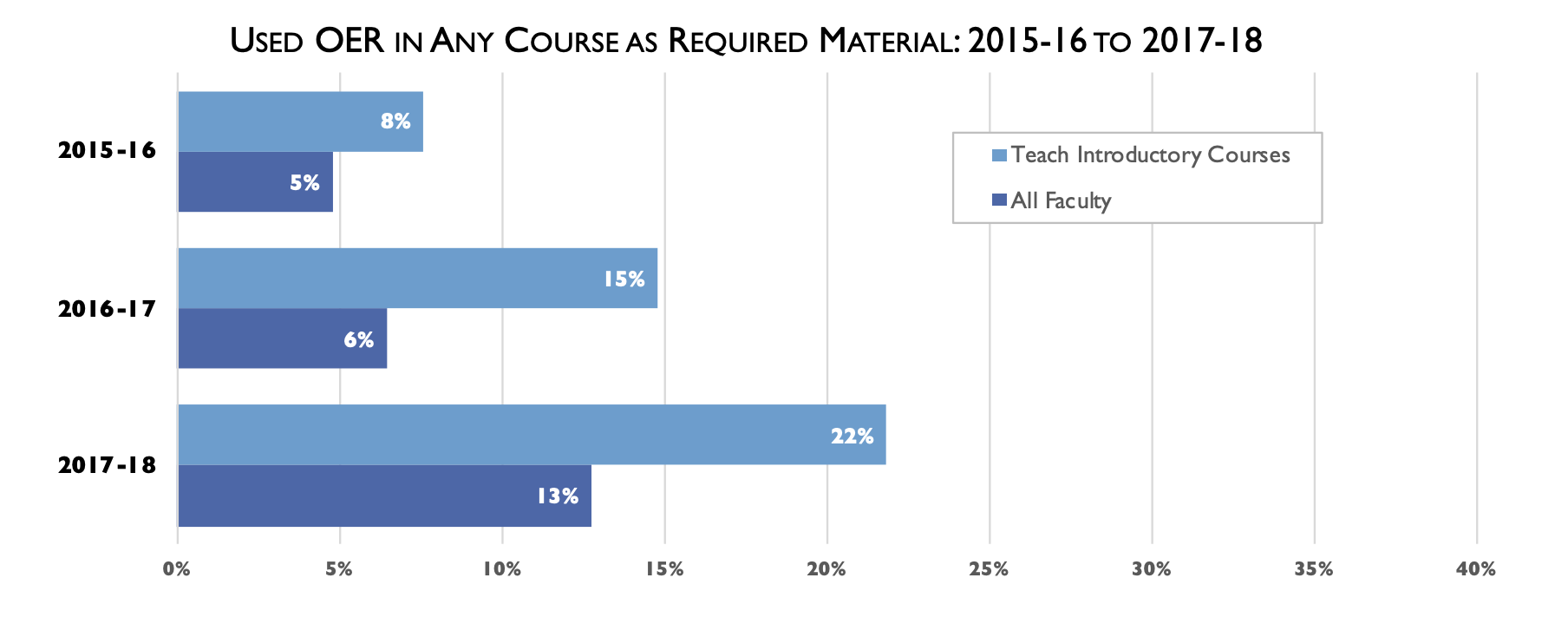
    The open-educational-resources movement, commonly known as OER, is an effort to encourage academics to use open-licensed materials in their classrooms as a way to lower costs. Some nonprofits, like OpenStax, have produced textbooks based on this material. The survey shows that OER has made inroads: 22 percent of people who teach introductory courses, subjects in which free textbooks are most commonly available, use it as required material, up from 15 percent last year.

    Yet the percentage of faculty members who say they will use, or consider using, open materials in the next three years actually dropped slightly, with the numbers now at 6 percent and 32 percent respectively.

    On the surface, this description indicates that OER adoption increased for faculty teaching introductory courses, but the second paragraph shows a potential drop in adoption over the next three years for all faculty. That would be major news showing that the OER movement hit an inflection point and is likely to drop soon, even though faculty have a natural affinity for the same issues that OER offers – lower cost and the ability to remix / reuse.

    It turns out this interpretation is wrong. The actual BSRG survey report states the following [emphasis added]:

    Each year, this survey asks faculty members who are not current users of open educational resources whether they expect to be using OER in the next three years.

    This question is only for non OER-adopting faculty. In other words, it measures growth potential, not total adoption potential. In fact, the percentage of faculty who used required OER material in any of their courses more than doubled this year, and based on the question above should continue to grow. BSRG further described the numbers for non OER-adopting faculty.

    There have been minimal changes in the proportion of faculty who report that they will use OER in the next three years, dropping slightly from 7% in 2015-16 and 2016-17, to the 6% reported this year. The number who report that they “Will consider” OER grew from 31% in 2015-16 to 37% for 2016-17, before dropping to 32% for 2017-18.

    This description is poorly worded and misses the context provided earlier, which I assume was part of the problem with Chronicle coverage.

    As for actual adoption, the category of “all faculty” grew significantly over the past year.

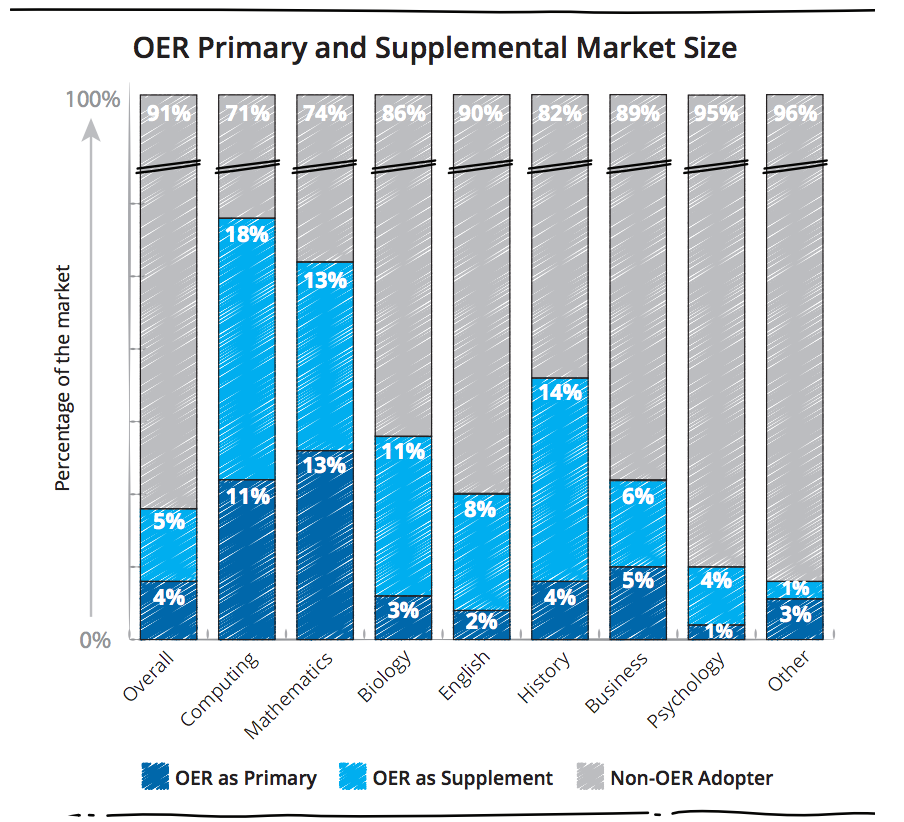
    Nearly one-quarter of faculty that teach large enrollment introductory courses report that they are using OER in some fashion, with more of these faculty responding that use OER as supplemental rather than as required materials. The rates are lower across all faculty, with 13% reporting using OER as required course material in at least one of their courses.

    These numbers represent a large increase over those in previous years, with the overall faculty rate of required OER use climbing from 5% two years ago to 6% in 2016-17, and then making a large jump to 13% this year. Given the sometimes vague understanding of the OER and its licensing, care must be taken in interpreting these results. Are faculty lumping any free resource into the OER category, even those that are not licensed as OER? Based on previous results we have to assume that there is some level of over-reporting in these figures of OER use; we just don’t know how much of an impact this is having.

    Chart showing growth of OER adoption

    What is interesting is that this adoption growth aligns with an independent source, the Cengage OER survey from Fall 2016.

    Open Educational Resources (OER) in higher education have the potential to triple in use as primary courseware over the next five years, from 4 percent to 12 percent, according to a survey of more than 500 faculty by Cengage Learning.

    What the data appear to show is significant growth in OER adoption for all faculty as well as for the subset teaching introductory courses. Adoption should continue, although it could be at a slower rate than was seen over the past year.

    It pays to read source material when the data describes important trends, especially when the results are surprising. I wish I had done this earlier.

  • Welcome Change: OpenStax using more accurate data on student textbook expenditures

    Welcome Change: OpenStax using more accurate data on student textbook expenditures

    Last week OpenStax, the Rice University-based publisher of open educational resource (OER) materials, announced that according to their data more than 2.2 million students at 48% of colleges in the US and 1,150 outside the US are using OpenStax free textbooks, saving an estimated $177 million.

    This is compelling data in its own right, and we are working on analysis around this organization and its model, but somewhat buried in the press release is another significant statement around what students currently spend on textbooks and what savings are possible with OER.

    “Our community is creating a movement that will make a big impact on college affordability. The success of open textbooks like OpenStax have ignited competition in the textbook market, and textbook prices are actually falling for the first time in 50 years.”

    As a result of the unprecedented downward shift in textbook prices, OpenStax will be decreasing its estimated student savings figure from $98.57 to $79.37 based on federal data. The U.S. Department of Education’s National Center for Education Statistics published a study in May stating the average undergraduate student spent $555.60 on required course materials for the academic year. Dividing that number by seven courses (the undergraduate average, according to enrollment data) comes out to $79.37 in savings for each student using an OpenStax book.

    I have long argued that OER groups and others arguing for making college more affordable should use baseline numbers based on what students actually pay for textbooks, rather than the all-too-common $1,220 – $1,420 per year numbers from a misuse of College Board budget numbers (see chart at top of page 10 in this document). With OpenStax moving to new federal data showing $556 average expenditures, we should start to see more reliable estimates of student savings. Kudos to them.

    However, this level of student spending should not be a surprise to anyone following the curricular materials market.

    Our 2015 post “How Much Do College Students Actually Pay For Textbooks?”, as well as a follow-up post, show in detail that we have had data for years showing that students roughly $600 per year on textbooks and related course materials, and that that number has been falling since at least 2008. Using data from the National Association of College Stores (NACS), we knew three years ago about the rough level of spending and the multi-year decline. NACS has continued to release annual updates, with the most recent public release from last summer:

    NACS data showing course material expenditure

    What OpenStax refers to, however, is the new National Postsecondary Student Aid Study (NPSAS) restricted-use data from the US Department of Education’s National Center on Education Statistics, showing $555.60 average student expenditures per year. Which is right in line with the NACS data.

    We plan to explore the NPSAS data in more detail, as it provides rich data for crosstabs and exploration of student expenses. But for now, kudos to OpenStax for this change in student savings estimates, even if it is years overdue. I would hope that other OER advocates would follow their lead.

  • Some Thoughts on OER

    Last week I had the good fortune to co-keynote the Northeast Regional OER Summit at UMass Amherst. My counterpart keynoter was Don Kilburn, the current CEO of UMassOnline and former CEO of Pearson North America. We each gave brief talks, followed by a conversation facilitated by UMass Amherst’s Marilyn Billings. It was a lively discussion that inspired a lot of passionate debate on Twitter. That, in turn, inspired requests for more information about the conversation from people who weren’t able to come. So this is my recap.

    Don’s talk

    Don was there in his UMassOnline capacity but he spoke from his perspective as a long-time senior executive at a major textbook publisher. From the beginning, it was clear that having Don on stage would be both potentially interesting and inevitably fraught. Many folks in the OER community have a visceral negative reaction to the way of thinking and the kind of language that Don employs instinctively due to his particular professional history. And Don, for his part, didn’t seem to have had a whole lot of exposure to or understanding of the audience he would be addressing. The most cringe-worthy moment was when he trotted out the old “free as in puppy” chestnut as if it were a novel statement and not something that the OER community, and the open source community before it, had heard ad nauseam for at least a decade. That cultural clash between the audience and the opening speaker…resulted in the kinds of tweets that you would expect, and appeared to have an outsized influence on the way a vocal segment of the audience reacted to the whole conversation.

    That’s unfortunate, in part because Don knows a lot that could be useful to people who want to learn how to be more effective at driving OER adoption and understanding how a broad cross-section of faculty approach curricular materials adoption in general. He knows about the many experiments, both successful and unsuccessful, that the textbook industry has tried in order to figure out which value propositions persuade faculty to adopt curricular materials. He knows what’s happening in the market right now, how the publishers think, where they are gaining traction, and where they are struggling. Whether or not you agree with him, he can provide useful intel that is normally inaccessible to academics.

    I won’t summarize his talk here, but since the first part of my talk built off of Don’s, you’ll hopefully get a rough sense of the ground he covered through my summary of my own talk.

    My talk, part one

    I’m not going to recap the discussion in strict chronological order. Instead, I’ll address the piece of my talk that built off of Don’s now and circle back to the other part—which was really the main part of my talk—later. In retrospect, the conversation after the talk provides some good context for understanding the main point I was trying to make.

    A lot of Don’s talk was about how curricular materials prices are coming down and how the industry is trying to establish the value of its product in the face of this change. This seemed like a good place for me to pick up, since the most common argument for OER is about affordability There is absolutely no question that the value of base informational content—the part of a textbook that could easily be replaced by a Wikipedia article, for example—has commoditized. This is one reason why textbook prices are coming down. (I could tell another story about used books and rentals and Amazon and Chegg, but the two narratives are really just two sides of the same coin.)

    In the curricular materials markets, there are two pricing bands that are beginning to emerge. The first one is in the $10 to $40 range, and it is often presented as either a cheap version of the print textbook—a black and white softcover, for example—or something close to a direct digital replacement of the book. The other band, in the $60 to $100 range, tends to have products with lots of formative assessments, student and instructor dashboards, nudges and reminders, and maybe adaptive capabilities. Here, publishers are trying to establish a different value proposition from the print textbook. The “courseware” products that typically inhabit this price band can provide both students and instructors with a lot more information about how the students are doing, whether they are coming prepared to class, and where they need help. I have written several posts about these two competing value propositions, labeling them as “good enough” versus “better enough”.

    As long as those two value propositions dominate the way in which curricular material choices are framed for (and by) the faculty, they will also frame the way that OER are valued. And I mean that partly in economic terms, since not all OER are cost-free to the students and none are cost-free to the creators and maintainers. If the Wikipedia-like portions of the textbook have little to no economic value, then what else are students paying for and how much should they have to pay for it? How much is professional curation—in the form of scope and sequence—worth? How much is it worth to have somebody align learning objectives, assessment questions, and the informational content? To keep the content up-to-date? To provide frequent, auto-graded or easy-to-grade formative assessments? To provide dashboards that show progress on those assessments? To provide adaptive learning tools as differentiated instruction aids? There is no one correct answer for each of these questions, but now at least the pricing is starting to become transparent enough and product options unbundled enough that it is possible to answer them. The affordability problem, while not yet solved, is moving in the right direction. Because unbundling is part of this movement, educators can start making more fine-grained, student-centered choices about any potential trade-offs between accessibility and effectiveness.

    In my view, the OER community needs to become more sophisticated in its discussions of these trade-offs and more respectful of the individual decisions faculty make as they try to find the right trade-offs for their particular contexts. “Free as in puppy” may be glib, but that doesn’t mean it’s completely false. On the one hand, I don’t know anybody who got a free puppy that didn’t…you know…already want a puppy and know that puppies require care and feeding. On the other hand, some people do underestimate the amount of care and feeding a puppy requires. If you want to make sure that those puppies don’t get given to a shelter or abandoned at the side of some road, you need to make sure that somebody is prepared to be responsible for them. You need a puppy sustainability strategy. Some puppies are more work than others, and some families are more prepared to care for puppies than others. Sometimes you’d be better off adopting a dog that’s already been house trained. Or to pay for a trainer. Or to get a cat instead. Or a goldfish. Any resource that has a cost of upkeep needs a sustainability plan. Resources that do more will often—though certainly not always—require more initial investment and more upkeep. A puppy that is going to be a family pet requires a different level of investment—both up front and ongoing—than a rescue dog or an agility dog.

    The utility of an open license, part 1

    Of course, “good enough” and “better enough” is not the only way to frame the value of either affordability or OER. This is where the conversation among OER advocates can (and did) get chaotic quickly. For example, one topic that came up during Q&A was the utility of an open license to enable faculty to customize the content to their students’ needs. I said that faculty can and do customize with proprietary content all the time, and that anyone who believes the only way to do this is with OER is fooling themselves.

    This comment caused some consternation. I stand by it.

    When faculty want to adjust proprietary content, they skip chapters, supplement with other content (including some they may have made themselves), reorder the content, combine different texts, and so on. Instructors are endlessly creative in the ways that they slice and dice proprietary content. In fact, this exact tendency is one reason why textbook publishers got into pricing trouble in the first place. They have known forever that English comp professors are likely to use maybe one out of every three readings in an anthology, and that the particular readings which get used will vary from professor to professor. So they produce anthologies with three or four times as many readings as any class could use in a term. They do the same thing with problem sets. Or textbook chapters. Maybe one Biology 101 professor likes to spend more time on cellular biology while another is into ecology. No problem; the publishers just put in lots of chapters on both. Faculty will use what they want.

    What you end up with by employing this publishing strategy is a puppy that has been house trained, agility trained, and rescue trained. That is one very expensive puppy. And the students—who, after all have to buy that puppy—get irritated because it is obvious to them that they will never have to use their dog for an avalanche rescue.

    Customization happens regardless of license. Yes, a license makes certain kinds of customization easier. It’s an affordance. If you train your puppy yourself, you can decide what you want to teach it to do. Our dog, who we adopted as an adult, was trained by her prior family to ring a bell with her nose when she wants to go out. That was apparently useful to them. But I’ve had lots of dogs during the course of my life, and we never had to train them to do something specific when they wanted to let us know that they had to go out. Each had his or her own way of accomplishing this function. We didn’t suffer from that particular loss of control.

    The definition of open education is an open question

    One weird aspect of the “free as in puppy” analogy is that it treats the dog like a possession whose primary salient characteristics are cost of purchase and cost of ownership. That’s certainly one valid way to think about curricular materials (though not about puppies). But if what you’re really interested in is a pedagogical approach—let’s call it “open education”—then this is not the only way, or even the best way, to think about OER. Some OER advocates are interested in open education as a way of teaching, with OER being a set of raw materials designed to support that way of teaching. The problem is that we don’t have anything close to a consensus on what “open education” actually is.

    Some of the summit attendees talked about the value of having students create and edit the content. Say you want your kid to learn some responsibility and empathy, as well as something about animal behavior and psychology. Having a dog will give them some of that. Having your kid train the dog will give them a lot more of it. Having two of your kids train the dog together will also teach them something about cooperation. In this case, the “cost” of training and caring for the dog is actually a benefit.

    There is overwhelming evidence that having students learn by doing (including by researching and authoring) can be very effective. But there are two caveats regarding how this general principle of learning translates into the specific activity of student co-creation of curricular materials. First, having students write and edit their own curricular content is not inevitably effective as an active learning strategy. Sometimes, sure. But like everything else in education, it’s highly context-dependent. Second, depending on how broadly the students are sharing this work, it’s not clear that you need an open license on it, or that you need all content and source materials to be openly licensed. If the instructor doesn’t put any license at all on the student-created content but makes it freely available on the web, is it OER? In spirit, probably, but that would not be consistent with common usage of the term.

    As a teaching strategy, I’m enthusiastic about having students co-create curricular materials. As a teaching philosophy, I’m agnostic and utilitarian about it. As teaching dogma—no pun intended—I’m deeply skeptical, as I am about all blanket generalizations about the “best” way to teach regardless of context.

    My favorite variation on student production of curricular materials as a teaching strategy is Mike Caulfield’s notion of choral explanations. It adds the dimension that having a handful of different explanations can be more helpful than having just one. Think about your own behavior when you’re looking up a health condition on Google or a how-to demonstration on YouTube. Do you tend to look at just one search result? Or do you look at a few different ones? I often look at a few, and sometimes more than a few. The reason we can have the benefit of that diversity is because, on the web, there are many different people producing content resources and sharing them for free. They may not have Creative Commons licenses, but they are OER in a real sense.

    Again, I’m enthusiastic about this approach as a teaching strategy and utilitarian about it as a teaching philosophy. If it works for your students, in your subject, with your pedagogical activities, that’s great.

    Not all open education advocates define it this way. And to be clear, I’m not trying to provide a comprehensive list of useful definitions for open education here. I’m summarizing and reflecting on last week’s conversation. But I do want to touch on a subset of those other definitions that are often less well defined, more essentialist, or both. Because they did come up in that conversation, and because that’s where there are real problems.

    Real problems

    One question I got in the Q&A was what advice I had about things that the open education community isn’t doing as well as it could. That’s easy: Stop bickering so much.

    Teaching, when done right, is deeply personal. That’s both good and bad. On the good side, first, many educators are motivated to be good teachers even when their environment actively disincentivizes them, because they care about their students. It’s one reason why educational systems produce so many success stories in spite of the fact that the systems themselves are deeply, disturbingly messed up. Also, there is evidence that the very fact that a teacher cares about a student has a strong chance of positively impacting that student’s physical, emotional, and financial wellbeing for the rest of their lives. (Many of us have our own personal stories about this, but there is also hard, longitudinal evidence.)

    The bad side of teaching being so personal is that it can be very hard to maintain ego boundaries when you care so deeply about so many students in a messed up environment like the modern classroom (or, really, like human existence in general). I speak from personal experience as well as from knowing, working with, and living with many educators over the course of my life. It’s hard to separate the job from your personal identity. For some people, “open education” is an affinity group of sorts.

    In and of itself, that’s fine. Teaching is hard, teachers deserve and need emotional support, and one way to get that support is to find your “tribe.” But I have observed a lot of infighting about shibboleths that mark membership in the open education tribe. Too often, it gets unreasonably heated and personal. At its worst, this behavior metastasizes into a particularly noxious form of identity politics. At that point, it is no longer about helping students.

    As I said in answer to the question at the summit, there are only two essential goals that I care about in education: (1) increasing access and (2) increasing the value that students get from the education that they can access. I am agnostic and utilitarian about everything else. To the degree that discussion, debate, or usage of open education teaching strategies or open educational resources furthers one or both of those goals, then I’m for it. To the degree that it distracts from activities that could further those goals, then I’m against it. In recent years when I have attended conferences that are billed as “OER” or “open education” events, I have not been impressed with the ratio of constructive conversations to painful distractions.

    This is absolutely fixable—if the participants decide that it is something they want to fix. I hope they do. Some of the brightest, most talented and dedicated educators I know are among these people. I would like to see them accomplish all the good in the world that they can.

    My talk, and the utility of an open license, part 2

    All of the conversation I described above is important. I’m glad we had it. But it wasn’t the conversation I had hoped to provoke. In the main part of my talk, I recapped the four levels of empirical education:

    1. Intuitively empirical: This comes down to whether you pay attention to your students and do something differently with them based on what you observe. Do you always do the same thing, or do you have a bag of tricks that you can draw from when you see students struggle? I believe that the substantial majority of educators are empirical in this sense. They may not think of it as empiricism, but they are observing student behaviors and are adjusting their strategies based on what they see, guided by some sort of rationale for choosing which strategy to employ in different circumstances.
    2. Mindfully empirical: Mindfully empirical educators think about how they can get the maximum amount of useful diagnostic information from day-to-day course work. They design their courses with a goal of creating many feedback loops that enable them to be adjust their teaching to the needs of the students.
    3. Meta-cognitively empirical: Meta-cognitively empirical educators are empirical not only about how they use their existing bag of tricks but also about which tricks they should have and how effective those tricks really are. They consciously and regularly test their own assumptions about effective teaching, and they are open to trying new appropaches. My read of Lauren Herckis’ research is that the barrier of moving from mindfully empirical to meta-cognitively empirical (and to the next level, socially empirical) is where a lot of the difficult work needs to be done. Lots of educators are intuitively empirical, and the transition from there to mindfully empirical is not a huge leap. Getting them to test and challenge their deeply held beliefs about what constitutes effective teaching is a lot harder.
    4. Socially empirical: Socially empirical educators view effective teaching not as an individual art but as a shared pool of knowledge and experience that everyone can learn from and contribute to. They seek out common vocabulary, methods, and standards of proof so that they can learn with their colleagues and raise the collective bar. This is the beginning of disciplinarity.

    One possible defining purpose of “open education” is fostering socially empirical education. We can learn together and teach each other, teacher to teacher, teacher to student, student to student, and student to teacher. We can collectively learn how to teach and learn more effectively. We can conduct experiments, check each other’s work, and develop shared notions of what constitutes “evidence” of effective education. With this formulation of open education, as with the others, an open license is not a necessity; it’s an affordance. But substantial kinds of openness are essential to socially empirical education. You can’t build a shared body of knowledge without sharing.

    The strategy of having students collaboratively construct knowledge artifacts fits in with this ethos nicely. Students learn how to negotiate the development of shared understanding. Here again, I am endorsing a strategy, not a dogma. But by framing student creation of curricular content as “learning how to negotiate the development of shared understanding,” we take the motivation for the educational activity out of the realm of say, social constructivism, which individual instructors may or may not buy into, and reframe it as a life skill that all humans should have. Doing this will help more instructors better understand why, when, and possibly even how they might want to utilize the strategy of having students co-create curricular materials.

    Framing open education in terms of socially empirical education is intended to be a provocation rather than an argument. Since I am a critical friend of the open education community rather than a member of it, I don’t really get a vote. But I hope that the notion of socially empirical education can enrich the conversation among proponents of open education.

  • Top Hat’s OER Announcement: Doubling down on faculty engagement

    Top Hat’s OER Announcement: Doubling down on faculty engagement

    Several months ago I wrote a post looking at the Top Hat’s push into digital curricular materials through their Textbook product and Marketplace for digital course content. Leading up to that post, I had been planning to cover the Open Educational Resources (OER) angle, as the Marketplace included a number of openly-licensed material, much of it from OpenStax, and Top Hat had already begun marketing itself as an OER provider. At the time, the OER strategy seemed a work in progress. In fact, I found that some of my questions for company staff about OER basics – the role of Creative Commons licenses, community dynamics exhibited at the OpenEd conference, etc – led to a lack of answers, and at the time there was no export capability to get OER out of the platform.

    To Fee or Not to Fee

    The situation has changed since January, and with last month’s announcement of Top Hat’s Open Content Initiative the company is taking a stand on whether it is appropriate to charge for platform access. The idea of hosting and modifying OER on a fee-based platform became a big topic last year. Lumen Learning pioneered the Red Hat type model in 2014, and last year there was a big movement with Cengage, Knewton, OpenStax, Macmillan, and Top Hat all offering OER within their platforms. In many cases, the OER content itself has been redesigned from traditional textbook-in-PDF format to learning objective-driven content with aligned assessments. ((Disclosure: Lumen is a client of MindWires, and I recently gave a paid keynote at a Top Hat user’s conference.))

    Top Hat has now removed the student platform fees and added an export-to-epub feature. As evidenced in a company blog post by CEO Mike Silagadze, they are not shy about it either.

    At Top Hat, we’ve been working on making education more effective and affordable since 2009. Now, we’re happy to make a move that delivers on both fronts. Beginning April 12, with the launch of our Open Content Initiative, we’re offering completely free access to thousands of textbooks and other Open Educational Resources (OER)—freely accessible and openly licensed learning materials—on the Top Hat Marketplace.

    It’s about time. Students have been forced to weigh the pros and cons of emptying their wallets and draining their financial aid to buy textbooks for far too long. [snip] Just as bad, digital publishing platforms and e-readers have been charging a toll to students—disguised as a platform fee—to access free, openly licensed OER.

    Enough is enough.

    I asked Silagadze about a point I noted when describing Cengage’s OpenNow product:

    For each course [VP of Content Strategy] Constantini estimates that the modifications take $50k – $100k of internal work, including verifying of licenses for embedded elements. I would note a certain irony here in that OpenStax produces more-or-less traditional digital textbooks requiring publishers or OER services companies like Lumen to break apart and realign to competencies or outcomes.

    Silagadze brushed off this description and stated that the modifications made by other providers were far smaller and easier to make than is being claimed. We now have a third variation in the OER market, with the provision of wrap-around platform and a clear argument that these platforms not only will be free on Top Hat, but that they should be free as a matter of principle.

    • Free content, not dependent on specific platform
    • Free and modified content, available on a paid platform, content available for export
    • Free and lightly modified content, available on a free platform, content available for export

    While this is a marketing position by one of the competitors in a new field, this move by Top Hat is a further sign of the OER movement breaking into different branches. From our perspective, the fractures in the OER community have been widening for the past several years, but to a degree this is a sign of success. Openly-licensed content usage is becoming more and more common in education, and even traditional publishers mostly accept the value of OER.

    Faculty Engagement

    Perhaps more significantly, at least in terms of understanding Top Hat as a company, is that the OER initiative doubles down on their bet on faculty engagement. A well-known issue with OER (and even with non-open content) is that few faculty end up taking advantage when given the ability to modify the course materials in any significant manner. In theory many people talk about open pedagogy in terms of faculty modification and collaboration on content, but in practice this rarely happens. Top Hat’s view is that the barrier has been flat content and cumbersome platforms, as best described in an eLearning Inside interview.

    “We think the promise of OER has fallen down,” said Nina Bilimoria Angelo, VP of product and customer marketing at Top Hat. The Toronto-based company has created a platform to house, customize, and share OER and other educational resources. It has been used by over 2.8 million students to date.

    “The promise was there’s a community that continues to build on open materials,” Angelo said. “But when those materials are trapped behind static PDFs, and then people are making changes to it on their own without a mechanism to share it back, that’s where things fall flat. We really wanted to create a system where things can be improved in real time, not over a 3 or 4 year cycle like with traditional publishers.”

    “Discoverability is a challenge with OER,” Angelo said. “Quality can be perceived as uneven which is probably why OER adoption has stalled at the 5-10% level for instructors. There’s a lot of skepticism amongst higher educators. We’re trying to make sure all the high quality material is available in the Marketplace. Once it’s adopted, it’s really customizable. But then those customizations – this is the magic – those customizations can be shared back with the author and the team so that they can improve upon what they’ve created.”

    This is the best way to interpret Top Hat’s OER move, in my opinion, and you can see more details in my January post about the Marketplace to better understand the customization and sharing capabilities of the platform.

    According to an internal Top Hat survey of users, 89% of adopters make changes to digital textbooks that they adopt, with 22% reporting “lots of customization”. If this internal data is representative, there may be some indicators that faculty can be more involved in modifying and sharing content. Top Hat is betting on faculty engaging with content, modifying it, sharing it, updating it. And they are betting that this model will drive faculty adoption decisions.

    There are a lot of unknowns about faculty adoption and modification of OER content through the Top Hat Open Content Initiative, but it is clear that the company is positioning itself differently than other providers. The transformation of digital curricular materials continues.

  • Hawai’i Senate OER Bill Update: Amended language saves the day

    Hawai’i Senate OER Bill Update: Amended language saves the day

    On Friday I reported about SB2328, a bill that passed (with amendments) the Hawai’i Senate Committee on Higher Education and would have mandated open educational resources (OER) for all courses at all 10 University of Hawai’i campuses. And if there were no adequate OER materials for a course? “. . . the faculty member or lecturer responsible with providing instruction for the course shall create the instructional materials and offer those materials free of charge to students through open educational resources.”

    This bill was a disaster in the making. Not only would it have been unworkable in terms of funding and intellectual property ownership, it would also have set back the OER movement by associating OER with unfunded faculty mandates and reduction of academic freedom. All this from good intentions but apparently shallow understanding.

    As mentioned in an update to Friday’s posts, the amendments that resulted from committee hearings removed the mandates. We now have the amended language, and it is a completely different bill.

    Updated language:

    The purpose of this Act is to:

    (1) Establish the University of Hawai‘i open educational resources task force to conduct a comprehensive analysis and evaluation on all general education courses and high attendance courses taught at the University of Hawai‘i system to identify open educational resources for those courses;

    (2) Establish and appropriate funds for an open educational resources pilot project grant program to incentivize faculty that adopt, develop, and implement open educational resources; and

    (3) Require the University of Hawai‘i open educational resources task force to report its findings and recommendation initiatives for supporting and expanding the use of open educational resources at the University of Hawai‘i to the Legislature prior to the Regular Session of 2019.

    During the hearings there were several dozen testimonies shared, and all but two opposed the bill (and one of those two changed positions to oppose). Leading the opposition was the University of Hawai’i Professional Assembly, the local faculty union.

    In short, the bill amendments removed mandates, creates a task force charged with a one-year evaluation of high-enrollment and general ed courses, and creates a $50,000 grant fund to incentivize faculty adoption.

    It is not clear whether the bill will make it through remaining hurdles to become state law, but if it does, we will have a fairly significant move in the state dealing with the costs of curricular materials and OER adoption.

    Billy Meinke, OER Technologist and UH Manoa and a key player within the system (let’s call him Kane OER), was unaware of SB2328 before it came out. This gets to the heart of the problem – the original bill appears to have been written without any input from the people already working on OER adoption within the University of Hawai’i.

    I still have a problem with the preamble of the bill that uses the misleading claim that the “average cost for books and supplies for the same academic year at public colleges averaged $1,250.” Students actually pay about half this amount, and this false setup will lead to erroneous estimates of how much any such bill could save for its students. But for now, crisis averted.