
e-Literate

Present is Prologue

Tag: OLI

  • There’s a Layer in Between Learning Content and Learning Analytics

    This post is the third in a series about the collaboration on a new courseware platform between Carnegie Mellon University’s Open Learning Initiative (OLI) and Arizona State University’s Center for Education Through eXploration (ETX). (The web version of this post has a clickable table of contents up at the top.) I’ll be writing about the platform periodically on a variety of topics ranging from nuts-and-bolts questions like what features it will have by when all the way to very broad and deep topics like architecture, interoperability standards, and hoped-for impacts on the educational ecosystem. As a reminder, I’ll also be holding a Blursday Social webinar with OLI’s Norman Bier and ETX’s Ariel Anbar on this Thursday, 2/4 at 4 PM ET.

    Today I want to review a fundamental aspect of the collaboration that I discussed in my previous post in this series from a slightly different angle. Not too long ago, I had a conversation about this angle with a new friend. After we had waded into it for a while, she said to me, “Everybody wants to talk about content and learning analytics. You’re saying that there’s a layer in between.”

    Exactly. She expressed it perfectly.

    And yet, two aspects about that moment surprised me.

    First, even though I have been writing about this idea almost since I started this blog in 2005 and have involved in the design of multiple EdTech systems that rely on this principle, I had never thought about it in quite the way she had put it before she said it. Second, I don’t think she had either. For context, my new friend is a PhD candidate in experimental psychology who is only weeks away from defending her dissertation at Carnegie Mellon University. She has a history in EdTech that is as long as mine. Furthermore, she had to be working with this concept directly and intimately, given the subject of her dissertation. And yet, her formulation of this idea also seemed novel to her as she expressed it to me in that moment.

    If I am still finding new ways to wrap my head around this concept, and she is too, then chances are good, Dear Reader, that previous blog posts I’ve written about the topic have failed to fully communicate the idea to you as well. So I’m going to take another go at it in this post. First I’m going to talk about what, generally speaking, we mean by “in between” and then about why it’s important for us to understand the layer that’s “in between” learning content and learning analytics.

    Meaning is the meat of the sandwich

    Imagine I handed you a piece of paper with “8429971043” written on it. Take a moment and try to imagine contexts in which that act would make sense to you. What might that number mean? Why would I be giving it to you? Sketch out a few stories in your head.

    Now instead, imagine I handed you a piece of paper with “(842) 997-1043” written on it. What stories are you writing in your head now? Did I give it to you printed on a little piece of cardboard at the beginning of a business meeting? Scrawled on a napkin in a bar?

    Now go back and reread those last two questions. Notice how much insight you were able to extract from the context embedded in the questions once you recognized that string of numbers as a phone number, as opposed to just a string of ten digits.

    Without the meaning of the number, you had the content, and you were trying to perform your analytics, but you were severely limited. The enabling layer in the middle is the idea of a phone number. Given just a little bit of punctuation, your brain transformed a random string of numbers into a thing in the world that you can do something with. It also enabled you to extract new information value out of other contextual information, like the kind of paper the number was written on or the location in which the paper was exchanged.

    There was a moment in the history of software when computing machines were given this layer in the middle for phone numbers. On one day, a phone number in an email wasn’t clickable (or tappable). The next day, it was. Clicking on it now offers you several predictable options. Would you like to associate this number with a person in your address book? Would you like to dial it now?

    Software developers deal with this “in between” layer all the time. They call it an “information model.” Consider, for example, the address book which stores the phone number that you clicked on. It has an information model that knows that phone numbers can belong to people. It knows that people can also have email addresses, physical addresses, company affiliations, and other things. Emphasis is on things. John Smith isn’t just a string of letters; it’s the name of a person. (842) 992-1043 isn’t just a string of numbers, spaces, and punctuation marks; it’s John Smith’s phone number.

    Information models represent meaning, including relationships between things (such as the relationship between John Smith and his phone number). Software architects work very hard to replicate the relevant ways in which we parse and store meaning in our heads to perform tasks that are relevant to the software being built. Suppose John Smith lives in Europe, where phone numbers have different numbers of digits. Suppose he writes his phone number as 842.992.1043. Suppose he has multiple phone numbers which he uses for different purposes in different locations. An information model has to capture all of these nuances. It’s hard work, but it’s a well understood process. Software developers do it all the time. They are constantly mapping bits of the human world into their software.

    For some reason, humans seem to struggle when thinking about how to map learning and teaching in this way. Even experienced and formally trained humans who think about it all the time struggle with it. We could chalk that up to how incredibly complex the human mind is. And there’s something to that. Learning is comprised of an incredibly complicated and varied array of processes. I’m going to write about that problem and its implications for, say, adaptive learning in a future post. But I don’t think that’s the whole story because even basic building blocks seem hard for us to wrap our heads around.

    Hard, but not impossible. Let’s give it a try.

    The pedagogical meaning in the middle

    Imagine you’re in a literature class studying The Odyssey. Your professor asks you the name of Odysseus’ dog. You may have one of two common reactions to this question. One is to try to come up with a thoughtful answer. The other is to roll your eyes in frustration. The reaction you have is related to the meaning you believe is attached to the name of Odysseus’ dog. If the name has no meaning—if it’s the Greek equivalent of “Spot” or “Rex”—then you might roll your eyes because you don’t think this question is has value relative to its purpose, which is to help you understand The Odyssey. The instructor’s question is a thing that is supposed to have a use. Specifically, it is supposed to help you learn—or show what you have already learned—about the literature. You expect it to fulfill one or both of those functions. You expect that the question, answer, and purpose for asking are all related to each other and to The Odyssey. This is the information model in your head that drives your interactions with your instructor. When your instructor asks you a question that doesn’t lead to an answer that helps you better understand the literature, then you get frustrated. It’s a little like being asked to memorize a phone number without knowing whose phone number it is or why you need to know it.

    When we are designing a lesson, either in software or in an old-fashioned, human-to-human class, we are (consciously or unconsciously) drawing on this information model.
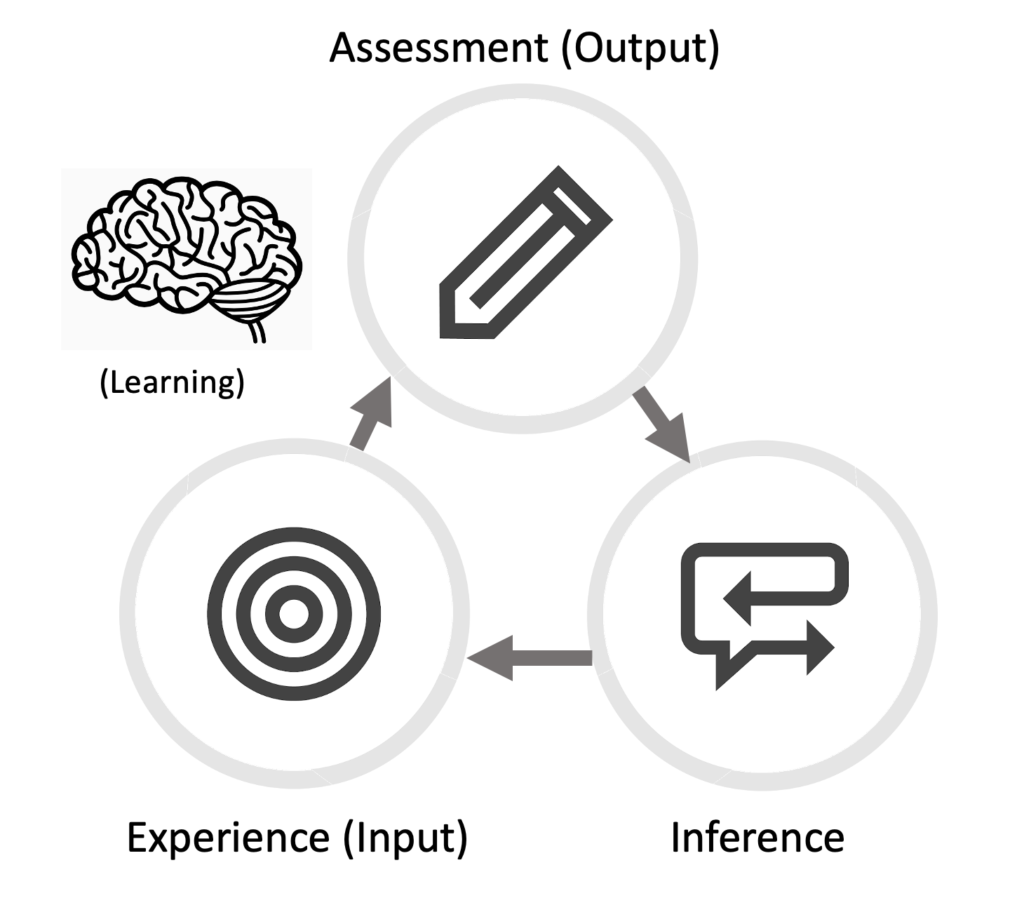
    A basic information model for teaching and learning

    Let’s see how this works with some more interesting questions about Odysseus’ dog. Suppose your instructor asked you, “Why does the author write about the dog at all? What is the function of the dog in the story?” That feels like meaningful question. If you’ve read The Odyssey, you may remember that the dog only appears in one scene and dies almost immediately. It’s not like the dog (whose name is “Argos,” by the way) is a major character in the story. It shows up exactly once, at a moment in the story that is very dramatic for reasons that seem completely unrelated to the dog dying. What’s that about?

    Now let’s try a similar mental exercise to the one we tried with the phone number. Imagine your instructor asking that question in different contexts. What would it mean if she gave you the question to think about before you read the passage? How would the meaning of the question—or maybe more more precisely, how would the purpose of the question change if your instructor asked that question in class discussion after you had already read the passage? How would it function differently if the question came as an essay exam question after the class discussion?

    In context, we can answer these questions fairly easily. The instructor is asking the student a question about a work of literature that is intended to stimulate or test the student’s understanding of some specific aspect of the literature. We can judge the nuances regarding stimulating versus testing understanding based on the context. That is our tacit information model. And yet, both educators and software developers, and even experts who study learning, can struggle to hold onto the model in the general case.

    This is an important problem to solve if we want to improve education in general and EdTech in particular.

    Making tacit educational knowledge explicit

    As humans, we have an enormous amount of experience with learning through questions or challenges. Why is there a dog in that scene? How do I calculate how steep a hill is? Why are my scrambled eggs so runny? What is the guitar chord in that song I love? What will happen if I lick a frozen flag pole? We try to answer these questions. The emphasis is on try. We learn by doing (even if the thing we are doing is in our heads, like imagining what might happen if we lick that frozen flag pole). If we don’t get the answer we’re looking for the first time, we may try again or try something else. These are goal-directed learning feedback loops. As animals, we understand these loops instinctively. It’s an essential part of what makes us human. One translation of the sapiens part of homo sapiens is “one who knows.” This knack for knowing is how humans survive as a species. For example, I want to believe that most people who lick frozen flagpoles once don’t do it again. On the other hand, people who are serious about making good scrambled eggs may experiment repeatedly with pan heat, scrambling technique, and other elements. Each of these, in turn, produces a question that leads us to construct a goal-directed learning feedback loop. “What if the eggs are runny because I’m not getting them scrambled evenly enough?” And so we try again.

    Teaching is the craft of creating, optimizing, and sequencing goal-directed feedback loops that help learners learn. But because these loops are so intuitively available to us, we often don’t think explicitly about what we’re doing. Many of us don’t have a clear mental model for a fundamental task that we perform all the time. Even those of us who do can struggle to keep that model in our conscious minds and continue to refine it. It’s hard to refine your model if you can’t keep it front-of-mind as you’re testing it. And it’s really hard to translate it into a software information model.

    In my personal view, one of the most exciting goals of the OLI/ETX collaboration is the opportunity to work on this challenge of making a broad swathe of our tacit knowledge about educational processes explicit. On the software architecture side, the exercise of translating the very different learning experiences supported by OLI and Smart Sparrow into a common information model describing goal-directed learning feedback loops helps us generalize. I believe we are searching for the language of educational DNA.

    Let’s take that analogy seriously. In actual DNA, all of life in its infinite variety and complexity is encoded using just four letters in strands of DNA. I believe we can describe the basic, universal building blocks that encode learning in all its infinite variety and complexity. Of course, knowing those building blocks does not unlock all the secrets of life or learning by itself. But it’s a pretty big step in the right direction. An ambitious but achievable intermediate goal would be to be able to create and test any style of effective courseware design, including adaptive learning designs, using a single information design and architecture.

    The more important aspect of this aspiration is on the human side. If we can create a system that helps both educators and students translate the teaching and learning knowledge they apply instinctively into an explicit model, see the benefits that doing so gives them in terms of extracting more meaning out of educational contexts, and practice translating their tacit knowledge about teaching learning into explicit knowledge, that would be transformative. We would become better teachers and learners because we would be translating teaching and learning from arts to crafts and, when possible, to science.

    To sum up, I believe the software that is emerging from the collaboration between OLI and ETX can help educators and students become more effective at learning about teaching and learning while simultaneously creating an architecture that can implement almost any style of courseware on the market today and some that aren’t on the market yet. It can accomplish both of these goals by baking a model for the basic building block of teaching and learning—the goal-directed feedback loop—into every aspect of the platform, from the user experience to the deep architecture. This, in turn, will enable other capabilities that I will write about in future posts.

    If you want to talk about this (or any other aspect of the project), come to the Blursday Social webinar with OLI’s Norman Bier and ETX’s Ariel Anbar on this Thursday, 2/4 at 4 PM ET.

  • Announcing a Lesson-level Interoperability Standards Effort

    I’m delighted to announce a project aimed at making it easier to share interactive digital content at the lesson level as well as to establish baseline educational analytics for digital curricular materials. I’m tempted to call this a “courseware” interoperability effort, but its potential application is broader than that term would imply to some folks. For example, the work could support well-structured content in LMSs.

    This effort is consistent in philosophy with my recent “Content as Infrastructure” post series as well as the post of a version of my IMS talk on interoperability, learning analytics, and pedagogical intent. One of the main outputs of the project will be a white paper, released as an Empirical Educator Project (EEP) contribution, describing the standards proposal that is ultimately developed and its value to education. The project also dovetails very nicely with both previously announced and as-yet-unannounced EEP projects, and I’m very excited about the work.

    The idea for the work both grew out of and is funded through a grant from the U.S. Department of Education (ED) to develop “active OER.” In the course of the grant planning process, ASU professor and grant PI Ariel Anbar came to the conclusion that the grant would have a much broader impact if the content being developed were interoperable. He consulted with ED, and they agreed that interoperability would potentially increase the impact of the resources related to the grant. So a small fragment of the grant budget was carved off to test the viability of building a coalition that can make useful progress on proposed standards definitions that are both practically useful and likely to be adopted. At the moment, my work as a facilitator is the main budget expense for the project.

    Business and mission goals

    We had a kick-off meeting of a small group in late October. (More on who was in it, why they were chosen, and how we hope to expand later in this post.) Here are the notes I captured on the goals and ambitions for impact:

    • Reduce platform lock-in for any interactive courseware content, particularly interactive OER content, which will support the following:
      • Increase the quality of existing OER content by enabling the preservation of learning design
      • Increase the supply of interactive OER content by creating a clear and achievable interoperability standard for content developers
      • Increase the availability and value of OER content for value-added platform and service providers by lowering the cost of goods involved in converting the currently available “flat” OER resources into interactive lessons with effective learning design 
      • Enable educators to more easily mix and match interactive content at the lesson level
      • Enable the development of an ecosystem of non-OER content that could be licensed at the lesson level
    • Enable lesson-level, cross-platform, cross-content learning analytics which will support the following:
      • Data-based continuous improvement of learning content, regardless of its source
      • Baseline student learning analytics capabilities that will enable institutions to monitor student progress in an apples-to-apples way across lessons, products, and courses
      • Student- and instructor-facing analytics that will help them analyze how well their respective learning and teaching strategies impact outcomes
    • A vision for implementation and ecosystem development that incentivizes participation for a wide range of commercial and non-commercial value-added participants in order to:
      • Lower the barrier to adoption for courseware platforms by assuring customers that any content they develop or use will not be locked into the licensed platform
      • Lower the cost-of-goods and availability of high-quality pre-existing content for value-added OER curricular materials product and service providers
      • Enable micro-licensing models for commercial content vendors that develop high-value lesson-level content
      • Lower the barrier for non-profit organizations and consortia to create interactive content that is competitive in functionality and measurable quality with baseline student and teacher expectations for commercial courseware

    I’ll provide more of my personal take on these goals in a subsequent post, but there is consensus in the group that we should be working toward a set of goals that are good for everyone—students, instructors, institutions, and value-added content and platform providers.

    Functional and technical goals

    Consistent with the posts I linked to at the top of this one, we’re going to start by identifying questions that educators and students would want to answer about student progress, effectiveness of content design, and effectiveness of learning intervention. Our default atomic unit for this work is the “lesson.” Our starting point for identifying this set of questions will be the ones that the participating implementors have identified as ones that their users/adopters/customers want to answer, but I expect that we’ll expand from that base over the two-year life of the initial project.

    Once we know what questions we want to answer, then we will identify the metadata for the content that is needed to answer those questions. For example, which learning objective(s) does this assessment question assess? Is the assessment formative or summative? That sort of thing. No firm decisions have been made about how this would work on the technical level, but the basic idea is that the pedagogical intent of the learning design would be captured in some machine-readable form.

    Technically, we’d like to build on as much existing standards infrastructure as possible and propose developing as little new work as possible. While the project, as a piece of a larger ED grant, does not have a formal affiliation with an interoperability standards body, I am pleased to say that IMS Global and its CEO, Rob Abel, have been highly encouraging and offered technical support to the group as we think through the effort. IMS has a lot of the infrastructure that would be needed for the effort already baked into its existing specifications. It makes all the sense in the world to try to re-use or extend standards that are already developed and adopted.

    Ultimately, the group will produce a set of recommendations for interoperability standards along with a rationale for those recommendations. The hope and intention are that these recommendations will be taken up and carried forward by the appropriate bodies at the end of the project and that the participants will continue to work together on implementation.

    More on process and risk management

    Standards development is a tricky business. You want to get to an “everybody in the pool” moment, but at the same time, you can’t win everybody over by promising to boil the ocean. So we thought a lot about how to get this process rolling and balance different risks over time.

    At my suggestion, we started by inviting in just a few of the many implementors who ultimately should be at the table. Two—Carnegie Mellon University’s Open Learning Initiative and Lumen Learning—are long-time and active participants in the OER world. While this effort will be helpful to more than just OER, the primary purpose of the grant is for the development of (inter)active OER, so we wanted representatives who could speak to the needs and nuances of the OER ecosystem. The two other implementors we invited—Smart Sparrow and CogBooks—are courseware platform implementers that both work extensively with ASU already. Smart Sparrow is also playing a major role in this OER grant since Ariel has chosen its Inspark Education network to help manage the grant and is building the content on the Smart Sparrow platform. Also, CMU, Lumen, and Smart Sparrow have all been participants in EEP. In addition to the implementers and ASU, we had representatives from Scottsdale Community College and ED at the kick-off meeting.

    This is a small enough group with enough interconnections that we have a good chance of making progress on scoping goals without excessive amounts up-front diplomacy required but diverse enough that we would get different opinions and perspectives. It’s a good group for getting started and for testing the basic idea that what we want to accomplish is doable within a reasonable period of time. Ultimately, however, the project will need more and different folks to be involved if it going to result in broadly implemented interoperability standards. The starting group of four implementer participants is going to work toward a letter they all can sign onto that says they are committing in principle to implement any standards that ultimately flow out of this effort. The value in their commitment at this early stage is to decrease the risk of other implementors who may want to join but are skeptical that the effort will produce results. In parallel, the project is seeking additional funding that would enable us to support the participation of more stakeholders—educators, platform implementers, content developers, and standards committees (and possibly students as well).

    It is early days for this work. So far, the group has only met once. There is still a lot to do and a lot to be figured out. But I am hopeful that we can both develop useful recommendations for advancing interoperability standards and pioneer some new ways of working together on productive EdTech collaboration in the process.

  • Empowering Students in Open Research

    Phil and I will be writing a twice-monthly column for the Chronicle’s new Re:Learning section. In my inaugural column, “Muy Loco Parentis,” I write about how schools make data privacy decisions on behalf of the students that the students wouldn’t make for themselves, and that may even be net harmful for the students. In contrast to the ways in which other campus policies have evolved, there is still very much a default paternalistic position regarding data.

    But the one example that I didn’t cover in my piece happens to be the one that inspired it in the first place. A few months back at the OpenEd conference, I heard a presentation from CMU’s Norm Bier about that challenges of getting different schools to submit OLI student data to a common database for academic research. Basically, every school that wants to do this has to go through its own IRB process, and every IRB is different. Since the faculty using the OLI products usually aren’t engaged in the research themselves, it generally isn’t worth the hassle to go through this process, so the data doesn’t get submitted and the research doesn’t get done. Note that Pearson and McGraw Hill do not have this problem; if they want to look at student performance in a learning application across various schools, they can. Easily. Something is wrong with this picture. I proposed in Norm’s session that maybe students could be given an option to openly publish their data. Maybe that would get around the restrictions. David Wiley, who does a lot more academic research than I do, seemed to think this wasn’t a crazy idea, so I’ve been gnawing on the problem since then.

    I have talked to a bunch of researchers about the idea. The first reaction is often skepticism. IRB is not so easy to circumvent (for good reason). What generally changed their minds was the following thought experiment:

    • Suppose that, in some educational software program, there was a button labeled “Export.” Students could click the button and export their data in some suitably anonymized format. (Yes, yes, it is impossible to fully de-identify data, but let’s posit “reasonably anonymized” as assessed by a community of data scientists.) Would giving students the option to export their data to any server of their choosing trigger the requirement for IRB review? [Answer: No.]
    • Suppose the export button offered a choice to export to CMU’s research server. Would giving students that option trigger the requirement for IRB review? [Answer: Probably not.]

    There are two shades of gray here that are complications. First, researchers worry about the data bias that comes from opt in. And the further you lead students down the path toward encouraging them to share their data, such as making sharing the default, the more the uneasiness sets in. Second and relatedly, there is the issue of informed consent. There was a general feeling that, even if you get around IRB review, there is still a strong ethical obligation to do more than just pay lip service to informed consent. You need to really educate students on the potential consequences of sharing their data.

    That’s all fair. I don’t claim that there is a silver bullet. But the thought experiment is revealing. Our intuitions, and therefore our policies, about student data privacy are strongly paternalistic in an academic context but shift pretty quickly once the institutional role fades and the student’s individual choice is foregrounded. I think this is an idea worth exploring further.

  • Release of University of California at Davis Case Study on e-Literate TV

    Today we are thrilled to release the fifth and final case study in our new e-Literate TV series on “personalized learning”. In this series, we examine how that term, which is heavily marketed but poorly defined, is implemented on the ground at a variety of colleges and universities. We plan to cap off this series with two analysis episodes looking at themes across the case studies.

    We are adding three episodes from the University of California at Davis (UC Davis), a large research university that has a strong emphasis in science, technology, engineering, and math or STEM fields. The school has determined that the biggest opportunity to improve STEM education is to improve the success rates in introductory sciences classes – the ones typically taught in large lecture format at universities of their size. Can you personalize this most impersonal of academic experiences? What opportunities and barriers do institutions face when they try to extend personalized learning approaches?

    You can see all the case studies (either 2 or 3 per case study) at the series link, and you can access individual episodes below. (more…)

  • Adaptive Learning Market Acceleration Program (ALMAP) Summer Meeting Notes

    I recently attended the ALMAP Summer Meeting. ALMAP is a program funded by the Gates Foundation, with the goals described in this RFP webinar presentation from March 2013:

    We believe that well implemented personalized & adaptive learning has the potential to dramatically improve student outcomes

    Our strategy to accelerate the adoption of Adaptive Learning in higher education is to invest in market change drivers… …resulting in strong, healthy market growth

    As the program is in its mid stage (without real results to speak of yet), I’ll summarize Tony Bates style with summary of program and some notes at the end. Consider this my more-than-140-character response to Glenda Morgan:

    Originally planned for 10 institutions, the Gates Foundation funded 14 separate grantees at a level of ~$100,000 each. The courses must run for 3 sequential semesters with greater than 500 students total (per school), and the program will take 24 months total (starting June 2013). The awards were given to the following schools:

    (more…)

  • Comment from member of research team on USA Today flipped classroom article

    Update 10/26: We now have Rachel Levy and Nancy Lape (who was the researcher interviewed by USA Today) both agreeing with Darryl’s comments. That’s three of the four members of the research team. While I do not claim to understand how the reporter developed her story line (I have asked for comment), it is quite clear that the article does not represent the work of the Harvey Mudd research team and has a misleading headline and lede.

    As a follow up to my response to the USA Today article on flipped classroom research, there was a very informative comment one Google+ from Darryl Yong (one of the members of the Harvey Mudd research team). I thought this comment deserved to be seen by a wider audience, so I’m reproducing in full.

    Thanks, Phil, for this post. The USA Today article paints an inaccurate picture of our work and I wanted to try to clarify some things and continue this conversation with you and your readers. (I am only writing on my own behalf and not for my collaborators on this study.)

    My biggest regret is that the article greatly oversimplifies things by portraying our study as an attempt to answer whether flipped classrooms work or not. That kind of research question is too blunt to be useful. Our goal is to better understand the conditions under which flipped classrooms lead to better student outcomes. As Phil and others here point out, there are many different manifestations of what we mean by the term “flipped classroom” and that we should be wary about talking about it as if there is one canonical implementation. How are the benefits of flipped classrooms affected by school and student contexts, and are there other benefits that we haven’t yet characterized? We don’t have any preconceived answers to these research questions. While folks might disagree with us whether these research questions are interesting or not, they should at least know that we’re aware of the good work that others have already done and we’re trying to build on it rather than debunk it.

    (more…)

  • A response to USA Today article on Flipped Classroom research

    Update 10/25: Bumped comment from Darryl Yong, a member of the research team, into its own post here.

    Update 10/26: We now have Rachel Levy and Nancy Lape (who was the researcher interviewed by USA Today) both agreeing with Darryl’s comments. That’s three of the four members of the research team. While I do not claim to understand how the reporter developed her story line (I have asked for comment), it is quite clear that the article does not represent the work of the Harvey Mudd research team and has a misleading headline and lede.

    USA Today published an article today titled “‘Flipped classrooms’ may not have any impact on learning“, based on research from four Harvey Mudd professors. This research is backed by a “$199,544 grant from the National Science Foundation to study the effects of the flipped classroom on students’ learning”. This is newsworthy, right? A real research report with NSF funding finding no statistical difference in learning outcomes from flipped classroom seems to contradict much of the recent promise of ed tech.

    Upon closer reading, however, there are some major problems with the story. Exaggerated claims by ed tech enthusiasts are not helpful, but neither are exaggerated claims by ed tech skeptics. We at e-Literate have been critical of both flavors (witness our analysis of San Jose State claims, Desire2Learn claims, and edX claims for examples of the former).

    Let’s review today’s story as an example of the latter.

    In a flipped classroom, students watch their professors’ lectures online before class, while spending class time working on hands-on, “real world” problems.

    The potential of the model has many educators thrilled — it could be the end of vast lecture halls, students falling asleep and boring, monotone professors.

    This is a decent summary, although I would argue there should not be a one-size-fits-all mentality. Flipped classrooms, even where successful, should not replace all lecture-based classes. But for national media, this is not a bad description.

    But four professors at Harvey Mudd College in Claremont, Calif. who are studying the effectiveness of a flipped classroom have bad news for advocates of the trend: it might not make any difference.

    This is the lede, and the claim that we should examine. What is the basis of their study?

    (more…)