e-Literate

Present is Prologue

Tag: Online Education

  • Expansion of OPM-Derivative Model: Disney covers online degrees for hourly employees through Guild Education

    Expansion of OPM-Derivative Model: Disney covers online degrees for hourly employees through Guild Education

    Two weeks ago The Walt Disney Company announced a new educational benefit program called Disney Aspire that goes beyond what other recent benefit programs have offered. As described in a company blog [emphasis added]:

    Disney Aspire is the most comprehensive program of its kind. To make participation easier for eligible employees, The Walt Disney Company will cover 100 percent of tuition upfront and will also reimburse application fees and required books and materials, removing the worry of paying to start or continue school. The program is designed for working adults and offers our Cast Members and employees maximum choice and flexibility with their studies, regardless of whether the program and classes they choose are tied to their current role at Disney. Disney Aspire includes a network of schools that offer a wide array of disciplines and diplomas—including college and master’s degrees, high school equivalency, English-language learning, vocational training and more.

    This program is offered through Guild Education to 80,000 of Disney’s hourly employees in the US (after 90 days of employment), and the ‘regardless’ point is crucial – the options for degrees is not constrained to pre-selected majors or degrees that have to be tied to an employee’s current role.
    Yesterday there were additional details announced by the University of Florida Online (UF Online) about programs that they are offering for Disney Aspire.

    As part of this relationship, Disney employees may apply to one of several fully online bachelor’s degrees – the Bachelor of Arts or Bachelor of Science in business administration from the Warrington College of Business; the Bachelor of Science in sport management from the College of Health and Human Performance; and the Bachelor of Arts in public relations, and the Bachelor of Science in telecommunication from the College of Journalism and Communications. If granted admission by the University of Florida, Disney cast members could begin UF Online classes in January 2019 as part of the University’s spring semester. Once cast members sign up for the Disney Aspire educational benefit, a coach from Guild Education will contact them to determine their eligibility to receive educational benefits, review their academic background, and to provide qualified prospective students with a unique link to the UF Online admissions application.

    One reason this announcement is interesting is the rapid growth of Guild Education, providing a derivative of Online Program Management (OPM) services. Guild describes itself as providing a platform that connects large-employer educational benefit programs with partner schools such as UF Online, Brandman University, Valencia College, etc. As we described in June when Walmart and Discover Financial announced their benefit programs:

    I think these moves are more significant than just individual benefits. What we are seeing is UF Online, along with a handful of others, defining a different approach to marketing and finding potential online students, at least for undergraduate degrees. Historically, there is a common assumption that to enable a scalable online program there is a need for traditional digital marketing as the primary approach – Google AdWords, call centers, social media campaigns – with a partnership or two thrown in on the side. The origin of the OPM market is centered on providing these services in exchange for a percentage of tuition revenue, and for the majority of cases, the OPM’s spending on this marketing and enrollment management category is the most expensive service in the package. The Employer Pathways approach by UF Online has the potential to flip the student acquisition assumptions – primarily driven by employer partnerships with traditional digital marketing channels as a secondary approach.

    Since the June post, Guild Education raised a round of $40 million for a total of $71.5 million since 2015. As EdSurge noted in its article, however:

    One challenge is that few employees who are given education benefits options take advantage of them. The Wall Street Journal recently reported that while nearly 90 percent of mid- and large-size companies offer tuition reimbursement, less than 10 percent of employees at those companies take advantage of the benefits.

    That figure is even lower at Guild’s partner companies, where only 3 to 5 percent of employees take advantage of the educational offerings, says Carlson. “We are optimistic that our companies want to go beyond that.”

    Guild Education works on a tuition revenue share basis, although the details of these agreements are not public information yet. Charging tuition revenue sharing for up-front marketing and acquisition of students for online programs – sounds like a lot of overlap with the OPM market, but for a new or derivative model. This gets to Michael’s point most recently described in a post about Noodle Partners and their evolving model:

    In my last two posts, I talked about OPMs being long-term partners in the ongoing management of online programs. I also argued that unbundling of services opens up a world of possibilities for solving different problems, and that we therefore need an umbrella product category called “Digital Enablement Solutions” with other (emerging) subcategories that could live along side Online Program Management.

    Guild Education does not provide any of the program management services beyond admissions, as they do not help with program design, instructional design, student support, ed tech platforms or analytics. So it would be a mistake to lump them into the OPM category, but there are some interesting overlaps. We referenced this situation in our response to the SUNY Online Education Request for Information.

    Financing models are proliferating in higher education, to the point of creating a great deal of market confusion, in part because one size does not fit all. Universities will likely have to evaluate a wide range of financial models and make sure that their approved portfolio of solutions providers includes a substantial subset of those models.

    As for the educational partners, there is long-term potential but not yet sufficient demand for that flip in student acquisition assumptions. UF Online estimates that within the next two years they might reach 10% of students coming from their Employer Pathways. One motivation for this type of program, according to Associate Provost and Director of UF Online Evie Cummings, is that ideally the  “coach from Guild” will be able to pre-screen applicants, since the cost of marketing to students who do not make it through the admissions process is quite expensive for selective institutions.

    Beyond the online programs, starting in January there are likely to be face-to-face options as well, as described in the Orlando Sentinel.

    Under the education program, Disney employees can take courses toward a high school diploma, a college degree or vocational skill.

    A Disney spokeswoman said the online courses are the first rollout of the tuition program and employees would be eligible for in-person classes — at Valencia College as well as other schools — in the next phase beginning in January.

    Count this news as further evidence of the broader market of Digital Enablement Solutions based on tapping into corporate HR and learning opportunities rather than traditional ad-based student recruitment methods.

  • UF Online’s New Corporate Partner: Discover Financial joins Walmart with Online Education benefit

    UF Online’s New Corporate Partner: Discover Financial joins Walmart with Online Education benefit

    Last week Walmart announced a new education benefit for its employers, subsidizing undergraduate college degrees at select online programs at the University of Florida (through UF Online), Brandman University, or Bellevue University.

    The company said it estimates as many as 68,000 of its employees initially could sign up for the new college program. Walmart employs 1.5 million in the U.S. The company declined to comment on how much this initiative will cost it.

    Employees will contribute $1 per day, for 365 days every year, toward their education, so long as they’re enrolled. Walmart will cover the rest of the tab. Workers will be able to choose from the three nonprofit schools and have the option of taking classes online with the flexibility to study during the evenings or on weekends.

    Today UF Online announced another partner: Discover Financial Services, issuers of the Discover Card and Diners Club International, with its 14,000 employees.

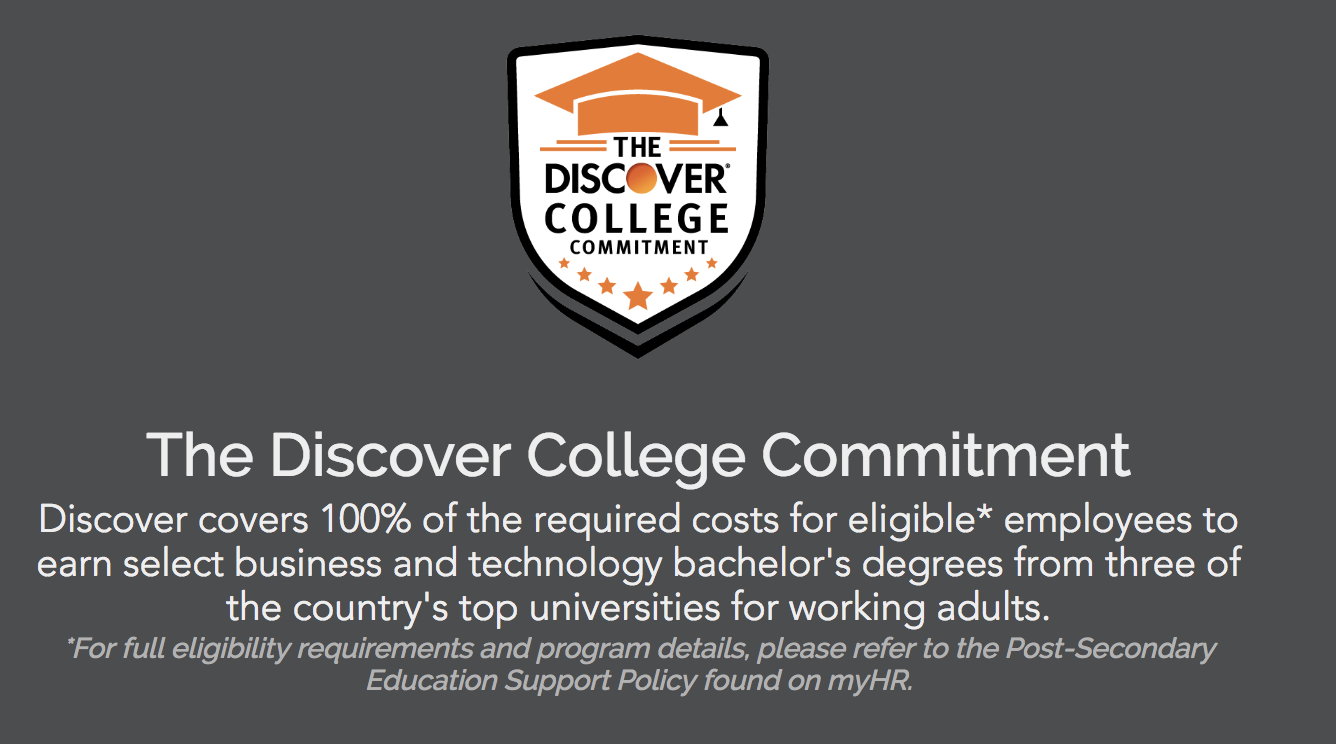
    Discover announced a significant new education assistance benefit that provides all eligible U.S.-based employees the opportunity to earn a bachelor’s degree online from an accredited public or non-profit private university at no cost.

    Known as The Discover College Commitment, the benefit covers tuition and required fees, books and supplies needed to complete select online degrees at one of three schools – the University of Florida (via UF Online), Wilmington University and Brandman University. The benefit has no tenure requirement so employees can start participating as soon as they want regardless of how long they have been with the company, including new employees on their first day.

    The two partnerships are part of what UF Online calls their Employer Pathways, and in the process seem to be defining an alternate method of marketing and enrollment management, in contrast with most Online Program Management (OPM) assumptions.

    Employees from Walmart and Discover Financial Services have expanded opportunities to earn a bachelor’s degree from the University of Florida (UF) thanks to a new and significant investment in their education from their employers. This remarkable step by these and other large employers demonstrates the value of a UF degree and the accessibility of UF Online, UF’s online undergraduate experience. Employers will provide a robust support package covering tuition, fees, plus access to life coaching and college readiness programs.

    Discover is offering this new benefit to select programs at UF Online, Wilmington University, and Brandman University.

    Discover is covering 100% of cost for select bachelor’s degrees. Discover is proud to offer “The Discover College Commitment” program – an innovative full-ride college education benefit, providing US-based employees the opportunity to participate in one of several select high-quality, fully paid, online bachelor’s degrees.

    Both packages of education benefits is managed by Guild Education, “a tuition reimbursement and education platform that helps large employers extend education benefits, including tuition reimbursement, to workers”.

    I think these moves are more significant than just individual benefits. What we are seeing is UF Online, along with a handful of others, defining a different approach to marketing and finding potential online students, at least for undergraduate degrees. Historically, there is a common assumption that to enable a scalable online program there is a need for traditional digital marketing as the primary approach – Google AdWords, call centers, social media campaigns – with a partnership or two thrown in on the side. The origin of the OPM market is centered on providing these services in exchange for a percentage of tuition revenue, and for the majority of cases, the OPM’s spending on this marketing and enrollment management category is the most expensive service in the package. The Employer Pathways approach by UF Online has the potential to flip the student acquisition assumptions – primarily driven by employer partnerships with traditional digital marketing channels as a secondary approach.

    Walmart and Discover already have potential students identified, and the companies have the incentive to internally market these education benefits to employees. UF Online needs to support that internal marketing and feed applicants into the same application process, but they have a reduced need for general-purpose marketing. UF Online started out with Pearson Online Learning Services (formerly known as Embanet) to be their OPM partner, but in late 2015 they pushed Pearson out and decided to take over this management internally.

    I talked to Evangeline (Evie) Cummings, Associate Provost and Director of UF Online, at WCET’s Leadership Summit last week, and she described how UF Online is trying to reduce their marketing spend and instead invest more in faculty and course development. Part of that move is to spend less trying to get out-of-state students, which may pay higher tuition but still cost much more per student in acquisition costs. But the other move is to decrease the need to spend on traditional marketing channels.

    We can think of Guild Education in this case as a derivative of the unbundling version of OPM, enabling the front-end services with an alternative approach and what appears to be a lower revenue share.

    Rather than charge a transaction fee per student to the employer, Guild takes a cut of the tuition revenue from the universities it works with. This revenue-share model is an “elegant” solution for institutions that want to grow their enrollment online but don’t want to spend more on marketing, said Carlson. It’s also an attractive proposition for employers, who don’t have to pay any additional charges on top of the contribution they make to their employees’ tuition. The tuition fees are not discounted for the employers and will be charged at in-state or out-of-state rates depending on the location of the student. Neither Guild nor the three universities involved in the Walmart offer would disclose what percentage of tuition revenue Guild will take.

    The bulk of the OPM market serves master’s programs, and UF Online is centered on bachelor’s degrees with a handful of master’s, so this approach might not work across the board. But I’ll bet that there will be plenty of undergraduate online initiatives that will be looking to UF Online and wondering if they should develop similar degree pathway partnerships as the centerpiece of their student acquisition plans. The online education space is maturing and becoming a lot more interesting.

  • Postscript on Rio Salado Coverage: Clarity about different outcome types

    Postscript on Rio Salado Coverage: Clarity about different outcome types

    After my two posts two weeks ago calling into question whether Rio Salado College has demonstrated clear student outcomes that justify its usage as an exemplar institution, college officials have responded through the WCET blog and in an article from Paul Fain at Inside Higher Ed. I recommend reading the IHE article in particular to get an understanding of the challenging an nuanced question of what is “good enough” in terms of college completion, and for even more detail read Rio’s written response. Unfortunately, the lengthy explanations on graduation rates from Rio end up obscuring a critical distinction between awarding degrees versus certificates of completion. The reason this matters is that Rio appears to be doing a better than average job supporting student transfers to four-year degree programs, a worse than average job of helping students complete two-year degrees, and an unknown job of providing students with non-degree stand-alone certificates.

    Before dealing with this issue, I’d like to point out how useful this dialog has been and how open Rio has been in sharing internal metrics. One example that I wish other institutions used, and that can help us clarify how to understand completion data, is based on student goals.

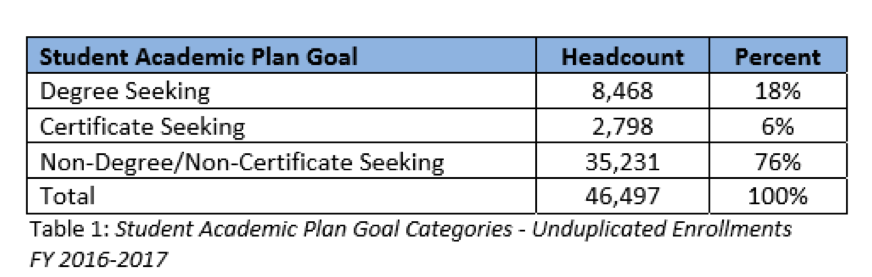
    Rio Student Intentions

    Fully 76% of Rio students have no intention to get a degree or certificate, and of this group 33% (11,628) indicated earning transferable credit as the key reason to enroll. As Sally Johnstone said in the IHE article, “It’s a feeder school for Arizona State University”. This transfer of credit mission can be good or bad – it depends on how well these students perform in getting an ASU degree. In the written response, but not in WCET or IHE articles, Rio shares an interesting but incomplete metric.

    Additionally, as part of the work RSC does related to accountability, we track the success of our transfer students to the three public universities in Arizona (The 2010/11 – 2015/16 5 year trend shows a 77.10% increase in bachelor degrees awarded to students that had completed a minimum of 12 credit hours (up to 60 or more hours) at Rio Salado College).

    Increase to what and over what? It is not clear if this is comparing to Arizona university students who do not transfer any credits from Rio, or those who transfer less than 12, or those who transfer from other colleges. Nevertheless, this is an indicator of the college helping students obtain four-year degrees through credit transfers.

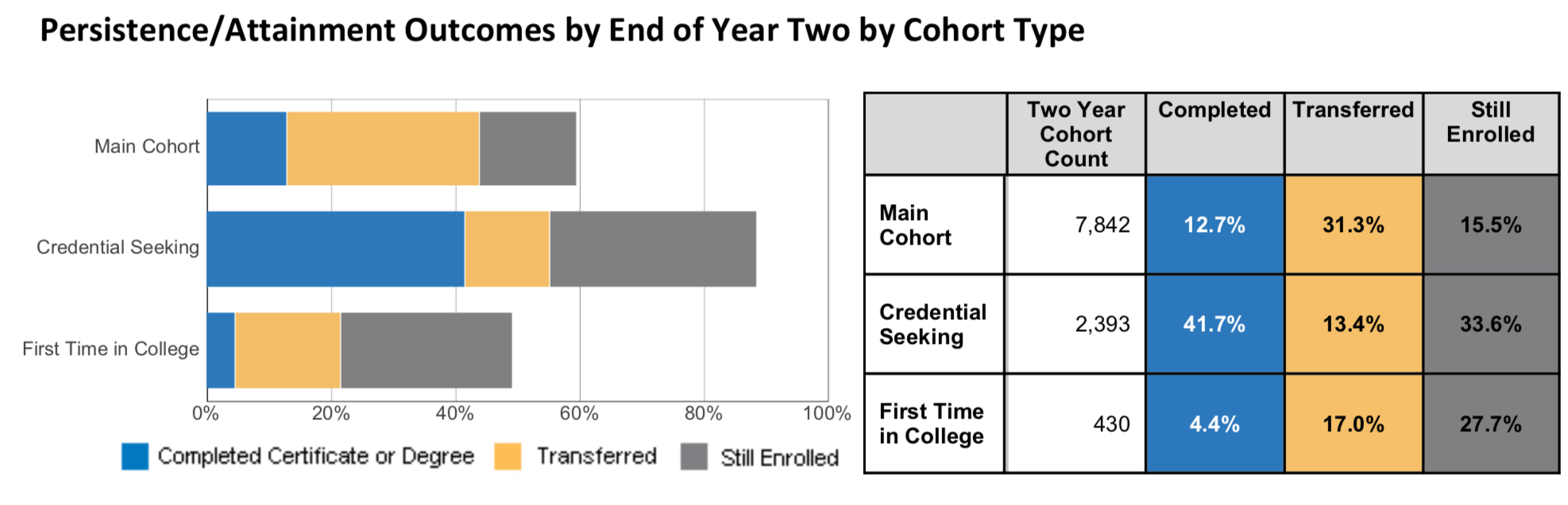
    Once you get beyond non-degree / non-certificate seeking students, the numbers are murkier, and this is the area that needs clarity. One out of four Rio students are there to get an award – how successful are they? Rio recommends we look at the Voluntary Framework for Accountability (VFA) measures, instead of IPEDS, with the following results.

    • 2-year graduation rate is higher than peer institutions: Rio 13%; Peer Institutions 10%
    • 6-year graduation rate for credential-seeking cohort is 36.2%
    • The credential seeking cohort far outperformed sister institutions in completion: Rio 42%; Peer Institutions 16%

    I do not know why Rio uses the term graduation rate, as VFA instead describes Percent Students Completed a Formal Award, but from the numbers used we can see where the data comes from. The first and third bullets come from the VFA Two-Year Progress measures (blue column under Completed). ((The VFA definition of the cohorts: Main Cohort = fall entering, first time at reporting college; “all students”; Credential Seeking = earned 12 credits by end of year two.))

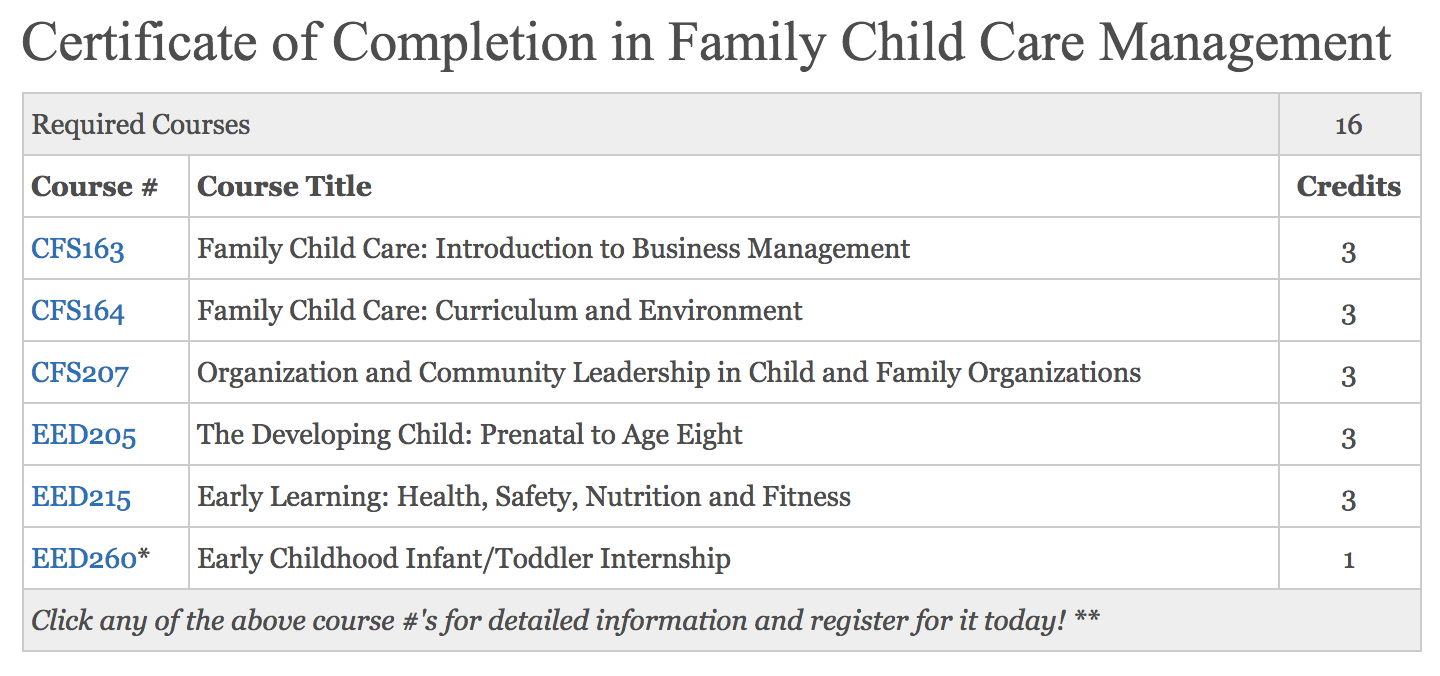
    What is key is that the Completed metric includes those who obtained an associate’s degree or official certificate. Unlike degrees, certificates of completion have no standards across schools, and their usage is very uneven. As an example of Rio’s usage:

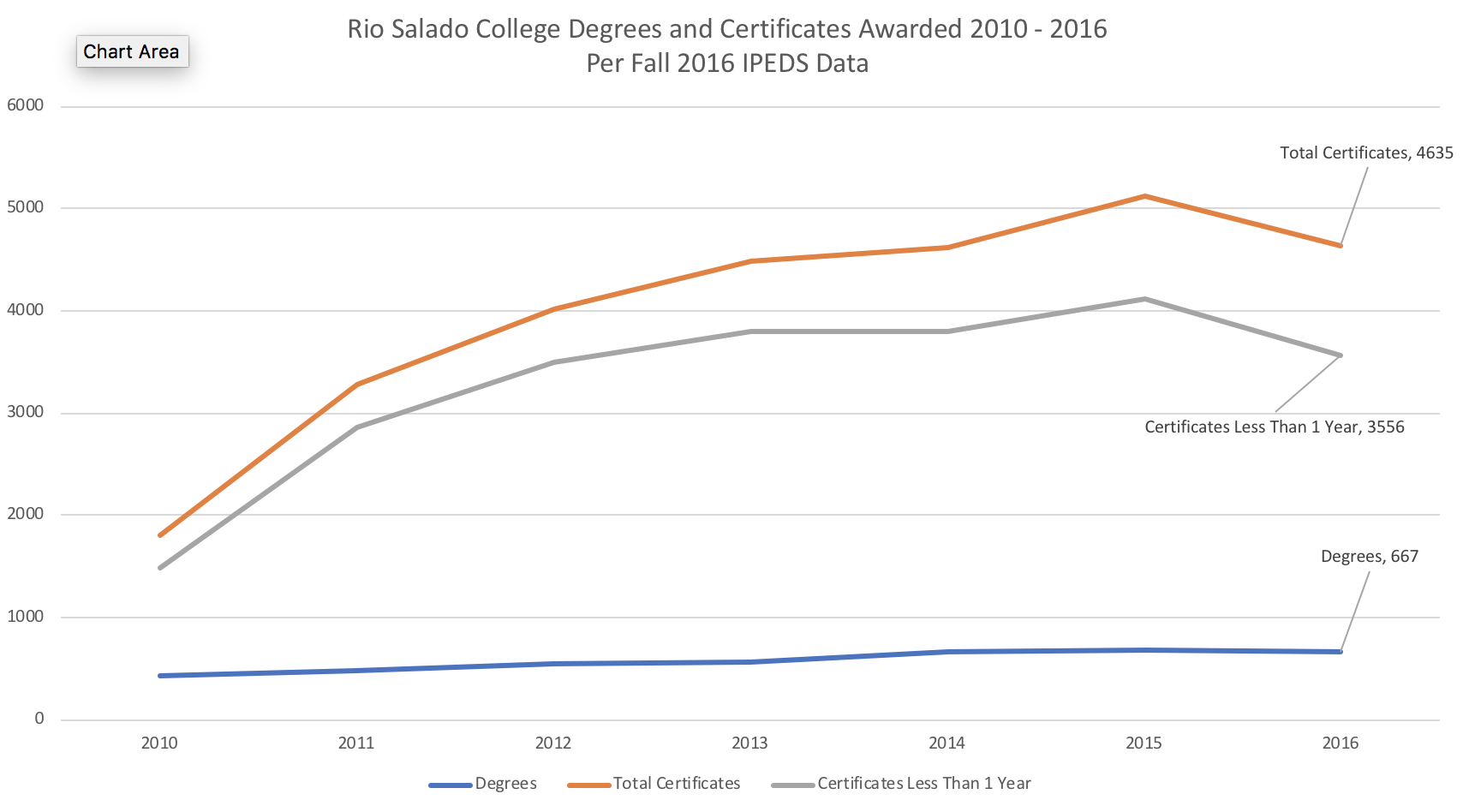
    Notably, since 2010 Rio has defined and awarded more and more of these <1 year certificates, based on IPEDS data.

    We can see is that the large majority of completions, which Rio labels under graduation rate, comes from the nonstandard certificates rather than degrees.

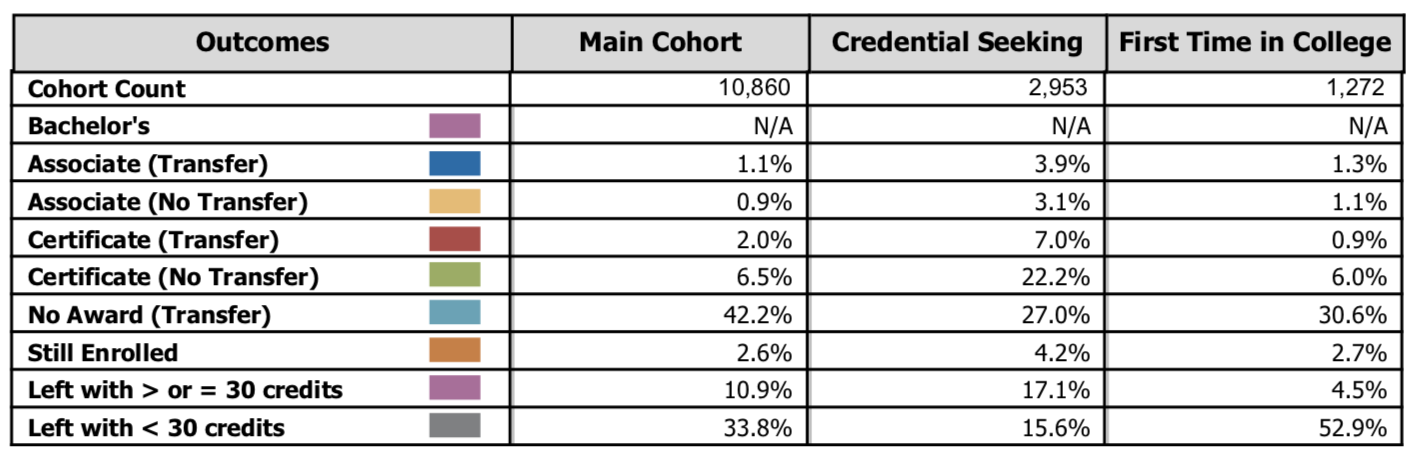
    One of the strengths of VFA is that under the Six-Year Outcomes measures, you can separate out the various types of award. Below is the data for Rio – pay attention to the Credential-Seeking Cohort, as it removes the majority of non-degree / non-certificate seeking students at Rio only looking to transfer a small number of credits. ((For degree or certificate-seeking cohorts, I prefer the Rio definition based on student self-reporting, but the VFA definitions get at the same idea.)) Also note that VFA outcomes are mutually-exclusive and hierarchical in the order shown. If a student gets a certificate and a degree, they are listed under the degree outcome.

    For the Credential-Seeking Cohort, 22% of Rio students get a certificate and do not transfer to a four-year school, 7% get a certificate and transfer, 3% get an associate’s degree and do not transfer, and 4% get an associate’s degree and transfer. A large majority of Rio Salado completions are for certificates, which is consistent with the IPEDS data.

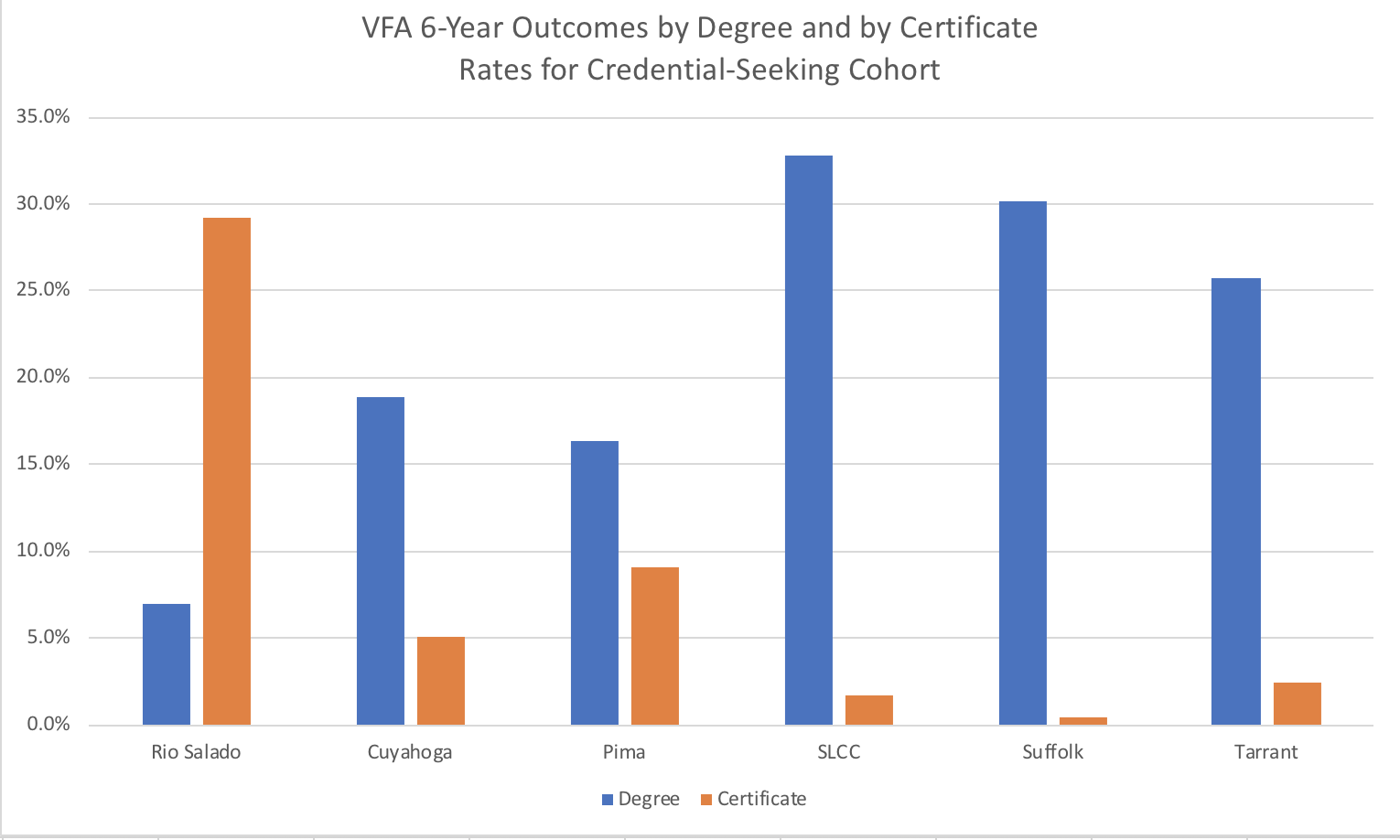
    How does Rio compare to other large community colleges? While we have not analyzed all 200+ colleges in VFA, spot checking with some peer schools indicates that Rio is well below others in awarding degrees but well above others in awarding certificates.

    The resulting data provide the basis of my comment in IHE:

    “This is not a bad situation, per se, as long as students are gaining value in the workplace for these official certificates,” he said via email. “But certificates are not useful in terms of comparing apples to apples, especially when one school uses them liberally, as does Rio, and most other schools do not.”

    Hill also noted that Rio Salado’s VFA completion rate for associate degree programs is a “troublesome” 7 percent.

    While I appreciate the valuable sharing of information from Rio Salado in this process, I’ll stick with my original conclusion:

    At best, this is a school with mixed results that should not simply be labeled a success without caveats or explanations.

    Rio has shown that they can cut costs and still be a successful transfer school, but not that they can be a successful degree school. This matters a great deal in terms of how transferrable the lessons are. It’s fine to focus on transfers when you’re right next door to ASU. But what if you’re Adirondack Community College? There are places where degree completion matter more or less than at Rio. And what about those students going to Rio who *are* seeking degrees? Does this model promote some educational outcomes at the expense of others? And if so, shouldn’t students know about that before enrolling?

  • OPM Market May Be Growing, But It’s Not Without Chaos

    OPM Market May Be Growing, But It’s Not Without Chaos

    There has been growing interest in the Online Program Management (OPM) market, as more schools try to develop a strategy and revenue model for online programs (particularly for master’s level), and as 2U continues its rapid rise in the stock market (with a nearly $4.8 billion market cap). Typically the description of this market is that the total annual revenue is somewhere between $1.5 – $2.5 billion and that it is growing. The implications are that we have a land grab as companies get rich off the new programs.

    The reality, however, is more complicated. The OPM market may be growing, but it is chaotic and messy. Consider the following problems within the market:

    • This is not an easy market, as many programs take millions of dollars of investment by the OPM provider before an account becomes profitable, often 3 – 5 years down the road.
    • 2U’s Semester Online initiative, targeted at the undergrad market as a consortium, shut down in 2014 due to the departure of several founding member institutions and due to low enrollment.
    • Later that same year Cal State Online shut down in all but name, along with its usage of Pearson as its OPM partner.
    • In 2015 Synergis Education pulled out of its work with USC’s Master of Integrated Design, Business and Technology program, to be eventually replaced by 2U.
    • In 2016 the University of Florida Online (UF Online) canceled its contract with Pearson and pivoted to a new approach not using an OPM partner.
    • After raising $230 million from Bertelsmann in 2015, HotChalk has failed to bring in any new clients of the scale of Concordia University, and in 2016 the company paid a $1 million settlement (though not admitted any fault) based on a federal investigation and lawsuit.
    • Sometime in 2016/17, the nonprofit OPM Educators Serving Educators from Excelsior College shut down.
    • In 2017 after a management shake-up, DeVry Education Group (now Adtalem) pulled out of the OPM market and got rid of its Integrated Education Solutions group.
    • In late 2017 the Eastern Michigan University’s chapter of the American Association of University Professors filed a complaint against EMU’s contract with Academic Partnerships, although an arbitrator sided with the school earlier this year.
    • Also in late 2017 Greenwood Hall – a call center-based fee-for-service OPM provider – collapsed in dramatic fashion, with AnswerNet eventually buying the remaining assets.
    • There has been growing pushback on the mainline revenue-sharing model, where full-service OPM providers make 50% or even more of tuition dollars from online programs. This has led to the rise of unbundled, fee-for-service category of OPM providers.

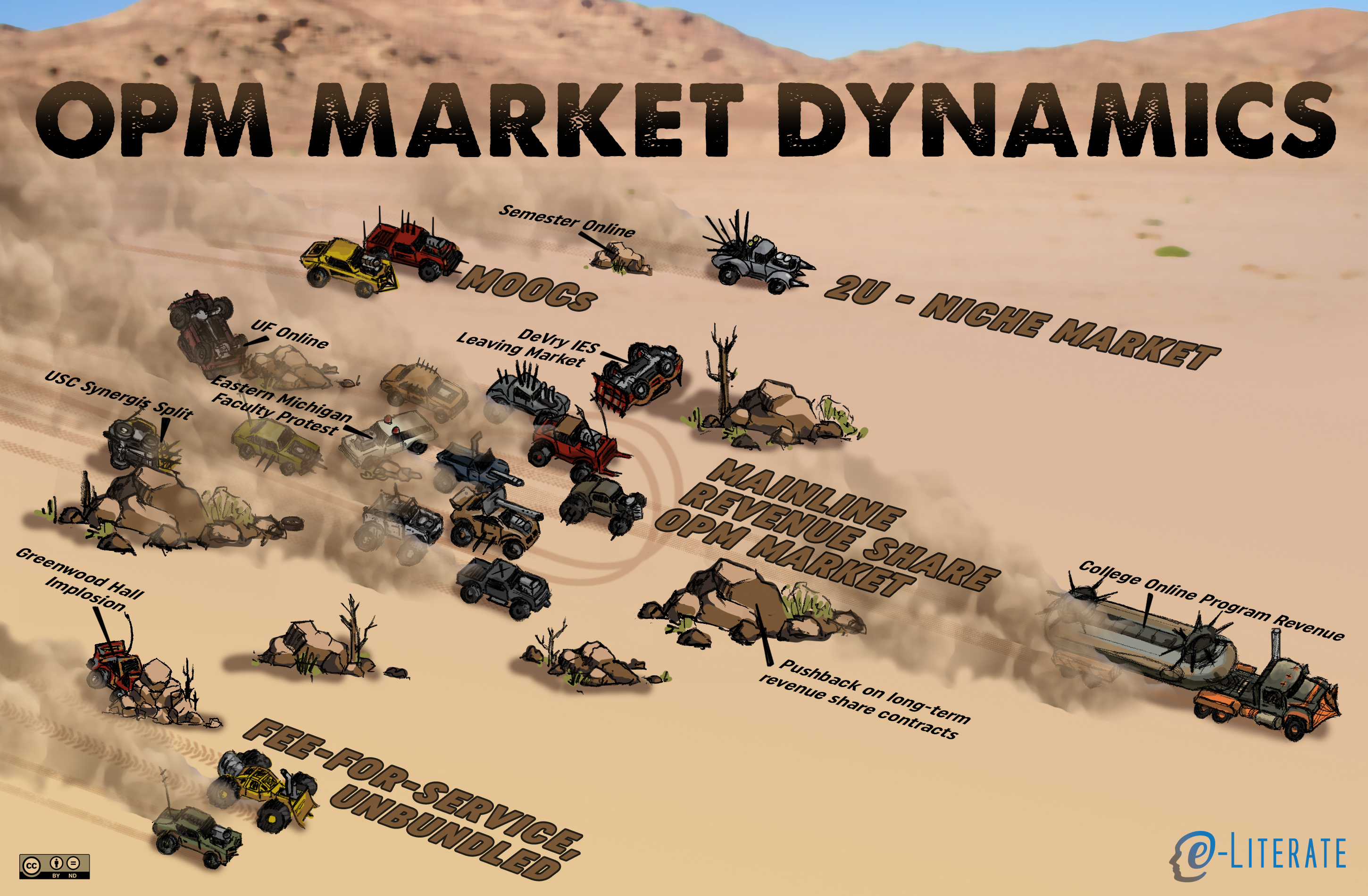
    The picture one gets is of a chaotic market that is not for the faint of heart, and one that will likely see further consolidations and category changes. 2U, for its part, has been successful partially due to a niche strategy where they go after elite master’s programs and mostly avoid direct competition or engagement with the rest of the market. And recently we have started to see the MOOC providers become OPM providers – where the primary revenue for Coursera and FutureLearn are based on revenue sharing with online programs, albeit with lower sharing rates and with very different marketing approaches. In other words, there seems to be several efforts to enter into the same OPM race, but if possible to avoid being in the mainline rev-share OPM market. The Toecutter would feel right at home.

    The Mad Max view of OPM market dynamics

    Not even represented here is the movement of former for-profit institutions (e.g. Grand Canyon University, the parent company of Kaplan University) becoming OPM providers.

    This means that our landscape view of the market is temporal in nature – expect more shake ups and category changes as the OPM market continues to grow in new ways.

    Market landscape of OPM vendors

  • Rio Salado College As Exemplar: A critical external view

    In yesterday’s post I described how a review of two courses at Rio Salado College indicated reasons to question the use of this school in the ASU / BCG case study report on Digital Learning ((Disclosure: Our e-Literate TV series was funded in part by the Bill & Melinda Gates Foundation who also funded the ASU / BCG study.)). The report, titled “Making Digital Learning Work: Success Strategies From Six Leading Universities and Community Colleges”, has the following description [emphasis added]:

    How can the use of digital technologies in postsecondary education impact students’ access to education, student outcomes, and the return on investment for students and institutions? What are the biggest challenges for an institution seeking to implement high-quality digital learning opportunities? What promising practices enable an institution to achieve impact at a larger scale? [snip]

    The answers, at least in part, lie in case studies of six colleges and universities: Arizona State University, the University of Central Florida, Georgia State University, Houston Community College, Kentucky Community and Technical College System, and Rio Salado Community College. The first three institutions in this list are public research universities, representing different geographic populations and access missions. The other three institutions include two community colleges and a state-wide community college system.

    These six institutions have a strong track record of using digital learning to serve large, socioeconomically diverse student populations, and each has been a pioneer in innovating to expand access to postsecondary education, improve student outcomes, and provide higher education at an affordable cost.

    Let’s look at the track record of Rio Salado College in terms of aggregate academic student outcomes to see how appropriate it is to include them as an exemplar in such a case study-based report. For much of my analysis, I looked at the 862 public 2-year colleges fully reporting data in the Fall 2016 IPEDS data set.

    Reduced Expenditures

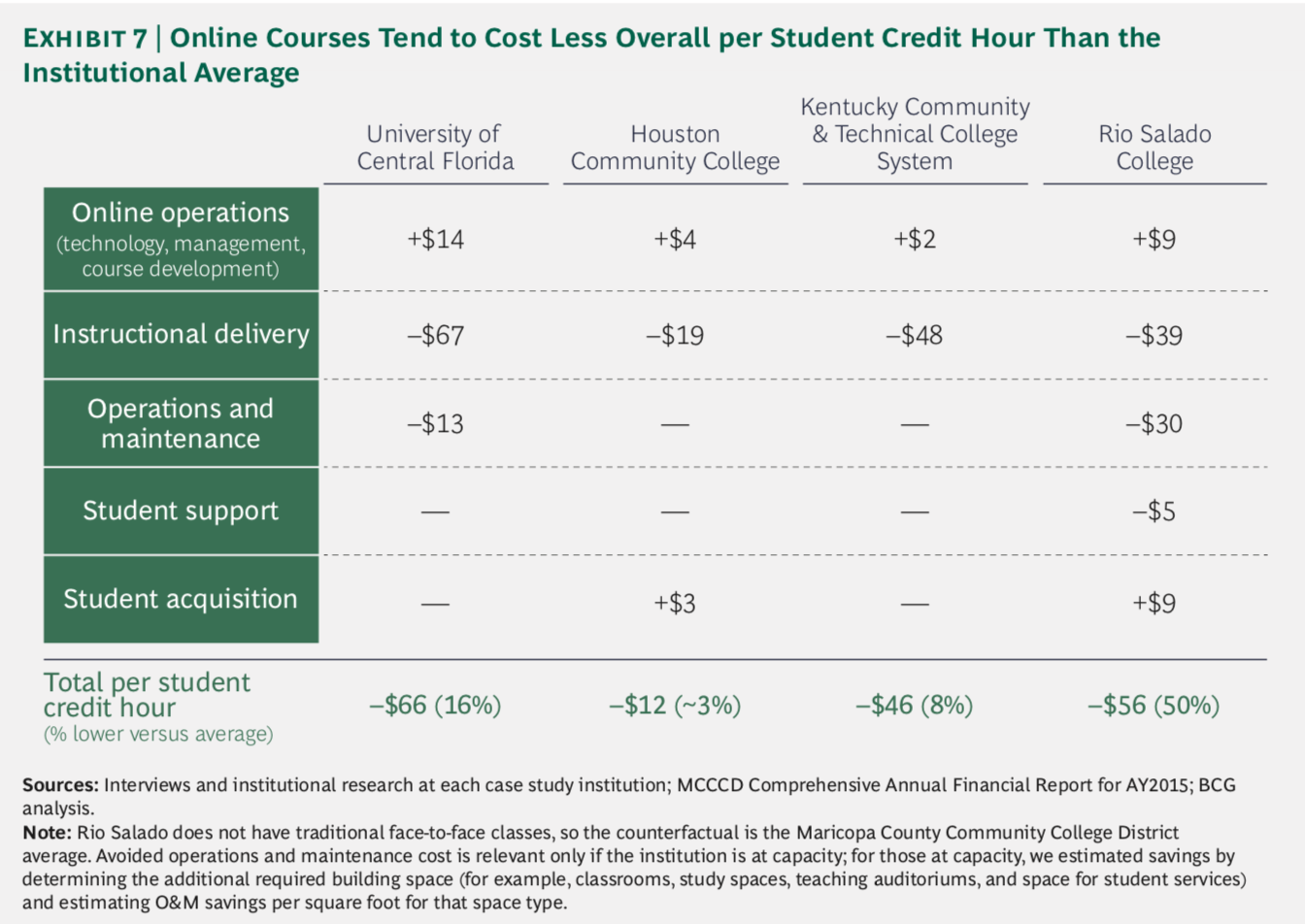
    The primary claim made in the ASU / BCG report is that Rio Salado is has reduced costs.

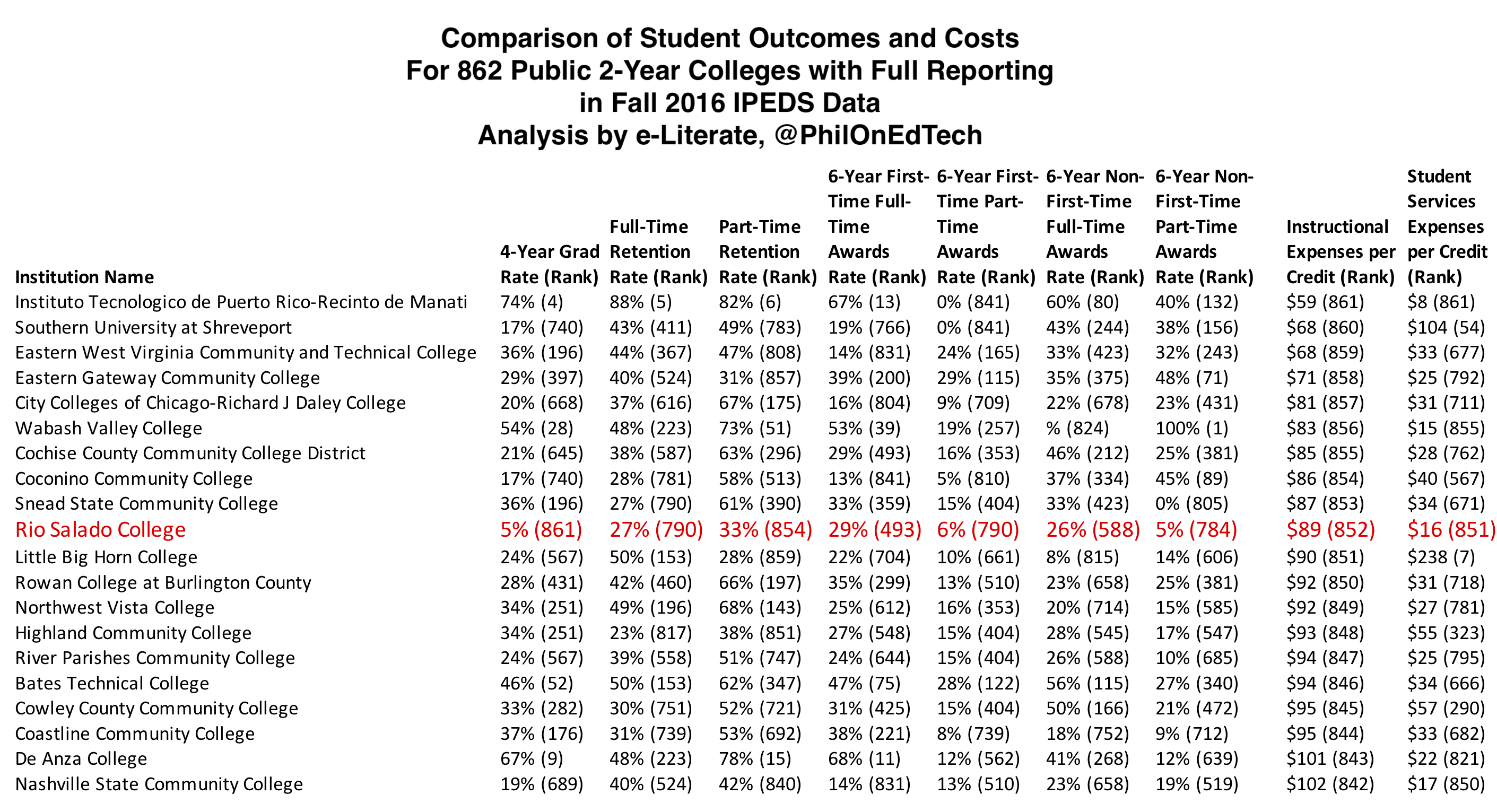
    This claim does hold up to scrutiny, as Rio’s $89 of instructional delivery costs per student credit hour and $16 of student services costs are 10th and 9th lowest in the country for the 862 colleges I reviewed.

    The primary outcomes claims made in the case study quickly brush off the standard metrics for Rio.

    Rio Salado’s success is not defined solely by improvements in graduation and retention rates. In particular, the college has a high transfer-out rate (32% compared to an average of 19% for other MCCCD colleges [ed. – the other schools in the Maricopa County Community College District]), and the students who transfer to Arizona universities from Rio Salado have a 74% four-year graduation rate—3 percentage points higher than the average for other MCCCD transfer students. At Rio Salado itself, students’ course-level success rates have slowly been improving over time, to about 64% in 2016.

    Graduation and Retention Rates

    It is all well and good to point out the importance of transfer students, but we should not ignore graduation and retention rates. And we should explore whether the data supports the phrase “improvements in graduation and retention rates”.

    The report describes Rio’s investment in a suite of advising tools.

    Obtaining these advisory tools required an initial investment of $1 million, but the tools pay for themselves by increasing Rio Salado’s term-to-term retention by 7%, increasing ROI through improved student progress and the additional tuition dollars that the institution receives from retained students.

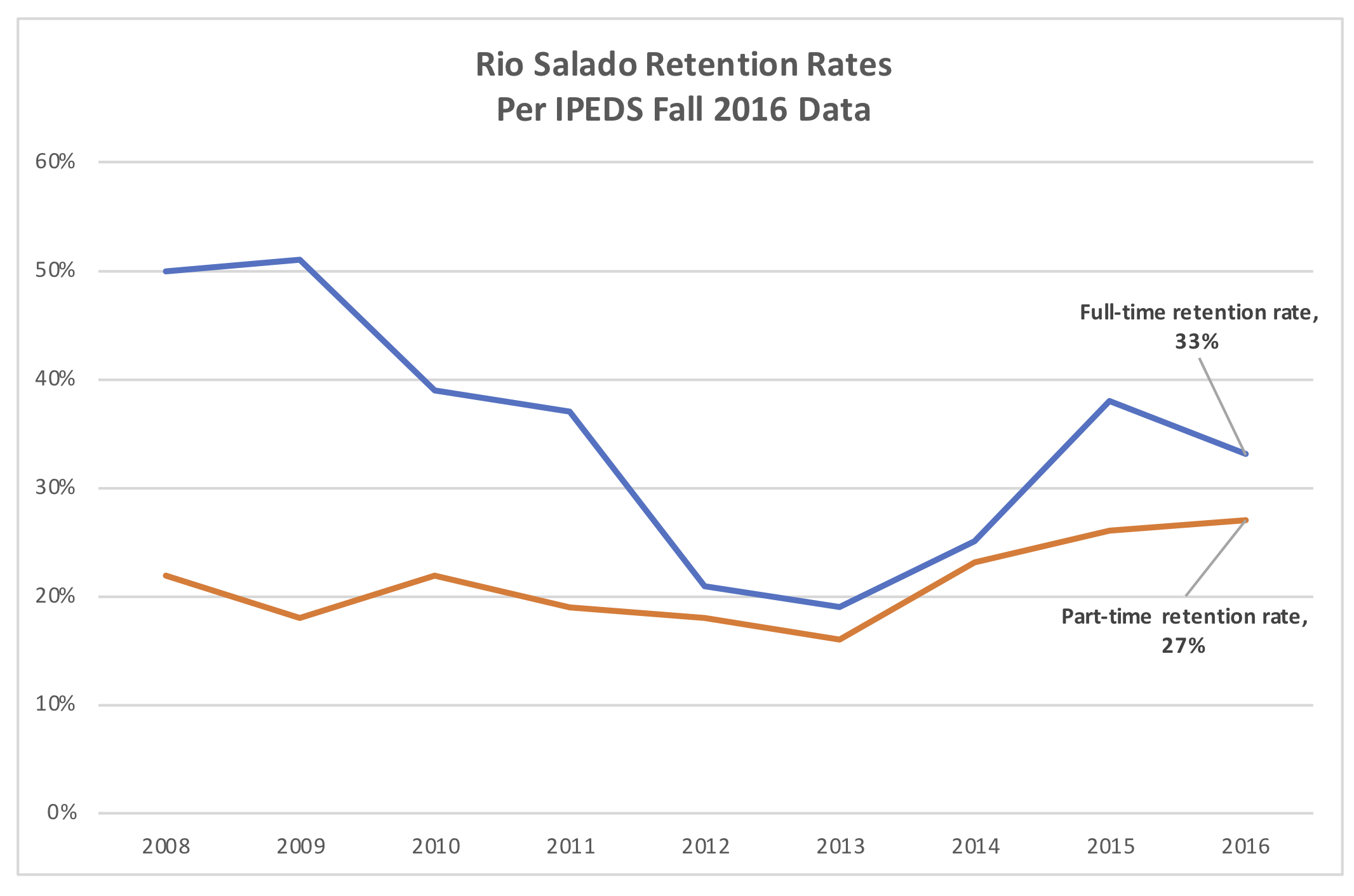
    Looking at IPEDS data, we can see Year 1 to Year 2 retention rates (not quite the same as term-to-term), and it shows improvement since 2013. Unfortunately, Rio’s retention rates for full-time and part-time students are both in the bottom 10% of all community colleges at 33% and 27%, respectively. And the full-time rate is lower than it was prior to 2011.

    Rio Salado Year 2 Retention Rates

    While the ASU / BCG report does not mention graduation rates directly, there have been several claims made about Rio’s numbers in other publications.

    The problem is that Rio Salado’s 4-year graduation rate for first-time full-time students as reported in IPEDS is 5% – the second lowest of any public 2-year college in the nation. How can we resolve this discrepancy?

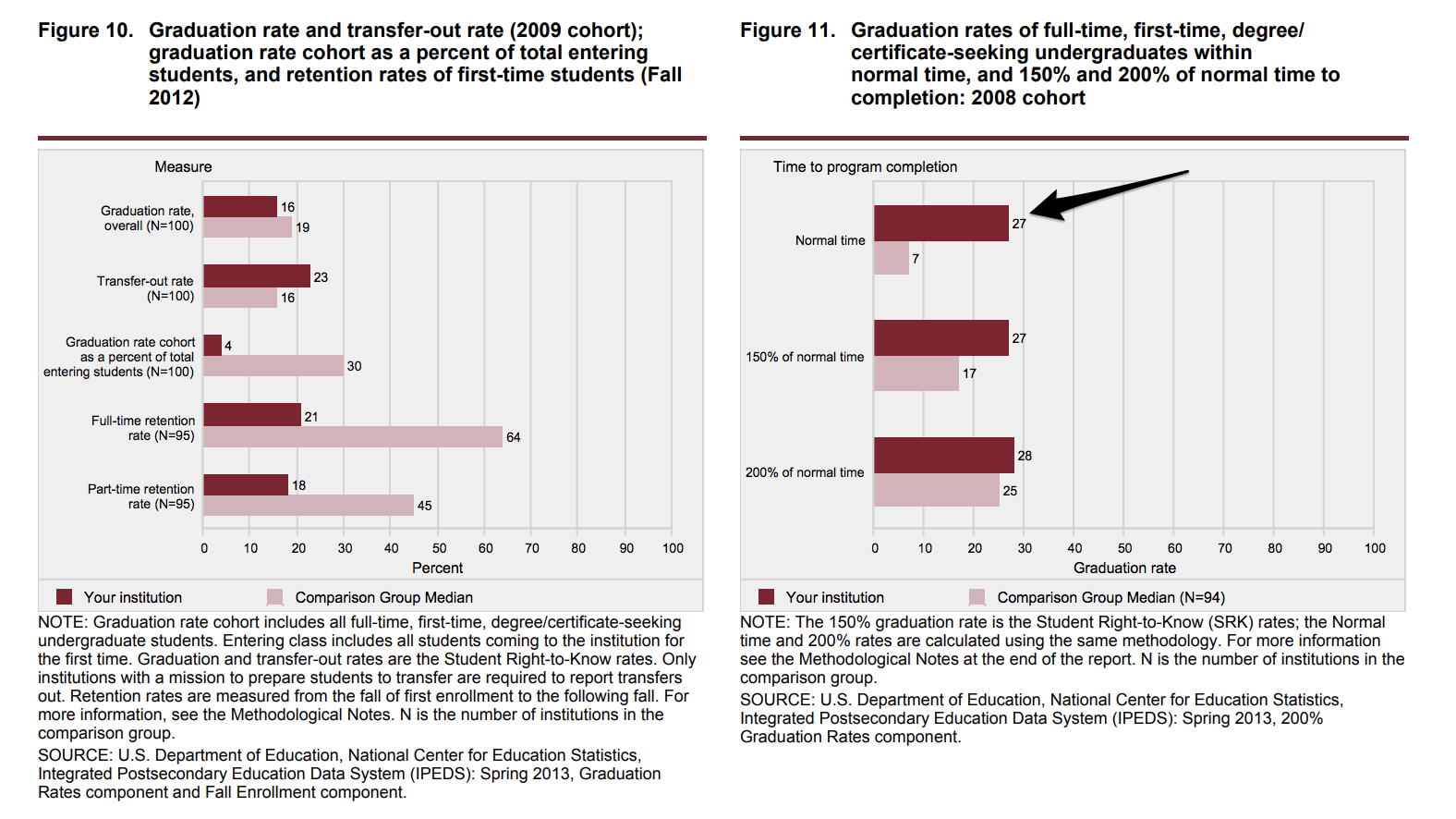
    The key to understanding the claims in these four articles is to follow the two links, which both point to a customized IPEDS Feedback Report from 2013 for Rio against their selection of 100 peer institutions.

    Figures 10 and 11 from IPEDS report

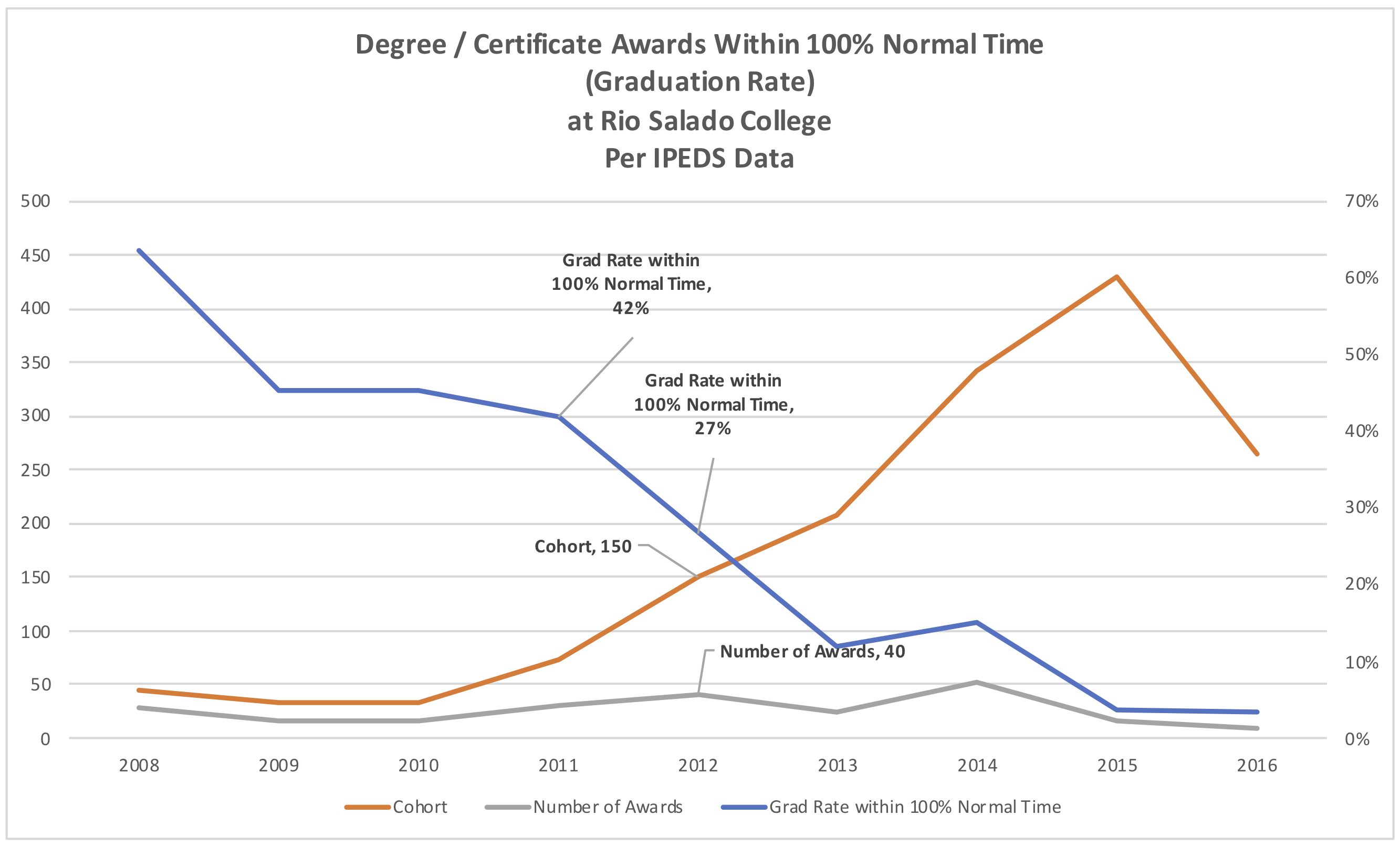
    This measure captures any award – degree or certificate – for a small cohort of entering full-time students at Rio from 2009. If you trace that data through IPEDS, you see that this measure is for a 150-student cohort (in 2012) out of the 45,000+ students at Rio.

    Using this specific metric, you can find the 42% graduation rate in 2011, and the “four times greater” rate of 27% in 2012, both as the rate plummets from 64% in 2008 to 3% in 2016.

    Using broader, up-to-date metrics for graduation and retention rates as well as the new IPEDS outcomes measures (which allows comparison outside of just full-time first-time cohorts), we see that Rio Salado College has some of the lowest student outcomes measures in the country.

    For all but two measures (6-year First-Time Full-Time Awards and 6-year Non-First-Time Full-Time Awards), the performance is in the bottom 10% of all colleges in the study. For those two awards measures, the performance is in the bottom half of the country and represents just 11% of the student body.

    Transfer Rates

    What we are left with are reports about high transfer rates and subsequent success rates 3% higher than other transfers out of the same district. The IPEDS data set now includes transfer rates in its new Outcomes Measures section, and it is true that Rio Salado College does transfer out a significant portion of students. For all cohorts defined below, Rio is in top 20% of public 2-year institutions.

    • First-Time Full-Time Students: 39% transfer rate, Rank 170 out of 862
    • First-Time Part-Time Students: 47% transfer rate, Rank 112 out of 862
    • Non-First-Time Full-Time Students: 46% transfer rate, Rank 196 out of 862
    • Non-First-Time Part-Time Students: 59% transfer rate, Rank 121 out of 862

    Note that this data indicates that students transferred to another institution and are still enrolled there. This data does not indicate what portion of the transfers were planned versus students deciding to move on for other reasons. Nevertheless, for a community college, especially one with very close ties to ASU (I have been told that a large percentage of Rio students are ASU students trying to fill out their schedule based on saving money and more convenient schedules), this is a favorable metric.

    I cannot provide independent confirmation on the subsequent success rates, so we’ll accept that claim at face value.

    Case Study Questions

    I should note that Rio Salado College does provide accurate information on the metrics mentioned in this post, both through IPEDS reporting and through their Research & Planning section of the web site. The picture that emerges from the aggregate outcomes data is of a large school that:

    • transfers out greater than average percentage of students;
    • is just below average for awarding certificates for full-time students;
    • is among the poorest performing in the country for retaining students;
    • is among the poorest performing in the country for awarding degrees; and
    • is among the poorest performing in the country for awarding certificates for part-time students.

    At best, this is a school with mixed results that should not simply be labeled a success without caveats or explanations.

    One question we should ask is whether it is appropriate to hold up a school with some of the lowest student outcomes measures in the country as an exemplar. Yes, Rio Salado has found a way to spend as little as possible on instruction and student support services, and yes, a lot of students transfer out, but that is not enough. We need greater evidence of student success if we are to use them as a case study for others to emulate. And we also need a more robust genre of a case study that looks across, at a minimum, a relatively standard set of publicly-available information, and deeper dives where appropriate, to understand educational practices and their impacts on students. These case studies should present information in context – the good and the bad – since education is complex and challenging, and a clear focus on evidence will benefit all parties in the end.

  • Rio Salado College As Exemplar: A critical internal view

    Rio Salado College As Exemplar: A critical internal view

    10 days ago Arizona State University (ASU) and the Boston Consulting Group (BCG) released a report, supported by the Bill & Melinda Gates Foundation (BMGF) ((Disclosure: Our e-Literate TV series was funded in part by the Bill & Melinda Gates Foundation.)), titled “Making Digital Learning Work: Success Strategies From Six Leading Universities and Community Colleges”. The basic idea [emphasis added]:

    How can the use of digital technologies in postsecondary education impact students’ access to education, student outcomes, and the return on investment for students and institutions? What are the biggest challenges for an institution seeking to implement high-quality digital learning opportunities? What promising practices enable an institution to achieve impact at a larger scale? [snip]

    The answers, at least in part, lie in case studies of six colleges and universities: Arizona State University, the University of Central Florida, Georgia State University, Houston Community College, Kentucky Community and Technical College System, and Rio Salado Community College. The first three institutions in this list are public research universities, representing different geographic populations and access missions. The other three institutions include two community colleges and a state-wide community college system.

    These six institutions have a strong track record of using digital learning to serve large, socioeconomically diverse student populations, and each has been a pioneer in innovating to expand access to postsecondary education, improve student outcomes, and provide higher education at an affordable cost.

    The methodology is a case study of each school, and the report then takes a stance on what other institutions should do.

    Now is the time for leaders to champion the potential of digital learning to open the doors of higher education wider and to improve student outcomes, while operating more efficiently and at lower cost. The journey of each college or university will be unique, but the set of promising practices described in this report may serve as a useful guide for all institutions.

    There are multiple methods to evaluating a school; it turns out that some are more meaningful than others, and it is always helpful to start with what students experience in actual courses. The ASU / BCG report provides useful context on course design.

    At Rio Salado, 22 full-time faculty chairs develop courses with the support of a central team that includes subject-matter experts, instructional designers, media support staff, and production staff. About 1,500 adjunct faculty members teach the courses, which they can personalize by adding an introductory message or video for each module.

    It turns out that I have access to two courses – ENG102 (First Year Composition) and EED200 (Foundations of Early Childhood Education) – and this gives an opportunity to better understand the student experience. What these courses indicate, however, is a troubling lack of meaningful interaction between faculty and students.

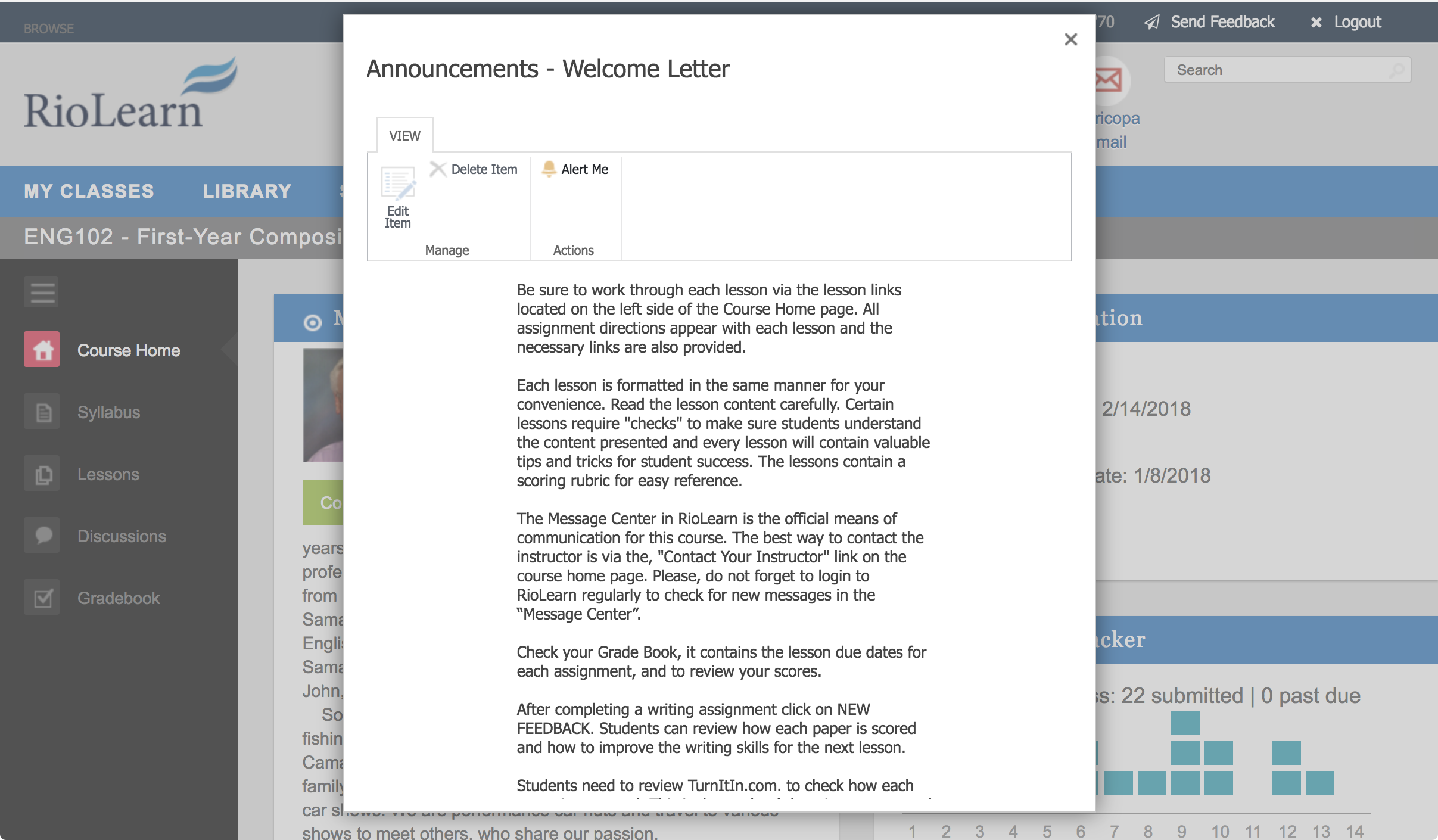
    Looking at ENG102, the course materials is Rio Salado developed courseware embedded in their custom course management system, RioLearn. The materials appear to be quite extensive, and all materials are available at the start of the term in 14 lessons. To find actual due dates, students have to go to the gradebook, as no specific dates are included in the courseware.

    Course Welcome Message

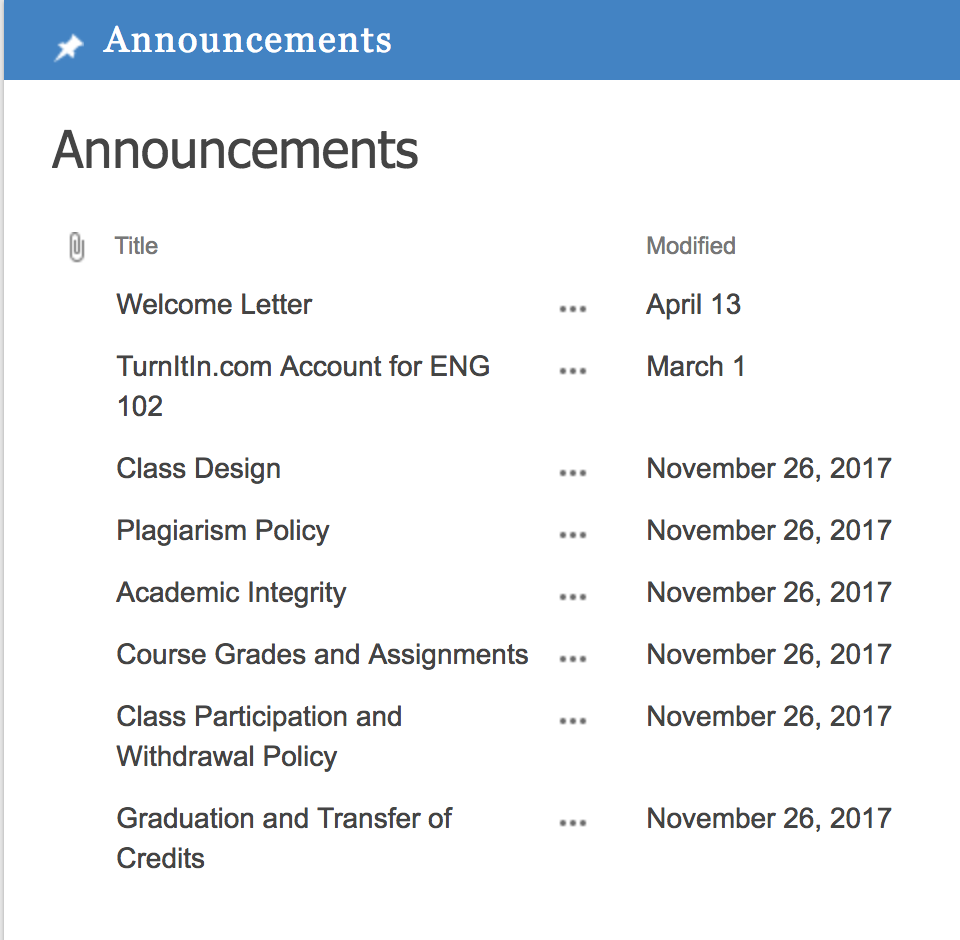
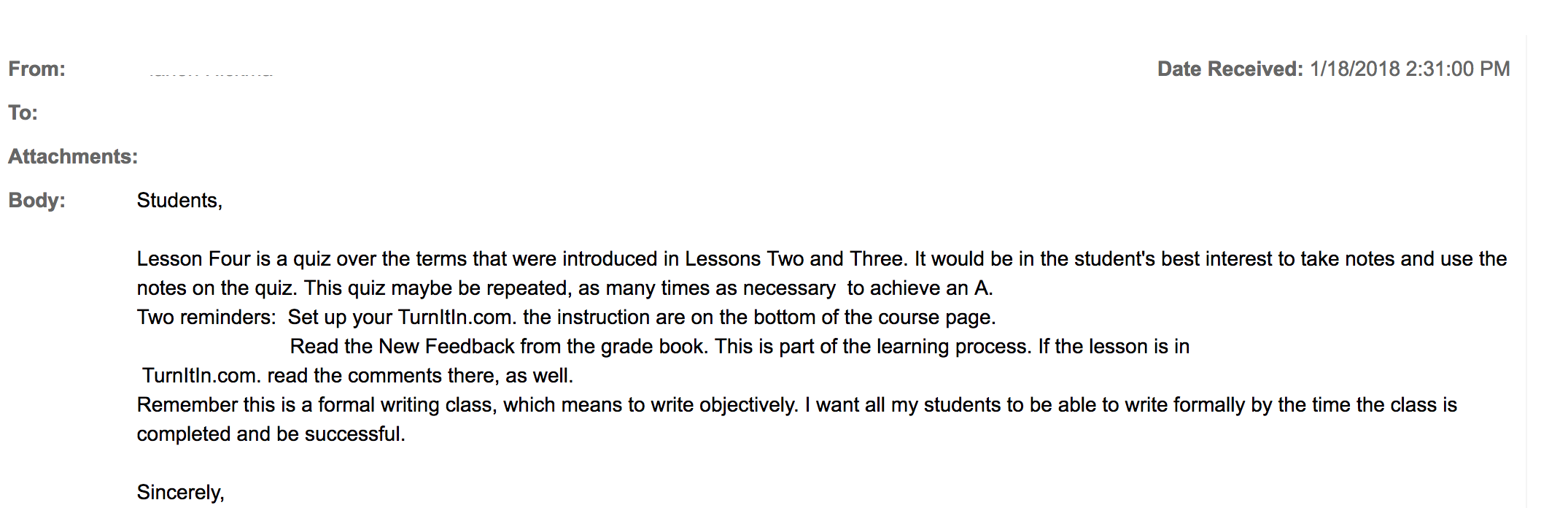
    The instructor sent out several announcements at the beginning of class, a welcome letter, and then one reminder or update message at the beginning of each month. That’s it for instructor-initiated interactions.

    Course announcements

    Sample Message

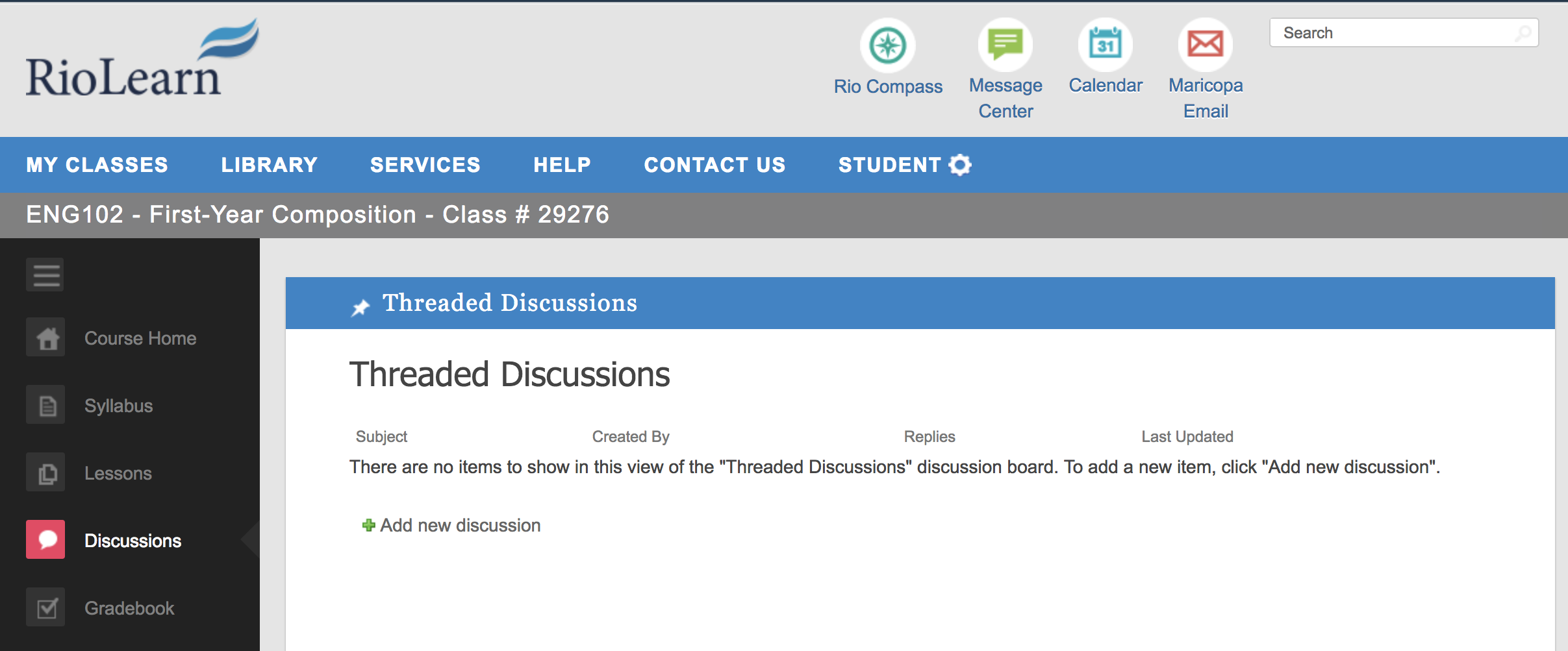
    There were no student-to-student discussions, as the discussion board was unused for the course. There was one peer-review activity, but otherwise no interactions between students. I have been a frequent critic of threaded discussion boards, but it is certainly better to have something instead of nothing.

    Discussion Tool

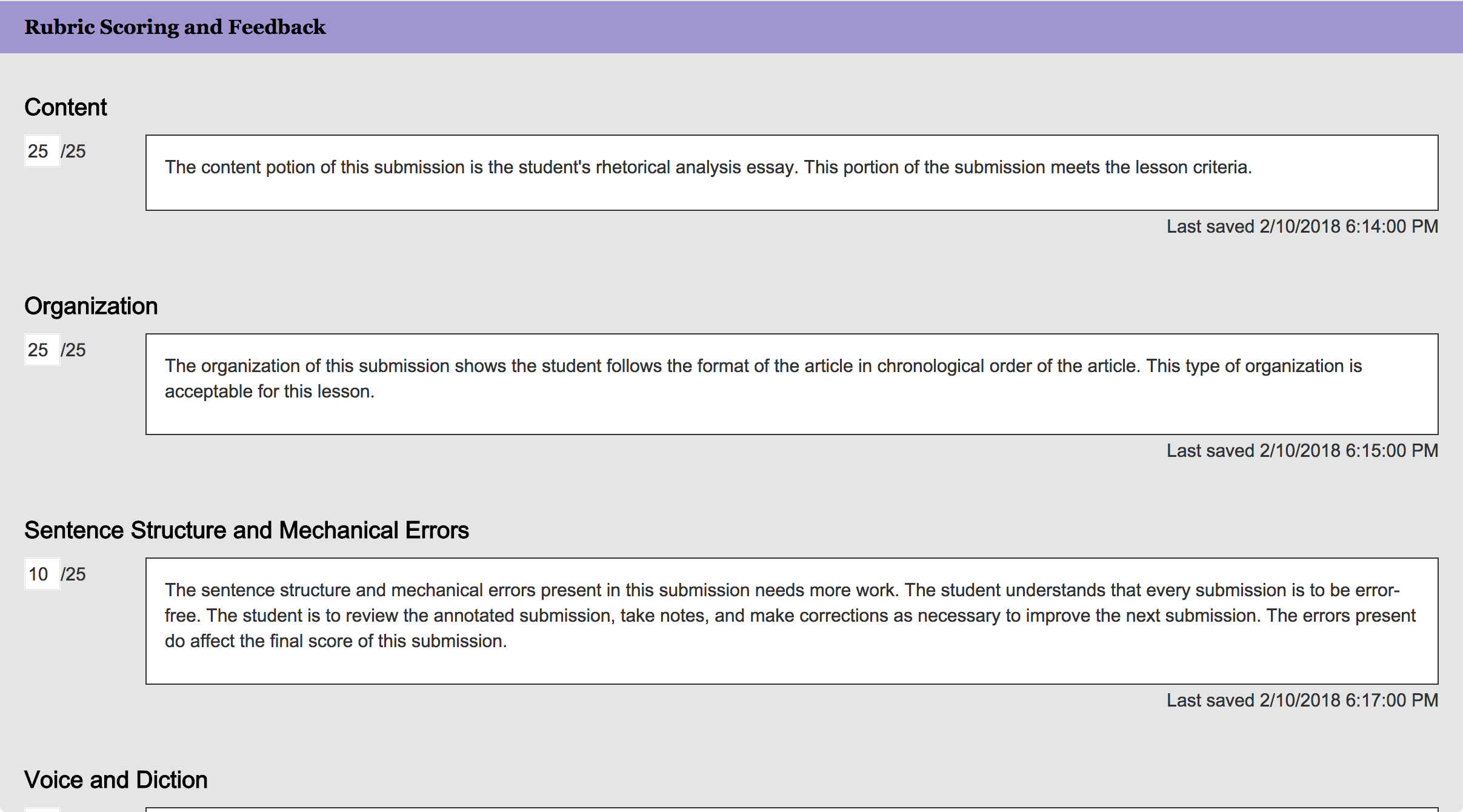
    The rest of the interactions came in two categories: grading of assignments and responses to student-initiated messages. The primary feedback method in these two courses was faculty usage of the custom-developed Feedback Tool, which uses rubrics to grade assignments.

    Lesson Feedback

    There were several assignments that included annotated mark-ups of the submitted papers, which appear to be the most useful feedback from instructors.

    A review of EED200 shows the same course structure – few instructor-initiated interactions, use of rubric grading as feedback on assignments, and specific responses when students send questions in through the Message Center.

    For both courses, the instructors typically responded to student messages within a day or two.

    This approach is troubling, as both courses appear to not meet the “regular and substantive interaction” regulation for credit-bearing online courses. I have been critical about the vague standards and the egregious application by the Department of Education’s Office of Inspector General audit of Western Governors University, but these complaints do not mean that the regulation has no point. The idea is that course design and facilitation should be implemented to ensure that students are not left to figure out static course materials and to be responsible for initiating most forms of interaction. As stated in a 2014 Dear Colleague Letter on the subject of regular and substantive interaction based on competency-based education (CBE) approaches [emphasis added]:

    We do not consider interaction that is wholly optional or initiated primarily by the student to be regular and substantive interaction between students and instructors. Interaction that occurs only upon the request of the student (either electronically or otherwise) would not be considered regular and substantive interaction.

    Some institutions design their CBE programs using a faculty model where no single faculty member is responsible for all aspects of a given course or competency. In these models, different instructors might perform different roles: for example, some working with students to develop and implement an academic action plan, others evaluating assessments and providing substantive feedback (merely grading a test or paper would not be substantive interaction), and still others responding to content questions.

    The problem with case studies is that the selection of cases to study may not be representative or appropriate to prove one’s thesis. It is possible that I happened to look in detail at two courses that are aberrations. But even so, this view is troubling, as these are centrally-developed courses (not subject to the whim of individual instructors), and both courses have little meaningful provisions for faculty-student or student-student interactions. The instructors were responsive to messages, but that is not enough to back up claims of high-quality courses. The dissonance between these two courses and what is described in the ASU / BCG report led me to take a critical look at the data.

    For the next post, I’ll take the external view and look at aggregate public data on Rio Salado College on academic outcomes.

  • Online Program Management: Spring 2018 view of the market landscape

    Online Program Management: Spring 2018 view of the market landscape

    Nearly two years ago I wrote two blog posts giving a high-level view of the Online Program Management (OPM) market landscape. This is a growing but messy market, and the market changes since mid 2016 call for an updated view.

    OPM providers are for-profit organizations that help non-profit schools develop online programs, most often for Master’s level programs. These companies provide various services for which traditional institutions historically have not had the experience or organizational capability to fully support, at least for fully-online programs and often for non-traditional student populations. Some examples of the services include marketing & recruitment, enrollment management, curriculum development, online course design, student retention support, technology infrastructure, and student & faculty call center support.

    The OPM market has historically been known for a full-service, revenue-sharing model, based on the premise that most traditional institutions are not only operationally unprepared to offer online programs at scale but also are not set up to invest in online programs up front. There are extensive costs, particularly in marketing and recruitment as well as curriculum and course design, that cause most scalable online programs (that is, those designed with the intent and infrastructure to allow more than just a few dozen students) to require investment over the first several years, before tuition revenue catches up. Rather than requiring the institution to spend sizable up-front money without a guarantee of repayment, revenue-sharing OPM vendors provide this financing themselves – which is in itself an expensive proposition. It often takes three to five years for an OPM company to become profitable for any online program, which is why they often require 10-year or even longer contracts.

    As the online education market has matured, however, there has been a growing pushback against revenue-sharing as the only model available. Thus there is an emerging unbundled fee-for-service OPM model, in which the companies offer the same services, or some subset, for the market price of those services. The institution pays for the services used, mostly independent of the amount of tuition revenue coming into the online program. This category leads to the program, or institution, to take the up-front financial risk but not have to sign contracts sending ~40 – 60% of the tuition revenue to the vendor. Fewer strings attached but more responsibilities and risks for the school.

    With the recent success of Southern New Hampshire University and longer-term models from Penn State World Campus (as well as others), there are also questions about whether non-profit schools can create scalable programs without an OPM partner at all. This category, for obvious reasons, is not presented in our market landscape but is a real option.

    In our view, there is not an either-or proposition in the market. We see strong arguments for both bundled revenue-sharing models and for unbundled fee-for-service models, and I personally do not believe that the market is moving away from revenue sharing as much as there is pressure for additional models. There are a growing number of choices available to schools, but there is also a crowded marketplace that is becoming more difficult to understand.

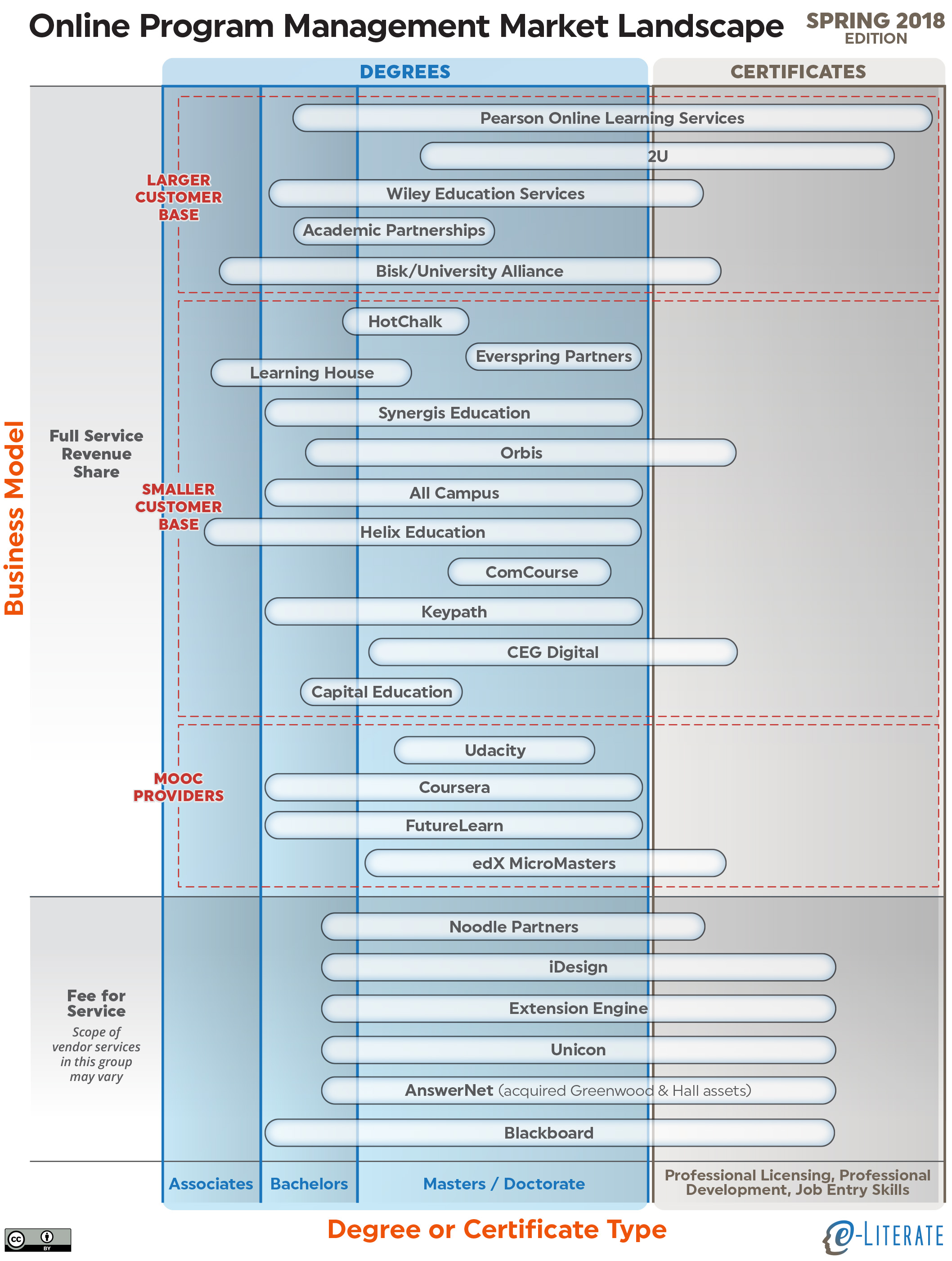
    With that setup in mind, on to the market landscape graphic.

    As before, please note that this view is intended to give a visual overview of the market landscape and is not comprehensive in terms of vendors represented. This is especially important to understand for the Fee for Service category, where there is no clear definition yet of what is an unbundled OPM provider and what is a product or service provider who happens to serve online programs. Treat this category as illustrative and not exhaustive.

    Market landscape of OPM vendors

    There are three primary changes to note in the graphic’s design since 2016:

    • We have combined different categories of Certificates into one column on the right side of the graphic, since it was difficult to to differentiate between OPM target markets.
    • We have added a sub-category of MOOC Providers under Full Service Revenue Share category to capture the recent changes in that market.
    • We have combined the Fee for Service and General Contractor into one category labeled Fee for Service, again due to difficulty differentiating service offerings.

    We should also note that there will likely be another sub-category of Full Service Revenue Share to capture the ongoing pivots by former for-profit institutions. Graham Holdings sold Kaplan University to Purdue University and remains a single-client OPM provider for that new brand Purdue University Global. Grand Canyon University is converting to a non-profit institution with the remaining for-profit company turning into a (single-client?) OPM provider. Bridgepoint Education plans to turn Ashford University and University of the Rockies into a combined non-profit institution, leaving the remaining for-profit company as an OPM. We are not ready to add this sub-category, and it is not clear yet if these providers plan to go beyond servicing the non-profit conversions.

    There are several changes to the vendors listed:

    • Pearson no longer refers to the Embanet brand that they acquired and now goes by Pearson ((Disclosure: Pearson, 2U, iDesign, Unicon, and Blackboard are sponsors for our Empirical Educator Project. See this post for more details.)) Online Learning Services.
    • 2U, after the May 2017 acquisition of GetSmarter, now serves certificate programs and not just masters degree programs.
    • Wiley no longer refers to the Deltak brand that they acquired and now goes by Wiley Education Services.
    • DeVry Integrated Education Solutions no longer appears to be active in the market, based on outdated web site (key executive listed has been gone for seven months) and no marketing or competitive presence. We have removed their listing.
    • Cambridge Education Group’s CEG Digital unit has emerged as an OPM provider serving UK-based institutions.
    • We (re)added Udacity based on the success of the Georgia Tech Masters in Online Computer Science program, which has helped spawn the new sub-category of MOOC Providers in the market, even though Udacity appears to have no interest in pursuing other higher education degree offerings.
    • We added Coursera as an OPM Provider, as this market now appears to be their core market moving forward.
    • We added FutureLearn based on their continuing expansion as a MOOC-based OPM provider.
    • We added edX with their MicroMasters initiative.
    • We added ExtensionEngine as a Fee for Service provider based on their work with Notre Dame and related program creation.
    • We changed Greenwood Hall to AnswerNet. After a spectacular implosion from Greenwood Hall a few months ago, AnswerNet acquired the remaining assets. It is not yet fully clear if AnswerNet will not provide more than Call Center services, so we’ll keep an eye on this one.
    • Excelsior College’s Educators Serving Educators (ESE) initiative, launched in 2012 to provide a non-profit OPM offering, is no longer active.

    We’ll keep updating our landscape diagram over time and look for other methods to help make sense of this market.