
e-Literate

Present is Prologue

Tag: Phil Regier

  • Pilots? We don’t need no stinkin’ pilots!

    Timothy Harfield commented on Arizona State University’s approach to pilots and scaling innovation at ASU.

    excellent comment on the problem of scaling innovation in #HigherEd. This is a central concern for @UIAinnovation.

    The University Innovation Alliance is “a consortium of 11 large public research universities committed to making high-quality college degrees accessible to a diverse body of students”. I wrote about this “central concern” last summer in a post titled “Pilots: Too many ed tech innovations stuck in purgatory”, using the frame of Everett Rogers’ Diffusions of Innovations model. While the trigger for that post was on ed tech products, the same situation applies for the course design situation.
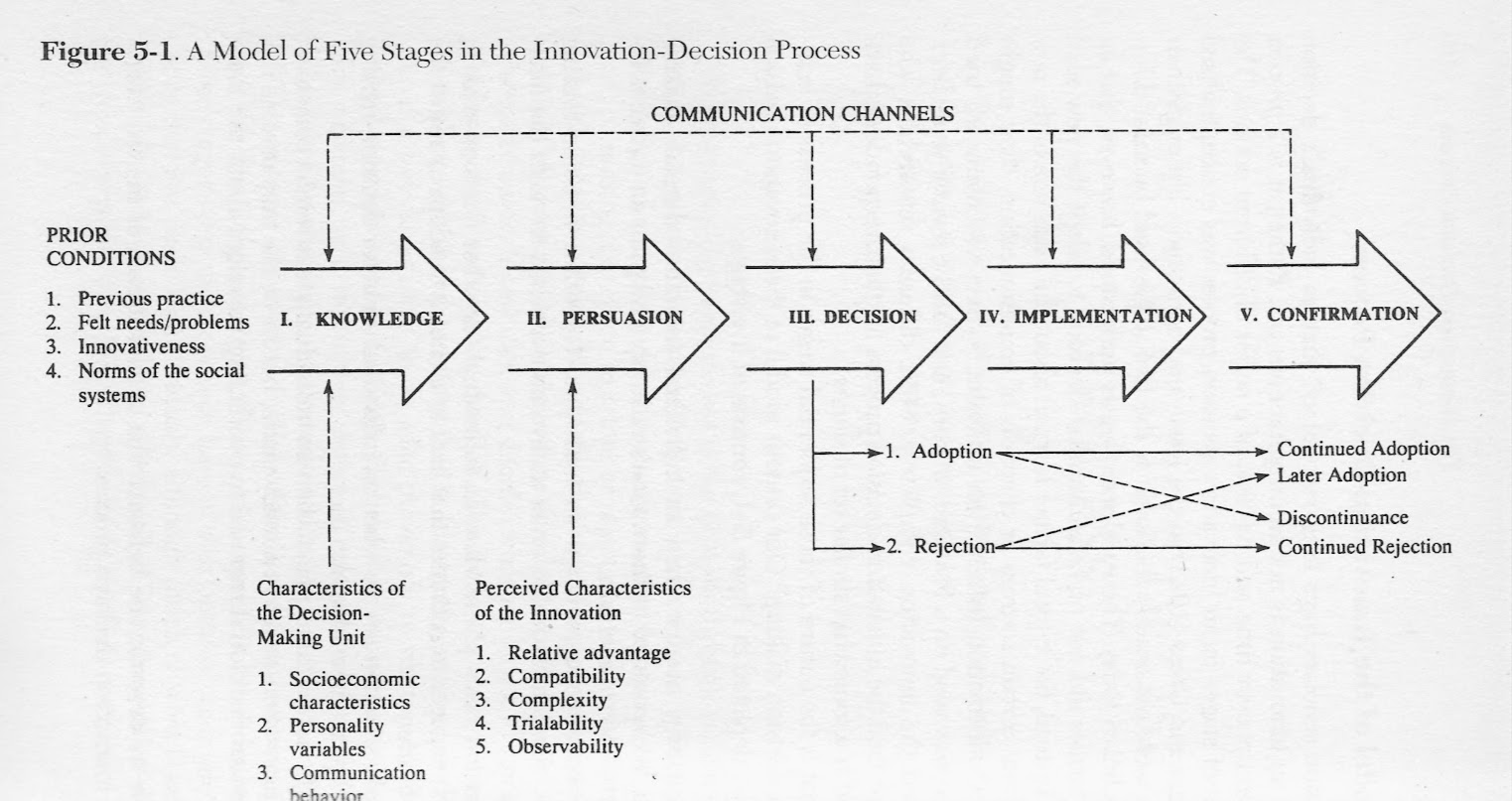
    5 Stages of Adoption

    What we are seeing in ed tech in most cases, I would argue, is that for institutions the new ideas (applications, products, services) are stuck the Persuasion stage. There is knowledge and application amongst some early adopters in small-scale pilots, but majority of faculty members either have no knowledge of the pilot or are not persuaded that the idea is to their advantage, and there is little support or structure to get the organization at large (i.e. the majority of faculty for a traditional institution, or perhaps for central academic technology organization) to make a considered decision. It’s important to note that in many cases, the innovation should not be spread to the majority, either due to being a poor solution or even due to organizational dynamics based on how the innovation is introduced.

    The Purgatory of Pilots

    This stuck process ends up as an ed tech purgatory – with promises and potential of the heaven of full institutional adoption with meaningful results to follow, but also with the peril of either never getting out of purgatory or outright rejection over time.

    (more…)

  • The OpenClass Vision: An Example

    In my last post, I described a vision for combining elements of MOOC-like scale with a more traditional face-to-face classroom experience, as articulated by Pearson’s Adrian Sannier. (Full disclosure: Pearson is a client of MindWires Consulting.) A couple of months ago, I suggested in an interview with Josh Kim for Inside Higher Education that this is where MOOCs would go next:

    Question 6. Will MOOCs replace accredited curriculum? Why or why not?

    I don’t know how to answer this question, because I’m not convinced that we know what a MOOC is yet. Will there be massive elements that are integral to many curricula? Almost certainly, although I don’t know how much of it we will see in 2013. Will the curricula be all massive? Probably not in most cases. Will we consider the mix of massive and non-massive elements to be “MOOCs”? I don’t know.

    The problem that we have right now is that we have very few models for how this might work. So when Sannier mentioned a course called Habitable Worlds being developed by Professor Ariel Anbar and Lev Horodyskyj at Arizona State University that will eventually be brought to OpenClass to support this model, I asked to speak with Professor Anbar in order to get some specifics. The conversation shed some light not only on possibilities for the mixed model, but also on possible futures for the liberal arts and the role of the professor.

    (more…)

  • Re:Booting CA Higher Education: My First Thoughts

    As expected, the 20 Million Minds-sponsored event was fascinating and information-packed. Kudos to the foundation for setting up such a rich and, I think, important meeting. In fact, I’m still digesting it, and may need to write several posts to lay out my thoughts once the dust settles. But I do want to get my initial thoughts down while they are fresh. In particular, underneath all the head nodding and apparent agreement, there were some strikingly divergent ideas about the future of higher education that are worth spelling out in some detail.

    (more…)