
e-Literate

Present is Prologue

Tag: Private equity

  • The Massive Decline In Larger Education Company Market Caps

    After our coverage of Blackboard’s CEO change last week, we were both interviewed by the Washington Business Journal, with the following lede:

    Analysts and sources I spoke with Monday, both on and off the record, said the decision to bring on Bill Ballhaus as CEO was a combination of Bhatt failing to make progress building the company’s business and lacking the experience needed to successfully run a company of that scale. And that means at least several years before Providence Equity Partners, which owns a majority of the company after paying $1.64 billion for it in July 2011, begins actively marketing the company for sale, according to industry experts.

    Earlier this week I wrote about Apollo Education Group, parent of the University of Phoenix, putting itself up for sale due to its weakening financial position. I also noted that I doubt that McGraw-Hill Education is going to be able to go public in the near-term. Part of the reason for this latter observation is the dramatic fall of Pearson in the stock market, triggered by its warnings that it would miss earnings estimates. In Audrey’s excellent year-end post on the business of ed tech, she noted:

    Private equity firms sure love buying ed-tech companies. Perhaps because the stock market’s sorta “meh” about them.
    (more…)

  • Parent Company of University of Phoenix Could Be Sold to Owner of McGraw-Hill Education

    Apollo Education Group, parent company of the University of Phoenix as well as Apollo Global, is in “advanced talks” to be purchased by Apollo Global Management, owner of McGraw-Hill Education and of Cengage debt. Got that?

    To clarify, the Apollo Education Group is the parent company of the University of Phoenix, and they have a subsidiary called Apollo Global, which is a joint venture with the Carlyle Group, another private equity firm. While the confusion is understandable, Apollo Global Management previously shared nothing in common with the Apollo Education Group other than their admiration for the choir-directing sun-god.

    With that in mind, here is the news from the Wall Street Journal today:

    A deal between Phoenix-based Apollo Education and Apollo Global Management, a New York private-equity firm, could be worth about $1 billion, some of the people said, with one of them adding an agreement could be reached in the next few weeks. Apollo Education had been in discussions with a number of private-equity firms since late last year, but Apollo Global Management is the only one still in the running now, this person said.

    It is possible, as always, in such situations that there will be no deal, and another buyout firm could re-emerge.

    (more…)

  • Why Is Blackboard Laying Off Staff Despite Improved Market Share Position?

    Over the past two weeks Blackboard had another round of layoffs, likely due to the company missing financial targets. While one estimate places the number at roughly 200, from what I have heard the number is closer to 90 – 100 people let go. I asked the company for commentary on the layoffs and associated reorganization. By email they declined to comment on the number of employees let go but added this comment:

    These changes included the elimination of select positions across the company. We deeply appreciate the contributions made by the affected employees and are supporting them in their transition.

    This is not the first layoff at Blackboard since they were taken private in 2011; rather this is the latest in a series of cuts that have gone well beyond “trimming the fat”. Posts on thelayoff.com and glassdoor paint a picture of high attrition due to routine layoffs and many staff leaving by their own choice. We have written on several of these events here at e-Literate. 90 here, 100 there, 74 . . . it adds up, especially when combined with staff departures.

    To get another view into the company downsizing, consider that Blackboard recently signed a lease that will trim its corporate headquarters by 37%:

    Founded in a Dupont Circle row house in 1997, Blackboard, which has occupied 111,895 square feet at 650 Massachusetts Ave. since 2008, will move into Ogilvy Public Relations Wordwide’s former space on the eighth through 10th floors [70,482 square feet] beginning in December 2015.

    This follows a recent move in its Reston, Virginia facility that cuts its office space there by over 50%.

    In an ironic turn of events, the new headquarters move will put the company into the same building it occupied before 2008, and their neighbors in the building will include former CEO Michael Chasen’s SocialRadar and CBE provider FlatWorld.

    Why More Layoffs When US Market Share Finally Stabilizes?

    (more…)

  • SunGard HE and Blackboard Acquisitions: Compare and Contrast

    UPDATE:  In the section on ‘Cash Cow vs. Growth Potential’, my choice of words could have caused misunderstanding.  I did not mean to equate Operating Income with Cash Flow, and my choice of the word ‘cash’ in this section should really have been ‘income’, as my analysis was obviously based on Operating Income.  I have made this correction below.  My apologies for any misunderstanding.

    Consider the recent news this summer that private equity firms have agreed to acquire both SunGard Higher Education (SGHE) and Blackboard in separate deals:

    • Two market leaders in technology solutions for education,
    • both generating revenues of several hundred million dollars per year,
    • both business strategies at risk due to eroding market share in their core business since 2007,
    • both facing challenges to integrate product lines and offer a clear road map for customers,
    • and both sold to private equity firms for more than $1.6B.

    SunGard Higher Education (SGHE) and Blackboard – brothers in arms.

    At first glance, there are some strong similarities between the acquisition perspectives of both market leaders, but if you look deeper, the differences provide a good insight into the future of technology markets for higher education.  These differences can explain why the ERP market seems to be consolidating with fewer choices while the LMS and educational technology market seems to be expanding with more choices.

    Cash Cow Income Machine vs. Growth Potential

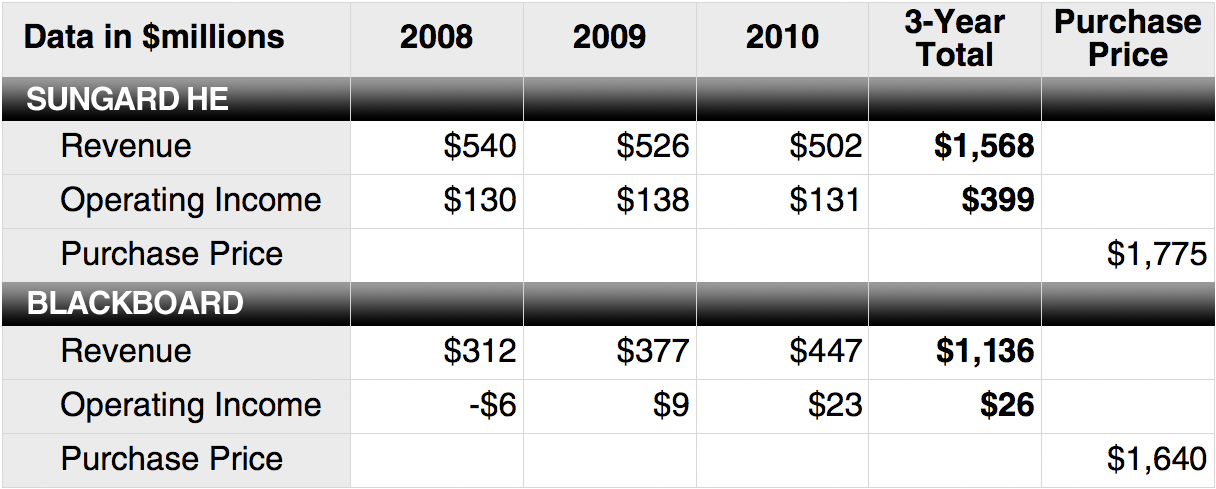
    During research for this post, I was surprised to find out how much cash income that SGHE generates and how close Blackboard has come to SGHE’s revenue numbers.  While Blackboard has seen its revenue increase due to corporate acquisitions of its own, it has only had a combined operating income of $26M over the past 3 years.  In that same time, SGHE has seen its revenue decrease by almost 10%, but it has had a combined operating income of $399M.

    It is somewhat difficult to compare the financials of the two companies, as they employ different accounting methods, so use the following table to see the big picture rather than the details.  I have attempted to show total revenue (numbers are fairly solid) and operating income (not as solid), while ignoring provisions for income taxes.  This data is based on SunGard’s annual report for 2010 (p. 36 as printed) and Blackboard’s annual report for 2010 (p. 26 as printed).

    (more…)